Listen to the pod and take in a really nice interview with Jeremy, from 4:45 to 2:27 marathon in 2 years!
Ken Goe needs to eat some crow!I don’t know what Nike pays Oregonian sports writer/propagandist Ken Goe, or if he gets personalized androgel massages from Alberto himself, but he has been a shill for Nike and the Nike Oregon Project for years.In 2016 or 2017 he wrote in the Oregonian that the investigation was “ongoing” for more than a year but no decision. i.e., lalalala,we’re hearing crickets here in Niketown. Goe did report on the ruling from the USADA investigation and arbitration over this past month, indicating the Salazar ban but with the general undertone that these are but small infractions, like Al Capone getting sent to prison for tax evasion, not for being a gangster. Well, we can slant this another way using the same analogy. Capone was a gangster and a thug who did lots of bad gangsterish and thuggy things. Well, Alberto’s actions are very likely the tip of the iceberg of what went on with NOP. In particular, the androgel experiments on his sons to test how much lotion it would take for Galen to be sabotaged. What? Sounds like spin and doublespeak. The latest straw, is that NOP is being rebranded under assistant coach Pete Julian with half of the same athletes. They did not waste any time on that. But there is a shadow over Beaverton and it’s likely to stay until they really clean house.
The US Olympic Marathon Trials will be in Atlanta, GA on February 29, 2020. Some news from September is that the top 3 go (no IAAF time qualifiers needed now), and the Trials organizers smoothed out the course, taking out some of the turns and large hills. So it should be a faster race. Also, the Olympic marathon next August will be in Saporro, Japan not Tokyo. So the weather will not ba as brutal as predicted.
The favorites by qualifying time Jordan Hasay 2:20:57 Chicago Marathon Chicago, IL 2017 Amy Cragg 2:21:42 Tokyo Marathon Tokyo, JPN 2018 Sara Hall 2:22:16 Scotiabank Ottawa Marathon Ottawa, CAN 2018 Emily Sisson 2:23:08 Virgin Money London Marathon London, UK 2019 Kellyn Taylor 2:24:29 Grandma’s Marathon Duluth, MN 2018 Sally Kipyego 2:25:10 Berlin 2019 Bates, Emma2:25:27 Chicago 2019 Molly Huddle 2:26:33 London Marathon 2019 Aliphine Tuliamuk 2:26:50 Rotterdam 2019 Desiree Linden 2:27:00 Boston Marathon 2019 Stephanie Bruce 2:27:47 Chicago 2019 Lindsay Flanagan 2:28:08 Chicago 2019 Nell Rojas 2:28:07 Grandma’s Marathon 2019 Allie Kieffer 2:28:12 New York City Marathon New York, NY 2018 Laura Thweatt 2:29:06 Chicago 2019 Roberta Groner 2:29:09 Marathon Rotterdam 2019 Taylor Ward 2:30:14 Chicago 2019 Sarah Sellers 2:31:49 Chicago 2019
Who’s on form, who is not Hasay – Coached by Salazar/Nike Oregon Project. Was said to be healthy for the Chicago build up, but often been injured. Has barely raced in 2019. Dropped out at Chicago after just 3 miles due to hamstring.
Cragg – Defending Trials champion, 7th at Rio Olympics, and Bronze medal at 2017 World Championship. Hasn’t raced in a year and a half and said to be injured. Chances are dwindling.
Sisson – On a roll, with a 2:23 debut last spring; has as good of a chance at making the team as anyone, and maybe the favorite to qualify.
Hall – Wife of Ryan Hall, has been on road racing tear over the past two years. Racing a lot on the roads and winning several national championships. 2:22 in Berlin a breakout race.
Taylor – Surprise of 2018-2019. Looking very fit as of summer 2019. Based on recent form also a good possibility for top 3.
Kipyego – Former NCAA champion for Texas Tech University and was 5th in the 2015 World Championships 10000 m (right behind Molly Huddle), running for Kenya, will probably be in the top group in Atlanta.
Huddle – Most talented distance runner (10K and up) in the US over the past 5 or 10 years (like 28 national championships), but hasn’t put together a great marathon. Almost certain to make the 10000 m team later in the year, and should be top 5 in the OT marathon unless something goes awry.
Bates – Emma Bates is a runner to watch. She’s still young (27) and made her debut last fall with a 2:28 on the fast California International Marathon, and winning the USA championship. Ran 2:25 in Chicago the other week.
Tuliamuk – Like Huddle, super talented at 10K to half marathon and would have a good chance if one of the top runners has an off day.
Bruce – Like Sara Hall a prolific racer and fierce competitor and a runner who has peaked in her mid-30s. 2:27 at Chicago. Has a chance at making the team.
L. Flanagan (no relation to Shalane) – Been on the scene for a number of years, and with a 7th and 2:28 PR at Chicago Marathon this month has improved her chances. Was not wearing Vaporfly or competitor prototypes, but a training shoe–Lindsay Flanagan 2:28 in trainers!
Linden – With the Boston win, probably now the most famous marathoner of the bunch. Has made two Olympic teams, but with NYC and Boston Marathons in the mix in 2019-20, may not even line up or take the OTs seriously.
Rojas – A triathlete with a good running background (father was USA champion in 10000 m back in the 70s and she ran at Northern Arizona University), Rojas had the break out race that Gwen Joregensen was expected to have. Ran that earlier this summer with the 2:28 at Grandma’s.
Kieffer – PRd just last year at the fairly tough NYC course but has struggled with injury and coaching changes since. Talented and iconoclastic/somewhat provocative, but probably a long shot to make the team.
Groner – at 41 the oldest in the field. Placed a remarkable 6th for USA at the World Championships marathon in Doha, Qatar.
Others who could be in the mix –
Gwen Jorgensen who won the Olympic triathlon in Rio and has run sub 32 for 10K and dipped under 1:11 for the half marathon. Also Elaina Tabb (qualifying with a 1:10 half).
Laura Thweatt, ran a debut 2:25 at London a few years ago (and top 10 all time USA) but had injuries. A top 5 at USA road championships this summer and the 2:29 in Chicago is encouraging.
Early Predictions (subject to revision!) Who is going to be? What a great field for the Trials next February. Deepest ever and there are no given favorites. Hasay might have been, but after the Chicago DNF and turmoil surrounding her coach, now banned, and training group, now disbanded she’s not a given. Here are my pics for top 3, with 2 on the wings:
Sisson ready for prime time (Runners World photo)
Sisson, 2. Hall, 3. Hasay. With Taylor and Bates mixing it up for a podium spot should one of the top 3 not have a good day or not line up.
Here is the list of most of the favorites, based on time from the IAAF charts. Next February there might be a few others in the mix, who qualified last year in a marathon or qualified with a half marathon.
2:06:07 Galen Rupp 2:07:56 Leonard KORIR 2:09:09 Scott Fauble 2:09:25 Jared Ward 2:10:36 Jacob RILEY 2:10:37 Jerrell MOCK 2:10:53 Parker STINSON 2:10:56 Andrew BUMBALOUGH 2:11:10 Matt MCDONALD 2:11:14 Matt LLANO 2:11:14 Scott SMITH 2:11:38 Brendan GREGG 2:11:42 Noah DRODDY 2:11:44 Wilkerson GIVEN 2:11:54 Diego ESTRADA 2:12:10 Bernard LAGAT 2:12:15 Andrew COLLEY 2:12:25 Augustus MAIYO 2:12:39 Brogan Austin
Rupp – Probably a toss up. If he’s healthy and the NOP controversy has settled, then he’ll be a favorite if not the favorite to make the team. But coming off major reconstructive surgery last year, and losing his coach and program just a few weeks ago due to a doping scandal, he might not even line up. He held on to 2:08 pace through 23 miles last week in Chicago before dropping out.
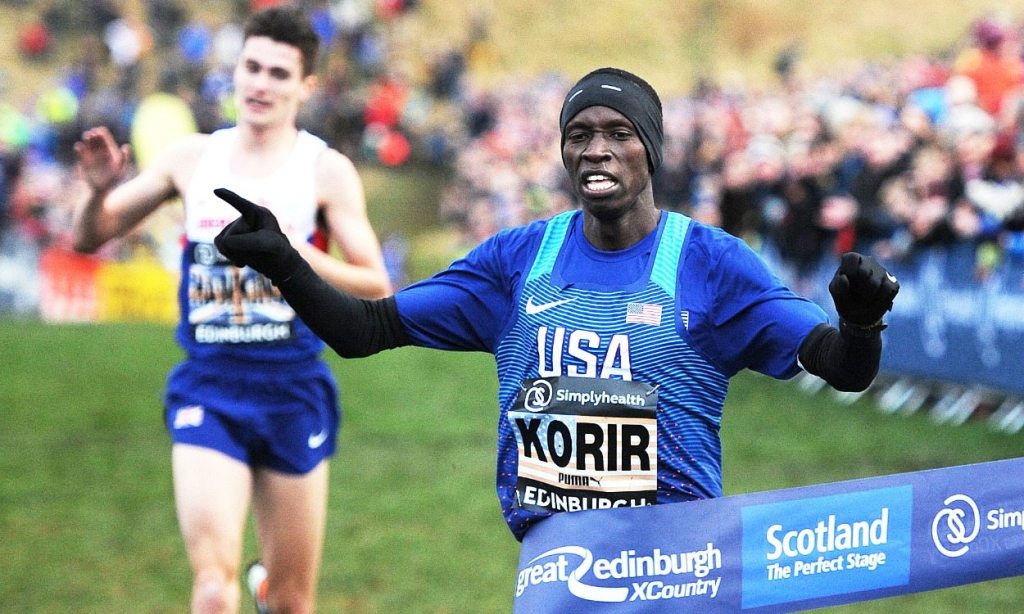
Korir – Moved to the US from Kenya about 10 years ago and ran NCAA track and XC for Iona. Ran a sub 2:08 debut in Amsterdam yesterday, fastest in American history. He’s on the upswing and has been strong on the track and roads the past few years with the Army team (WCAP). Likely to make the team in either marathon or 10000 m or both.
Fauble – 2:09 and top American (7th) at Boston this year. If Rupp doesn’t run Fauble has a real good chance at making the team. And even if Rupp does run, he’s been getting stronger each year and would battle the others for that 3rd spot.
Ward – 2nd best American at Boston (8th) and not far behind Fauble there. Ran on the 2016 team in Rio and was 6th overall in the Olympics. That’s a pretty good feat and shows he’s a gamer. He is also running NY in a couple weeks and that may or may not affect his training going into the Trials. Ward, like Fauble, is a strong favorite to make this team.
–we might almost be done here–could easily come down to these four, they are a notch above everyone else.
However, there are a number of exciting newcomers and later bloomers who could step in (and if history is any guide, it’s often someone that is off the radar a bit who steps up on the big day to make the Olympic team).
We’ll just jump in with the next three on the list: Riley, Mock, and Stinson. Jacob Riley at 31 is a journeyman runner running for Hanson’s with Desi et al. early on, and has had a number of injuries, including the same injury and surgery that Rupp is coming off. He ran a 3 minute PR last week in Chicago to place 9th and place as the top American. Jerrel Mock is just 24 and unsponsored. He ran at Colorado State and was an All American, but did not have a strong senior year and for the past year and half has been on his own. However, he’s been placing high at a number of big races, including USA 20K championships, Bix 7, and Utica Boilermaker. The 2:10 at Chicago will get him a sponsor. Parker Stinson has shown a lot of potential over the past few years, but his race tactics haven’t been great (going out fast and fading). But he’s now coached by Olympian Dathan Ritzenhein and has tempered his early pacing. He ran even splits to break 2:11 in Chicago.
And that brings us to two more competitors not on this list: Ritz himself and Chris Derrick, both high school and college running legends who have had injury plagued pro careers. Ritz has a 2:07 PR but that was some 7 years ago, and he’s now in his late 30s. So just getting to the start line is a big deal. They say talent doesn’t go away, but he’s a very long shot to even make the top 6 or 7 in Atlanta. Derrick showed much promise as a high school phenom and college All American at Stanford (running 27:20 for 10000) m. And he won the USA XC championships in 2015. But he’s hardly been healthy since, and broke his foot in a road race a few months ago. Making the starting line and placing in the top 15 would be a good day for Derrick who is still under 30.
Last but not least is the wily old man, Bernard Lagat. At 45 he ran a 2:12 marathon this summer in Australia for an American masters record. He’s won Olympic and world championship medals in mid-distances and has been a strong road runner. He’s had some controversy in the past but remains a popular presence on the circuit. A few months ago, he was actually considered as a contender. Not likely with the newer runners stepping up. But he IS Bernard Lagat and he could surprise us all by making yet another Olympic team.
Others to watch out for: Shadrack Kipkirchir, Korir’s teammate has a 27:07 10000 m PR. Should he line up in Atlanta, he’d have a good chance at making this team.
Favorites
Korir winning Edinburgh XC against World and Olympic 4th place marathoner, Callum Hawkins of Britain (Athletics Weekly)
Korir, 2. Rupp, 3. Ward – 4th and 5th ready to take a spot if one of the early favorites does not run or lets up an inch: Fauble and Mock
The title here, a bit tongue-in-cheek, is my motto if not an outright battle cry for coming back from an injury. I had a lot of time to think about that in my 2016 rehab and comeback.
I fell on August 6 and had surgery about three weeks later. I could only hunker down for the first week, but got in a few short walks. Hobbled around in one of those big super slings with the hefty arm pad. I got on the exercise bike at the fitness center within a few days and started out with 20 minutes a day, was up to 45 to 60 minutes within no time, and after two weeks I added 30 minute walks a few times a week. In late September I got clearance to start up on the eliptical trainer (hand free of course).
The big break came in early October when they said I could start running easy a few days a week. I ran outside a couple times but was told to stay on the treadmill, and for the most part I did that. Felt great to be back running again. Through October and November of that year averaged about an hour a day of cross training and running, thinking a lot about what I wanted to accomplish in 2017.
In the meantime we moved from 5,500 feet elevation in suburban Denver, into to the foothills at over 7,000 feet. This has proven to be a big bonus. A little more hypoxia for 12-15 hours a day means more red blood cells and more oxygen carrying ability. This, along with the diet changes earlier in the year were two of the three factors that got me onto a track that have allowed me to reach levels I would not have dreamed of.
In December of 2016 I was up to 40 miles a week, following rehab routines to the T, and without the doctor’s approval jumped into a snowy 10K race with my son (was still supposed to be running indoors at this point). I ran that in 39 minutes, outkicked by my son.
In first comeback race, Mikko takes down Dad with a half K to go. Shhhh. Don’t tell the doctor!
I finally got full clearance from the doctor in early February. Ran a few low key local races as tune-ups, and had my sights set on a March New York Road Runners 10K in Central Park. In that race I started cautiously, not really knowing where my fitness was, but by 2 miles locked into a 5:50 pace, and finished in 36:08, my fastest 10K since 2009 (8 years) and 89.9% age grade (a PB). Three weeks later I ran the Platte River Half for the third year in a row and posted a 1:21, a course PB, and the next month a 2:58 at the Colorado Marathon, to win my age group and BQ by more than 55 minutes. And to cap off the comeback of 2017–in which I got more than even–we traveled back to Alaska following our son’s graduation from college. There, I ran the Midnight Sun run in 35:43 and for the first time ever nabbed an age grade of >90 percent. Comeback Mission Accomplished!
September 2017, a new state half marathon record for 55-59 age group! 1:18:40.
To close out the year, I traveled to Tulsa and ran the USATF 15K masters championships, and ran 55:29 to place 3rd in the 55-59 age group and nab my first age group medal a bronze. Six weeks later, I returned to the Club Cross Country Championships in Lexington, KY in the biting winds and 20 degree temperatures placed 5th, bumping up three spots from my last outing in San Francisco two years earlier.
2016 had been a rough ride with some great times, but 2017 was better than I had dreamed of. In 2018 I would turn 60 and couldn’t help but look forward to that
I started this blog in 2016, with just a couple posts. It was a year of some good running, but interspersed with a couple of health issues. Here is a run down from late 2015 to summer of 2016.
After ending 2015 with some decent efforts, a 1:21 half marathon in Washington and a relatively solid showing at the USATF masters championships in San Francisco, where I took 8th in my age group, I looked forward to 2016 with some high hopes. Although I had hoped to be top 5 in SF I was pretty happy to run sub 37 minutes on the course at Golden Gate Park and to finish near or ahead of some pretty good runners in my age group (I was 8th in the age group and 25th/415 in the age grade catergory). In the back of my mind, however, was the thought if I ate a really good diet and shed some pounds I could move up some.
Start line at the 2015 USATF Masters 10K championship in San Francisco.
Trying to finish strong at USATF Masters 10K XC on the way to a 36:54.
As the new year got rolling, however, I could not get on track. It was more difficult getting out the door. Long runs were a grind, and easy runs were almost painful. My whole body ached. And my workouts and races fell off from the previous year. I was running nearly a minute slower for 8K and 10K, and recovery between hard efforts dragged on for weeks instead of days. I was getting in the miles (55-60 miles a week), hadn’t gained any weight (150+/-) from previous years and felt that I was eating okay although knew there was some room for improvement.
The kicker came at the Platte River Half Marathon in April, a key spring race. I had run a 1:22 there the previous year–fastest 55-59 year old time in the race’s 15 year history. But in the 2016 race I felt somewhere between off and awful. Although I did win my age group again and was happy about that, the time was only 1:26. I could not figure out why I was training the same amount, doing similar workouts, but feeling fatigued every day.
I went to the doctor for a physical. Everything checked out okay, but they ordered a blood test. I thought it might be a Vitamin D deficiency, or maybe iron, or even testosterone. But who knew? A few days later I got a call from the physicians assistant who said that two things stood out, very high cholesterol (265) and a high A1C (3 month level of blood sugar) of 5.9, indicating that I was pre-diabetic. What?
They suggested that I go on statins right away, but also gave the option that I could try to work on my diet and get follow up test in about 6 weeks. So that’s what I did. I cut out weekly pizza and burger, processed lunch meats, near daily sesame bagels, and snack food like chocolate, cookies, chips. Instead I ate more nuts and fish, stuck to only egg whites, and gobbled up more whole grain food in place of processed wheat.
By 3 weeks I felt better, and at 6 weeks I got the 2nd blood test where the cholesterol had dropped a remarkable 60 mg to 205, and AIC fell a bit to 5.7. I felt good, and proceeded to win my age group at Bolder Boulder 10K with 38 minute 10K. It was about the same time as the year before, and I felt better than I had since the end of 2015. I had turned the corner.
The highlight of that year was a 12 day trip to Scandinavia, with a day and a half in Iceland and then 10 days in Norway and Sweden. I joined up with about 15 runners who had lived or were otherwise connected with Alaska to run the grueling 4 day St. Olavs Loppett (350 km, 170 miles) from Ostersund Sweden to Trondheim Norway. I raced about 24 miles (6 miles a day) and by the end, felt like I had run full marathon!
With Tamara at Tannforsen Waterfall in central Sweden, 2016.
Running an 8.3K leg in the St. Olavs Loppet, June 2016.
After recovering for a few weeks I started my prep for the Bellingham Bay Marathon, where my goal was a sub 2:55.
Prior to this week, August 2, 2016 was the last time I posted on this blog. I had planned to continue with stories of some of my early running days, interspersed with updates on running adventures. However just a few days later, on August 6, I had a freak fall while warming up for a 10 mile run. I tripped on a rock fell into a pile of other rocks on an old creek bed. The pain was immediate and searing. I could barely get up, and a passerby had to walk me 0.1 mile to a curb for Tamara to pick me up. I thought I had broken my collarbone figured I’d be out for 6 weeks or so while it healed. Actually it was a shoulder dislocation, resulting in a torn rotator cuff and torn labrum. I would need surgery and 6 months of rehab.
Does anyone even blog anymore? It seems so passe' now. We see Twitter (not a great way to communicate but incredibly popular)), Instagram (a bit better), Facebook (No!), and of course various message boards. And of course podcasts and vlogs are all the rage. But blogging? Well, I'm going to give this another shot.



 rrunnin234