The remarkable couple months in running continues, with the Salazar ban and (sort of) dissolution of his team, the Nike Oregon Project (NOP), followed by Mary Cain’s revelations a few weeks ago, sparking a body weight Me Too movement of sorts. The seven minute video has gained world-wide attention and resulted in widespread discussion in print and various forms of media, which in the long-term will be good for the sport. Not to mention Eluid Kipchoge’s sub 2 marathon and Brigid Kosgei’s smashing 2:14 the next day, leading to weeks and weeks of speculation about the shoes. So I guess I’ll chime in on that.
Shoe skeptic but not a Luddite.
I’m not really jumping on the bandwagon enthusiastically here. I’ve been happy with my Adidas Adios Boost (Adizero for 5K to half marathon and Boston for Marathons) over the past five years. About two years ago when the Vaporfly 4%s arrived on the market I was intrigued a bit but was completely turned off by the market manipulation by Nike, with its limited release of the product. Playing hard to get to create more buzz and increase demand.
As masters runner knocking on the door for some American age group records (5 seconds shy in the 8K, 23 for 15K, and 45 seconds short for the half marathon) I supposed I could have benefited from these or the Next%s in the past couple of years, but still I haven’t taken the plunge. The shoes do seem to work for a lot of runners, and there is no denying the evidence, but I can’t tell if my reluctance is anti-Nike (which seems to own the sport, dominating rankings, headlines–both good and bad–as well as governing bodies like World Athletics (IAAF) and USATF). How do you spell conflict of interest? Or if it’s the concept of what effectively appears to be a spring-loaded technology that actually gives an extra few percent of return.
That just doesn’t seem right, and wondering where this will all end. Are we going to be seeing average runners with 4-6 inch platform shoes bounding with 10 foot strides down the streets of Chicago, New York, and Boston in a few years? And when (or if) will the competitors like Adidas, Brooks, Hoka, Saucony, New Balance catch up? They all seem to be three or four years behind the behemoth out of Beaverton, Oregon.
Last weekend I traveled to Philadelphia for the marathon weekend, to attend the half that I did not run because of the injury. However, my son did run and had a good time of it. We also had a great weekend there, visiting museums and sites (my great great great great grandfather is buried 20 feet from Benjamin Franklin), and also enjoyed taking in some of the racing.
Before we continue. True confession, prior to the debacle in Tulsa I was leaning toward getting a pair of 4%s for the Philly Half. But with that point rendered moot, I can hold off. Nevertheless, here are a couple of photos and some thoughts on race weekend.
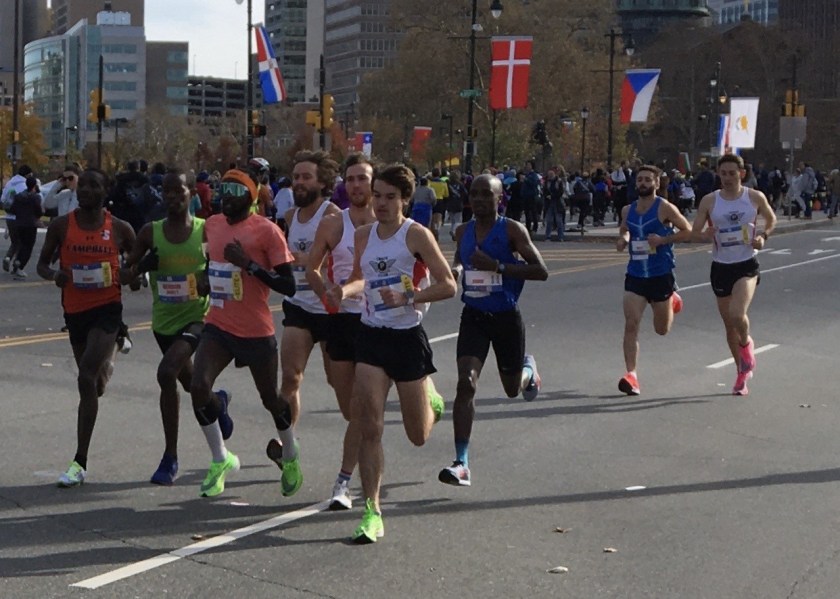
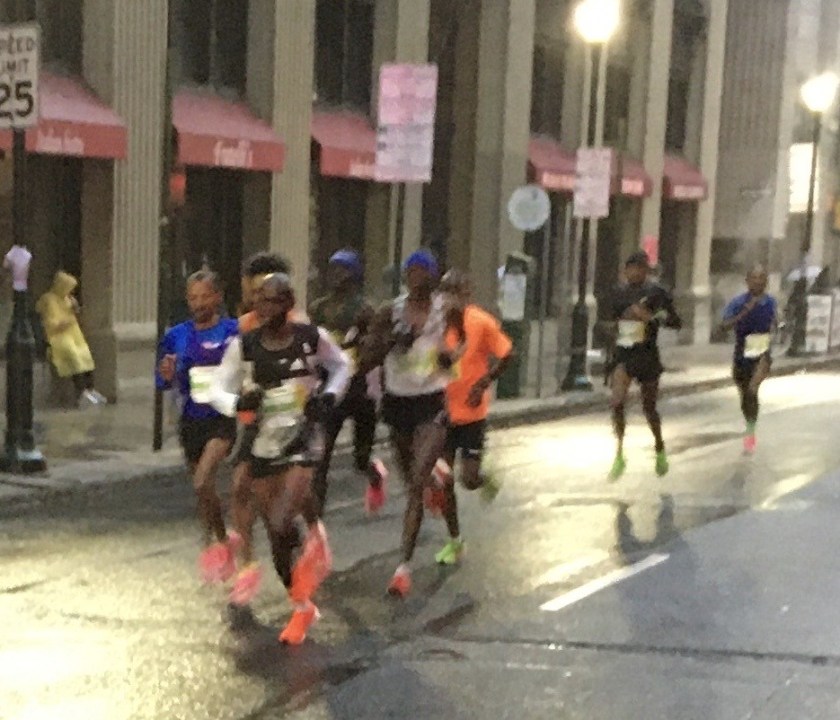
Lead pack at Saturday’s Rothman 8K. Mixed on the shoes. The majority of the top 20 were indeed wearing 4%s or Next%s, but the top three overall wore other shoes brands without the plates and new foam. However, with 18 runners under 25 minutes, compared to just 6 or 7 last year…you wonder if it was the weather, depth of field, or shoes.Blurry but you get the picture, the top 8 at Sunday’s Philadelphia Marathon, at 6 miles and all wearing the new shoes. In fact, about 18 of the top 20 were wearing the glow in the dark canoe shaped contraptions. For a marathon, you can’t argue with that. The technology works and runners know it.
However, despite some skepticism, I’m not going to be a Luddite and ignore something that has a clear advantage. I’ve held off, partially out of respect for the age group records, many of which were set a generation ago. However, I’ll be turning 62 next year and that window of opportunity to chase records in this age group is narrowing. So as I rehab and rebuild this winter, I’ll be keeping an open mind about the shoes and will consider the options as the big spring races approach.
We have had a remarkable, maybe unprecedented, couple of months in track and field. Going back to the controversial selection of Doha for the World Athletics championships, to the breakout world best marathon performances by Eluid Kipchoge (1:59 in a time trial) and Beatrice Chepkoech the next day with a 2:14, shattering Paula Radcliffe’s record by almost a minute and a half. And then the discussion has been much about the shoes.
However, the biggest buzz has been about Alberto Salazar and the downfall of the Nike Oregon Project (NOP). That part is long overdue, as the revelations came out several years ago, but we had to wait as the behind the door proceedings between USADA and Nike played out in arbitration. There were no new major revelations out of that inquiry from what was in the press in 2015, but it was satisfying to see that all come to closure with a 4 year ban for Salazar, with shutting down NOP, and resignation of the Nike CEO who was clued in on Salazar’s testosterone testing schemes.
We likely got just 10% of the iceberg of what really went on there, at least among the tight inner circle of the coach and some athletes, and we’ll have to be satisfied with that. There was some good follow-up last month with whistleblower Kara Goucher on the Clean Sport Collective and other podcasts and articles.
Then the other week Mary Cain finally spoke out with a shocking 7 minute video published by Lindsay Crouse and the New York Times. Cain broke away from NOP right when the big stories of crossing the ethical lines of sport were coming out, and I thought–and likely most others–she left because she did not want to be associated with such a program. As a teen, who by then was struggling with performance compared to 2012-2014, we thought she’d seen enough of the gray area and decided to go back home.
Salazar has long been thought as kind of jerk from his interviews and press conferences at his peak as a runner in the early 1980s, to stories of how he and some of his teammates treated other younger athletes at the U of O. So maybe it shouldn’t be surprising to hear Cain’s account of Salazar’s obsession with her body weight, ensuing verbal abuse and telling a still maturing teenage athlete to take diet pills. But it was shocking nonetheless.
Since then former NOP athlete and Olympian Amy Yoder Begley revealed her years of degrading treatment under Salazar from 2007-2011, primarily due to his perception of what she should look like even though she was at the very lower limits of body fat for an adult female athlete. Following that, and lot of ensuing discussion, former Stanford All-American and Nike runner Lauren Fleshman penned an opinion piece in the NY Times about her own struggles with body image and weight toward the end of her college career and early years as a pro. While she did not blame her coaches (Vin Lanana was her college coach) she did call out for more female coaches in the sport.
I’m all for that. While more women coaches have stepped in at the college and high school levels, and many club-level and private training groups have women coaches, they are still far outnumbered by males. And at the pro level, top female coaches are not at all common.
However, as important as it is to close that gender gap it sort of misses the mark. Because what is needed is open discussion and dialogue now, and continued education of coaches and athletes to rid us of the idea that a runner can’t be too thin. Running, even at the highest levels, is still about keeping healthy. And athletes crossing that line, be it through overtraining, doping/gray area performance enhancing activities (e.g., thyroid or asthma medications, whether they need it or not for their health), or training and competing under nutritional deficits. These all can have life long implications for athletes, and we need to make sure that we are on the healthy side of the equation. Otherwise, it’s not worth it.
Preamble: Marathons are a bigger deal today compared to the 1970s and 80s, at least in terms of participation and general interest. And it seems that anyone serious about doing a marathon is a either strong adherent to a plan (e.g., Pfitzinger, Daniels, Hanson’s, Hudson, etc.) or they have coach and training team.
In this post I will take you back to a simpler time. We knew less, did not have fancy shoes and calorie count watches. Formal training groups and private coaching services were uncommon, and good training guides were not all that readily available. So a lot of us did things on our own. Here is my story.
Background – Heading into 1983 I had been running and training for almost six years, including four years of cross country and three of track at a small (NCAA Division III) school in the Midwest. In that program I had improved fairly quickly (running sub 10 for the indoor 2 mile after just 9 months of training as distance runner, and under 32 for 6 miles on the roads at 15 months into it) but my improvement plateaued and even backpedaled due to classic over training, poor nutrition, and stress from trying to wend my way through a school with high academic standards.
My last season of cross country in 1980 was mostly a disaster, and I ended it with an underperforming 27th place (of about 70) at our conference meet, and a 27:10 (on a very fast 8K course), and 110th place, a the NCAA Regional Championships. The team environment that last year was somewhat toxic. As disappointed as I was to close out that way, I loved the sport and vowed to keep running.
However, my running cratered even more in that first year out of undergrad. I believe the overtraining had resulted in some muscle damage and it took more than a year for my body to return to normal. I raced about 15 times in 1981 and usually did not come that close to what I had done the previous year. My best mark was a 33:35 10K, about 40 seconds slower than my PR set the year before.
1982 didn’t start any better, as I had ben working 50-70 hour weeks doing biological field work in Northern Minnesota, and running only maintenance miles. By the end of February I had put on 10 lb. I returned to my college for a weekend and my old teammates ridiculed me for the extra weight. I got back into shape quickly, however, and PRd at the 8K (26:35) in the spring. Later that year with just 6 weeks of focused training (after a summer of 40 mile weeks, but a lot of hiking at 10-12000 feet) ran a 1:13:05 half marathon at mile high elevation. That is still my all time best (sea level or altitude) at the distance, and equates to 1:11 or under at sea level.
At this point I had made two attempts to run a marathon. I broke down during a high mileage summer in 1980, after a string of 100 mile weeks, about three weeks before the Paavo Nurmi Marathon in Hurley, Wisconsin. And in 1981 I was trying to prepare for Grandma’s Marathon in Minnesota, but ended up with tendintis in my foot about four weeks out. Those non-starters aside, at the end of 1982 I felt stronger than I had in three years, and felt that I should attempt a debut in Denver the next spring.
January 1983 – I rung in the new year without a lot of running miles. I’d been putting in about 40-50 miles a week since the half in October, plus some cross country ski training with the Colorado State University Nordic club team. But that was maybe one or two sessions a week over December and January.
At the time I was back in school, at CSU studying biology and planning to go into graduate school by the following year.
February 1983 -I did one Nordic race, a 15K in Steamboat Springs against collegiate and club racers. My technique was not good, equipment worse, and was pretty far back in the standings, some 12 or 15 minutes behind the leaders. So I shelved the Nordic scene for a better time (that turned out to be the next year).
Around President’s Day weekend I reviewed my training log and realized I had not run over 55 miles in a week since late September and my longest run had been no more than 12 or 13 miles. However, I had gotten out on the skis once or twice for about 2 hours. The Mile High Marathon in Denver was less than 3 months away.
I cut the skiing and ran 50 and 55 miles over the last two weeks and upped the long runs to 14-15 miles.
School that semester had some challenges, but I was doing student lab research as part of my curriculum and had a lot of flexibility. I had become a better student, and did not feel the same pressure as I had as an undergrad.
One thing that did not suffer was my social life. I had four rather hard partying housemates who liked the night life. So every weekend (sometimes starting on Thursday night) was a party, and we usually centered it around music with concerts in Denver (Neil Young), Boulder (Stray Cats), and Fort Collins (The Blasters, The Suburbs) plus many local and regional acts. That all involved a lot of drinking (beer mostly for me, my housemates were much less discerning with what they consumed or inhaled) and one or two late nights a week. The results were frequent weekend runs on 5 or 6 hours of sleep, while hung over.
So while my study and work habits had improved, and running balance (not overtraining) was better, my weekend lifestyle had regressed to sophomoric levels. I was 25 going on 19 in that aspect.
March 1983 – I ramped up the weekly mileage to 60 and 65, and gradually increased the long runs. I got to 70 miles and 18-19 by the end of the month. I wasn’t doing any workouts until the last week of March, just running 7-10 miles a day and doing the long runs, all at 7 minute pace or so. Also got in a few days of alpine skiing in Aspen over spring break, with a St. Patty’s party in Aspen village, singing The Clash’s Rock The Casbah as we bar hopped.
Big album on alt radio as well as MTV in the early 1980s.
April 1983 – A month in which it all (rather improbably) came together. I started thinking about goals for the upcoming marathon. A 2:40 seemed conservative but reasonable. With that breakout half marathon the previous fall, pace charts indicated I could do better but with a limited build-up my goal was to finish the full and to have that as a launching point for more serious efforts in the future.
Until 1982-83 Prince was kind of a cult rock and R&B hero, but not known well outside of the upper Midwest.
About six weeks before the the marathon I started doing weekly workouts, starting with 6X 1/2 mile at 10K effort and building from there. Some workouts I remember, were 4X1 mile in 5:20, and 2X2 and 1X 1 mile at about 5:20-5:25 pace, but the emphasis was not on pace, more on keeping at what seemed to be 10K effort. I also mixed in some mid-week longer runs of 12-14 miles, about every other week.
U2 was my big find of 1983, and bought their debut album soon after it hit the shelves at the record store.
In early April I went down to Denver and did a 10K – 5K double in Washington Park as a training effort. Don’t try this at home (kidding because actually it worked I think). After a 3 mile warm up, raced the 10K (34:06) in race flats, took a slug of water, ate a banana, switched into my training shoes, and jogged for about 45 minutes (6 miles, mid-7s +/-), and ran the 5K at 5:50s pace. I was feeling a little numb and seeing stars even as I lined up (low blood glucose). The road seemed wavy, but I held on for a low 18s. 19 miles for the morning with 9.3 at quality. That set me up well for fending off a bonk.
I went home after that and ate a box of cookies and a pickup load of food.
Mileage wise, I topped out at about mid to upper 70 mile weeks for a few weeks and did three long runs of 20 miles. The first one was just steady 7:00 pace. The next two involved marathon pace. First time was 10 miles at 7:00 pace, then 8 progressing from 6:20s to 6:10s-6:00. And the final long run (about 3 weeks before the marathon) started with 10 miles at 7:00 pace and finished with 10 at 6:00 pace. With that I knew I could run under 2:40.
Every weekend was a party weekend, and for a bit I dated an undergrad who drank more than me and only went out because I paid for all the drinks. That relationship did not last very long
On the last weekend of April, two weeks before the marathon, I entered a local 10K (part of it on the now renowned Fortitude 10K course), and this would be my final tune-up and test. My goal was 5:20s pace. A couple runners went out quickly and I just settled into my own private Northern Colorado pace as we wound around Old Town Fort Collins. Nothing felt difficult that day, and while I never did reel them in, and the gap at the end was only 10-12 seconds. I finished in 32:58. Compared to my sea level PR of 32:54, that was a relative jump of about a full minute–and in fact for altitude I had skipped the 33s altogether, as my previous 10K efforts had been in the 34s.
Winter/Spring Training Program 1983 – To summarize my training. Six weeks of build up, easy-moderate miles by feel, starting from mid-low 50s to 70 miles a week. Then about six weeks averaging at 70 – 75 (range ~65-77) with one workout of longer reps at 10K effort, and a weekly long run building to 20 miles with up to 10 at marathon pace. Other than that, mostly 7-10 mile days with a mid-week longer run about every other week.
The sub 33 10K at the end of April was well under my goal, and a friend who was a national class race walker called to remind me that the marathon equivalent would be 2:32 or 2:33, which would be a very competitive time for Denver. That was exciting to hear, but also a little unnerving.
With finals and the marathon coming up I didn’t go out and party or stay out late the following weekend, probably the first time all semester. However, my housemates decided it would be a good idea to have a tequila party, and ended up doing tequila slimes, where they smeared limes and globs of avocado on their forehead before each shot. I ended up being nanny and made sure the house stayed on its foundation.
Somewhere along the way, was it an article or something someone said, I decided to go caffeine free. Went almost cold turkey, maybe with a two or three day transition. I had heard a million times by then, you don’t change things up immediately before a big race, but at the time it seemed like a reasonable idea. So I went through that final week of taper, which is always a maddening endeavor, feeling off.
On the eve of the race, I was nervous and so dragged my friend out for a beer. I think I had the better part of a pitcher, maybe three or four beers. This was rare for me to have drinks the night before a race, but not without precedent. The night before my best college cross country race, I was visiting back home and went out for beers and dancing the night before and had stayed out until 1 AM. Rolled into the race with barely a warm up and placed top 10 overall out of 80 runners, and was 2nd runner on our team that day.
But for a marathon? Wouldn’t recommend it.
Buzzed or not. I barely slept that night.
On race morning I did have a couple cups of caffeinated tea. Plus a bit of a hangover. My mom was living in the suburbs so we drove over with her and a couple friends.
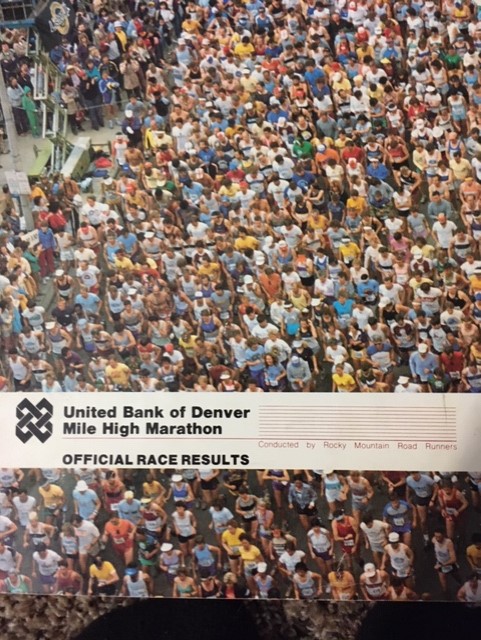
Nearly 2,000 runners lined up on Larimer Street in downtown Denver, and I took a spot on the front row with a race plan as simple as my training. Run about 6:00 pace and see how it goes, bottom line goal was to break 2:40. High end goal was low 2:30s and make the podium.
2000 runners lined up, a big turn out for a marathon in 1983.
The course would head east from downtown, circuit City Park and return for a loop in the city canyons through half way, and then turn to the south and pass through Washington and Cheesman Parks, before returning to downtown.
I settled into what seemed like a reasonable pace but was surprised to be so far behind that I already wrote off a podium finish. Came through the mile in 5:40 and I heard someone say we were in about 40th place! Way too fast.
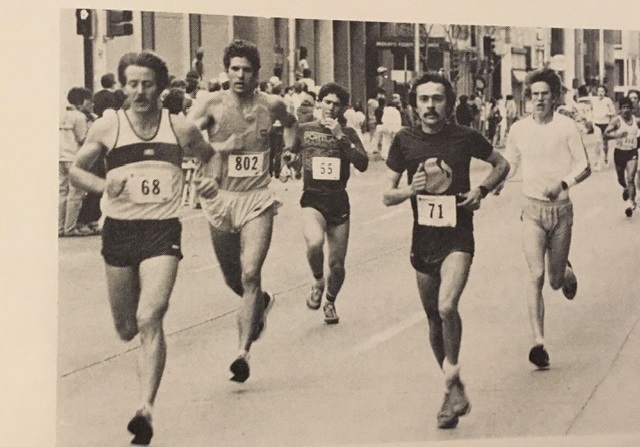
Lead pack in the early miles, the two favorites on the right set a fast (5:15-5:20) pace in the early going, but faltered by mid-way. Relative unknown Bill Aragon (far right) would run 2:28 for the win.
I immediately slowed down to 6s, the lead group pulled away, and a couple dozen other runners went on by and also ran away.
The second pack still way ahead, I ended up catching four of the five in this group (#55 placed 4th overall).
The beer wasn’t sitting well with my stomach either. I was thinking this was not going to be my day. Came through 5 miles in about 30 minutes and I couldn’t stop burping every mile or so, and it was worse after an aid station. Back then we had no gels nor energy drinks, we had water and ‘Gook’ (Gookinade, an electrolyte drink). But I dutifully watched my pace and took two drinks at each aid station.
I had to pee. No fucking way was I going to stop at a porta potty.
I kept going, and heading back to the city noticed that I was picking of a fair number of runners. We sped down the 16th Street Mall, which was line with hundreds of spectators. I soaked it up, and like a high jumper or long jumper in a stadium threw my hand up and mugged around a bit so they would cheer louder. It worked and I felt energized. An hour in, the fuzziness in my head was going away.
We looped through the downtown blocks and ran by the start line and more crowds at 13.1, which I hit in 1:18 and change. Just a few ticks under 6:00 pace, and I was in the top 30.
Heading south on Lawrence Street at 15 miles I noticed my quads were getting tight in a way that has become all too familiar in a marathon, but this was the first time I had felt that sensation. However, I did not have to go pee anymore. The 6:00 miles kept rolling by.
Into Washington Park at 18-20 miles, those quads got more tight. I had to stop, lie down on the grass and stretch them out. Ten or 15 minutes later, while exiting the park area, I had to do it again and for the first time since the second or third mile I was wondering if I would be able to finish. However, I got up both times and moved right back onto pace, energized because I was catching passing the faster starting runners. I came through 20 miles in just under 2 hours. Every minute or two, I’d catch a runner. Go by and work on the next.
Despite the sore quads and growing fatigue I also noticed that my splits were getting faster, with some into the 5:50s. The last three miles were grinding but ecstatic because I knew I would finish and finish strongly. The gaps ahead became longer and I ran that part almost all alone, somewhere in the top 20. It did not matter.
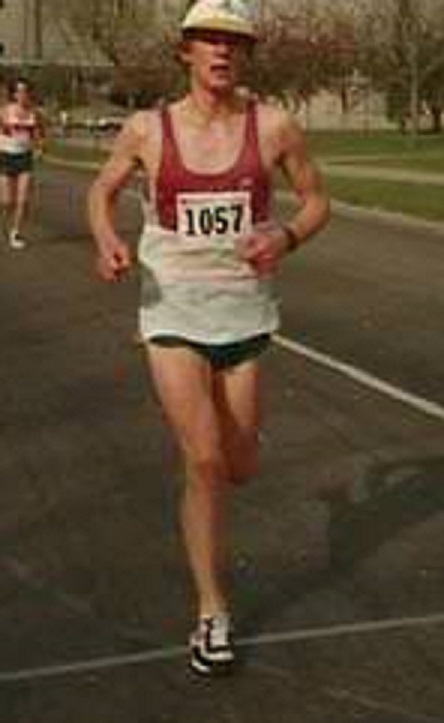
Unseeded with a four digit bib number, in the closing miles and holding onto 5:50s pace.
Approaching downtown for the final time, the temperature had climbed into the mid-60s, warm but I was not uncomfortable. I dropped a 5:40 for the 26th mile and strode through the finishing throng, with a couple fist pumps and a big smile.
Final meters!
2:35:49 – 14th place (and my only negative split in a marathon)
No coach. No training program other than what I had figured out on my own. Short build-up with moderate mileage. Having way too much fun on the weekends. Making a couple fundamental errors in the final days. And did I mention the altitude? I could look to running 5 or more minutes faster at sea level, at the same effort.
I had broken out, and had come a long ways from the 16 minute 5K, 27 minute 8K runner I had been in college. I looked forward to even better days ahead.
Just the other week I described my fall and comeback from 2016. And was actually going to follow up with some detail of the masters dream seasons of 2018 and 2019. However, here I am drifting among the flotsam and jetsam of 2019, which ended abruptly the other week in Tulsa, OK.
Tulsa was the springboard that launched this journey onto the national masters circuit. So this is a story of bookends.
2017 Breakout
Although I had done the USATF Club Cross Country championships a few times, Tulsa 2017 was my first USATF masters road race championship. Still running as an independent for Boulder Track Club, I traveled with my new mates on the Boulder Road Runners 60+ team. We had a blast, despite some issues with jerseys.
Funny in hindsight. A cardinal rule on the USATF masters circuit is that team members must have the same singlet/jersey. No exceptions.
The team had just switched its uniforms but one of the guys didn’t get his in time, so we spent the afternoon chasing down appropriate race attire so the team could remain eligible. After much debate and some running around the city, the team ended up wearing red Route 66 Marathon singlets, with BRR penned on the front and back. Everyone held their breath as the officious USATF official, who had scolded us all the afternoon before, checked the makeshift uniforms, and gave them the okay.
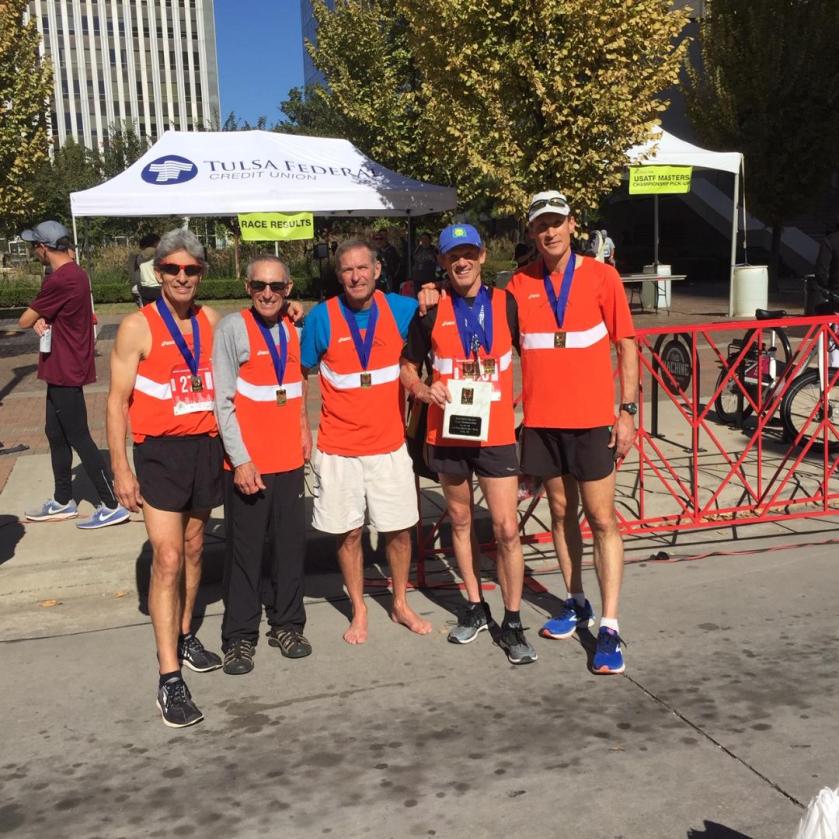
In the race I was still in the 55-59 age group, but only a few months shy of 60–not where you want to be in a championship race. Plus the field was intimidatingly deep. On a cold blustery morning I started evenly and wound my way through the pack and locked into an age group 3rd place by about 5K, with one guy just ahead, and one only a few seconds back. Even though my legs went numb from the cold and wind, I held on for 55:29 finish, and age grade of 89.5% to finish 3rd in the overall age grading and 3rd in the age group. These were my first podium finishes at the national masters level. Despite one bad injury on the BRR team, they dominated to win the team race and clinched their claim on the 2017 national title. BRR claims USATF age group title at 2017 team champs on a chilly morning
Riding the Wave in 2018 and 2019
That event set me up well for the breakout years of 2018 and 2019, where I went on to win a string of consecutive USATF age group national titles on the roads and some world masters championship medals.
We returned as a team in 2018 and dominated the day, and I won the individual title as well to close out the year with a sweep of USATF masters championship road races. I had added two more in 2019, on top of two runner-up spots in cross country, and came into Tulsa with 390 points on the grand prix. All I’d need was a 4th place finish to win the title.
August through late October had gone well, and even a bit dialed back on training and racing load compared 2018 because I had wanted to be more fresh this time. I was confident that I could still round the hilly circuit in under 56 minutes and break into the 90% age grade range to win that overall title (I had been 2nd twice).
Raced hard but winning felt easy in 2018. 2018 15K age group championship team.
Tulsa 2019
All was good the other week, and I had no issues in the training block, running between 59 and 69 miles over the 8 week period, I felt healthy and strong, planning on 6:00 minute pace for the race. I cut back on my long run on the Saturday before and did a final tune up on Tuesday, just a few reps of 2-3 minutes at goal pace and a couple pick ups. Jogged back, felt solid.
Wednesday I ended up running on the treadmill because an early snowstorm had a arrived. Plan was an easy hour give or take. 30 minutes in, my lower back and glute got a little tight, but I thought nothing of it but slowed down to 8:10 pace. At 40 minutes I noticed it wasn’t going way, and I slowed a bit more, an cut the workout short at 45 minutes. When I got home it definitely hurt. And I hopped into a hot bath and took some ibuprofen.
I reconsidered overnight, but decided to make a go of it. And while the results were a disaster, it’s a good thing that made the trip.
I did not run a step until Saturday morning but all I could to get ready. Ibuprofen every 4-6 hours, lidocaine patches as needed, hot baths–including right before the race (those seemed to help the most).
I warmed up with an easy mile and 2 minute surge approaching race pace. It felt tight. But I felt I could run at least 6 or 8 miles, enough to carry me in with a good lead for the stretch. My main competitor has been running 18:20 or 18:30 for 5K, which is my 15K pace, so I felt I could hold him off, and if not still run under 60 minutes and ahead of everyone else.
At 8:50 we were off! 100 master runners for the 2019 finale! I was not uncomfortable but surprised at the fast pace of some starters–some going out well under 6:00 pace even though you’d expect them to finish in the 65 minute range (closer to 7s). I hit 2 miles in 12:08, just a couple ticks off of last year’s pace and felt that I could sustain this effort, if not a low 6s pace, for the duration. However, just after that I heard rapid footsteps, and the women’s leader Fiona Baily was soon on my heels. We had a number of turns and some rolling hills and I just ran by feel. But that 3rd mile (which I missed) was a 6:24. She pulled way, wearing the most talked about shoe ever, the Next%s and I got to thinking that indeed there must be something to those. And in the 4th mile another guy passed me back, also wearing Next%s.
Those two pulled away and I was running alone, with splits of 6:03 (some downhill) and 6:24 (rolling), and that 5th mile I was starting to feel actual (rather than tightness) pain in my lower back and glutes. It was taking a lot of concentration just to keep going. I was slowing. On the long downhill toward the river the 2nd woman Melissa Gasek caught me, and she said she’d buy me a beer if I helped her catch her competitor Bailey, who was a block or so ahead. I picked up the effort, feeling like I was on sub 6 pace, but each stride was stabbing. And after a few minutes, just had to drop back. My 6th mile was a 6:40 on a stretch that I covered in 5:50 last year.
My race was in trouble. Somewhere around 6.7 to 7 miles, by then only running a 7:30s pace, the first competitor in my age group passed by. I stopped just before the long bridge that spans the Arkansas River, thinking of just dropping out. A pack with two more more age group competitors ran past, asking if I was okay.
Not.
So my was my own title going down the drain, but the team’s 2nd place was also in jeopardy. If I did not finish, we would lose our grand prix podium standing. So I decided to go the extra mile on the out and back portion over the bridge. And resumed running at 9 to 10 minute pace. At about 8 miles I had to walk for a half mile, but somehow I as able to resume a very slow jog to the finish.
68 minutes with final 5K of 29 minutes. That was brutal. But by finishing the race, we held onto 2nd place on the day and for the grand prix. I do feel the effort was worth it. Even though I lost the individual title that day, in a worst case runners scenario, by finishing the course I also held onto a 2nd place. It’s a bitter pill to swallow but had a great three year run leading up to this race. And it masters running, being at the top usually means you are going to crash down from time time. Limping in at the finish in 2019
I could barely walk for the next two days and it has taken two weeks and some realignment therapy to even start feeling normal again. Onto more rehab, cross training, and plotting for 2020. Don’t get mad. Get even!





 BRR claims USATF age group title at 2017 team champs on a chilly morning
 Limping in at the finish in 2019
 rrunnin234