Without a race season to look forward to and assess along the way a lot of us are looking back. I’m going to review 30 years past and 1,700 miles away (with tens of thousands of running miles and miles moved in between) to Ithaca, NY 1990.
I was in my second of three years working at Cornell University as a wildlife researcher, doing deer damage studies in people’s back yards on the hillsides near Cayuga Lake. This was one of my favorite jobs and Ithaca, was a great place to live.
That and I miss the 1990s.
We had a good running community, my wife Tamara and I were running with the High Noon Athletic Club, based on the Cornell campus. Our first year in Ithaca had gone well running-wise, and Tamara had dominated the Central New York running scene, by winning most of her races, setting records, and PRs almost every race. Her highlights of 1989 included winning the Empire State Games 5000 meters in 17:08 and placing 3rd at the TAC (The Athletics Congress, now USATF) New England cross country championships behind a couple of future Olympians. I will write about Tamara’s remarkable run in a future post.
My running also had gone well, although maybe more run of the mill (back then I was known as Tamara’s husband). I PRd in the 3000 m (8:54) and ran my fastest sea level 5K with a 15:34 on a very steamy morning (dew point 70s) to place 6th in that race.
The year did not end great, however, as my first job was stressful and I injured my back and shoulder from a fall while XC skiing in December. However, I switched jobs at the end of the year and got back into doing field work. I also had the entire winter to heal and rebuild a base through XC skiing and racing.
Spring – Inspired by a Legend
As usual I had a good cardiovascular base from the skiing, but had gained a few pounds over the winter. Tamara would tease me, saying that I ran like a duck due to all the skate technique training I had done over the winter, with only minimal running.
With just a few weeks of training under my belt, my debut that spring happened to be the Billy Mills Fun Run. With, yes, THE Billy Mills. It was on a chalk marked course on sidewalks, roads, and bike paths through the lands and agriculture part of the campus. I ran about 16:35 and was 3rd, a podium finish. At the awards I got to go up on stage and shake Billy’s hand–he asked what I ran and said that was a good time. The 1964 Gold Medalist gave a talk about his experiences growing up and at the Olympics and we watched his biographical movie Running Brave.
While I wasn’t super stoked about my time, a minute slower than the summer before, it was a inspirational start to the season. My running fitness got better with each workout. A couple weeks later I ran and won the Syracuse Mountain Goat road 3K (the accompanying 10 mile was much more prestigious) in a 9:10, and two weeks later ran 32:27 at the Lilac 10K in what was the last time this was a professional race. I placed 35th, while 10 runners went sub 30 that day. That was a deep field and was happy with that result.
Prepping for the Empire State Games
I was 32 years old, and 10 years out of college and somehow got the idea that I would return to the 3000 meter steeplechase, an event I hadn’t done since my final college track race. Now at the elite-professional level we frequently see steeplechasers competing into their 30s. However, it is not common for a middling post-college runner to return to the event on a whim a decade later. I did like the challenge, and it felt cool practicing the barriers. I had planned on running about a 9:50 for the qualifier and figured that would be an easy in to the Games, which would be in July-August.
I practiced hurdles and barriers every week for about six weeks and felt confident going into the race. However, I didn’t count on a Divsion I runner from the Southeast Conference returning to home to run a sub 9:20, and found myself battling it out for the other spot with two other runners. I held onto 2nd for most of the way, but got bogged down on the last water jump with dead legs and landed thigh deep i the water, slowing to a near standstill. Two competitors shot by and I came in 4th with a 10:03. It was a PR but a disappointment.
The next day I was was more discouraging. Landing in the water pit 7 times had caused a tear in my plantar fascia, and after a doing hilly 7 miler with friends I was hobbling.
Rehab and Revenge – Summer 1990
This was my first bout with PF, but I got a lot of good advice from Tamara and friends so I set out for a good stint of rehab, while coaching her over the summer as she easily qualified for the Empire State Games in the 5000 meters again.
We had a hot and muggy summer. I wore hiking boots every day at work because they offered good support for my foot, and I could walk pain free. For exercise, I swam a little and biked a lot. At first rather easy but as the weeks went on, I would go for 2 hours on the weekends and do speed/hill work and tempo (threshold) sessions during the week. I remember finding a big hill south of town and doing intervals, close to all out for 2-4 minutes a rep to simulate a tough 5K workout.
The cross training went quickly and by the end of July I could walk pain free in light shoes. So I started jogging. Just a few days after starting up my clubmates called and asked if I would run with them at the Manufacturers Hanover 3.5 mile corporate challenge in Syracuse. Umm. Okay. Maybe. With just a week or 10 days of running easy, I could handle 3.5 miles, but wasn’t so sure about the foot.
I felt surprisingly good that day and ran 17:59 for the 3.5 miles (5:08 per mile pace) and was 5th overall. Better yet, with four of the top eight finishers our scruffy band of university employees and grad students upended the heavily favored General Electric corporate team. They were so pissed off at us! They even tried to get us disqualified because they said the university was not a corporation. After an official review our status was kept and we were regional champions for the day and would get an all-expense trip to New York City for the championship in October.
The race effort did not set back the PF at all, and I kept running. My fitness came back quickly. A week later, I time trialed a 4:32 mile, closing in 2:12.
September – Enchanted Momentum
Those running two months were some of the best I had experienced. I was only putting in an hour or so a day of training (usually just 6 days), but everything just clicked. Over Labor Day weekend, we traveled to the southwest part of the state for the TAC regional 10K road championships for the Enchanted Mountain 10K in the town of Olean. The race had both individual and team categories–but that year no prize money so some of the faster runners were not there. Had a good duel with the local favorite and former champion, and eked out a win in 32:24 a season’s best. Our team won as well.

The following week I ran the 5 mile at the Ithaca 5 and 10 and took 2nd in 25:43, a personal best (still stands).
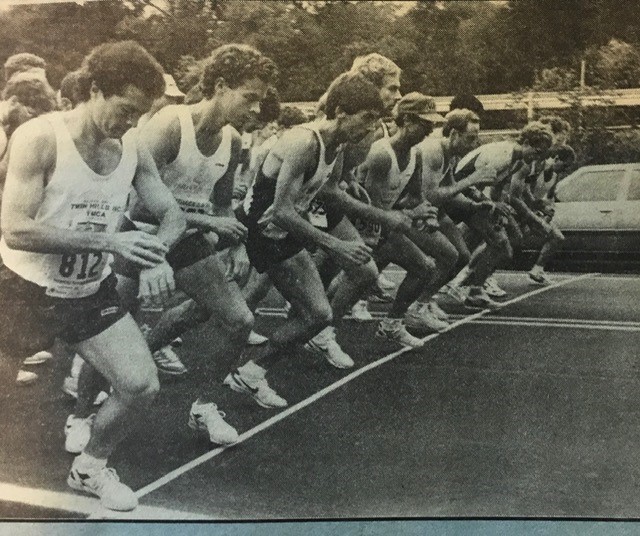
We had some good workouts with club mates, and on the first weekend of October we were on the jet to New York City at a fancy hotel on 5th Avenue. I remember running by Trump Tower on our shakeout run. Blech then. BLECH now.
The corporate championship (now known as JP Morgan Corporate Chase) had teams that had qualifed at races from all over the country, plus hundreds of other teams from the city and NYC metropolitan region. More than 3,000 runners were in the race. It was a very competitive event, won by sub 4-minute miler Steve Ave (he played Tunisian Olympic silver medalist Mohamed Gammoudi in one of the Prefontaine films). Second place that day was 2:10 marathoner Pat Peterson, known for his somewhat awkward running style. I set out to run 5:00 per mile, and ended up just over that in 17:41 (5:03 pace) and about 40th place overall. Our team took 7th out of some 500 teams. GE sent their best runners on a coed team. The women were nice and cordial, the guys still hated us. It was all good.
Competitively, and time-wise those were the highlights of that year. However, next up would be cross country.
Cross Country
Following the flurry of races over a couple of months, coming off an injury no less, I backed off the intensity and just ran for a couple weeks. Seeing how I wasn’t logging a lot of miles (+/- 50 a week) I didn’t see a need cut back on volume. That year, Pete Glavin a former Rutgers runner from Rochester created the Upstate New York Cross Country Series. It still exists as the Pete Glavin Cross Country Series. Pete had so much enthusiasm and put together five or six races a year for post-college runners in the region. We’d get between 50 and 70 runners per race, and Pete and his family would sign us up and oriented on the course, and he’d jump in usually placing in the top 3 or 4. We lost Pete to brain cancer some years ago and miss him. Tamara and I still talk about him every fall.
So I missed the couple of races of the first year of the series, but did all remaining races in 1990 and 1991. I think I ran four of the races in 1990, all in the Rochester area. We had a great (dominating) team and I don’t think I was better than 4th on our team.

We had four guys who had run low or sub 14s in college, and three of them were still running mid-14s at the time. Marty Froelich, Scott Jones, Mike Bunsey, Terry Goodenough, and Karl Staven. Plus we had a half a dozen other very solid runners from the club showing up, often enough to field an A and B team.
November – The Intensity Catches up
At the series championship in mid-November I was barely hanging on to my early season fitness. With moderate miles, weekly training sessions at 5K pace (repeat 800s to miles) plus tempo runs, and racing almost every other week since August I could tell my body was getting tired. I remember that last race, I think it was a 6K at Cobbs Hill Park in Rochester I faded a bit over the stretch. Phew! Both men’s and women’s teams won the championship, and Tamara won her first series title. What a great way to wrap up the season.
One more race, though. The TAC (The Athletics Congress, now USATF) National Cross Country Championships that year would be at the fabled Van Cortland Park in New York City. If there ever was a bucket list race that was it. I tried to talk the other guys from our team to enter, but they’d had enough for the season. So Tamara and I traveled to northern New Jersey, where we stayed with my aunt and Uncle and cousins, whom I rarely got to see.
Although I caught a cold a few days before and didn’t have a great race, just being there made it a great outing. While stretching and getting my spikes on just before the race, future two time Olympic marathoner Bob Kempainen plopped down next to me and did the same. Kempainen would beat 8 time champion Pat Porter that day, ending one of the greatest streaks in USA distance running history. I was about 5 minutes back, somewhere in the third quartile. However, running at Van Cortland with all the buzz along with the cool breeze was a thrill that I shall not forget.
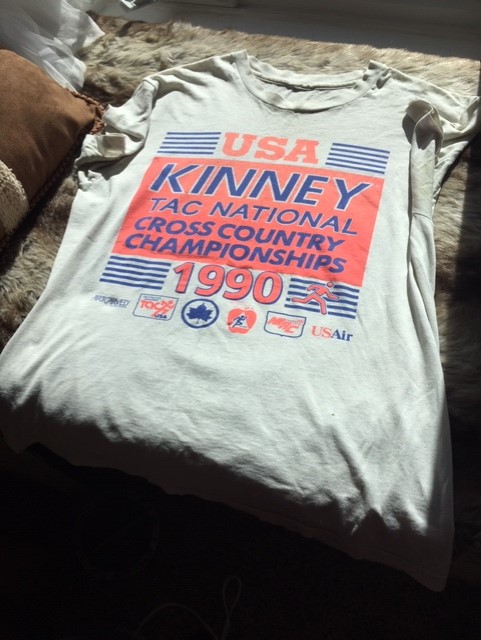
That’s how 1990 ended. Even with the mid-summer injury, I probably raced 20 or 25 times. Didn’t rack up a lot of miles, but did get a couple PRs, a regional championship, and a five race cross country season. If all of this were today, I would probably approach the training and racing differently, but for back then it was all good.
Postscript – Times Were Changing
Professional road racing and big-time road races were still new, and in 1990 we were barely a decade into the running boom. Looking back, things changed quickly in the early 1990s. Early corporate sponsors pulled back and prize money races became less frequent. The 10K was still a prestigious race and often considered to be key race in anyone’s racing year, not an afterthought or stepping stone race from 5K to half or full marathon. Americans were still competitive on the world scene and dominant at domestic road races. It was a time of gaudy neon colors in gear. Chartreuse. Fuschia. Hot Pink. Florescent green or orange. The women runners either had big hair or a boy cut, hardly any of the now ubiquitous ponytail. Men sported mullets–okay that wasn’t such a great thing–or the shaggy look. Races often supported charities, but they were not managed by corporations. However, most importantly, the older we got, the faster we were! (battle cry of the aging road warrior in the late 1990s and early 2000s).
 rrunnin234