The women started first, at 9:20 Central time on a crisp (28-30 degree) day with some wind. The rolling two loop course looked firm.
TV coverage for these championships were great, perhaps one of the best ever for a running event and by far the best I have seen for cross country. The announcers, John Anderson, Carrie Tollefson (an NCAA champion), and Kyle Merber (ran in the NCAAs twice), were enthusiastic and knowledgeable. They had video from the lead vehicle, one of those ATV/gators, and from drones. The lead shots were sometimes broken up, although it was mostly good, while the drone footage was suburb.
The field took off as a mass, and it took several hundred meters before the lead group coalesced, with the favorites in front. Through the first split, just over 1 km, Valby and Tuohy were in front, but they were essentially even with the top group. Valby began pressing the pace at about 1.5 km and opened a gap. Initially Tuohy went with her but she dropped back. At a sharp turn Valby did veer off the curve, apparently following the lead vehicle instead of the tangent. That cost her maybe a half a second.
There was much post-hoc criticism of Valby and her course running acumen, not to mention not wearing socks on a fairly cool, almost cold, morning. Although she was not perfect on the tangents, and Tuohy was generally better, that drift was the only time that it really cost her.
Crossing 2K in 6:36, Valby took a 3 second lead over Touhy and mass of the lead group, which was yet to string out. The lead stretched to 9 seconds at 3K, with Tuohy leading a pack of 30 runners on the wide course. Soon after, Tuohy began to chase, and no one was really able to challenge her. The lead stretched to 12 seconds at 4K, and the announcers began to question whether the gap was too big with just 2K to go. Valby was definitely holding strong, but Tuohy seemed to be even more powerful and you could see that the gap was closing a bit with each stride.
At 5K the difference was 6 seconds, with Valby in 15:59, Tuohy in 16:05 and the pack another 6 or 7 seconds back. At this point the race appeared to be Tuohy’s, even though she was behind because she was gaining each time the camera angle changed. With 500 to go she was just a couple seconds back. Would Valby hold off the former teen phenom?
Over the final turn which was on an incline, Tuohy passed on the Valby’s inside. Yeah, that was another tactical error for Valby but the effect was miniscule, maybe a few tenths of a second. Nevertheless, that was all the fast-closing Tuohy would need, she was in control as she headed down to the finish over the final 200 meters. She pulled away decisively, and built enough of a gap to even let up over the final 40-50 meters, raising her gloved hands in victory in 19:27 a new course record. Valby closed in 19:30, while fast closing Kelsey Chmeil of NC State took a solid 3rd, having gapped the pack over the last kilometer.
In the team race for most of the way it was a battle between NC State and Alabama, but everyone knew that the even-starting/even-pacing New Mexico team would move up. And that’s what happened. In the end Alabama’s top 4 were ahead of NC State’s (even though State had all 4 in the top 25), but it came down to the 5th runner, and NC State’s runner was 7th, to Alabama’s 127, so the final score was 114-166. As expected New Mexico ran as a pack and although their top runner was 20th, they finished strong with 140 points to take 2nd. Oklahoma State was 4th with 201 points, and a surprise University of North Carolina placed 5th with 242 points.
The NCAA Division I cross country championships are usually one of the best and deepest races of the year in the U.S., but the event rarely gets the attention it deserves. However, I think this year was a good step in bringing the event more to the forefront.
The NCAA System Past and Present
The NCAA system is not perfect and for decades there has a been a lot of criticism that the college leagues are really not the best way to develop distance runners in particular. While our sprinters and a fair number of mid-distance runners have developed well and thrived at the world stage, the outcome for those running 5K and up has been more mixed over the past 40 years. Yes, many top NCAA runners have become Olympians, but only rarely have they gone onto podium at Olympics or World Championships (if that is a measure of success). If you consider making a final at that level a success (I would), then the record is better. Nevertheless, the argument for a long time has been that the European or East African club systems are better.
For cross country at least, there have been some improvements in the U.S. over recent decades. And, despite a recent investigation on body image/body measurement protocol for cross country runners at CU Boulder, I think CU’s approach to racing has reformed how the system works. Back in the day (say 1960s-90s) most programs would have weekly meets starting in September and going through mid-November so runners would typically race 10-12 times a season. Maybe a good coach would pull some of the top runners out of some smaller meets along the way, but they all ended up racing a lot, while into a full training block, not to mention university course work and student life. That was a lot to take on for an 18-22 year old aspiring to be world class.
At CU coach Mark Wetmore typically took a more measured approach. The Buffs would hold a team time trial in late August, to see who was fit enough to run with the team, but some runners sometimes would not race until the home opener in early October at the erstwhile Rocky Mountain Shootout (ca. early 1990s – 2016). They’d do a big invitational or two in October, race conference, regionals and nationals. So any one healthy varsity runner on the team might only race three to five times in a season, not 10 or more.
That worked, and from the late 90s and into the 2010s CU won many national championships and were a consistent podium finisher at the big show in November. Other schools began catching on and emulated CU’s model.
Meanwhile, the NCAA, like the rest of our society became more and more quantitative-oriented and instead of hosting the regional championships in November and taking the best two-four teams per region (depending on how strong the region was), they implemented a points/ranking system based on a handful of large invitational meets. So rankings going into regionals played more into team selection. The result of that is even fewer small or mid-sized meets in a season. Dual meets went out by the 1990s, and since 2015 or so, a team might run at a September invitational, a super meet in October (Pre Nationals, Nuttycomb in Madison, Wisconsin, or the Cowboy Jamboree in Stillwater, Oklahoma). And then just conference, regionals, and nationals.
The points system is a bit arcane, although there are now objective regional and national rankings which you can follow through the year. The end result, however, is that teams are not over-racing. In addition, individually, many of the top programs (e.g., CU, Northern Arizona [NAU], Portland, Oklahoma State, Brigham Young University [BYU]) are more interested in the longer-term aerobic development of an athlete, rather than what they can contribute right away as an incoming freshman–that puts a lot of pressure on a new recruit to keep their scholarship. Rather, the CUs an NAUs and BYUs of the world typically redshirt their incoming freshman runners, and often do not expect them to contribute significantly in cross country for the next two or even three years. They just do a lot of miles, building from their high school base (often lower mileage and higher quality in the U.S.) to higher something like 80-100 mile weeks by their later years in college.
This makes for better teams and long-term development for aspiring pros. And that’s why we are seeing some amazing team performances at the championships, where some squads are able to score their top five runners as All-Americans.
The Hype for 2022
If you follow cross country at all, this year has been all about two young female runners: High school legend and track NCAA champion Katelyn Tuohy running for defending champion North Carolina State and relative upstart Parker Valby from the University of Florida, who had a solid high school career (sub 5 minute mile in 2019) but who burst onto the national scene last spring (2nd at the NCAA 5000 m in 15:20 to Tuohy’s fast closing 15:14).
They did not race head to head all season, however Tuohy was undefeated going into Saturday’s championship while Valby was also undefeated and she ran some blazing times in the mid-season, leading some to speculate that she was in 14:40 5K shape. Fit enough to blow Tuohy out of the meet venue in Stillwater.
In addition to that there was some good team hype, with the speculation of whether NC State could hold on for another championship, or would the tightly packed team University of New Mexico (with the top five runners finishing within seconds of each other at most of the meets), be able to split up NC State’s squad enough to win on points.
The men’s team and individual races were also wide open, with Stanford leading the rankings most the year, followed by BYU and host Oklahoma State, while Northern Arizona was only ranked fourth, and were considered something of a longshot to win. Individually, pre-race hype considered any number of men that could make win. The names bandied about most were Charlie Hicks of Stanford, Nico Young NAU, Isai Rodriguez and Alex Maier of OK State, Casey Clinger from BYU, and Dylan Jacobs running for Tennessee.
One thing for sure, the winner and podium finishers would be college stars, no matter what happens in the future.
ESPN a New Addition
Until the early mid-1990s the only way you could follow NCAAs was to be there in person (I watched the championships in Madison, Wisconsin back in the late 1970s), or track down a summary article in Sports Illustrated, a brief blip with top 25 lists in USA Today, or maybe a local paper from the host site if you could get your hands on one. A more thorough Track and Field News article wouldn’t arrive in your mail box for another six weeks.
In the 2000s it was more like logging onto Letsrun, the snakepit of the American running scene, while one of the brojos or a minion of theirs posted text updates from a computer–those were crazy times but at least you could get some close to real time updates while the race was happening.
Flotrack stepped up in the early 2010s and actually did an okay job, although the coverage was the quality of a couple college bros grabbing their cell phones and offering up some wobbly glimpses of the unfolding races. I also think the NCAA itself stepped up for a few years and they provided some decent, free, online coverage of the races.
Then came Flotrack again and the dark years. Their production quality hardly improved but somehow they were able to wrangle a multi-year contract with the NCAA, and they provided sub-standard coverage at a $20 per month service fee, in which you were pretty much locked into for the entire year. I heard many stories of those getting locked in with no way out. Meanwhile, the coverage itself on race day would often freeze-up mid race. If anyone else tried posting their own feed YouTube it would be shut down with in minutes. So, for several years the best I could do was go back to 2002 and follow Letsrun posts, and get text updates from those on hand or others watching the online feed. What a mess.
Finally, last year I think, NCAA grew up and got a better contract for the championships. So this year ESPN took over. I already subscribe to RunnerSpace and Peacock for running and track coverage and was reluctant to try ESPN, but at $9.99 a month and NCAA XC is my absolute favorite event to watch each year so why not, I’ll give it a try and I signed up on Friday.
This is going to involve some perhaps weird introspection and navel gazing.
According a friend/acquaintance Kevin Beck who writes the rollicking, often acerbic blog “Beck of the Pack” running blog, a successful marathoner should be able to run a marathon at roughly equivalent levels as other distances.
At one time I could, running 10K and half marathon at 32:50 and 1:13 at altitude, and followed by a 2:34 marathon. So just slightly off a calculator prediction. However, that was decades ago. Since turning 60 I have run under 1:20 three times for the half marathon, and the equivalents for those would be in the mid 2:40s (2:43 for the 1:17 I did in 2019). And this year’s rather ordinary 1:21 would be low 2:50s if I was on board the successful marathon train. I have not been able to break 3.
Fail?
I now have friends and acquaintances questioning my validity as a runner because not only am I not close to an equivalency for shorter distances, I have been unable to break 3 hours in my past four attempts.
Weather has been A factor in all four of those races, particularly of course while running the infamous Boston Nor’easter of 2018, where I could only manage a 3:12 (and big positive split) into sustained 20-25 mph wind and rain.
Grandma’s last year was warm (60s) and humid and we never had the benefit of a tail wind. Cross winds mostly, resulting in 3:02. This was my first marathon cycle since 2018, and I didn’t get that rolling until March/April of 2021 following a year of cutback (40-50 mile weeks) while coming back from an injury and taking it a little easier due to little or no in-person during the first year of the COVID pandemic. I held sub 3 pace (barely) through about 22.5 miles but couldn’t hold it together once we got into the city where there were a lot of turns. I had online and in-person friends questioning my race that day. “I thought you/he could do better.” Nevertheless, I won my age group.
Fail?
Boston this year was the best of the bunch, both performance-wise and as an overall experience. We had perfect 40-50s temps, but a light headwind of 6-8 mph the entire way. I kept it (reasonably comfortably) under 3 hour pace through 24 miles. It was the 25th mile that got me. As we rounded by Fenway and the giant Citgo sign, that wind picked up substantially, I say to 15 mph. So while I kept the effort the same my pace slowed from 6:50s to 7:20. The result was a 3:00:18. I crossed the line with mixed feeling. I ran with just a 1 minute positive split, on a course and day when most were in the 5+ minute range. I just had one off mile, which effort-wise was not off, I just slowed due to the pesky wind on that stretch.
And last week was last week. I ran better than any of my three previous attempts, steady and in control through 23 miles. Yeah it was getting harder after 20, but 7:00 was not bad and I was confident I would hold that. Nope. The wind was my wall. Hats off to the dozens of runners who could and did hold the pace to finish under 3.
So I’m a bit perplexed and downtrodden. This was a good effort, at 85.7% age grade on a bad day, that’s a 2:22 equivalent. Nevertheless, it still feels like a failure of sorts because I did not get the job done.
And got my ass kicked in the age group department as well, finishing more than 3 minutes behind a competitor who DID manage to hold onto race pace through the gale and rain over the final 3 miles.
Here’s a bit more about that. Who was that guy? I did a little sleuthing and a little more. Very surprising results. He (Jeff) ran a 3:19 in 2018, and 3:07 at Boston in 2021 (hot and humid), but Indy was an 8 minute PR. That’s huge. I also found a smattering of other results for this 64 year old (same age as me), and he did have a couple ultras (50 milers) but other race times well behind what I have been consistently doing, so 19s for 5K, low 40s for 10K, and high 1:29for the half. Congrats to that Jeff! And he’s going to be a force to reckon with next year once we turn 65.
My 3:01 was the third fastest Men’s 60-64 time in Indy’s 15 year history. But it was 2nd place on a day I would have been certain that anything under 3:05 would probably win!
Fail?
Although some friends might think so, I don’t see that as a failure at all. I did not meet my time, but competitively I ran a good race. Jeff just ran better through the finish. You cannot control what others do, especially in a big mass event where you often do not even know where they are out on the course. Moreover, in a marathon even if you are an elite, you still have to run your own race for that day.
So I’m coming up short. Some friends have said that maybe I should consult “more successful” age group marathoners. As if they’d help!
I think I’m doing the right things, with a mix of consistent mileage with requisite long runs and workouts, including marathon pace. Could I increase to 80 mpw? Or would that be too much? Should I add in more marathon pace, say 10-12 miles in a 20 miler? Or is that too much? Those are some of the things I’ll try to sort out over the next 6-8 months, before my next marathon build.
In the end, I don’t count any of these as failures, I just did not break through.
That was a whirlwind trip to Indianapolis for the Indy Monumental Marathon, with barely 24 hours from landing to take off and 26.2 rather difficult miles of running. And I must admit that I’m still trying to reconcile with what happened.
The big story of course was the weather with a massive front moving through the country over the weekend, hitting central Indiana just as we were lining up on Saturday morning. Temps in the 60s (not bad, could be worse could be better), some rain (also not bad, depending), and insane winds steady at 15-20 mph on Friday and Saturday and gusting to 40 at times. That was the story.
My training block could hardly have been better as I ran a dozen weeks in the 65-73 mile range, had five 20 mile plus long runs, and the only glitch was catching a cold three weeks out and it took two and a half weeks for that to clear. This was one of my most solid and consistent marathon build-ups and there is not much I would change other than maybe polorazing a few of those weeks to something like 80-60 rather than 66-73. But really, who knows if that’d make a big difference in overall fitness.
Nevertheless, I felt I that I was in 2:56-2:57 shape going into Indy, and maybe challenge the age group course record of 2:57:07 set in 2018.
The Goal
Sub 3. Not for a Boston qualifier, at my age 3 is well under the standard but to run a sub 3 at age 60+. Sub 3 is something I have been chasing for five years (last one was a 2:58 in spring of 2017), with four attempts: 3:12 at Boston in 2018 (facing wind, rain, and cold), 3:02 Grandma’s last year, and 3:00, Boston last spring. In each of those races I had the fitness to run sub 3, but just didn’t put it together. Well my first Boston was a gargantuan weather shit show and everyone was off their pace by a lot that day. Grandma’s and 2022 Boston were in the would-shoulda-coulda category although I do think I gave both my best effort. Just a small lapse at mile 24-25 cost me that sub 3 last spring.
The goal of of sub 3 also plays into things like longest duration between sub 3 (only 10 or 11 so runners have spanned more than 40 years). At 39.5 years, this would put me in the top 15 of all time. In addition, there is the five decades sub-3 category (5DS3), which is a little more attainable if you started late in the 80s and can hang on to early 2020s. I ran 2:34 in 1983, 2:44 in 1999, 2:54 in 2008, and that 2:58 in 2017.
So yeah, to me this has been a big goal for the past few years.
Travel and Prep
The trip was relatively smooth. Maybe could have flown out Thursday and had all day Friday to relax (my fancy Garmin told me that Friday had been a high stress day); HR in the 100s on my flight as we hit a fair amount of turbulence over Kansas and Missouri as that front was making its way eastward! But again, with a 2:15 flight and only one hour of time change I felt arriving the afternoon before wasn’t too bad.
Got checked in, picked my packet at the expo, and did a short shake out run by the Convention Center. Dinner at 6, just a couple blocks away, and relaxed for a couple hours before turning in at 9:30 Central. Sleep, sometimes an issue before a marathon, wasn’t too bad and my biggest source of anxiety was not the distance or the weather but knowing I would only have an hour between finishing (assuming I was finishing in about 3 hours) before having to check out, and the finish area was 1/2 mile away from the hotel.
Early morning I had breakfast of a bagel, oatmeal (granola bar soaked in hot water), and some caffeine. I listened to some psyche up music, with Eminem’s Lose Yourself, Led Zep’s Battle of Evermore, and Black Keys Lonely Boy as the headliners, followed with a looping version of Depeche Mode’s It’s No Good because I like the beat.
It started raining about 30 minutes before the start and the wind kicked up, just as the forecast predicted.
The Race
I put it all out there and held pretty close to plan. If I could do it again maybe would have stuck with Plan A, which was to run the first half at pace, but controlled so to have plenty of energy for the second half. I thought 6:45+/- was a good pace, but from 13 to 15 or 16 I was thinking about easing up to about 7:00 to see how that goes–all I’d need to do is run 7:00 for the second half and I could finish under 3.
The first half went right according to plan, although I never felt comfortable. It was still very dark over the first couple miles, and with wet pavement, and a thicker crowd of runners than I had anticipated the first 5 miles were like driving through heavy freeway traffic during a wet rush hour. However, my breathing felt fine and if I did pick up pace a bit, I’d drop back some.
Once we got out of the city center and onto straight streets, heading north things opened up a bit, and when the half marathoners split off at about 7, we were more into a line two-three runners wide, not 10 abreast in a big crowd.
It would rain intermittently, but that served as cooling effect so was mostly fine with that. I did notice that the trees and branches were not bending substantially from the wind, and the short headwind sections we had in the early miles didn’t feel bad, so maintained some hope that this would hold on our 90 or so minute return to downtown.
My pace was fairly consistent and I was keeping my heart rate below 145, so that first half could not have gone better as I came through 13.1 in 1:28:23, 6:44 per mile. I had been running with a group of about a dozen runners for several miles and we turned back south at about 13.6 miles. And this is where I had to make a decision, to stick with Plan A and back off the pace a little to conserve some energy for the finish, or stay with the group and draft as much as possible.
I stuck with the latter. It did not make a lot of sense to back down, because I would be losing some ground at 7:00 pace but for the most part would also be bucking the wind on my own as the group pulled away and other people would pass and gap me. So I went with the pack. I don’t know if this was a fatefully wrong decision or not. Our pace only slowed slightly into the wind (which wasn’t all that bad yet), running 6:45-6:50. However, looking at my heart rate data after the race, even though I was drafting most of the time (80% at least) my heart rate was now into the 150s, which is getting into threshold effort. I knew I was breathing harder and hoped this would be sustainable. We hit some decent rollers in the 17-19 mile range but I got through those just fine.
The roughest patch so far was mile 20 which was on a bike path more or less directly into the headwind, and I found myself in no man’s land for a bit. But tucked in with some other runners, holding a 7:00 pace and not feeling too bad as we turned to east for several miles.
From mile 20-23 I really though I’d hang on and be well under 3. Was running right at 7:00 pace and was at a projected 2:58, and it seemed like my energy level and stride were holding just fine. I took a final Maurten gel at 35K, just 30 minutes to go!
I think I was feeling it by then as our pack had dissipated, as some runners pulled away, some others were catching me, but I was passing people as well. Holding on.
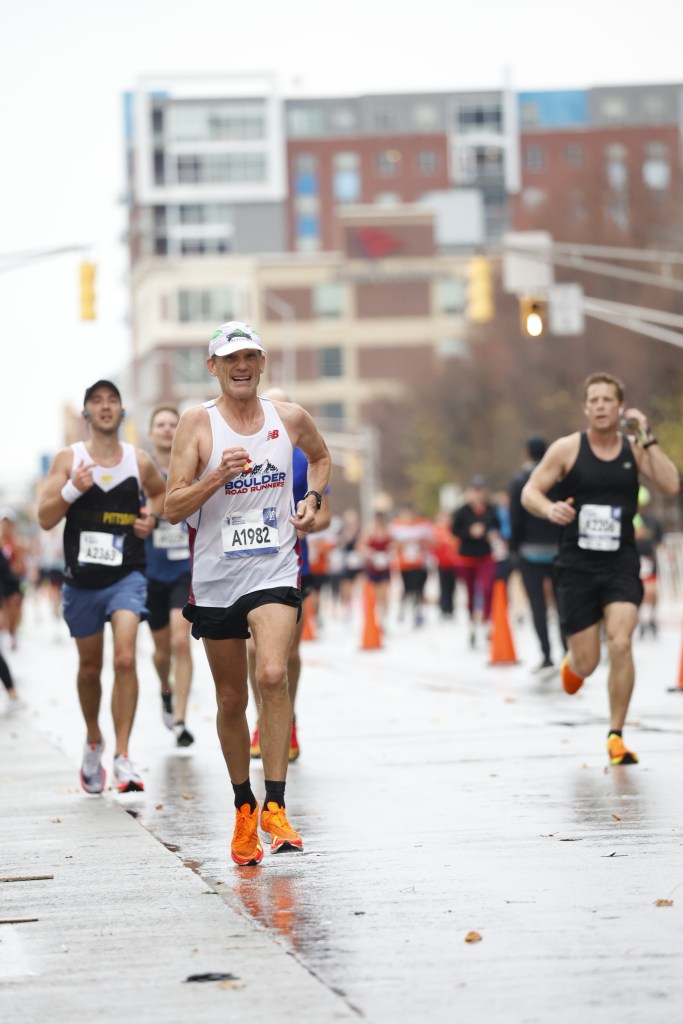
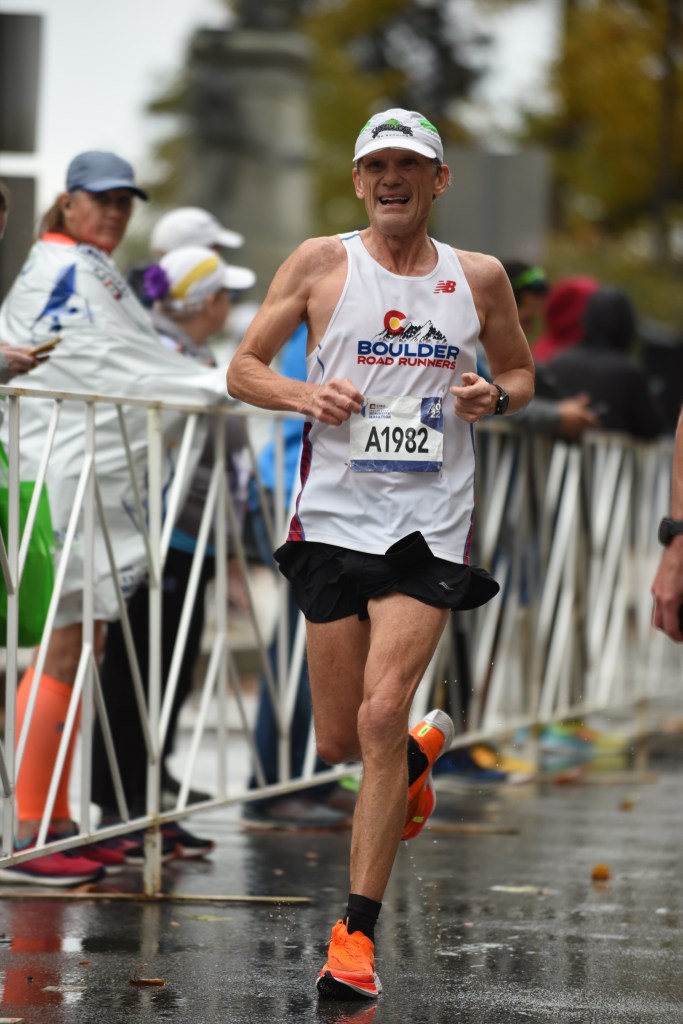
At 23.5 we turned south on Meridian Boulevard, and I only needed to cover 2.7 miles in 20 minutes. I didn’t do the pacing math, but figured I could hold whatever it took. Within just a couple blocks, however, I knew I was in trouble. The wind was just horrible (20-25 mph sustained with higher gusts) and I just could not move through it. I tried focusing on stoplights ahead to keep focus, and a times tried to latch onto passing runners, but anyone passing seemed to be heading for the barn at 6:30-7:00 pace and I could no longer do that. So no drafting, and with that wind my pace slowed to 7:50s.
The most disheartening moment of the day was when the sub 3 pace group, a peleton of 50 runners, went by with maybe a mile and a half to go. I tried to hang, but they also were moving too fast and I didn’t even make it a city block in their slipstream. At that point I knew I wasn’t going to break 3.
All I could do was to keep running and not give in to walking. I had no kick or energy at the end. I felt defeated as I crossed in 3:01:16. Walked maybe 50 meters before I started uncontrollably dry heaving for a minute or two, so I laid down on the wet pavement until the guy from the banana table helped me up and sent me on my way toward the gear pick up tent. I just talked to one person, a guy whom I had run with from about 9 to 22 miles before he pulled away. Other than that I was just in my own silent disappointment and slight nausea. Marathons, we do these for fun?
I did make it back, slowly, to my hotel and got to my room by 11:40 with barely enough time to shower and get dressed before the noon check out time.
Aftermath
I don’t know, that was rough. I do think I really put it out there but the weather did me no favors. Of course there were other runners, who I had been with through 22 miles, finishing 2-3 minutes ahead but I just think that stretch just hit me as my reserves were on E. Under less extreme conditions for the finish of a marathon I think I could have hit 7:20 and held on.
A couple things I could have done differently would be to stick to plan A and slide back a little until I got picked up by the sub 3 pace group, they were probably no more than 30-40 seconds back on the return. I could have drafted more when the going got really tough. I also could have programed my watch to bleep when I got into the mid 150s so I’d know I was redlining or about to. It was at 159-160 on miles 20-22, that’s getting toward 5K level of cardiac output. But at the same time, marathons are also about keeping momentum, and I did not want to lose the good flow I had from mile 5 to mile 23.
So who knows? It’s over and I have to move on. Maybe someday I’ll pat myself on the back and tell myself that even though I came up short it was still a heroic effort on a very challenging weather day.
I’m not there yet.
Looking forward to eight or nine months of non-marathon training.



 rrunnin234