Rates of Decline for a Masters Runner

At the London Marathon last weekend 59 year old Jenny Hitchings ran a 2:45:27, shattering her own age group world record of 2:50:36, which she set at New York City in 2019. That record spurred some online controversy, how could a relatively unknown run nearly five minutes faster than the venerated Olympic Gold Medalist Joan Samuelson at the same age?

This time, after bettering her lifetime personal best of 2:46, which she did back in 2011 at age 47, at least some on the internet have gone apoplectic, accusing her of using PEDs. Arguing that it’s impossible to PR at age 59.

I don’t know, I have seen a lot of remarkable masters breakthroughs in recent years, such as Tommy Hughes of Ireland running a 2:30 marathon in his 60s, or 60 year old Austrailian Steve Moneghetti doing a sub 16 5K last fall. Hitchings is at their level, and the trolls and naysayers on the internet don’t like it. Maybe because A) she is female and B) she was not an elite-level runner when she was younger while the likes of Hughes an Moneghetti were pros.

One of the more common arguments is that it’s simply not possible for an athlete to run as fast or faster at 60 compared to their mid-40s. And they cite the commonly used statistic that runners after the age of about 35 or 40 decline at a rate of about 1% per year. Of course, the first mistake they make is that they equate that 1% as a rule, and deviation Will Not Be Tolerated! (so if an athlete’s times decline at a rate much less than 1% they are immediately suspected of taking testosterone or performance-enhancing drugs). Another mistake you often see is that often the most outspoken have declined at a rate much higher than 1%, so using the famous adage ‘anyone faster than me must be cheating!’

This article Sub 3-Hour Marathon Runners for Five Consecutive Decades Demonstrate a Reduced Age-Related Decline in Performance https://www.frontiersin.org/articles/10.3389/fphys.2021.649282/full counters those arguments and insecurities, and the data from those in the 5 decades sub 3 marathon camp (including Olympic Gold medalist Joan Benoit Samuelson) have declined much less than 1% per year, more in the range of 0.5% to 0.7%. The journal article is also summarized here in Canadian Runner.

Before delving into my own rate of decline, what about Jenny Hitchings and her remarkable feat? Amazing is all I can say. I don’t think it’s at all fair to say that she’s an obvious drug cheat. Nevertheless, I’m in the camp of giving the benefit of any doubt but I also believe that high level athletes (record setters and champions) in the masters ranks need to tested both at competitive events and at random times outside of competition.

USATF and USADA need to up their testing. I have been to about 20 USATF championships over the past decade and one for World Masters championship. At these events you have to sign a waiver acknowledging clean sport and that you will agree to drug testing. That’s fine and needed, but they need to do more. Test at least six or eight athletes at every championship road or cross country race. Currently, they only test a few athletes a few times a year. They also need to implement random drug testing for athletes who are at or approaching the record breaking level of performance. As far as I know that is not done at all.

My Own Rates of Decline with Some Real Data

The table below summarizes my best performances at different ages over the years, starting with my best times as an open runner (all those list were set in my mid-late 20s), note those were altitude conversions, using the NCAA calculator. In my masters years, the times are mostly sea level but some years I didn’t live at or travel to sea level.

Age1 mile5K1/2 MarathonMarathon
20-394:2615:151:102:29
40-454:3816:211:172:44
465:0817:411:213:12 (trail)*
474:5617:031:193:00
484:5417:081:193:10 (trail)*
495:0817:28
505:0017:231:193:09 (trail)*
515:0017:011:18
525:1418:05
535:1117:431:20
545:0317:171:19
555:1017:171:203:17 (trail)*
565:1017:271:193:15 (trail)*
5718:211:20
585:1118:101:24
595:1117:401:182:58
605:1417:291:193:12 (Boston)
615:1417:281:17
625:2418:101:26
635:2818:111:233:02
645:1818:301:213:00
65?18:241:24

How has it gone? I think the biggest drop off for me has been in the mile, while I have done better in the 5K and particularly half marathon, and the marathon is somewhere in between.

Open to 40-45 age group: In the mile I slowed by about 12 seconds in 12 years a drop of 4.5%. For the 5K it was 1:06 over 13 years 7.2% decline. In the half I slowed by 10.0% in 17 years, and marathon the decline was 9.8% in 16 years. Note that in my early 40s I was mostly running 40-50 miles a week, and only did one marathon block averaging 55-60 miles.

Open to now – age 64-65: I the mile I have declined by 14.7% and 5K 13.4%. In the half only 6%! and full it has been 9.3%.

Now the interesting statistics, the one that the online naysayers do not want deviation from 1% per year. From my 20s to mid-60s, the decline has been 0.41% per year for the mile, 0.55% at 5K, 0.15% for half marathon, and 0.23% a year for the marathon. So I beat the aging curve by a fair amount.

As to why, maybe that’s something for another blog post here, but I think some important contributing factors would be maintaining good healthy and weight, not getting frequently injured/nor having chronic biomechanical issues, adjusting my training and adapting to the aging process, and no doubt some good aging genetics thus far.

However, compared to the likes of Hitchings, Janine Rice, Jacob Nur, or Alistair Walker it’s nothing that remarkable. They are at the extreme end of the bell curve.

Syracuse Half/USATF Masters series

With just two weeks of recovery from my all-out effort at 10 miles in Sacramento, I figured doubling back would be fairly tough. It was.

The intervening training was mostly recovery for the first week, with a mix of cycling and running (including a 15 miler on the 8th) and capped off with a final ski outing on April 9. Only 40 miles of running but I did manage 9 hours for the week.

Last week I kept the volume up to an hour plus a day through Thursday, with a couple of moderate to light tune-up workouts. It was warm out all week (70s and 80s) so I took advantage of the year’s first heat wave in preparation for Syracuse.

Traveled on Friday and that was a “rest” day, although I walked a lot. On Saturday I drove down to Ithaca, where we lived for a few years in the early 1990s, and caught some of the old sights and took in a 4 mile run (probably warmer and hillier than it should have been) through the Cornell University campus and arboretum.

Race Day

The forecast called for high 50s to to low 60s with some clouds and wind. It ended up being 100% sunny, low-mid 60s, and a very light breeze out of the south or southwest. Not bad but weather would be a factor.

I did a short 10 minute warm-up, and could tell right way that my legs were not fresh. I have been planning to peak for a 25K race next month and if not for that I would have taken it a little easier last week. I adjust my goal from repeating last year’s time of 1:21:42, and with the warmer temperature figured that a sub 1:23 would be a good day. So I wanted to lock onto 6:20 pace. My watch had me at 6:18 for the 1st mile but that may have been deceiving because I started it at the gun and it had a net uphill. In hindsight that and the very much uphill 2nd mile (GAP 6:10, 6:19) were probably too fast for the day, although I did settle down early in that 2nd mile.

We were pretty strung out and mostly single file with growing gaps by the 3rd mile, different from last year when the field was twice the size and we ran in packs because of the wind. My official 5K split was 20:05.

From then on through mile 11, it was mostly a matter of hanging on to the effort and picking off runners one at a time. I passed maybe 6 or 7 runners, and clicked off 6:20-6:25 pace through the lightly rolling hills, and long downhill of mile 9 one was about 6:15. My 10K and 15K splits were 40:13 and 59:54.

The 12th mile was the toughest of the day, running into a slight headwind and totally exposed to the sun, I could only manage a 6:37 and I thought a sub 1:25 might be in jeopardy. One guy passed in that stretch but I couldn’t match his pace. I did regroup at about 20K as we headed back into the downtown canyons with a more favorable wind and some shade. Another young runner passed me, and encouraged me to keep up, saying “I believe in you!” That was kind of funny but my stomach was getting queasy and I knew I was at maximum sustainable pace at about 6:20.

I could not pick up the pace over that seemingly endless 0.4 mile straight after the final turn. Over the final block the announcer called my name and age, and the crowd gave a rousing cheer. I was top 5 among those 50 and up, and he said I might be leading the age grade category. I was hopeful of that! But it wasn’t so.

I won my age group by a good margin, and ended up third in the age grade rankings, with an 88.3%. That was not at the <1:23, >90% I had hoped for but given the day, a win’s a win, and another podium age grade finish is still very satisfying.

Next USATF race looks to be a road mile in June, which they just added, and May the 25K and Bolder Boulder 10K. Then, I’ll need a short break.

6

USATF Masters 10 Mile

It’s only early April but the USATF Masters Grand Prix is half over and by the end of the month it will be three quarters done. Go figure.

This was my third race of the series for this season, which starts with Club Cross Country in December. I was only 64 for that race and placed 14th in the 60-64 age group, but would have been 2nd in the 65-69 age group. I only get credit for the 14th place.

There were only a dozen racers entered in my age group and none of the heavy hitters so I channeled my focus on age grading and making a top 5 in the overall age grading category. That’s a tall order, and I expected that it would take a 92% to make that top 5, and that was my A+ goal.

Training

For my 14 week training/base block I used a modified Norwegian system with a Nordic twist. Averaged 9.2 hours of aerobic work a week, 45 miles running (5 or 6 days a week) at 5300 to 7500 feet elevation, and cross country skiing another 21 miles (35 km) with the skiing (1-3 days a week) at elevations of 8500-10000 feet. This is the most skiing I had done since 2015 and jumped into several races, so it was good to mix that in.

For the first six or seven weeks I did a double threshold day every week and on five of those weekends did a ski race (7.5 to 32 km). The threshold workouts started with 5 or 6 minutes at current estimated marathon pace (low 7s), usually progressing toward actual threshold pace. The afternoon session were hill reps of 1.5 to 2.5 minutes at a faster effort, 10K to CV, and I would jog down equal time for recovery. Those were really hard this year (I did double-doubles, mostly running last year), and consistent snow, cold, and wind on those days didn’t make it easier.

After that period I shifted more to weekly threshold/progression work one day, and a progression from 10K to 5K repetitions on another day, plus a long ski or run on the weekend (1.5 to 2.5 hours). I raced one 5K, an 18:24 on a rolling course in Atlanta at the end of February. On paper, I think 1:02:30 was about what to expect, but I knew the course in Sacramento was fast and over the last couple weeks some of my reps started to creep down so I thought something in the 1:01s wasn’t unreasonable. I did a one week light cutback, with one easy ski of 90 minutes and 34 miles of running in 5 days, one day of rest.

Pre-Race

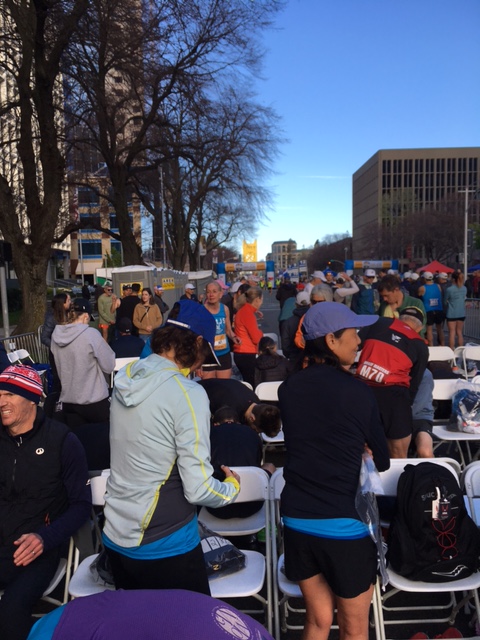
Traveled to Sacramento the day before, on an early flight that really messed up with my sleep. So that was a bit of ding. But I did get an hour nap after a short shakeout run. Slept okay the night before, getting maybe 6 hours of actual sleep. Did a short 15 minute warm up, on a cool breezy morning. Mid 40s and a stiff breeze from the south. So it would affect us more on the first half of the race, which was primarily an out and back along the Sacramento River, with a couple ~1 mile city loops for miles 1 and 10. My ideal plan was to go out cautiously, 6:15 and then wind it up to low 6s over the final miles.

Race

I lined up in about the 5th row. And we were off, but double clicked my watch so it stopped at the starting mat and I didn’t notice it until the first turn on the next block, so it was off about 30-40 seconds. I got swallowed up pretty quickly, but at about a quarter mile in I could see a number of runners I knew a ways ahead and they were pulling away, so I moved up a bit to get back in contention.

Coming from altitude to sea level without an adjustment period is always a mild shock. Your legs are going faster, you are breathing harder, and you just feel off. I have learned that you can push through that because you don’t go under as quickly. As a result I was running faster than comfortable but it also felt sustainable.

Things strung out by the end of the second mile as we crossed the bridge and headed south into the wind. The next group was pretty far up already so I settled into a pack of five or six other runners, a mix of masters and open men and younger women, going about 6:05 pace. With the headwind I mostly tucked int. Mile 3-4 was the hairiest because they narrowed the course two narrow lanes the out and back, and our pack congealed into 15 or so runners navigating a 6-foot wide section of road way, so it felt almost like track. But with some potholes you had to be wary. No one fell but there were a few close moments and a bit of bumping.

Back on the open road we opened up and I got to front of the group, trying not lead much but staying out of the way from feet and elbows. Splits for the first 5 miles were 6:01, 6:05, 6:03, 6:15, 6:06

Hit the 5.4 mile turn at 6:05 pace and was hoping to pick it up with the tail wind. However, my body said otherwise. I felt okay through 7 to 7.5 miles, and then it became a lot of work to maintain pace. A couple of the female runners from that big group caught up and I hung on through 8 or so, and fell back a bit more. One young guy encouraged me and I kept him in contact for another half mile but he also pulled away.

Even with the tail wind my 9th mile was a 6:13 (but did have a couple rollers). We had to turn back into the wind for about a half mile but I kept the effort going. Turned onto the bridge and toward the state capitol building, a half mile from the finish, I think one guy caught me but I held him off, but the three runners I had been running with/chasing since the middle part of the race pulled away some. So I didn’t didn’t close those low 6s I was hoping for, but held on okay.

Splits for the second half of the race were 6:06, 6:09, 6:02, 6:13, 6:13 (average of 6:09)

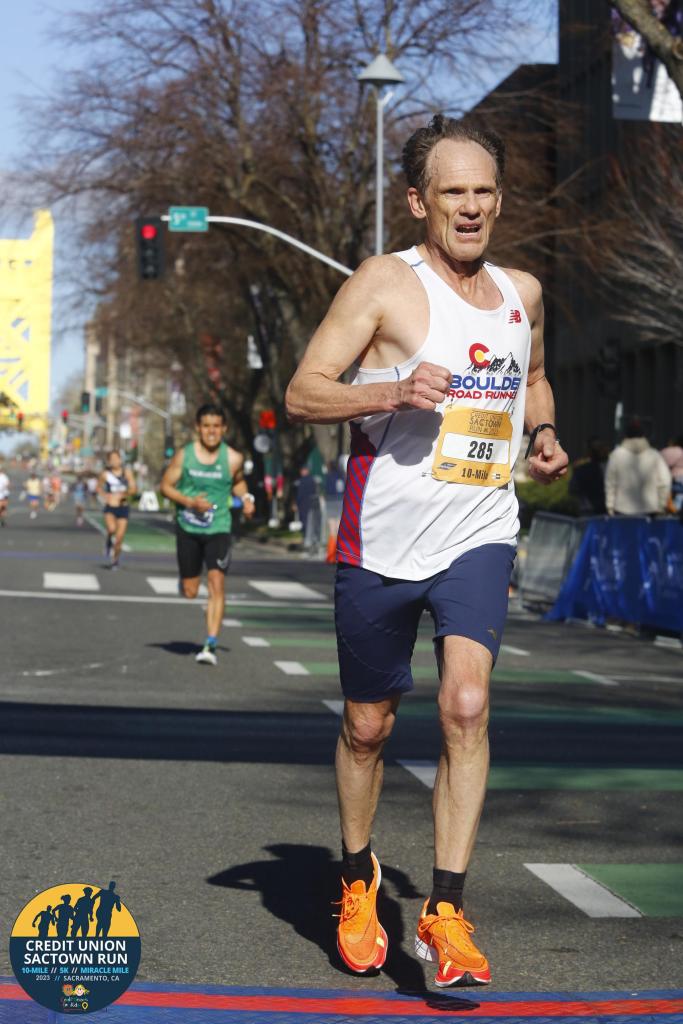
Officially finished in 1:01:09, and 92.24 age grade, an A+ goal time! I was pretty thrilled. Won my age group by several minutes, and ended up third overall in age grade rankings, so got some extra bling and chaching! Our age group team placed second so that was great as well.

Post-race

Had a good time rehashing the race with friends. I have been doing the Grand Prix circuit for five or six years now and know a lot of the competitors across the different age group. So we’re rivals on the course but once the race is done there is a lot of camaraderie. Took the train west in the afternoon to the Bay Area to visit family.