Background
Before jumping into this year here’s a little history. From 1979-84 they lined up everyone at the same time, with the elite men going off first, elite women 30 seconds later, the A waves after another 30 seconds, and following waves at 30 second intervals.
Switching things up has been good for spectator viewing, no other race has the mass race go first so runners can go the expo or bask in the huge 45,000 seat CU football stadium until the elites line up and race. The only downside is that it’s a 4 hour wait if you are in an earlier wave. Nevertheless, it’s a great moment when the winners come through the tunnel and into the stadium and some 40,000 spectators roar–doubly loud if the top runner happens to be an American. It is Memorial Day after all.
Going in I knew my 2023 return to the Bolder Boulder might be difficult. I think this was my 11th outing at this event, one that has been a highlight some years but more often a challenge, sometimes a disappointment. This was also my first official running of the event since 2019. 2020 and 2021 were virtual and socially distanced events on different courses, just not the same. Last year I was coming off of covid19 and nowhere near race ready. Instead, I helped with the mile/km marker takedown crew, but I ran an easy 4 or 5 miles beforehand and felt terrible so deferring for another year was a good call.
In the past my best Bolder Boulder was 34:06 in 1985, good enough for 100th in the first edition of the split Citizen’s/Pro Elite race. At the time I was disappointed because I felt I was in better shape than that (did run a 33:09 10K a few weeks later in Loveland). Subsequently, I have had the good fortune of winning my age on five previous occasions 2001, 2016, 2017, 2018, and 2019. So a lot to be thankful for.
In my previous 10 starts (plus the two virtual/socially distanced attempts in 2020 and 2021) I ran under 40 minutes. They give incentive t-shirts for sub 40, and prior to this year only one runner over the age of 63 had run under 40, and that just once. So my goal, deferred from last year, was to be the oldest to finish under 40 and to set a new age group record (40:48 was the mark for 65 and up). Considering that I had 10 miles at 6:07 pace in April, followed by the half marathon (6:26 pace) and 25K (6:29 pace)–although all at sea level–I felt pretty confident that sub 40 could reasonably be attained.
Going In
Nevertheless, there were the caveats heading into Monday’s race. First, I only had 15 days to recover from the all-out effort for that 25K record attempt. I finished that race with practically nothing left in my legs. Second, Bolder Boulder is at 5300 feet elevation. Third it’s a hilly course, with more up than down, that finishes some 70 feet above from where it starts. It’s generally my slowest 10K of the year. For example, in 2017 I ran 35:43 at sea level in Alaska and only 38:40 at Bolder Boulder, and in 2019 I did 36:53 in Colorado Springs but only 38:10 in Boulder. That shows the differential. So I knew I’d need a sub 39 effort (at altitude on a faster course, otherwise sub 38 at sea level) to break 40 this year. Would I be ready?
Recovery and Final Prep
I took the first week following the 25K very easy, running just 15 miles in the first 6 days. On the 7th day I did a moderate tempo workout, running 6:30 pace (Sub 4) for 2X 3K, and the following Tuesday did a set of 3 minute reps over some rolling terrain to simulate Boulder’s course and those also felt pretty good. Recovery to that point was better than expected.
My Friday workout before Monday’s race was a mistake. I had planned on just a set of 6X 45 seconds as a final primer. But instead, I made it more difficult by doing a 6 minute tempo followed by 2 minute CV effort, and 5X 1 minute reps getting progressively faster. The 6 minute part felt a little harder than I’d like but the rest of the workout went fine. Normally, with three days before a race (unless it’s an A+/championship event) I can recover in time and feel fine for race day.
Not this time. I failed to account that I was still recovering from the 25K
I took it easy on Saturday and Sunday, running 6 and then 3.5 mile shakeout at a very comfortable pace, and figured it would be enough of a cutback for Monday morning.
Race Day
The day was perfect for a race, mid 50s at the start, into the 60s by the finish with barely any wind. Can’t ask for better than that.
I started in the A wave, based on my time from the 10 mile at sea level (no way can I run 38:00 for 10K or an equivalent at altitude any more). This might be my last time running the A wave. Although still might get one more sub 38 10K or 62 for 10 mile at sea level in the next year.
I planned on 6:30+/- for the first mile and 6:30-35 for the uphill mile 2. If you can get through the first 2 or 3 in reasonable shape, the rest of the race is usually a lot of fun. Felt decent on the first mile, splitting 6:25 which was within range although maybe a few tics too fast. Mile 2 also went decently, and I stayed just about on pace with 6:31 (12:56). However, by then I did feel I was working for it. But with less than a mile before the course becomes more rolling through 5+ miles (with a net downhill) I felt confident I’d get through that and have some breathing room.
That’s not what happened. About 2.7 miles I could feel myself struggling to catch a breath and I was slowing down. There is a nice downhill starting just before 3 mile/5K but rather than picking it up as I usually do, all I could manage was to hold onto about 6:30 pace–on the downhill. I crossed 3 miles in 19:37 and 5K in about 20:15 and knew my primary goal for sub 40 was in jeopardy. Normally I could make up those 15 seconds and then some on the 4th and 5th miles but my breathing wasn’t right.
Hit the firehouse hill at 4 in 26:10 or so, and would need a 6:10 on the flying 5th mile and 6:20 on the final mile, followed by a strong kick on the grueling final 0.2 (the last mile of the race is all up until you get into the stadium).
I did try to pick it up on mile 5, but could only do 6:27, so I knew sub 40 was out of the question. Runners from the AA and AB waves were streaming past (I probably finished in the bottom 5% or 10% of the A wave), so these were runners who had started 1 and 2 minutes behind. I tried not to give that too much thought, but knew what was happening. I just couldn’t get on track and lost focus.
I just worked to maintain the flow at a pace I could finish (mustering 6:40 for the tough mile 6). Into the stadium I put in what kick I could. It was faster than race pace but not terribly quick as yet another flurry of runners pulled away or passed by.
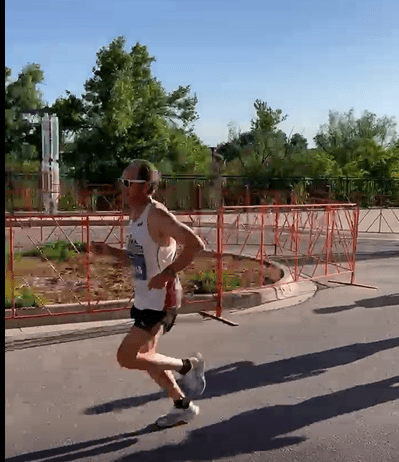
I crossed in 40:46. The silver lining is I did break the existing single age record of 40:48 by a scant two seconds, and won my age by nearly two minutes.
However, the effort was well short of what I considered a fairly reasonable goal, even considering the short recovery. Some runners who I normally beat by a minute or two finished ahead. More power to them, they deserve the kudos! Nevertheless, it just wasn’t my day.
Post-script
I took it pretty easy for three days, and then did a set of 4X1400 meters tempo reps at 6,000 feet. These were faster than on Monday. I just didn’t have my day. Next time, I’ll take recovery a bit more seriously and go light on Friday, Saturday rest, Sunday shakeout. Bolder Boulder is by far the biggest and most important road race in the state. People build their year around it, not just try to fit it in. I do plan to run the 25K again and will have a better roadmap to enter Bolder Boulder.

 rrunnin234