Vexed Again in Cross Country

Recent Past 2013 – 2021

I have had a good run over the past decade of masters/senior competition at the national level in road races and cross country. It all started in 2013 with the USATF Club Cross Country Championships in Bend, OR. After a decade in Alaska I ventured to the lower 48 for an attempt at a national title. Going in I thought I could medal, but it wasn’t even close. I was 6th in the men’s 55-59 age group, and a good ways off the podium. However, the fire was lit and less than a year later I had moved back to my home state of Colorado. The reasons for the move were financial, but also to live in a better winter climate. The skiing was great but months of darkness and weeks of -40s or -30s, with a 6 month winter had been enough and we needed a change.

Cross country has been my favorite, since my first season as a college runner in 1977. I scored top a couple top 5s (2015 and 2017) and several podium finishes including a 2nd and 3rd at Club Cross Country in 2018 and 2021, and a 2nd at US Nationals in 2019. That was followed a couple months later with a 3rd at the World Masters cross country championships in 2019. So that four year span from 2017 to 2021 were really good, and I came to expect a medal at national meets.

Since 2021, however, things have taken a step back in cross country and I have not been competing at the level I would like. Maybe some bad luck and bad timing, but maybe also fitness.

In 2022, I felt really I had a great chance for a medal at the US Masters cross country championships in Boulder, but came down with and ill-timed cold virus just four days before the race. I held onto 4th place for about 2.5 miles but faded to 6th over the final stretch and that was my worst finish at a national championship since 2015.

A couple months later (five weeks after a marathon) I finished way back in 14th at Club XC in San Francisco. However, there were some mitigating factors. Coming off the marathon I was not sharp, and age 64 that was my final race in the age group. It also happened to be the best field ever for the age group at any race. There were Hall of Famers and world or national record holders finishing out of the top 5 or 10! That was just a crazy day in hurricane winds and driving rain and sort of an anomaly. Nevertheless, no excuses the results stand.

2023 and 2024 the Struggle Continues

The types of woes that struck me in 2022 have continued in 2023 and now 2024. I did not do US Nationals last January and instead skied and trained back home. I also skipped the 5K masters championships which were held in Florida on the same weekend as the Chicago Marathon. I wasn’t at all disappointed to miss that (93 degree heat index), we had perfect weather for Chicago.

Three weeks later after the marathon, probably against good judgment, I wanted to get back to cross country and entered a 4K in Boulder, and that was a disaster, as my heart rate spiked to 95% after just a kilometer and I struggled to run 6:45 pace (not much faster than marathon goal effort) for 2.5 miles of agony on an unseasonably cold morning. I simply was not recovered. Two weeks following that disaster I ran the Colorado USATF championship and although it went better than the 4K, I could not break 20 for the rolling 5K, and was significantly slower on the same course than the previous year when I was sick. It felt like I was breathing through a straw. I did win my age group, but got beat by people I am normally well ahead of.

I opted out of Club XC, held in Florida (again), and decided to do US Nationals in January, figuring that an extra six weeks of training time would be better following what had been a long, but largely successful 2023. I figured I would be a shoe-in for a medal in Richmond and might actually feel disappointed if I didn’t win. I knew the guys lining up and felt I could beat them.

However, I do respect my competitors and know that you can’t take anything for granted. I won three road titles last year but on each of those days I was at 100%. And to tell the truth, running cross country is more difficult than the roads, and the competition tends to be stronger and deeper at most cross country championships. Runners like to show up to these championship races at their best.

The Lead Up and the Race

I hadn’t raced since the Thanksgiving Day fun run 10K, where I ran decently on a cold blustery day in Wisconsin in a 39:15. It was a great way to close out 2023. And it was a few seconds faster than the time co-favorite David Westenberg had run earlier in the year. I was also pretty happy with the last two months of training for the year, building to 60+ miles and in December I mixed in a few days of XC skiing and spin cycling. The base-build was on.

Things kind of dropped off after Christmas, however. We were supposed to ski on our New Years trip to Flagstaff, but there was no snow so instead of three out of five or six days on the snow I got none, and while I maintained running that week I did have to cut back to about 55 miles. I got in a solid workout at 7200 feet in Flagstaff, CV effort in the 6:30s and was pretty happy with that.

And a few days later, back in Colorado I had a good progression effort, and felt that if I can run 25 minutes of reps in the 6:20s-30s at altitude I should be able to run 6:15-20 at sea level. Right?

Then I got sick. I picked up a bug on our return trip on the 1st or 2nd of January, and by the weekend I was having trouble wit breathing. I took off two days completely and ran just 3-4 miles a day for three more days. Fortunately it wasn’t Covid. Just a cruddy chest cold that ended up more as a head cold after the first few days. I took it easy until Friday the 12th, when temps dropped to sub zero, and got in a good weekend of treadmill sessions with tempo, long run, and CV reps on Friday, Saturday, and Monday (MLK Day). Although I was still having to clear my throat all week (and into race weekend) I was feeling pretty good on those workouts and on the recovery days.

I lined up on the cold blustery morning at Pole Green Park confident that I could run well under 6:20/mile for the 8K race. I was nervous, but also relaxed, like let’s bring this on and see what everyone’s got!
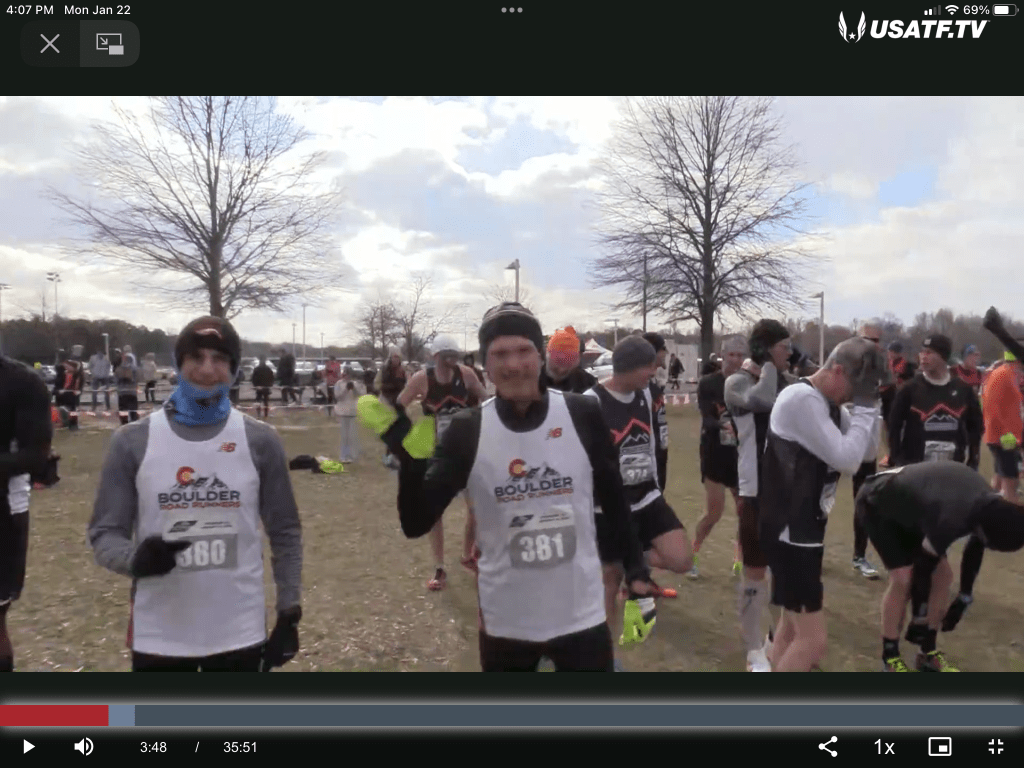
I darted off the line quickly for 50 meters, and settled into my pace. The lead pack swallowed me up quickly, before the course narrowed by 600 meters.

It was a little tight through those early turns, and I was already breathing hard. I could see two of my rivals, Ken Youngers and David Westenberg pull away, by a km the already had 10 seconds on me, and I knew then that this was going to be a tougher than expected outing. I was running 6:15-20 pace and it felt like 6:00, as my heart was racing and I was breathing hard. They were already pulling out of sight by the first lap at 2K, I might have seen David’s bright green hat bobbing but he had 20 seconds on me by then and knew I wasn’t going to catch him.

Hit rock bottom emotionally at 3K when Tim Conheady in my age group passed assertively as I mumbled to myself (somewhat audibly), “this just not my day”. Tim broke away and had put on 8-10 seconds by the half way split, as I really struggled with that part of the loop with a few hills and headwind. He stayed 10-15 seconds up the rest of the way.

It seemed to gain on a few stretches but would hit a bad patch and his lead maintained.

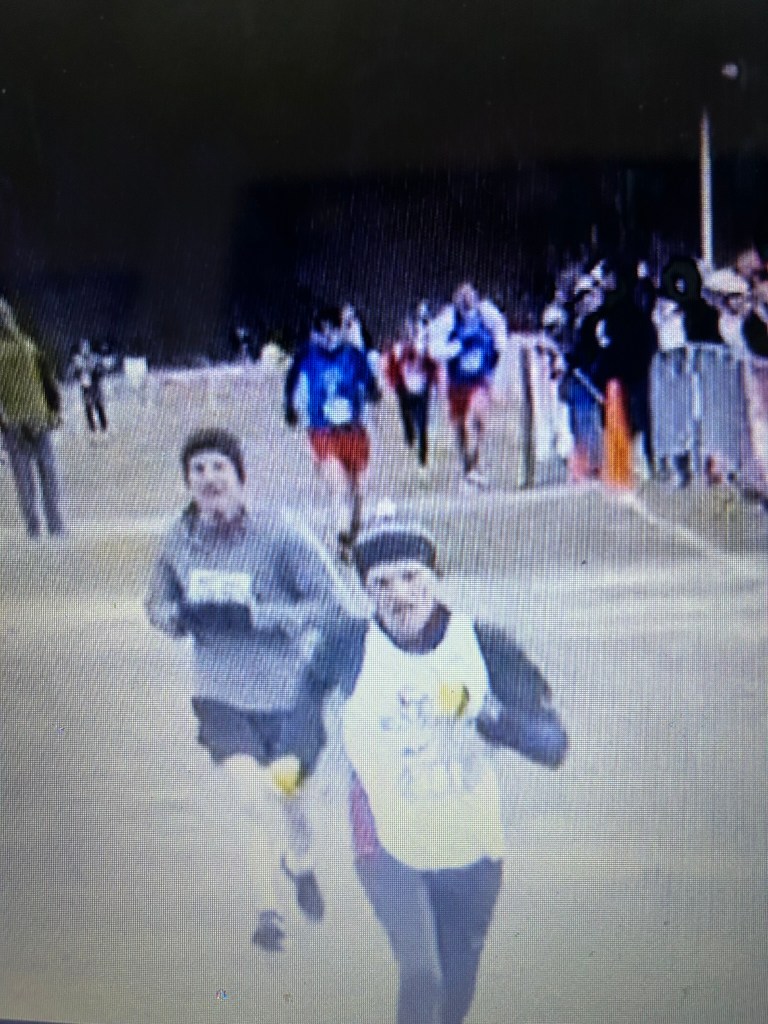
I threw down a hard kick over the final 300, into the wind, and bent over almost throwing up as I crossed the line, just passing an injured Ken who had thrown out his back after a stellar 4 miles.

For a while I thought I might have finished 3rd and on the podium but it was not to be, as a runner (unknown on the USATF masters circuit) from the local VA region was just behind David for the silver medal. Tim was 12 seconds ahead of for third, and I was 4th, Ken 5th crossing just a second back.

That was a very good field, perhaps best ever for a USATF championship at our age group.

My mile splits were approximately 6:18, 6:25, 6:31, 6:38, 6:27, which is about on par with what I might do on a tempo run at Crown Hill Park at 5500 feet elevation. So yeah, I’m a little disappointed. Looking at my heart rate, it shot up to the high 150s by 1/3 of a mile (at about 6:10 pace), and 160 just before 2K. 160 is not sustainable for more than a couple minutes for me.

So bottom line, maybe not quite recovered from that cold, plus overall fitness–that ability to sustain a hard effort–is not quite where it needs to be for to compete for a title at a national championship event. I’m a little disappointed that I didn’t fight a little harder for that thirds spot, but he passed and gapped me at just the right time and if I had fought and faded I would have finished 5th instead of 4th. You have to live with those decisions.

My work over the next two months is cut out pretty well: Get healthy (stay healthy! No colds), get stronger with a string of 8 to 10 hour weeks, and get comfortable running some reps at sub 6 pace for 2-4 minutes in workouts.

20 Years a Comeback: Part 2

After hitting rock bottom in 2002 and 2003, which ended with a tonsillectomy and about eight weeks of no running, I gradually made my way back in 2004. However, by January and February I was running pain free up to four or five times a week. Most of the runs were short, in the 3-5 mile range, but I felt good. As tough as it was to get those tonsils pulled, a bonus was I felt that I could breathe deeper, get in more with each intake and exhale more. That may or may not have occurred at a significant level but breathing sure did feel easier, not to mention not having those perennially sore and pocked tonsils in my throat.

In February I did my first ever snow shoe race at Eldora, and cross country skied a couple 10K skate races–my first ski races since 2002. I was nowhere near top shape but it was great to be huffing and puffing at 8,500 to 9500 feet elevation!

Late in the month my boss walked with me across the CSU campus and asked if I would be interested in moving to Fairbanks, Alaska as an environmental planner. The incumbent had recently left the position and they were looking to fill it. Think about it, he said.

I did not take him that seriously, but mentioned to my wife and kids over dinner that night. We kind of laughed it off. Her parents and my mom lived in the Denver area, less than 90 minutes away, and we figured we would be staying in Colorado for years to come.

A few weeks later, my boss brought up the transfer again. This time less in passing, in fact he was direct. The environmental project that we had worked on for two-and a-half years was wrapping up, and at that time there were no big projects on the horizon. The Alaska job would be more stable, if not indefinite. Our client, the US Army Alaska would need a couple of planners on its staff just for day-to-day operations. He could not guarantee a long-term stable position in Fort Collins, but the Fairbanks position was there for the taking. He sweetened the offer which would give me a substantial raise, plus cost of living, to move to Fairbanks with my family. He offered to fly me up there to talk to my co-workers, whom I had already worked with for a couple of years and knew fairly well, and suggested that I bring Tamara along. So we took a late March trip to the north.

It was a record breaking 82 degrees F when we boarded our jet from Denver to Seattle, then Fairbanks. We arrived at 2 AM amid light snowfall and -26 F in Fairbanks. I thought no way, would she want to spend any more time in the north than this four day trip. However, we explored the area, contacted a realtor and looked at houses, and went to dinner with the co-workers. They really wanted me to move up and work with them. By the second day we were sold on the idea. A huge step to make when you are in your 40s and have two kids in school.

Spring Racing 2004

By late March I was running five or six days a week and picked up a copy of Pete Pfitzinger’s Road Racing for Serious Runners, and decided to do the Colorado Half Marathon in May. I had been running consistently for three months and had built up to 40 miles a week. I had not run a half marathon in five years, and in fact had only done one other half in the previous 15 years! I knew I could finish, but figured I would be well off my altitude best of 1:13, as well as the 1:19 I had run five years prior.

I built up to 50 miles a week, more or less following the plan and in April did a 5K and 5 mile tune race, about two weeks apart. Although I was well off the times I had been running in 1998-2000 (sub 17, low 28 respectively) it was great to line up healthy and to see what I could do. I ran 18:13 for the 5K in Loveland. And then at the 5 mile Cherry Creek Sneak (once a seasonally huge race in Denver, with 20,000 participants racing three distances) I ran just over 29 minutes and placed in my new age group.

At the half in May, I knew I wasn’t yet ready for prime time racing, but gave it my best shot. I ended up running just under 1:22 and placed third in the masters division, which was a surprise because northern Colorado boasted a deep contingent and this was one of the biggest springtime races in the area.

Although I have done a ton of racing in the years since, including huge races and national or international races, still have that plaque and it sits on the top of my bedroom bookshelf signifying my comeback.

North to Alaska

A few days later I loaded my car with gear and a bunch of scientific journals that I had collected in 1990s (I still had some hope then of returning as a research biologist), and drove up to Alaska. After a few weeks I flew back and picked up the family and we drove north together.

I kept up my running, but scaled back and missed a lot of days, maybe doing only 25-30 miles a week. Just a week after after arriving back in our new home of Fairbanks I entered the Midnight Sun Run, Alaska’s biggest race, with some 4,000 participants. I expected something like Bolder Boulder, which was 10X as large, but the Midnight Sun Run, starting at 10 PM on the summer solstice weekend, was more like a mini-version of Bay to Breakers.

I did not expect much out of myself competitively, maybe a top 15 or 20/ After just 2 miles I found myself in the top 10, and by 4 miles I was fighting for a top 5! I ended up finishing 6th place and as first masters in about 36:50. My first age group win in five years.

The running club there held a seven race series every year and I jumped into the track mile (5:08), another half marathon, this one mostly off-road (1:22), and a tortuous 16.5 mile race that dropped 1800 feet on trails and back roads. I made some new friends in the masters running community and all they could talk about was Boston Marathon–which they had done many times each, running 2:40 into their 40s–and the upcoming Equinox Marathon in Fairbanks, it was Alaska’s oldest and toughest marathon with 18 miles off road and trails, about 8 miles on pavement, and 3,300 feet of elevation gain and loss. Totally gnarly, and a Fairbanks institution.

Over the summer, despite huge historic forest fires (over 5 million acres in Alaska burned that summer), I was able to build to 70 miles for couple weeks and was in the 55-65 miles per week range for more than two months. I been on some hilly back-country long runs, up to 23 miles.

It was in this summer that I decided that I would not back down from training and racing in the future. Both of the long-term injuries I had endured in my late 30s and mid-40s had followed an extended break from training, although I had run some I had only done minimal miles. In the future I vowed that unless I had to ease up due to injury or illness, they’d have to drag me away kicking and screaming from running.

I also changed my approach. Rather than a modified Daniels with two or three quality workouts on an otherwise mid-mileage week (50 had been the standard for more than 15 years) I embraced the easy lopes on forest trails and roads, with usually just one workout a week. But even then, I found Pfitz’s quality workouts to be a little too taxing. I did his 9 miles of tempo at half marathon pace and 14 at marathon pace in an 18 mile run, but recovery was slow from those efforts.

The work paid off for the Equinox, as I finished top 5 overall, and ran 3:12 on a very cold morning (never even got much above freezing).

The rest of the way

We spent nearly 11 great years in Alaska. I ran the Midnight Sun Run 10 times, winning my age group each one. I did the local series at least six times, and never won it but had several top fives, and ran the Equinox five times, winning my age group on four of those occasions (the time I didn’t win it was a big deal, the times I did win it wasn’t–local personalities and such came into play), and I set an age or age group record on each of those races.

Plus I skied as much as anyone could want. In fact, I think by 2014 I’d had enough and had carried the skiing as far as I desired. It was time to move on with work and sport.

I moved back to Colorado at the end of 2014 and Tamara followed six months later while our younger son was finishing high school. Moving back to altitude, with better weather, allowed for more consistent year-round training. The skiing became a cross-training add-on just 15 times or so a year. For the most part, I have stayed healthy (save a very painful shoulder injury and surgery). I have run in nearly 30 USATF national road and cross country championships, dozens of local races, and several top tier road races across the country, including Boston and Chicago Marathons, the Lilac Bloomsday, Bix 7, Utica Boilermaker, as well as the World Masters half marathon and 8K cross country.

Career-wise it was a good move (for the most part), and definitely for running.

I have run about 45,800 miles from the beginning of 2004 through 2023, and have put in over 100,000 miles in my lifetime. I haven’t really wrapped my head around that one yet!

In 20 years?

Can I keep running? How long? Will I keep racing and training? I can’t answer these, but hope to keep it going for as long as I can and as long as I enjoy the grind.