I have wanted to do the Canyonlands Half in Moab Utah for 25 years now. Well, maybe discounting the 10 years in Alaska, but even then I would sometimes check the results online. It just never worked out in the late 1990s and early 2000s, when many of my friends from Fort Collins would race there. For the past 9 years since returning to the Lower 48, it seems I have always had something else on the calendar. With no USATF masters races on the calendar in March or early April I considered traveling out to one of the big half marathons, or maybe the Shamrock 8K in Chicago to be held next week. However, we drove through Moab on our way to Flagstaff in December, and I thought that 2024 would be a good year to check this one off the bucket list and to check out the scenic and venerable race (ongoing since 1976).
Training
Training has gone well since the Atlanta 5K last month, with a couple 9-10 hour weeks and a decent mix of tempo runs, a couple of CV sessions, and solid long runs. For the weeks leading up to the race I maintained roughly 9-10 miles a day until last Wednesday. My Wednesday through Friday runs were 7, 5, and 4 miles what I call a cutback (too short for a taper). That’s my standard for a race like this–one you want to do well, but there is not a lot on the line. It is not a race that you want to have much of a taper because you want to save taper for the championship-type races or ones where a time is really important. My final big training session was couple weeks ago when I did 2X 5K on the bike path, averaging about 6:35 per mile. I was hopeful that if I could do that at 5500 feet elevation I could run sub 6:30, maybe 6:25 pace at 4,000 feet on a course with a net downhill.
How’d that work out?
Travel and Pre-Race
Every week this winter we have had a weather system bringing some snow, and usually it has been on the weekends or late in the week. Last week’s weekly snowfall ended up being more than the normal. This was the big one for 2024, if not the decade!
Forecasters predicted 2-4 feet of snow in our area on Thursday. Our plan was to leave on Friday morning, but fearing that if it snowed that much we might not even get out of our parking lot let alone up I-70 and over the passes to Western Colorado and into Utah. So on Tuesday night we made a quick decision to leave on Wednesday morning before the weather turned bad (things were forecast to get ugly by 4 PM, and it would snow for something like 36 hours).
We hit the road at 8:30 on Wednesday and drove to Grand Junction, catching some flurries along the way and a snow squall in Glenwood Canyon. Grand Junction was cool, damp, and breezy, but there was no snow. Meanwhile the Front Range was getting pounded. I-70 was closed by early evening, so good thing we got out when we did.

Storm brewing on the West Slope on Wednesday afternoon.
We arrived in Moab mid-day on Thursday and I had to telework, which did sort of dampen the vacation feel, but it wasn’t so bad.

Thursday midday snowfall totals; it would snow another foot before the storm subsided.
I did a couple easy runs Thursday and Friday. I was not feeling super (legs were a little tight) but otherwise not bad. On Friday I ran an easy out and back from the finish to about mile 11 and then we drove the rest of the course to get a feel for the terrain.
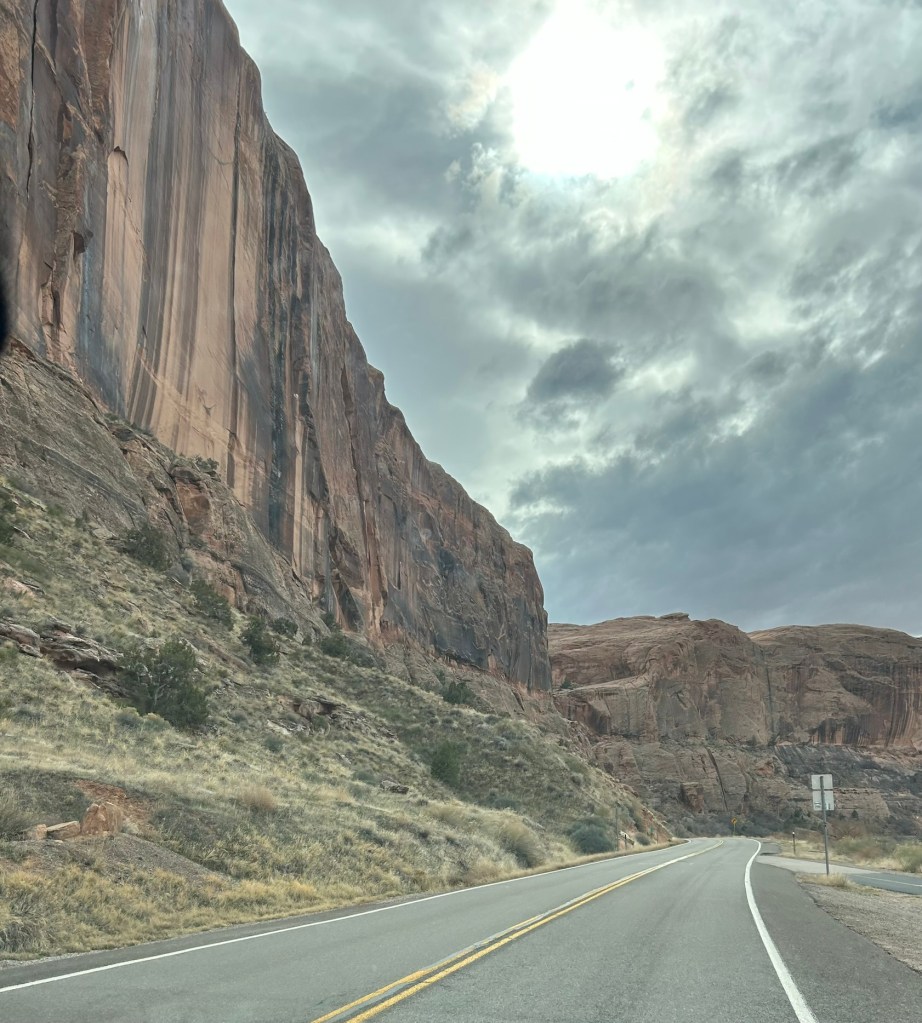
Scoping the spectacular race course on Friday.
Race Day
We got up early on Saturday and I had a couple cups of tea, some coffee (race days are the only day I drink coffee), and a bagel. It was still quite dark, and raining, when the shuttle bus pulled away pulled away from the park, for the 15 mile trek to the start, and it was just getting light when we arrived at the start area at a little after 7:30. So about 40 minutes before the start. I put on my plastic disposable poncho and waited with some friends before embarking on a chilly 0.5 mile warm-up jog.
It was 40 degrees and raining when we started. For attire from head to toe, I wore a baseball cap, a merino wool long sleeve top under my singlet, half tights, longer socks, and my older Vaporfly 2s. I was planning to wear light gloves but they were soaked 10 minutes before the start, so I tossed them in my bag and slapped some gobs of Vaseline to stave off the chill. Clothing worked well. Not 100% sure about the shoes on the wet pavement. This was the first rainy race that I have worn these shoes. I have heard they don’t do as well on slick pavement, who knows.
We lined up in the rainy chill at 8:15 and were off! I was in about the 3rd row in the narrow starting chute (they had a rolling start), and quickly settled into about 25th place, so fairly near the front of the 700 or so starters. We headed east for a half mile, then turned around and down the canyon for the next 12.6 miles. My hands were cold for about the first mile but after that, didn’t give it a thought.
My race plan was to run about 6:30 for the first few miles then to push to run 6:20s for as long as I could hold it, and then maybe close in the 6:10s, for a 1:23-1:24. I was fairly confident I could do that, based on workouts and last month’s 5K which indicated I was in as good as shape as last year when I ran 61 for 10 mile in Sacramento an 1:24 for the half on a hilly course in Syracuse, on a hot day. In hindsight I think I underestimated the Canyonlands course, as well as running at 4000 feet elevation. It was not like running at sea level. Maybe a little easier than in Lakewood or Denver (5200-5500), but was working pretty hard to run my first 3 miles at 6:40 pace (fairly good climb in that second mile).
For the first few miles I ran in a semi-pack of runners, about five or six of us had been strung out over 30 meters or so, three ahead of me 10 or 15 meters and a couple 5 or 10 meters back. Even though the miles weren’t coming easily, after three miles I picked up the effort and pulled away from that group. I set my sights on three runners, also sort of strung out about 5 or 10 meters apart, with the closest about 20 seconds ahead. The footsteps behind faded, and those ahead got a little closer maybe 15 seconds up, as I had picked up the pace to low 6:30s. Each mile was about 10 seconds slower than anticipated. Nevertheless, the effort seemed sustainable, and while I wasn’t gaining ground I wasn’t slowing down or struggling to breathe. Riding the edge, which is what you want to do in a half.

Map of the race route.
The rain had let up after about 15 or 20 minutes of running, but the pavement was still wet. Miles 4, 5, and 6 were fairly flat, with just a few small rises, and probably the easiest running of the day of the day and my splits were 6:30, 6:32, and 6:34. At mile 6 we had completed the horseshoe shaped “Big Bend” part of the course and would head southeast for most of the remainder of the race. Here it got hillier, nothing really radical but a series small hills and drops of 20-40 feet. The gap of runners ahead stayed at about 20-30 seconds and I did not make any progress at closing in. As I passed the aid stations I could hear the runners behind were about 20-30 seconds back. So I was really in a no-man’s land.
I tried to maintain a high tempo and not to overstride, it felt like I was pushing hard but my splits dropped off to 6:40, 6:43, 6:42 from 7 through 9 miles. However, I did notice that two of the runners ahead had come back a little, now they were maybe 15 or 20 seconds ahead. Mile 10 was a net uphill and my slowest of the day at 6:50. Nevertheless, I was gaining on a woman who I presumed was first or second female overall. I caught her just after 10 miles and said good job. She stayed close, only a few meters back. It started to rain again.
By about mile 11 the runner ahead, looked like a masters runner, was struggling a bit. We were shunted off the road and onto the bike path. I gained, very gradually and passed him with just over a mile to go. Soon however, I heard fast footsteps behind–was he or the woman runner coming back? I was hurting pretty bad by this time and just tried to relax. I felt that I was running faster all out and breathing was difficult.

Screen shot with a mile to go.
With about 3/4 of a mile left, a runner from that first group I had been in in the initial 3 miles went by quickly. I matched his stride for as long as I could hold it, maybe a minute, and then eased up a bit. His gap grew, but those behind me were not catching up and I knew I should be able to hold this pace and place to the finish. The footbridge at the mouth of the canyon was less than a quarter mile ahead and I knew the finish line was less that 100 meters after that. On a course with no turns to speak of for 13 miles, we hit a few meandering twists into the parking lot and to the finish. My last three miles were 6:31, 6:39, and 6:27.
The finish time was 1:26:20, about 2 or 2.5 minutes slower than I had hoped. Nevertheless, I finished 19th out of nearly 700 entrants, and was 5th masters (40 and up) and 1st in my age group by 7 minutes. Although I had hoped for a 90% age grade or better, I ran 87.5% (1:06). That was second best for all runners on the day. I can’t really complain about that either.
Post Hoc
Although I did not run the time I had aimed for and was off by 10-12 seconds per mile, I was delighted to have done this race, after wanting to all these years. My self assessment, I am fairly happy with the execution and effort. As planned I ran at a moderate effort for about 3 miles and then tried to pick it up to a pace that I could hold. Three mile splits were 19:56, 19:36, 20:05, and 20:00 and my last mile at 6:27 was the fastest.
I underestimated the course and the altitude. I knew it was a net downhill but only 128 feet, with a lot of rolling hill some taking several minutes to crest. Moreover, 4000 feet of elevation seems low when you live at over 7,000 feet and do most of your training at 5,500-7,400 feet. However, it’s still altitude and unless it’s going downhill you’ll be running 8-10 seconds per mile slower than you would at sea level. That’s physics and physiology, and puts me in roughly 1:24 shape for a sea level half.
To be competitive (into medal shape and to contend for the win) at World Masters next summer I’ll need to improve my fitness and find a way to get those 8-10 seconds per mile because I think it will take a sub 1:21 or 1:22 to win and 1:23 to medal. This was a good test, and a fair appraisal of my current half marathon fitness.
To close, Tamara and I really enjoyed our extended trip to the Colorado River, instead of two days it was four. Although the weather wasn’t perfect, we were glad to get out ahead of the massive snowstorm that dumped 3.5 feet at our place, and up to 5 feet higher up. The canyon was spectacular, Moab was a fun place to visit for a few days, and the race was well managed–I think everything went off without a hitch.

The scene back home three days after the storm.

 rrunnin234