Short version, 2,500 mile road trip (minus side trips in California), nine days, two gold medals.
I think next time we’ll fly. A week ago Sunday we had a flat tire before even starting the trip, which cost us five hours and had to stay in a motel in Salt Lake City instead of camping in Nevada. And in the middle of the week our car battery died, thinking it was a starter or alternator we took the car into the shop. That cost $300. Driving all those miles in 100 degree temps wasn’t pleasant either.
Road Trip
I do appreciate the scenery, however, so here’s a few thousand words in pictures.

Utah canyon country.

Rainbow over Provo, Utah.
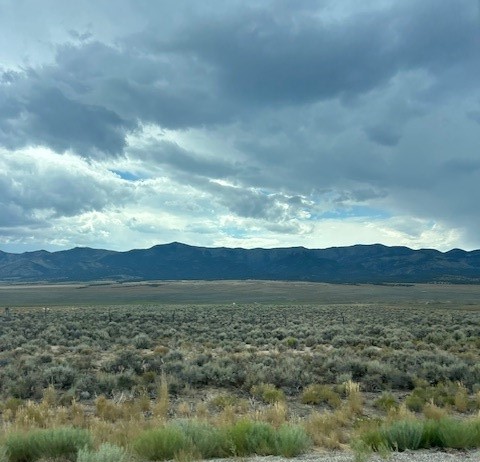
Egan Range, eastern Nevada.
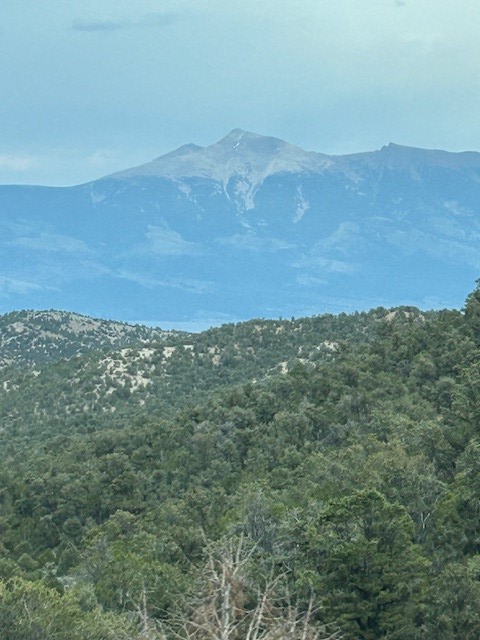
Mt Wheeler National Park, Nevada.

Campsite sunrise near Truckee, California.
The Agony of Setting up the 4 X 800 Relay
Ahh the relay. For the past year almost, our team has talked about putting together an age group team that could challenge for the American club record of 11:22. That only requires a 2:50 per leg and on paper we had the runners to do it. Months ago we sent out signals, and I was appointed the de facto coordinator. I don’t think I did a great job at that for this event. However, our “team” ages 60-69 is more a confederation of runners without a lot of cohesion. And less so post 2020-21 pandemic. Just say that there are some personal and political differences in this team, and some aren’t afraid to verbally smash you in the mouth if you happen to disagree.
Not to mention, injuries and health. It’s hard to get four guys in our age group healthy enough to line up, and a track race is all the more risky.
I spent months encouraging an cajoling potential relay members and typically got mixed responses. Two of us were committed, one seemed to be ready if we had a team, a couple were injured or not interested, and one had been battling off and on injuries over the past year and had the attitude that if we are not going to set a record then the travel is not worth it. I even offered space at my brother-in-law’s place in Sacramento as a incentive. In the weeks leading up to the championships we seemed to have settled into a quartet of four capable runners who on paper could pull it off.
Creating a mental form chart, I figured I could run under 2:35 on a good day, Dan capable of matching that, maybe faster maybe a bit slower. Jack was hoping for 2:40-2:45 or so, and Bob sub 3. Adding those up our best case indicated maybe 10:50 for the four of us. Reasonable expectation without a blow up by one of us certainly put us comfortably in a sub 11:20 (for example, a more conservative estimate would put us at about 2:35, 2:40, 2:50, 3:00 for a 11:05, still well under the record).
We had a handoff practice a little over a week before the race and all seemed well. Shots were fired on the weekend, however, as one of our guys complained of a bad foot. He’d said he would run, but it would be some risk. We really needed a back up, but had none. Nevertheless, Tamara and left town on Sunday thinking we’d all be good.
I was looking forward to racing the relay on Thursday.
On Monday morning we had just driven into Nevada and I got a text. One of our guys was out. No explanation. Just that he wouldn’t make the trip. Cold feet or injured? I spent the morning texting, to see if we could pull together a make up team. It was so frustrating. I just don’t like the attitude that either you must set a record or forget about, especially at such a late hour. That is just poor etiquette.
I told our teammate with the bad foot to stay home and heal up. Wasn’t worth it for him to travel that far and risk further injury for a make up team.
Fortunately, we had other teammates in the 60-64 category and rest of us came together and made a team of our own teammates, with four guys in the 60-69 range, with a couple in their 70s as back ups. We wouldn’t get a record but we could score points and medal in the event.
By the time we arrived in Sacramento on Monday evening the on again off again relay was back on, although not the age group line up that we had spent months trying to put together. Come on guys, it should not be this difficult!
Brutally Hot Sacramento
The temperatures rose into the 100s each day that we were in Sacramento, which made for some challenging race conditions. The mornings were actually reasonable, 60-70s until about 9 or 10 AM most days. But the afternoons and evenings were brutal.
We arrived on Monday evening so I had two full days to rest from the long drive and to get in a couple final runs. On Tuesday I did a light workout on the track, 4X 1000 at 10K goal pace, followed by a couple of quick 200s to prime for Thursday’s relay, which would be held at about 3:30 or 4 PM on one of the hottest days of the year.
Relay Race Day
I got us signed up in the morning, and our main competition were two teams from the same club in California. I didn’t expect much because our replacements were doubling that day, and had other races in subsequent days and they said they wouldn’t be going all out. I figured that maybe we’d get a gentleman’s Silver Medal.
Other than actually figuring out who would run and our order, the biggest question was what time we’d go. We actually expected to race after 4 or 5 PM, because there would be some men’s and women’s heats before ours. I got to the venue just before 3 and my teammates were already heading toward the staging area! There would only be two heats, each with about a dozen teams.
We lined up at 3:30, and I would go first. Although this was just a make-up team and we were running for points I decided to go all out because, (A) I had some pent up energy from the team falling apart earlier in the week, and (B) for some redemption from the previous week’s disastrous 2:44. I felt I could run under 2:35 and the question was by how much.
It was 102 degrees at race time with a light wind on the homestretch.
At the gun I cut in a little too quickly and slowly into the curve, and found myself at second to last place. In the backstretch I moved into 5th place and the pace felt easy. One guy from SoCal was a few meters up and I tucked in behind him, planning to pass him after a lap. But he slowed more on the home stretch so I passed him at about 350 meters, crossing the lap in 79. It felt a lot easier than the 77 second first lap at altitude earlier in the month!

At the gun.
From there I just wound it up, picking up my pace as I took the second lap.

Saving my final kick for the last 80 or 90 meters. I did feel some tightness with about 20 meters to go, but handed it off to Bob with a nifty negative split of 79-74. I am more than happy with a 2:33!
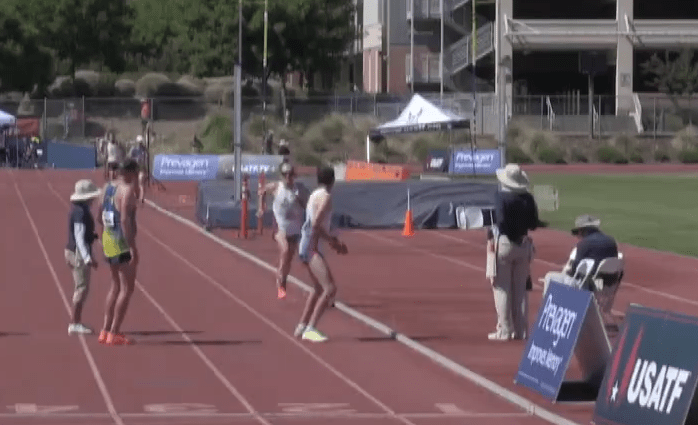
15 meters to go!
Bob kept it rolling with a 2:55 and the other Bob (who had already run some sprint prelims on Thursday and had the finals on Friday) cruised in a 3:00, and Adam took the final leg in 3:14, holding off a late charge from SoCal, and ensuring a surprise age group win for us in 11:41!
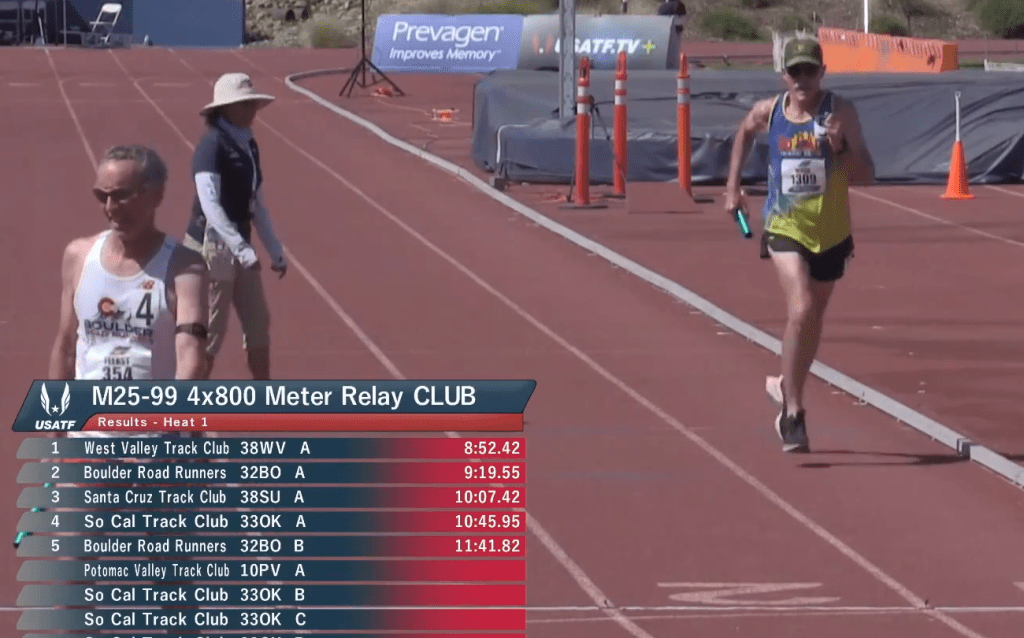
On the screen.
The relay was a big success! The aftermath less so.
After we crossed the line, I milled around the finish area for a few minutes and enjoyed the moment with my teammates and competitors. Soon after Adam had finished however, I started coughing and gagging. It wouldn’t stop. This went on for about 10 minutes and I realized I wasn’t going to make it back to the car, let alone back to the house to get my inhaler, which I had left behind. I usually bring it, but forgot on Thursday. So some officials pointed me toward the medical tent at the end of the straightaway and I asked for some assistance.
It was a little embarrassing to have the EMTs drive in, take my pulse and O2 readings, check my breathing. But it was a relief to get a mist of albuterol and oxygen to calm the attack. This took about 20 or 30 minutes and I missed the celebration with my teammates.
My chest and throat were tight for the rest of the evening and overnight but I was otherwise okay. I ordered a new inhaler as soon as I got home this week.
Saturday the 10000 Meters
The 10K is more in my wheelhouse as a race distance, but I have only run two of these ever on the track (both in 1991, when I ran a 32:11). You don’t have hills and turns on the track, and the going is more smooth but it’s more mental than on the roads or in cross country.
I felt fine for the warm up but was concerned about the heat. It was already in the upper 70s when we lined up at about 8:40 (79 degrees according to Garmin) and it had to be 5 degrees warmer on the track, with the radiant heat from the previous day.
My plan was to run about 3:50-55 per km/6:10 per mile to finish under 38:30 and if I was having a good day under 38. Seemed fair enough based on recent workouts and races, and because I usually perform a little better at 10K than 5K. That was probably a little over-optimistic. My pacing was supposed to be over 6:10 for the first 1600, maybe as slow as 6:20s, and in hindsight I should have stuck with that.
Two guys in their 60s went out quickly in about 90 for their first lap and I held back some and was about 96. An age group rival was right on my heels, almost clipping them. That made me uncomfortable, and run a second or so per lap faster than I would have.

The two 60-64 guys already had a gap in the first kilometer.
I ended up running a string of 91s and 92s, and for 2 kilometers, my California shadow was right there. If I slowed he’d slow. So rather than stepping aside into lane 2 and letting him pass I just kept going. I think in a normal temperature (say 50s or low 60s instead of 80 or more) I would have been fine with the pace. Finally, after five laps he fell off the pace. The leader was running steady 90-91s, and had built about a 20 second lead, and second was less than 10 seconds up. I also tried to maintain my effort but started to worked to reel them in. I crossed 3200 in about 12:20, so effectively right on pace, although I was running by feel then and not focused on times and splits.
The sprayed us each lap at the beginning of the back stretch the cooling water felt nice but it was a brief respite from the heat because the water would mostly dry off by the time you rounded the track again.
Although the two leaders were not in my age group, I treated it like a race that I wanted to win outright. I caught the second runner at 5K. He fell back about 10 or 15 meters and it seemed like I was gaining on first. And so it went. The 1600 splits in the middle of the race were both at about 6:15.
There was a water table on the backstretch but it was in lane 4 and you had to veer out and slow down a little to get your drink. I went for my second drink at about 7000 meters and my competitor seized the moment and scooted past–quickly. By the time we came around for the next lap (I went to the table again to grab a cup to throw some water on my head and shoulders) he already had put on 15 meters.
With less than 3K to go, I had my own race wrapped up as I was coming up to lap the second and third place runners from my division–that was good, but they were not coming back as quickly as I would like, which meant that I was slowing up. The 5th 1600 would be the slowest of my day, I only ran about 6:27. Although I fell back some against the younger competitors, I lapped my age group rivals on the 21st lap–I had it in the bag and all I had to do was hold on.
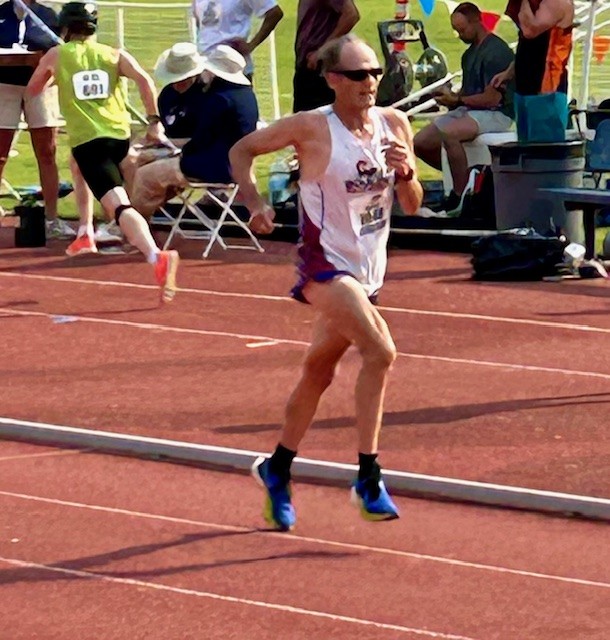
Sweating it out over the final laps in Sacramento.
I maintained for a few more laps and then picked it up over the final two, crossing the line in a very hot 39:16, nearly 30 seconds slower than the younger runners. But I had lapped the rest of the field. So perhaps not as fast as I’d like, but I’ll take the win, but I am with winning my age division by more than two minutes.
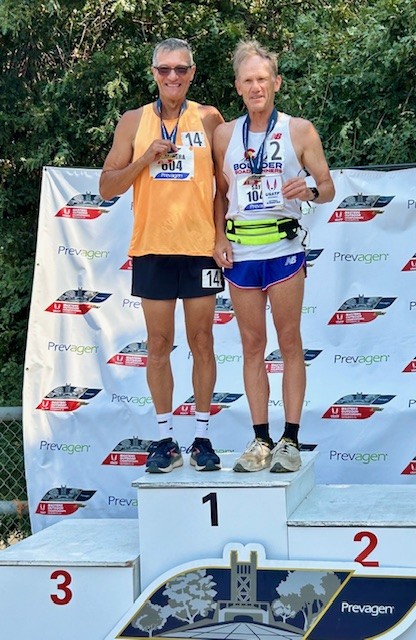
Age group winners! Javier caught the leader Scott with just a couple meters to go to win the 60-64 age group and I came out ahead in the 65-69 category.


 rrunnin234