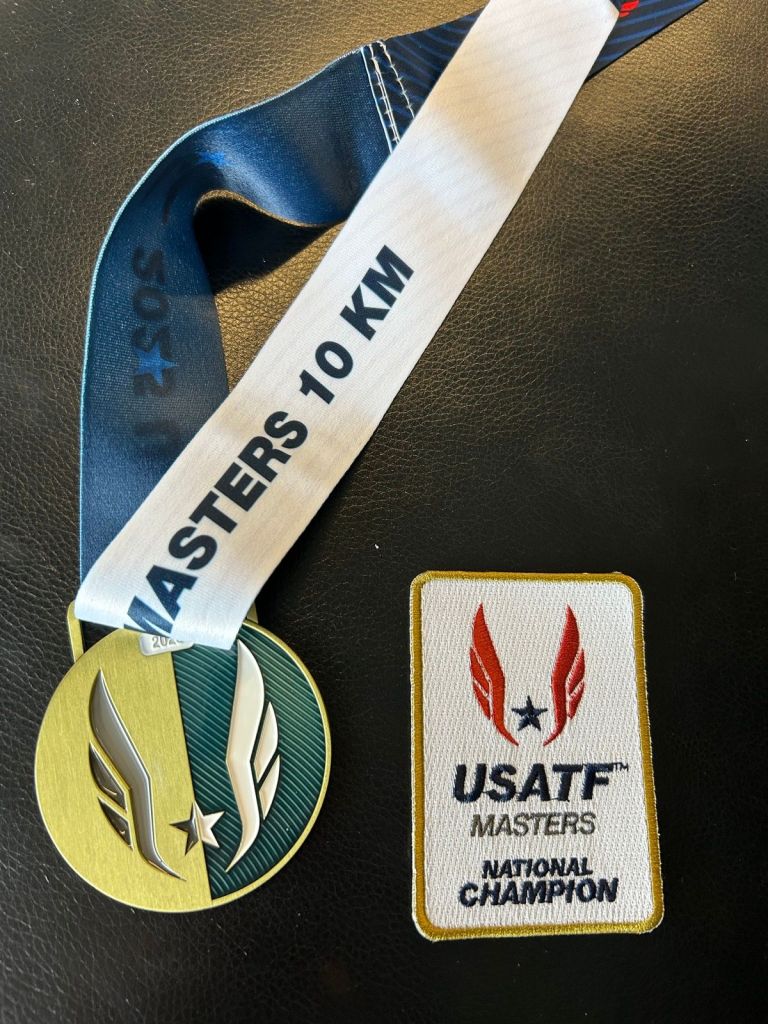
Bolder Boulder 10K: One More Time

Some History and Background

This was my 15th Bolder Boulder, going back to 1983. To date me even more, I was in town for the first Bolder Boulder ever in 1979. Some college friends and I traveled to Boulder to train for the summer, but I broke my foot a few days before the inaugural race and had to skip it, and I was so disappointed that I did not even watch the race.

I have lived in Colorado for half of my life, and I have run this race more than any other. However, I regret missing many years due to injury (1979, 1984, 2002, 2003) or work and travel (1982, 1987, 2004, 2015), or travel, plus the covid years. That’s a lot of misses, each with regret.

My course PB of 34:06 (1985), is 2 minutes slower than my 10K at sea level. It’s not an easy course, with rolling terrain and an uphill finish (and a net gain of 90 feet from start to finish; and nearly 300 feet of vertical), all at +/-5300’ elevation.  

The goal was to break 40 minutes, a tough task at altitude and proving to be just as difficult for me as breaking 3 hours for the marathon (which I haven’t done since 2017). My last official sub 40 at Boulder Boulder was in 2019, although I did run 39:45 in a solo virtual attempt in 2020, and 39:37 at a socially distanced race in 2020. Both of these were at different locations and on flatter courses, and they do not count in the record books.

No one over the age of 64 has been under 40 minutes on this course, I was hoping do that in 2022 but covid knocked me out.

I returned in 2023, but it was only 16 days after an all-out (American age group record) at the Riverbank Run 25K in Michigan. Afterward, I did not manage my recovery as well as I should have. The result was a lackluster 40:46 in Boulder, my slowest Bolder Boulder and probably my worst result of that year. In 2024 I also had run the 25K a couple weeks prior but did a better job of recovering and tapering for the Bolder Boulder. On Memorial Day last year I just missed the mark, with a 40:08.

2025

So here we are in 2025, probably my last best chance to break 40 because we are moving to sea level next month and I’m not getting any younger. Unless I do 5 or 6 week altitude block, maybe with some coaching from Mike Smith or Ed Eyestone, it’s going to be quite difficult to break 40 going on this course.

This is a year of transition in other ways; for first time I did not qualify for the A wave, in which you need to run an 18:10 5K, 38:00 10K or 1:24:00 half marathon to qualify. I did not achieve any of those standards in the past year and had to run in the AA wave. There are about 500 runners per wave in this huge race, and 100 waves! They are going out all morning an 80-90 second intervals.

Nevertheless, the AA wave is very competitive (the fastest from our group ran 31:30 and was top 20 on Monday). If anything I found the A wave a little more relaxed because I would line up near the back and it was fairly easy to find a rhythm.

Race Time!

I got to the start corral a few minutes later than I probably should have (about 7-8 minutes before the start) and lined up back a way. It’s all chip timed of course, but it was crowded the entire way and in particular during the first 2 or 3 miles—enough so you could not really run the tangents effectively.  I just watched my space and hoped not to get tangled up with another runner.

Monday was an odd weather day with mist and rain, and slick pavement. However, it was cool, in the upper 40s at race time. I split the first two miles in 6:24, and 12:47 (6:23). On this course you are climbing gradually through 2.7 miles, before getting some respite. The 3-mile split was 19:28 (6:41) and my 5K was about 20:10, which was just about what I wanted, because I was hoping to run a negative split. Despite those intentions and being right on for halfway I was not feeling optimistic, it felt like I was pressing as hard as I could and I did not know if I could hold on for another 5K.
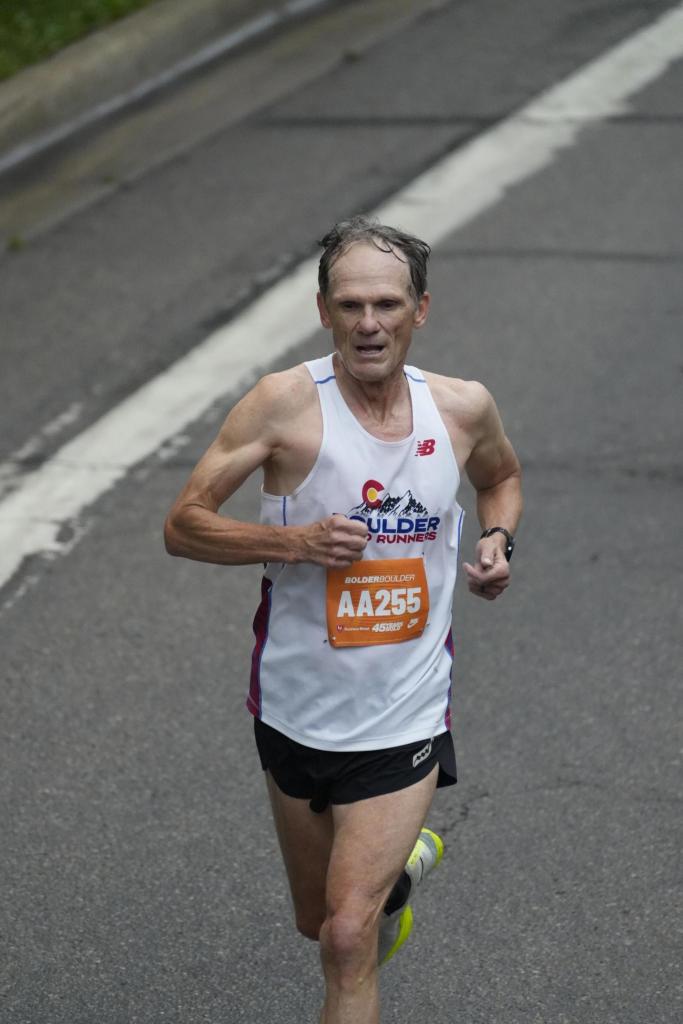
Half-way and already feeling it.

The 4th mile is rolling, and I was struggling as I split in 26:04 (6:36), and I had wanted to be about 5 or 10 seconds faster on that mile. The 5th mile drops close to 80 feet, and it is the easiest stretch on the course, and I passed 5 miles in 32:21 (6:17). My mental math told me that I would need to be under 6:20 for mile 6, and have a strong kick, to finish under 40.

The course makes the turn onto Folsom Avenue, heading south, with about a mile to go. On that stretch I was hanging on with the but also struggling.
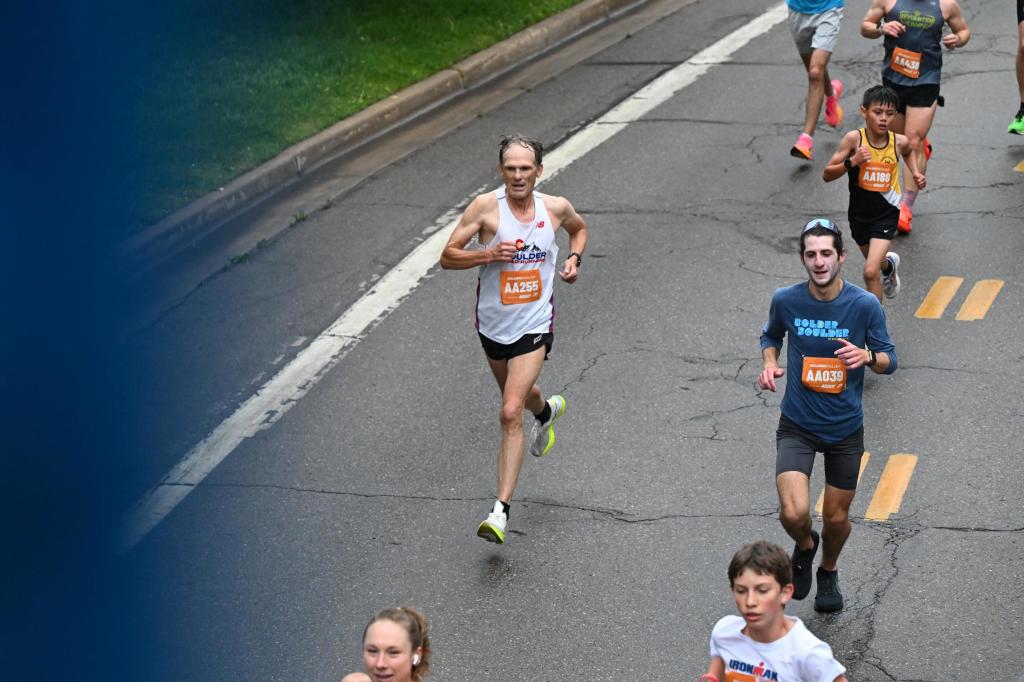
Running down Folsom, hanging by a thread (note the 9-year-old on my tail!).

The last kilometer is uphill and always extremely tough and I lost some time. With about 450 to go the climb gets more serious as you turn onto the stadium access road, I had practiced and visualized that dreadful hill over the past month, and I tried to increase my pace for a final long kick, but it kicked back! And by halfway up I was jogging. The 6th mile was a 6:37, not what I needed. I was gasping. Into the stadium with just a couple hundred to go I mounted a feeble kick (the mat was very slippery) to finish in 40:23. Shucks.
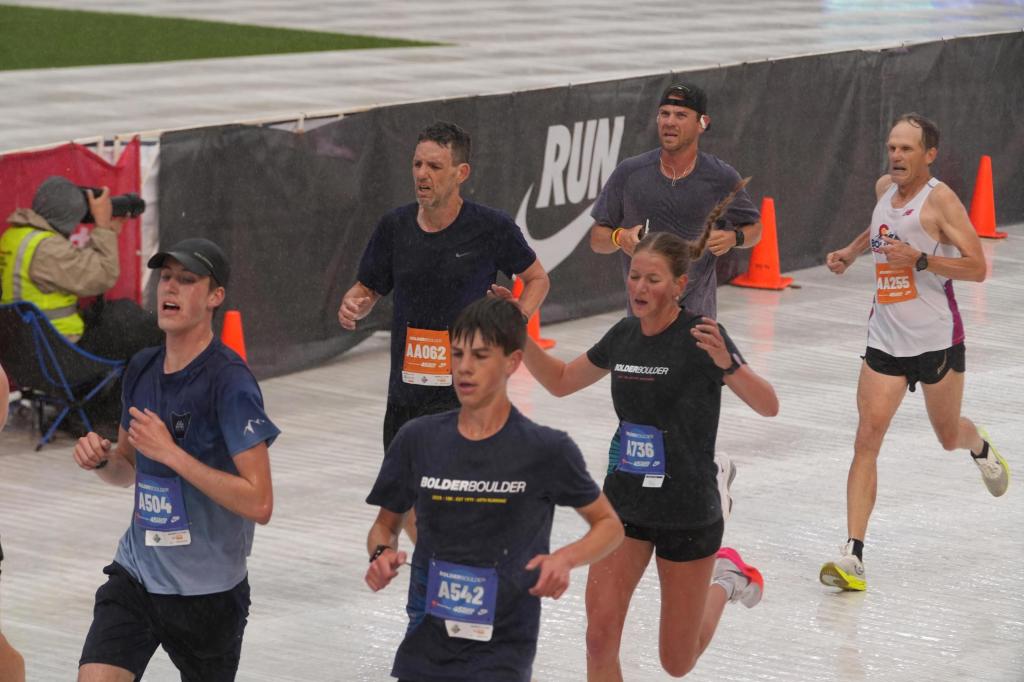
Entering the stadium, usually a joyous moment, but you can see we are all in our own private pain cave.

I fell short of a big but difficult to achieve goal at this point in my running journey. However, I am pretty happy with the race overall, I did break the single year age record, won my age group, and now have the two fastest times ever for the 5 year age group. This was also my 8 official age win at the Bolder Boulder (10th if count the covid races). Can’t argue with that. However, there are some caveats and maybe a misgiving or two (self-flagellation) about the shoulda, woulda, coulda on Monday.

As I mentioned earlier, my first half splits were good on paper. However, I had actually planned on going out a little bit easier, closer to 6:30 pace for miles 1 and 2, and then about 6:30-35 for mile 3. That would have put me a few seconds back, but maybe with a little bit more energy for the first half.

Did I get caught up in competition in those early miles, with certain rivals just ahead or behind? As the old adage says, for every second too fast at the beginning, you can lose 2 seconds on the back half. Did the rain and slick roads have an effect, as indicated by race announcers Alan Culpepper and Frank Shorter. It was definitely more crowded in the AA wave than hanging off of the back in the A wave. Running better tangents and turns might have helped shave off a few seconds. Or are those just three excuses?

It also just comes down to finding the wherewithal to push through over the second half. I lost time on the 4th mile (5 seconds), 6th mile (at least 7 seconds), and the final finish into the stadium (5 seconds), that was easily my weakest finish ever at Bolder Boulder.

Post Race and Elite Races

After the race I met up with teammates for a bit, trying to get warm in the old CU field house, and then hung out for the morning to watch elite races.
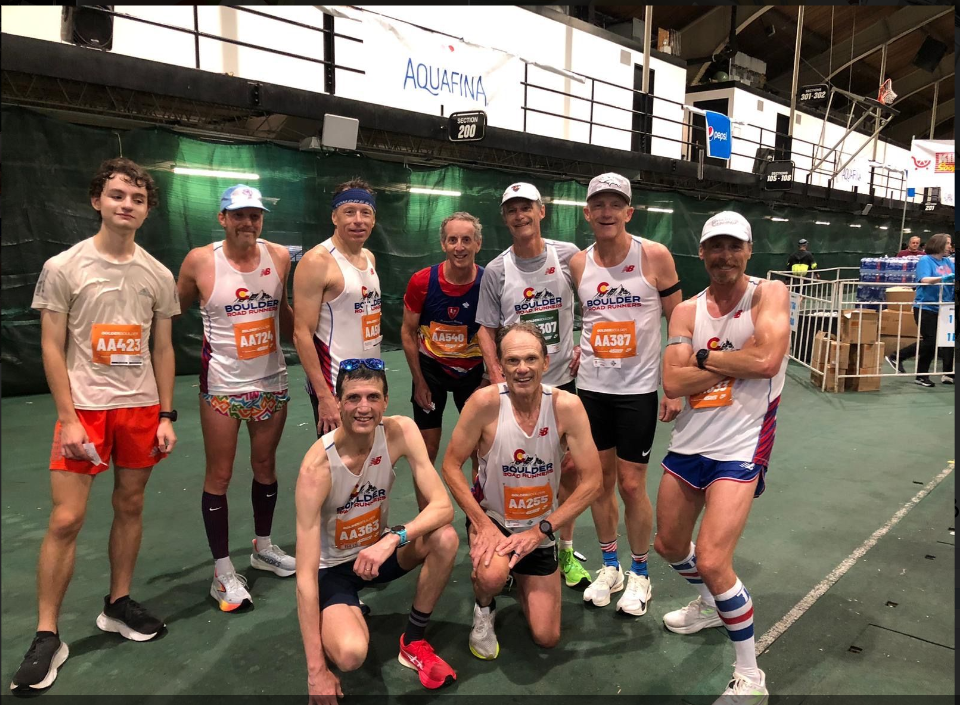
Had some mixed emotions as this will (probably) be my last time racing the Bolder Boulder as a Colorado resident. Nevertheless, although it was an exciting, if not damp and chilly morning.

The elite races were fantastic! Connor Mantz had a huge kick to win men’s race in 28:21, passing Kenyan star Daniel Ebenyo with just 50 m to go, and Grace Nawowuna broke the long-standing record (set 30 years ago) of 32:12 by running 31:52.

Bolder Boulder and Me: The Future

In spite of having some success at Bolder Boulder, I have never run quite as well as I had hoped. Or maybe it is just the course. As an open runner I probably should have run well under 34 minutes, in fact my goal back then was to run under 33. However, those years I ran too fast in the opening mile or two and then paid a heavy price to the finish. As a masters runner (1999-2001) I felt I could have been under 35, but didn’t put it together (pacing in 1999, hot weather in 2000, and out of shape in 2001). In this latest era as a grand masters and senior runner (2015-25, minus the covid years) I had the most success age group-wise, but it never has een my best race of the year. I guess that’s okay.

As for the future I want to return even though we are moving away. I will return. Whether or not I am as competitive as I have been is a different story. Maybe it will not matter. You see former world class runners taking more than an hour to complete the course, and they are happy and we are happy for them. Participation in this event is what it is about.

When I do return, I guess at least once, I would like to have the final weeks of my training block to be in Colorado or at altitude. To get into the best competitive shape that I can. That’s not a given, but something to maybe plan and strive to make happen.

Until I do return, thank you Bolder Boulder for the excitement as a participatory runner and fan of the sport of road running.
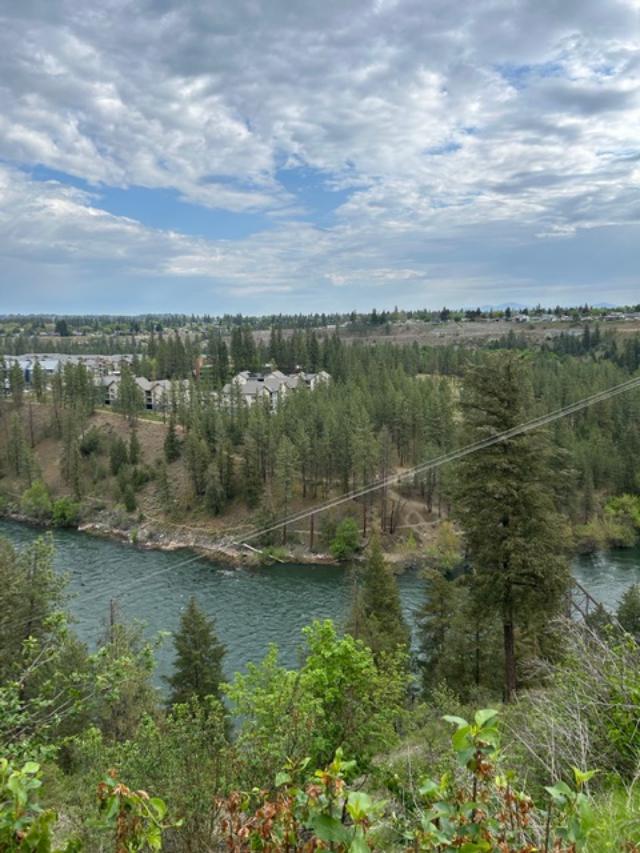
A Return to Bloomsday

I first did this race in 2022, more than 40 years after thinking that I had to run it someday. Getting to Spokane and running the race was a huge bucket list race event for me. We liked it so much we thought about moving to Spokane, and by 2024 those thoughts became a plan.

We planned the Bloomsday weekend back in January, thinking that this would be a pre-move scouting trip, or we would already have a bid on a house by then. However, things changed, and that was discussed in last week’s post and we decided not to move to Spokane after all.

Despite that, I still wanted to make the trip and run the race in 2025. Although I have only raced to it twice now, the Bloomsday 12K is one of my favorites.

Quick Turn-Around From The 10K

I only had a week to recover from the USATF Masters 10K, which was on the East Coast. In-between the travel and these races we had to move out of our condo on Wednesday, with closing on Thursday before Bloomsday. Not to mention flying out Friday night. The week was a bit of a blur. I had couple of easy running days, but put in 21,000 steps on a 14-hour moving day. The last three days of the week were just easy runs with a few strides thrown in.

Returning to Spokane after thinking-expecting to move there this year was a bits strange. Let’s just call it bittersweet.

On Saturday morning I ran about 4 miles along the course, including the top half of Doomsday Hill, and we drove around the town some after bib pick up. Otherwise, we took a restful day which was nice after such a busy week.

Doomsday Hill

Doomsday Hill a 5% climb over a half mile in the background.

Race Day

Race day dawned rather cool, at 39 degrees. We made our way downtown early to ensure that we had good parking (that wasn’t a problem) and waited in the car for 40 minutes before making our way to the Riverfront Park area and race hub.

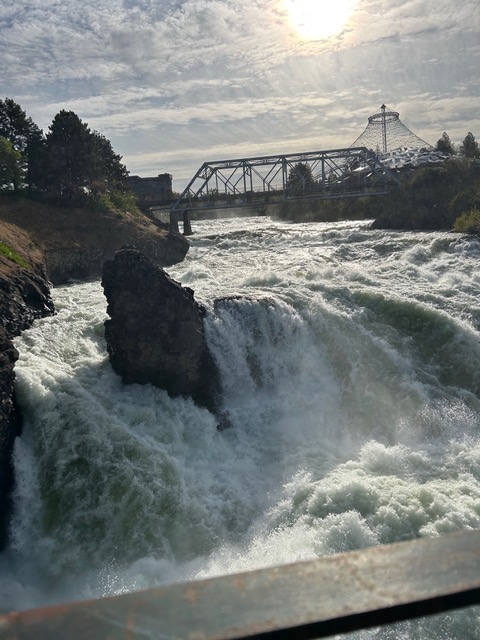
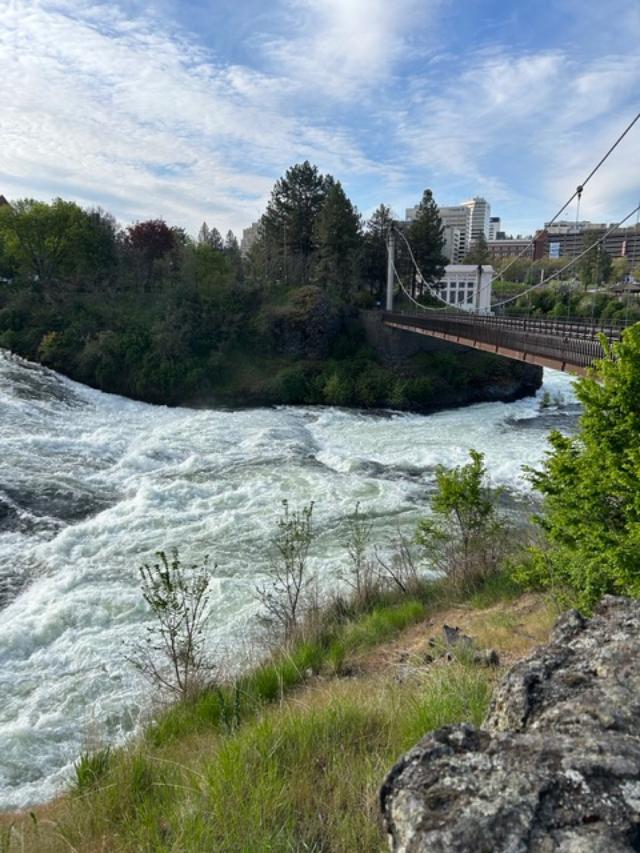
Took some pictures of the falls, but just doing that was chilling so we found a coffee shop and warmed up there until I was ready to start my jog.

I got in just 2K for a warm up, dropped off my bag and lined up in the second seed wave, about 30 meters behind the elite runners. It had warmed up significantly, to about 48 degrees with just a slight breeze. These were perfect race conditions.

The first half mile or so of this race is a little sketchy compared to other big races. There are several slight turns with curb jumps and the streets are narrow in spots. Plus, there are potholes. However, I managed to avoid any mishaps.

The plan was to run the first two miles a little slower than goal pace, which was about 47:00 (6:18/mile). My secondary goal was to break my time of 47:32 from 2022.

The first mile is relatively flat and the second mile has a half mile descent (dropping 140 feet) and sharp uphill. My splits were 6:18 and 6:18. Just a few seconds faster than I had planned but it seemed within reason, my breathing was good and I felt in control.

Mile 3 had another big uphill and it was a net climb of about 80 feet, so my split was a bit slower at 6:34 (but the grade adjusted pace was another 6:18). Through mile 3 my effort was fairly even and I felt good. So I pushed it some in mile 4. Maybe that was my mistake. With a drop of about 30 feet I ran about 6:08, my fastest split of the day. At this point I was ahead of my 2022 time and I was feeling good about that as we crossed the Meenach Bridge over the Spokane River. This, the low point of the course at 1740 feet, would be the highlight of my race.

Onto Pettit Drive and the start of Doomsday Hill, I eased up a little and let the pack just ahead pull away from me. I figured I could make up some time once we summited (which I knew was nearly a mile ahead). The course climbs over 100 feet in that initial half mile, at a grade of 4-5 percent. Just get through that part I thought, and I could grind out a good finish. My 5 mile split was 32:00, almost exactly what it was in 2022.

Course profile and pace, along with some stats.

Although I had run up the steep part of the hill, the run out was another half mile at about 1% incline. Small but I was just zapped at this point, and I ran a 6:30 for the 6th mile. Fortunately, I regrouped by 10K and got my rhythm back, knowing that it would be a net downhill to the finish. This stretch along Broadway is more than a mile long with no turns. However, it’s easy going and there were some crowds along the way cheering us on. That mile was a 6:20, again a little slower than 2022. We made the turn on to Monroe and I threw all I could into it for a strong finish in 47:42. Short of my goals, but I’m still happy with the effort and to take home another age group win.

I’ll reiterate that this is one of my favorite races. It’s huge, with 30,000 runners, but everything is well managed. They have an exciting elite race up front and those in the mid pack and back are out there on a Sunday morning having some fun running or walking with friends and family on the scenic yet challenging course.

We did not move to Spokane in 2025, but I will return for this race!

US Masters 10K Road Race

“Think you’re escaping and run into yourself. Longest way round is the shortest way home.” 

I took a long trip away to run the James Joyce Ramble, and then we sold our home. It was that kind of week.

We planned to sell our place in the Rocky Mountain foothills this year, or at least look into making a move, but I envisioned that we’d close the deal during the summer. Or maybe we’d make the move next year. However, events took a life of their own as soon as we returned from a weeklong trip to Spokane, WA where we were planning to move.

Life sometimes throws curves at you. Two factors changed our destination. We bought our mountain condo in 2016, and all seemed pretty good, but the monthly homeowners association fees increased 10-15% a year and by 2024 it had doubled, while the services and quality of maintenance at the site declined. In a few more years the fees would be greater than our mortgage, and that would be financially unsustainable for us. Not to mention the value of our property would decline. At the beginning of this year we decided that moving out in 2025 would be better than 2026. That would mean having the condo on the market by spring.

Things accelerated from there. Realtors, you know. We were on the market on March 7, with open houses the on the following two weekends. So much for a relaxing beginning of spring! Had we not been selling our place I would have stayed the World Masters Championships in Florida to run the 10K road race on March 30, but I needed to get home to help take care of things.

Meanwhile, other events prompted us to rethink whether we actually wanted to move to Spokane. It checked a lot of boxes, but one issue was that it was no closer to our family, in fact further. In mid-March, just a week after the condo went up for sale, we decided that a move to the Midwest might suit us better. Three factors gave the edge to the Midwest. Housing is even more affordable, it’s closer to our oldest son (his brother lives on the West Coast, but it was still a 2 hour flight from Spokane), and access to cross country skiing would be better. We have decided to move to the Twin Cities this July. It beat out Spokane in 10 of 12 categories that we considered. The only two that it was better were location and landscape and size.

Enough of the preamble, now to Dedham and the 10K.

Post WMA Training

I had five weeks after the 8K cross country championships. Recovery from that race took longer than expected. I was completely washed out that first week, and it felt more like following a half marathon, indicating some life stress no doubt but also that the race in Gainesville was an all-out effort.

My weeks in April, leading up to the 10K at the end of the month were 47, 43 (with some skiing and cycling), 56, 43, and 39 miles. For me that’s kind of in the lower end of moderate mileage. I usually like 60-65 miles a week. With so much going on and the slower than normal recovery it was adequate.

Workouts were nothing special in April but I got in a couple of double threshold days, and some single workouts focusing on threshold or CV effort (essentially race pace). I guess my capstone workout, 10 days before the race, was an asymmetrical ladder with 2,3,4,5,6,5,2 on rolling terrain. Starting at threshold and then working toward low 6 minute/mile effort (CV for me right now). That workout went well enough, and I felt I could run under 6:20/mile in Dedham.

Travel and Pre-Race

I flew into Boston on Friday afternoon and visited my cousin and her husband in Brookline that evening. Saturday was very chill, I ended up spending the day on my own at the hotel in Dedham, with my only activity being an easy run to pick up my race packet at the course venue.

Race Day

My friend Jim drove down from New Hampshire Sunday morning and we visited for a bit before taking the short drive to the race. It was cool, windy, and raining off and on. More like day for a cross country race, but it wasn’t terrible and everyone would be facing the same conditions so it didn’t phase me much. Got in a 2-mile warm up jog with some friends, did my strides and stretching and before I knew it, we were lined up and ready to go.

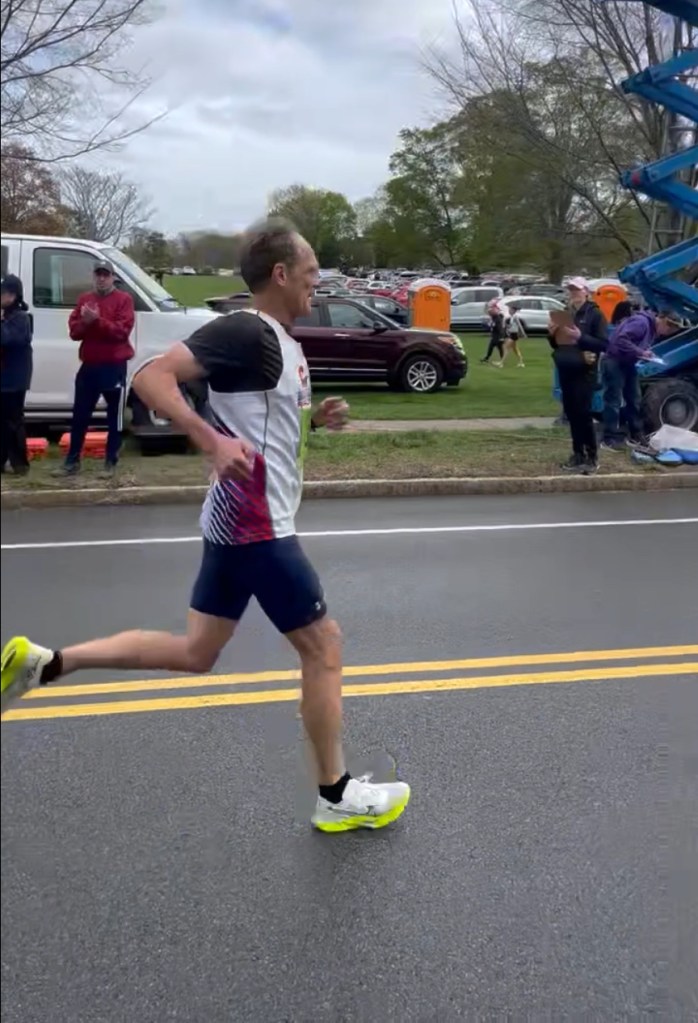
The first part of these races is always a little frenetic, and I’m always surprised at how fast some runners shoot off from the starting line. I focus on staying on my feet but also try to be aware of my pace-effort, next is to survey the scene and to keep an eye out for competitors. Two local guys from my age group strode by in the first 200 m, and then a guy in the 70s age group! I couldn’t even keep track of how many in the 60-64 group were ahead, but it seemed like a lot. Then another runner (a future teammate from the Twin Cities) ran by looking light and fresh.

I was hoping to win the age group, but figured that even if I had a bad day, I would be top 3 in the age group. However, you never know and I’m always full of doubt in the early stages of these masters running events.

By the first mile (a bit too fast in 6:03) I had pulled away from the two local runners and had my sights on my new friend/rival from the Twin Cities who was about 30 meters ahead, who had thrown in at least one surge and was and looking strong. A hell of a way to introduce ourselves, I thought.

I gained some ground in the second mile, but when I got within about 10 meters he surged again and the gap had quickly opened up to 30 meters. I knew I’d have to keep focused and have good middle and latter part of the race to keep in contact. At about 2 miles we made a sharp turn to the right, and I could see him easing up some. I was in a good pack of about six or seven other runners and I went with their tempo. We crossed 2 miles in 12:12. This was faster than the 6:15/mile I had anticipated, but I felt it was important to keep in contact.

Just after mile 2, pulled along by the pack of runners, I eased past my competitor. This was mostly a flat mile, with a net downhill and I think the wind was in our favor. That split of 5:56 was my fastest of the day, as I crossed 3 miles in 18:08.

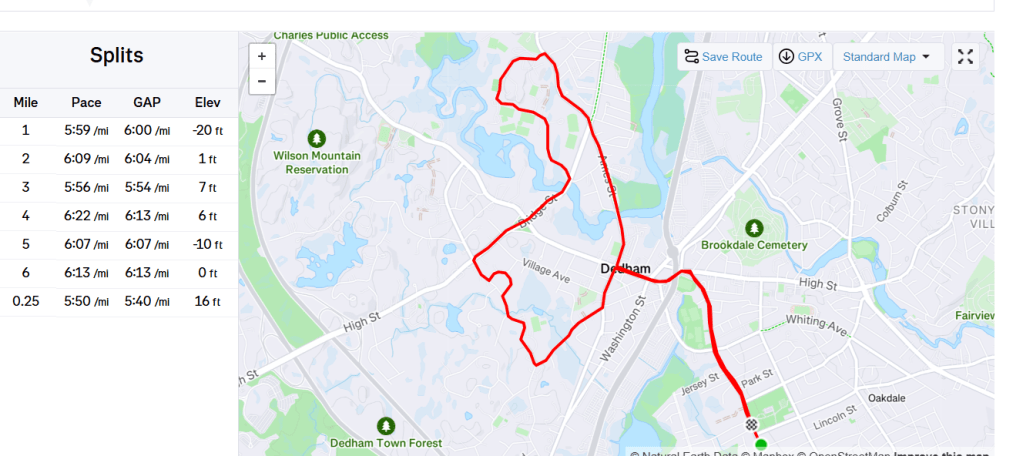
Then things got harder. The 4th mile is through a campus and it features two solid hills. The first one was 25 feet, not too bad, but after a short downhill the second hill climbs at 6% with a net gain of 40 feet. I really slowed on that one. My mile split was 6:22, the slowest of the day. The 5th and 6th miles were a grind, with lightly rolling terrain, the splits were 6:07 and 6:13. I was running out of gas during mile 6 and on the final turn, with about 1200 m to go, did a head check to see where my competitors were. I had about 20 seconds and although I was feeling uncomfortable I felt that I could hold the effort for a few more minutes. He’d have to have a blazing kick to run me down.

Course map with Garmin splits (probably about a second per mile faster than actual).

The last 500 m have a slight net uphill, with a final hill with about 350 to go. I threw it all down and closed in about 5:50 pace to hang onto a 38:17, good enough for 48th overall and 1st in my age class.

A final surge at the finish was enough to put me on the age grade podium, 3rd out of all runners/ages in the race.

That was a hard fought race–it’s going to be interesting once I get to the Twin Cities, with such strong and competitive teammates! Meanwhile, although we did not field a 60s team, the 70s team showed up strong and took 2nd place to a surging Shore Athletic Club from New Jersey. They rarely lose, but Shore is strong this year.

With BRR 70s team.

And speaking of future teammates, in the age grading category I edged another Twin Cities runner (early 60s) by 0.05% to score a 90.6% age grade, and 3rd place overall. That was probably the biggest achievement of the day.

I was really happy with this race. Although I felt rough in that 6th mile in particular, I held on and didn’t lose much ground. Had I put my head down and stayed with the leaders of that pack I might have eked out 8 or 10 more seconds and been at the 91% range or age grading (and moved up a spot), but other than that I don’t think I could have gone much faster.

Bling!