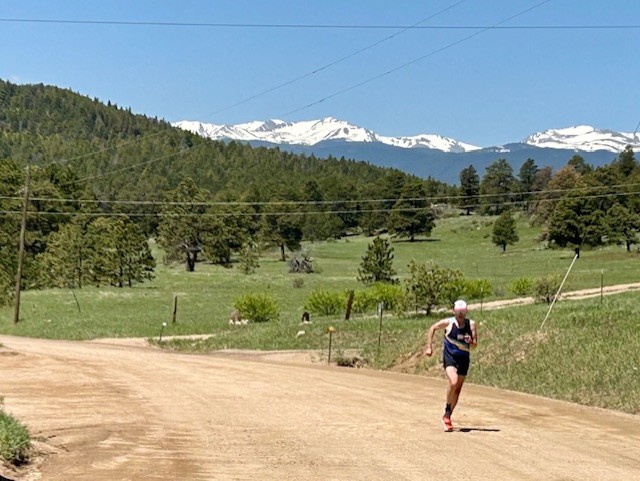
Steamboat Classic 4 mile

One more for the road! I ran the Steamboat Classic on Saturday to close out a long winter-spring racing campaign with seven races over the past six months.

The pre-race was a little hectic, but there was no getting round that for this race. I had an endoscopy on Thursday afternoon, and they had to knock me out for half an hour. The procedure went well but I was groggy on Friday morning.

I flew out to Peoria on Friday evening and arrived at the Airbnb that teammates had rented just before 10 PM local time. Everyone got up a 4:30 (so 3:30 my time), we had some breakfast and caffeine, and got to the race by 6 for check in and warm up. During the 20 min warm up I mentioned that it all felt sort of out of body because I wasn’t awake enough yet.

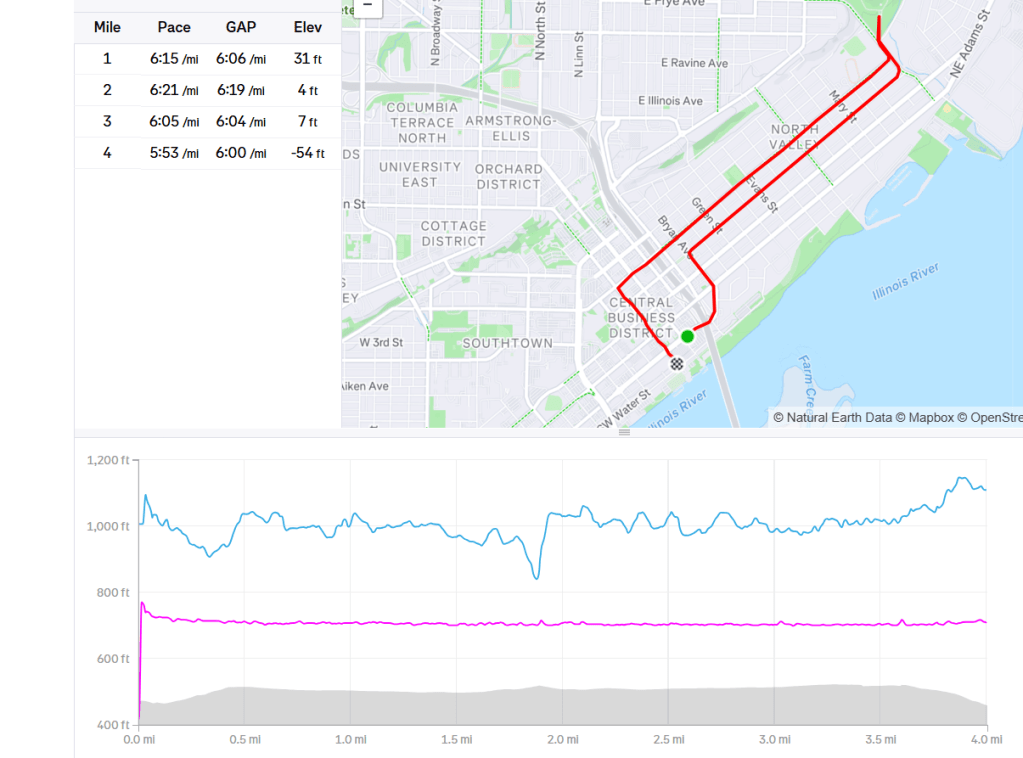
Conditions were decent but not perfect–67 F but 92% humidity with a light head wind on the way out. The course basically had 1 hill over the first half mile and a fast downhill over the last one-third mile. Otherwise it seemed almost completely flat.

The elites went off just after 7 AM and we started about 10 minutes later. My plan was to run about 24-flat or low 24 for the 4 miles and score >90% to close out the season (7th race in 6 months). I have been feeling a little flat since the 10K out east at the end of April.

I felt terrible up that gradual hill but hoped I would be able to pick it up once we got on the flat street toward the turn around. I checked my watch a couple of times and saw I was only running 6:10, although it felt like 6-flat. Maybe I could have surged to snap out of it, but instead I tried to work into it a faster pace. Split 6:15, way slower than planned.

I was running in about 25th place and 40 meter gap had opened up with a pack of 10 or 12 runners at about 6:00-6:05 pace. I briefly went after them but tied up and my breathing got heavy, so I eased up and ran with the lead woman from the masters field and an open runner. We played cat and mouse through mile 2. That split was even worse! 6:20. It looked like I might not be able break 25, so I was was writing it off as a bad day.
But at the turn around a masters runner from my age group was only a few seconds back. I decided to fight it out for as long as I could. Dan, my main rival was already well ahead, and I figured that going home with a silver medal would be better than a bronze. Plus there was team competition and age grading to consider, both with prize money.

The lead woman were just a few seconds ahead, so I surged to catch up and stuck with them through mile 3. We picked up, and that split was a 6:05. I didn’t feel great but the pace and effort were more like it. We crossed 3 in 18:40.

Over the last mile I pulled away from those runners, and my masters challenger, and worked to reel in stragglers from the faster-starting group. They had 20 seconds on me, and although I did not catch them I made up some ground. I kept it together by looking at the stoplights as focal points. We made the turn to head down the hill and I picked it up to closed in 5:51 to take an age group sliver and to help our team to win.

I fell short of my age grade goal, with 89.5%. I needed to have been a few seconds faster in the opening mile or two to be at 90%. The highlight of the day was to drop down an age class and to run with the men’s 50-59 team. We won that against some stiff competition from the Atlanta Track Club and Shore Athletic Club.

Mixed on these results. Ended up running little less strongly than what I had expected. However, I haven’t been firing off great workouts lately so it wasn’t unexpected. It is the end of a long campaign and I had a lot going on last week.

I’m looking forward to a few days off dialing back for a couple of weeks, with not much intensity work over the next month or so. That should be a pretty good reset for the next training block.

Taking on Magnolia Drive

I ran the 15-mile run on Magnolia Drive west of Boulder the other day, the route made famous in the book Running with the Buffaloes, a cult classic about the 1998 Colorado University cross country team. The route is an attraction for runners visiting Boulder. It’s not really a staple for locals, other routes are preferred, but a lot of people run the course or parts of it a couple times a year.

Here as a good video with sub 2:10 marathoner Frank Lara and Roots Running: https://www.youtube.com/watch?v=3_J825loALw

The out and back route starts about 10 miles west of Boulder at an elevation of 8200′. It has a series of long climbs (1/3 mile to 3/4 mile) that are followed by a drop in elevation. Repeat seven times, then you turn around. The low point is 8050′ peak elevation is over 8700, and in its entirety, runners must climb and drop about 1,500 feet.

I have always run Magnolia (aka Mags if you’re a cool kid) about once year just as regular weekend long run. Even then, with all the hills, it’s not an easy run. Magnolia Drive is famous for some Olympic-level runners doing some crazy fast times and I have wondered what I can do on it.

I probably should have done it 6 or 8 years ago, when I was younger and a little more spry but it never fit in. Now that I’m in my last month in Colorado, and with just more one race to go on the calendar this season, I decided to give it ago. Although I had only five days of recovery following the Bolder Boulder 10K, I felt good enough this weekend to give it a try.

We had a wet week and I actually delayed the attempt a couple of days becasue of the wet and foggy weather. On Saturday morning it was 60 degrees, clear, with only a light breeze. So pretty close to ideal (50 degrees might have been better). I

I have been thinking about this for years now, and figured that I could run 7:30 pace on average. Maybe I could have five or six years ago, but that that proved to be over optimistic. The uphills were just too hard.

I slurped down a gel and some water, did a half mile jog as a warm-up and rolled into my start. I actually started the watch at the crest of the hill, which was 30-40 meters behind the start of the pavement. I figured that Garmin/Strava would sort that out and start my route when hit the dirt. Didn’t work out that way! So in the end I ran some 60-80 meters further than necessary.

Running at a hard effort at an average of 8,400 feet for nearly 2 hours is hard enough. Throw in all those hills and the task becomes really tough. The nice thing is that the downhills do not beat you down too much because of the soft surface. It’s the uphills, which start early and don’t really let go until you a done.

You start with a nice 3/4 mile downhill (150 foot drop), the first mile is the easiest of the day. I hit a 7:15 and felt really good, although dreading what was to come.

Tamara provided support every 2-3 miles, and I took in a few ounces of Maurten 160 drink at each stop, I figured that would be enough and once I ran out there’d be water. Going out was hard! We moved from our condo at 7,400 feet a month ago and even though we’re staying at 5,900 feet now I think I could tell that my breathing was more labored. It did get better once I settled in, after about 15-20 minutes. Nevertheless, I had planned on averaging 7:40s-7:50s on the way up and to be well under an hour at the Peak to Peak Highway (7.5 miles). But the hills were relentless, and I slowed way down on the steeper sections. As a result, I was about 59:26 (7:56 pace) at the turn around.

The return, until the last hill, was better. And I was able to run 7:20s most of the way. But even there, on the some of the, thankfully shorter, uphill sections I could only run about 9-9:30 pace. Fortunately, my legs were fine on the downhills and I could run 7 min pace +/- when I wasn’t going uphill.

It’s hard to gauge effort compared to sea level. Too many variables (hills and elevation) to draw a direct comparison. However, I would say that I was running pretty to a marathon effort for the 15 miles. Not that I could have held that pace for another 80 minutes on Saturday, unless they were flat miles!

I don’t normally go that hard for that long unless it’s in a race. The most marathon pace do while actually training for a marathon is about 10 miles. I have gone up to 14 in the past (ala Pete Pfitzinger plans) but decades ago decided that might be too much if its incorporated into an 18-20 mile long run. Usually, the most marathon pace I’ll do is 10.

I ended up running about 1:55:50 from pavement to pavement (that’s the official demarcation), which is 7:43/mile. Strava said it was 7:37/mile, but there is some discrepancy with the different watches. That’s the fastest for the age group by a long way, and I set numerous age group segment leads along the way. It’ll be interesting to see if any of my friends, frenemies, or friendly rivals decide to go after those times. I know one who could probably take them down and another one or two might try over the next year or two. Bring it on! That’s why we do these things. Although I’m not making a huge deal about it on social media. Just put the run down and let it be.

That was freakin’ hard! Although I’m way down on the segment list (like mid-pack with more than 1500 attempts) but if you age grade it (1:27:30) I would be in the top 5 on the Strava board.

Glad I did it, doubt that I’ll do it again, especially coming from sea level. Unless it’s an easy paced effort.