Entering 2020 with Uncertainty

Nothing is given as a masters runner, especially one about to enter a third year at the senior level. Not to mention that it will be difficult to match the level of performance that I experienced in 2018 and 2019. Nevertheless, I hope to give it a try. Or rather just do the best I can.

I entered the decade with a major injury and lot of uncertainty and it took a year and a half to more or less completely overcome that setback. But come back I did, and for most of the rest of the decade had quite a run.

This injury does not seem as acutely severe as the knee fracture of 2009, 2010. But as an apparent soft tissue injury, you never quite know when things will clear up. I rested and cross trained for six weeks following the Tulsa 15K, and in early December took some light steps, and increased the load gradually for about three weeks, up to 20+ miles in the third week of the month. However, on Christmas day I attempted a 55-60 minute run (ended up at 58 minutes), and felt pretty good for 50 of that before my glute and hip started getting tight. And the next day, I did 3 miles on the treadmill and walked away from that definitely tight. So I just XC skied or rested for a another week.

I’ve taken two little test runs of 5 and 8 minutes with mixed results (the 5 minute run on New Years Day didn’t work out so I stopped). Yesterday’s 8 minute (actually a whole mile in 8:40) was a little better and I walked away with no ill effects, and later did a moderate level session on the elliptical for another 35 minutes.

This weekend I ski and I’ll start a gradual build up of running again next week. But this time a little more gradually through the month of January. So it might be mid to late spring before I’m really ready to go again. I’ll be looking into PT to help things along and to prevent recurrence of this injury.

So my 2020 goals are sharply modified, and the primary goal is to get to a couple consecutive months of running an hour a day, get back to some workouts, and hopefully resume racing in the spring. Not sure what level I’ll be at, but would just be happy with training and racing again.

My work is another point of uncertainty. After nearly 40 years as a natural resources specialist, and more than 15 with my organization the playing field has changed. Very much in the past two years. The work is not fulfilling and although I like the pay check, I dislike going in every day and I want out. What I really want to do is coach full time.

2019 and the 9 Years Before It

At the end of the year we are supposed to summarize and reflect on our past year of running. I’ll do a little of that and also sum up the decade.

Although the year did not end well with the injury to my SI joint in October, the first 10 months (and 2 years prior) were quite a ride.

I went into 2019 planning on taking another crack at US 60-64 age group in the 15K road race and maybe the track 10000 meters. I did neither of those, nor was I able help our masters team win the USATF Grand Prix overall title–tell the truth we were never in the game–thwarted every single time we lined up against the Atlanta Track Club. With injuries and other commitments in the way, we never fielded a fully strong team and our opponents always found a way to finish ahead. We can always say maybe next year. But that’s what we did last year. And I did not win the overall title either, leaving that on the streets of Tulsa.

Despite those setbacks, however, the year was fantastic for running and I would not trade those 10 months for anything.

Championship Racing
I ran a total of six championship races and here are the results:
USA Cross Country Championships 8K – 30:22 (2nd)
USA 8K Road Race Championship – 28:19 (1st)
World Masters Cross Country Championship (2nd)
World Masters 1/2 Marathon (1st)
USA 5K Road Race Championship (1st)
USA 15K Road Race Championship (8th)

Finished runner-up for both individual and team category in the USATF Grand Prix Rankings.
Awarded USATF Age Group Long Distance Athlete of the Year

Rankings and Times
Ranked World #1 in 5K road and Half Marathon
1 mile road race – 5:25 (10th USA)
5K road race – 17:28 (#1 World Ranked)
8K road race – 28:19 (1st USA)
10K road race – 37:30 (3rd USA)
Half Marathon – 1:17:49 (#1 World Ranked)

The 5K and half marathon are also in the top 10 all time USA for the age group

Summary
Interestingly I began and ended the decade with an injury (with the shoulder injury in between).
At a time when I am supposed to be slowing down, I have run faster in the last three years of the decade compared to the first three, as well as the years in between.

2010 – 2012
1 mile – 5:04
5K – 17:37
10K – 36:35
Half Marathon – 1:19:50

2017 – 2019
1 mile – 5:15
5K – 17:28
10K – 35:43
1/2 Marathon – 1:17:49

I attribute that to good health (better diet) and lifestyle (moving from Alaska/6 months of winter, to Colorado and altitude, with better access to competitive races).

Special thanks to my family and friends for support over this past decade.

Review of My Favorite Running Podcasts

Like blogs in the early 2000s it seems like half of everyone has a running podcast. I’m only scratching the surface, but here are the ones I have been listening to the past couple of years. Listed alphabetically.

Citius Magazine with Chris Chavez. Chavez is only in his mid-20s, but as a writer for Sports Illustrated he is a pro. Don’t let the haters on Letsrun.com dissuade you from listening to Chavez’s interviews because he hasn’t broken 3 hours in the marathon. With his connections from SI and living in New York City Chavez has a slew of top guests (this fall alone, he had Shalane Flanagan, Scott Fauble, Gold medal shotputter Joe Kovacs, and a panel with Mo Ahmed, Olympic medalist Evan Jager, and Ryan Hill). Chavez asks good questions and gets the inside scoop. His Berlin Takeover series with a couple friends was a bit much, but those were also fun.

Clean Sport Collective
is fairly new, having just started up about a half a year ago. The podcast is hosted by Olympic runner Kara Goucher, Shanna Burnette, and Chris McClung. Kara has led most of the interviews and discussion, and Shanna provides good insight. McClung of Running Rogue (see below), usually just does the introductions. They have put together a string of very compelling interviews this fall, following all the Nike Oregon Project (NOP) revelations and similar stories. They have interviewed Mary Cain, had a fantastic two part interview with Olympic Gold medalist Frank Shorter who helped create the sport drug testing bodies USADA and WADA in the early 2000s, as well as Tyler Hamilton a cyclist who doped for years but has admitted it. These interviews are in the must-listen category, and I’m looking forward to more from Clean Sport.

Inside Running
from Australia with Brady, Brad, and Julian and these guys, accomplished runners all, are a hoot. They are very knowledgeable about running both inside and outside of Australia. They have great guests, mostly Australian elites and sub elites, and they cover a broad range of topics along the way. Their weekly intro runs a little long, with up to an hour of their activities, but that’s some of the best stuff as they bust on each other. And their guests get into it as well!

I have a theory, we used to be more that way here in the States (think the 90s with Seinfeld), but now everyone is so polite, you don’t hear as much banter in the American podcasts. I think our bitter political divisions over the past 25 or 30 years, plus happenings on the world and domestic scene have tempered the good-natured ribbing. But the Aussies still have it! I love this show as I get versed in the Australian running scene.

Running Rogue. Even though I’m going alphabetic on this review, I’m going a slight bit out of line here with Running Rogue and Running on Purpose, because the former co-hosts Chris McClung and Steve Sisson used to work together on Rogue. At the beginning of 2019 they went their separate ways. I really liked them together, as they played well of each other, with Chris being an articulate steady and methodical everyman while Steve, a former elite runner and coach, who also speaks very well, was mercurical, passionate, and somewhat of a visionary.

Nevertheless, Chris has carried the torch quite well in 2019, and has had a string of really good guests from some of his local friends and colleagues in the Austin area as well as some national level stars and pundits. Chris covers elite-level running and my favorite Rogue podcasts are when he teams up with Johanna (Jojo) Gretschel to discuss elite performance at the US and world level. Running Rogue still covers current events and insights it now appeals most to the recreational road and trail runner. However, if you haven’t listened in yet, go back to the first 100 episodes and you’ll pick up a lot of great training podcasts with Steve and Chris.

Running On Purpose After Steve left Rogue he started up with a few podcasts on Telos Running and then came back this fall with Running on Purpose, a podcast dedicated to delving into the body, mind, and soul. Although the output has not been consistent with fewer than a dozen shows out, Sisson and his co-host Kirsten are working well together, peeling the layers of what makes us tick as runners and getting into things that really make you think. Check out the episode on Unreasonable Expectations for how to deal with setbacks and goal setting. The frequency of shows has been sporadic but I look forward to hearing a lot more from Running on Purpose.

The 1609 Podcast is co-hosted by running friends Evan and Alex. And while they are not a couple, the podcast is like a visit to a mom and pop shop, where the talk is about running. Sometimes food. The co-hosts are friendly and knowledgeable and they cover a lot of ground every week, from their weekly training to elite discussion and anything that’s in the news. Evan an Olympic Trials marathon qualifier is lifetime runner from a running family, and Alex is an adult onset runner preparing for her first marathon. They speak well and have had a good list of guest over the past couple of years from elites like Luke Puskedra and Neely Spence, to an array of friends who have done some amazing ultras, qualified for the Olympic Trials, or just qualified for their first Boston Marathon. Their weekly updates on the news carries the bulk of the program and they do a good job of summarizing what’s happening, including rants from old timers, Lord Fucking Coe and all.

I know there are a ton more out there including House of Run, Letsrun, or Magnus and Marcus coaching, or the Science of Running. I’ve only dabbled into bits of these.

The other ones I reviewed above all have their strengths and are worth a listen.

Results from Reinvented Training

Here is a summary of my best times using different training systems.

Before (age 20-25)

Running 50-60 mpw for track in college (lots of intense intervals), 70-90 mpw for cross country and up to 110 in the off season. Post college 70s to 80s mpw for road racing, mostly single sessions (usually just one interval session a week, sometime a second fartlek or some hill work)

800  m – 2:05.4
1500 m/mile – 4:17/4:31
3K – 9:03
5K – 15:28
8K – 25:45
10K – 31:45
15K – 50:35
1/2 marathon – 1:11:05

After changing training (age 26-35)

Training as described in previous post (45-55 miles a week, periodized with two or three quality days a week)

800 – 2:03.9
1500/mile – 4:05/4:26
3K – 8:54
5K – 25:35
10K – 32:11
15K – 49:41
Half Marathon – 1:13:18

Post script

The training system I used worked very well for 8 or 9 years. I only had two injuries in that time, each taking about six weeks to heal. One was from doing a set of 200s (like 6X) too soon after XC ski season, followed by a road race a few days later, and I ended up with Achilles tendinitis. Second time was an ill-fated attempt at the steeplechase at age 32, 10 years after not racing the event post-college. I did PR by 10 seconds, but ended up with plantar fasciitis from landing in the water pit.

However, from age 35-39 things really fell apart and I could not keep up with the training intensity for long without getting injured. I was injured at least half the time those years and couldn’t even put together a decent training block.

If I could do it all again, I would have done a couple marathon/half marathon cycles in my late 20s or early 30s. I was just concerned of getting injured. Other than that regret, I enjoyed the moderated training and feel that I got the most out if it I could.


How I Reinvented My Training – Nuts and Bolts

So 1984 had been a wash. I had taken a step backwards from the previous two years. I started up that summer with no base and only had built up for about two months, from 0 to 45 miles. I started in (too early) with some interval workouts that did not suit my goals, and my races were sub par.

I focused on XC skiing for almost three months over the winter into 1985. Skiing a few days a week and running on the off days. Over the next eight or nine years I followed a similar pattern. I developed a training program that kept me in active in the sport, but it was moderated to keep injury free and gainfully engaged with my graduate studies and career.

The Salad Years 1985 – 1992

These were great years and being in my late 20s to early 30s, my physical prime. If I could do it again, though, I would have done a few more half marathons and marathons. To mix up the training and to test what I could do. Nevertheless, I enjoyed the running over those years.

Goals and Objectives

Rather than the marathon and half marathon, I decided to refocus on 5K and 10K road races, and some track racing in the summer. On average I ran just 1 hour to 1:10 a day.

Macrocycles

I had two primary cycles a year depending on how it all worked out. A winter XC ski cycle, and summer-fall running.  Most years the XC skiing would go from December-March and summer racing from late May/June into September or October. I usually had a small reset in late summer, where I’d take an easy week or go on a trip for a few days, and then have a month or so of build up or easy miles before hitting it hard again for fall races.

XC ski phase. This is where I got aerobic volume. I usually started the season later than my Nordic peers, and did a minimum amount of dryland training (rollerskiing on roads, ski bounding or ski walking, plyometrics and upper body conditioning). But by mid- or late December I’d be focused on getting on the snow as much as possible. I used the same principles of training as with running, base phase, long repetitions, and long races. For many years I did not incorporate threshold effort in the typical sense, but would do moderate effort over hills, so would get the somewhat of the same benefit, using a fartlek approach and something like doing cruise intervals (3-5 minutes climbing at moderate-sustainable effort, and then the downhill would be a short recovery).

Nordic skiers like to race a lot. Typically we’d do four or five races a month of 5K to 30K, and in the late season (February or March) one to a few Loppets (long races/marathons–mostly in 40K to 65K range). You recover much more quickly with ski racing. Over winter I would build to a volume of 9-15 hours a week for about two months (sort of equivalent of 70-110 mile a week of running), which is actually lower end for Nordic racers. And race 10-15 times a season, with the last month cut back on volume to maybe 6 or 7 hours but a more intensity.

Running phase. Following ski season I would take a short break and start building up miles and within a month I would be up to 40-45 miles a week of mostly easy running.

I referred to some training guides over those years (e.g., Self Coached Runner) but mostly developed a system through trial and error. Trying new things and seeing what worked. By the late 1980s it was not much different from Jack Daniels training (although he would not publish his first book for another decade). He did visit our club in 1989 or 1990, and while I had been doing tempo runs by feel for several years, I did incorporate his pacing formula for threshold type workouts.

I’d start out with a threshold effort every week to 10 days, and hill reps of 1-3 minutes also about every week to 10 days. The tempo runs were by feel, and would be at 5K to10K effort, with recovery about 2/3 of the repetition. This phase was usually about 4-5 weeks. And I might throw in a road race or two (5K to 10 mile) to test fitness and for some motivation.

Mileage was fairly moderate, 40-55 miles a week, sometimes up to 60 but not very often.  Longer runs would be from about 80 minutes to 2 hours (11-16 miles), but usually in the 13-15 mile range.

A typical week in the build up phase would be:

Monday – rest
Tuesday – hill reps, something like 6X 2 to 3 minutes with 1:30 jog recovery with 2-3 mile warm up and cool down.
Wednesday – easy run 6 to 10 miles
Thursday – moderate or hilly run of 7 to 10 miles
Friday – easy 5 or 6 miles
Saturday – tempo run of 18-25minutes at 15K to 20K race effort
Sunday – long run of 13-15 miles

Race phase. By late May or June most years I’d be set to race. I’d cut back the longer runs to every other week, and keep them under 1:50. I also cut back some on tempo runs to every other week.

I would do one day of longer reps on the track (or athletic field), and another day of shorter speedwork (often barefoot on soccer fields), that was usually fartlek. Although sometimes (not that often). I would switch it up and do the long reps on the fields and short fast workouts on the track. Overall, I would keep track workouts to once a week.

The longer reps were at 3K to 10k pace and I would focus on pacing. I’d run not much beyond the distance I’d be racing at that particular pace (so a 3K workout would be something 4X800 or 3X 1200 at race pace), 5K was 5X 1000m  or 3X 1600, with a couple of fast 200s-400s to close out. A 10K workout would be 4-5X 1 mile. I still see runners doing very hard workouts like 5K of reps at 3K pace, or 8-10Ks of reps at 5K pace, and think that’s too much intensity and counterproductive.

The purpose of these workouts is to prepare you to be ready for the event, not to Prove to yourself or anyone that you can do the work. Let your races do the proving.

Speed work was more by feel and usually a progression effort, starting with a rep or two of about 2 minutes at 3K pace, and then working down to mile and 800 pace with shorter reps but longer recovery. I would do no more than 10-12 minutes of faster running in these workouts, and often just 8 minutes or so.

For recovery days I would do 35 to 70 minutes easy. Easy days were easy. My 5K pace was +/- 5 minutes a mile and I had no problem running 7:30 to 8:00 pace.  At the time I didn’t do much ancillary speed work (strides) other than before/after a scheduled workout or race.

So a typical week during the race phase might be:

Monday – rest
Tuesday – long reps at 3K, 5K, or 10K pace (described above)
Wednesday – easy 35 to 60 minutes
Thursday – speedwork on the turf
Friday – easy 40 minutes
Saturday – race or tempo run (alternating every other week)
Sunday – semi long run of 10-13 miles

If I was tired I’d skip either the tempo run or fast speed work.

I would race through most of the summer, but usually got tired/a little burned out by August so would take a very easy week of 30 or so miles to recover and then do a 3 or 4 week build up without any speedwork, but maybe a tempo run and some pick ups every week or 10 days. And then would extend racing into mid-late fall (by November I’d be pretty cooked! But might enter a race or two).

After the last race I’d take a few days off, and start thinking about skiing!

How I Reinvented My Training – background

A Short-Lived Marathon Career

Actually I have changed my training approach a few times over 40+ years of running and I’ll write more on other transitions or phases as we go.

Last month I described the background and build-up for my first marathon, way back in 1983. It was a success, with a 2:35 debut in Denver, but with just one more serious attempt at the distance, I did not carry it much further.

With great hopes, my plan was to run the relatively new Twin Cities Marathon in October 1983 with a goal of about 2:28, which seemed pretty reasonable for sea level.

At the end of a good summer of marathon training while spending months living and working in the mountains at an elevation of 9,000 feet, I contracted a nasty case of giardia. It took two rounds of antibiotics and then some to knock it back. I lost about 10 or 15 days of crucial training and decided that I would not recover in time for Twin Cities, so I deferred running a marathon for couple weeks and signed up for Rawhide Marathon in Fort Collins. At the time it was the best marathon in Colorado.

However, as we rolled into October I was down to about 132 lbs about 4-5 lbs light, and not at full strength. I was buoyed by PRs in 5K and 10K (32:51 at 6000 feet elevation) on consecutive weekends. Missing some long runs, I still felt confident and set out for a 2:32.

I ran a decent race there, holding 2:32 pace through 21 miles, but slowed over the last few miles and ended up with 2:34. So it was a PR by about a minute and a half, but I walked away disappointed.

With my seasonal job in the mountains wrapping up, I planned to go back to CSU to get ready for graduate school. I even contacted the women’s coach there to see if he’d be willing to coach me in 1984. We said, let’s talk in a few months. In my head I planned to up my training to +/-90 miles a week (up from 80) to prepare for the Boston Marathon the following spring.

However, on Christmas day of 1983, I did a 10 mile run in brutal 0 degree temps, windchill -15 on icy roads, and ended up with a persistent case of bursitis in my hip. This bothered me off and on since the week before the marathon and never really went away.

From Runner to Nordic Skier

So I skied and joined the CSU Nordic team. This year I purchased some good racing gear, a racing suit, and competed my first full season with a series of races in Colorado and Utah usually 15K on Friday, 5K relay leg on Saturday.

At the end of the season in March I tried to run again but couldn’t even get around the block. Physical therapy and a couple cortisone shots later it still hurt. Eventually, I found a new doctor and physical therapist, and they loaded me up with anti inflammatory meds.  It wasn’t until July that I was able to run again.

False Start

My comeback was short and unpleasant. After some 9 months of battling the bursitis and several months of not training much at all I was starting from practically the beginning. By summer I was in grad school and for the first time getting paid to be a student. I didn’t want to blow that great opportunity and figured I’d only train about an hour a day. By September I had built up to 40-50 miles a week and had a couple test runs at 2 and 2.5 miles, in which I was only able to muster the previous year’s 10K pace.

Over Labor Day I tried a 5K in Fort Collins, the old Colorado Run (precursor to the Fortitude), and was disappointed to run 16:23. Considering the altitude this was a good 20 seconds faster than I had done in college. But it was nearly a half minute behind what I had done the previous September. I joined up with a group of triathletes for their Wednesday intervals. And that was always a set of 6-8X half mile on the schools vastly outdated cinder track. They were very regimented and aimed to do their sets in 2:40. I was aiming to get back under 16, so would do a progression with the first two or so at their pace before working into 2:34-2:35. That created some friction with the triathletes and they scolded me for running too fast. This arrangement lasted only four or five sessions.

And I ended the season early with a very disappointing 34:06 10K at the Governor’s Cup in Denver. This was a fast point-to-point race, starting at the Museum of Natural History and finishing in downtown Denver. I expected to run in the 32s and could not even hold pace for 33!

One of the triathletes, Greg the most outspoken, called me up the following week and asked what had happened in Denver. I didn’t really have an answer other than I could not hold a 5:20 pace on a course with a net downhill of 200 feet. “You ran your intervals too fast.” was his final word.

I shut the season down and just ran easy 40-60 minutes a day for the next couple of months until ski season rolled around and was able to get up to the high country a couple times a week.

Injury – Rehab Update

Six weeks ago I came down with pain in the SI joint that crept in from nowhere. Everything was fine on Tuesday as I did a final tune up for the Tulsa 15K, but on Wednesday with just an easy run on the treadmill planned, what started as just a little tightness in my upper pelvis/lower back in a matter of a few minutes resulted in cutting the run short followed by a lot of pain. And that got real bad just three days later when I attempted to run the race to defend the championship age group title for both the race and the masters Grand Prix series.

IMG_0123I was severely hobbled for the next several days, until I got into a clinic where an osteopath did some 30 minutes of manipulations. It was still mighty sore for the next week but mobility improved and I could tell the healing was beginning. A week after Tulsa I started some light cross training on the elliptical trainer and stationary recumbent bike. I tried an easy run about 10 days before Thanksgiving but it tightened up 5 minutes in. So went in for another session with the osteo, but was able to increase the cross training workouts, from 3 to 4 to 5 and 6 hours, going 6 days a week. And two weeks ago I started to do some threshold level work once a week and a bit of fartlek at 10K effort. It’s hard to get your heart rate up on the elliptical, while at the same time not going so hard as to strain any muscles or joints, particularly that SI joint.

Finally, last week I jogged 2 minutes and felt pretty good, but the hip joint felt sore and week. Two days later I tried 3 minutes same thing. On Wednesday just under 6 minutes dodging some snow and ice, but it actually felt better. And Friday (yesterday) it was 1.2 miles in 11 minutes (at a blazing 9 minutes per mile) and I felt no pain before during or after. Plan is for 15 minutes tomorrow and some 20 minute jogs next week. If all is well, it will have been 7 weeks and any bone or ligament damage should be mostly healed up, and I’m hoping to up the frequency and distance of the runs and being winter and all, mix in some cross country skiing.

Going to take some time and no big races planned until spring time, but hope to tune up with some local events.


Say it ain’t all about the shoes!

The remarkable couple months in running continues, with the Salazar ban and (sort of) dissolution of his team, the Nike Oregon Project (NOP), followed by Mary Cain’s revelations a few weeks ago, sparking a body weight Me Too movement of sorts. The seven minute video has gained world-wide attention and resulted in widespread discussion in print and various forms of media, which in the long-term will be good for the sport. Not to mention Eluid Kipchoge’s sub 2 marathon and Brigid Kosgei’s smashing 2:14 the next day, leading to weeks and weeks of speculation about the shoes. So I guess I’ll chime in on that.

Shoe skeptic but not a Luddite.

I’m not really jumping on the bandwagon enthusiastically here. I’ve been happy with my Adidas Adios Boost (Adizero for 5K to half marathon and Boston for Marathons) over the past five years. About two years ago when the Vaporfly 4%s arrived on the market I was intrigued a bit but was completely turned off by the market manipulation by Nike, with its limited release of the product. Playing hard to get to create more buzz and increase demand.

As masters runner knocking on the door for some American age group records (5 seconds shy in the 8K, 23 for 15K, and 45 seconds short for the half marathon) I supposed I could have benefited from these or the Next%s in the past couple of years, but still I haven’t taken the plunge. The shoes do seem to work for a lot of runners, and there is no denying the evidence, but I can’t tell if my reluctance is anti-Nike (which seems to own the sport, dominating rankings, headlines–both good and bad–as well as governing bodies like World Athletics (IAAF) and USATF). How do you spell conflict of interest? Or if it’s the concept of what effectively appears to be a spring-loaded technology that actually gives an extra few percent of return.

That just doesn’t seem right, and wondering where this will all end. Are we going to be seeing average runners with 4-6 inch platform shoes bounding with 10 foot strides down the streets of Chicago, New York, and Boston in a few years? And when (or if) will the competitors like Adidas, Brooks, Hoka, Saucony, New Balance catch up? They all seem to be three or four years behind the behemoth out of Beaverton, Oregon.

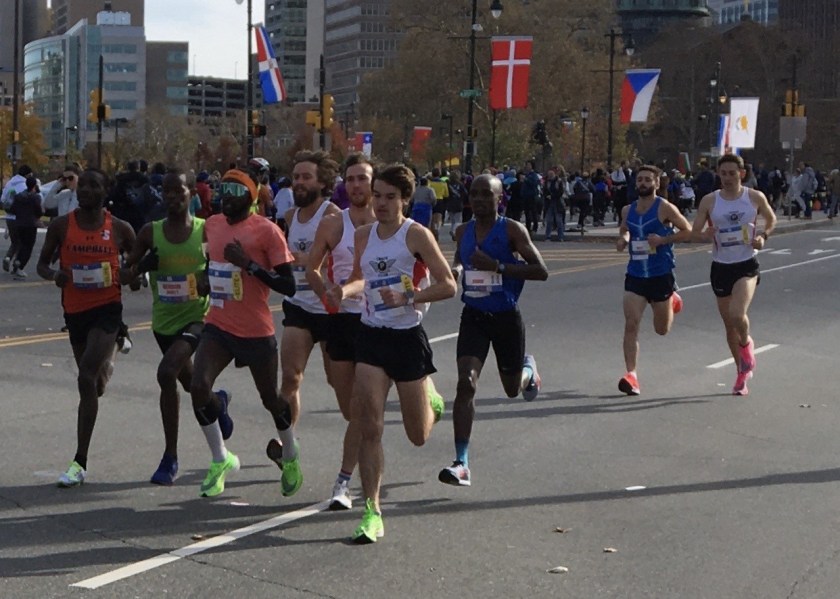
Last weekend I traveled to Philadelphia for the marathon weekend, to attend the half that I did not run because of the injury. However, my son did run and had a good time of it. We also had a great weekend there, visiting museums and sites (my great great great great grandfather is buried 20 feet from Benjamin Franklin), and also enjoyed taking in some of the racing.

Before we continue. True confession, prior to the debacle in Tulsa I was leaning toward getting a pair of 4%s for the Philly Half. But with that point rendered moot, I can hold off. Nevertheless, here are a couple of photos and some thoughts on race weekend.

Lead pack at Saturday’s Rothman 8K. Mixed on the shoes. The majority of the top 20 were indeed wearing 4%s or Next%s, but the top three overall wore other shoes brands without the plates and new foam. However, with 18 runners under 25 minutes, compared to just 6 or 7 last year…you wonder if it was the weather, depth of field, or shoes.
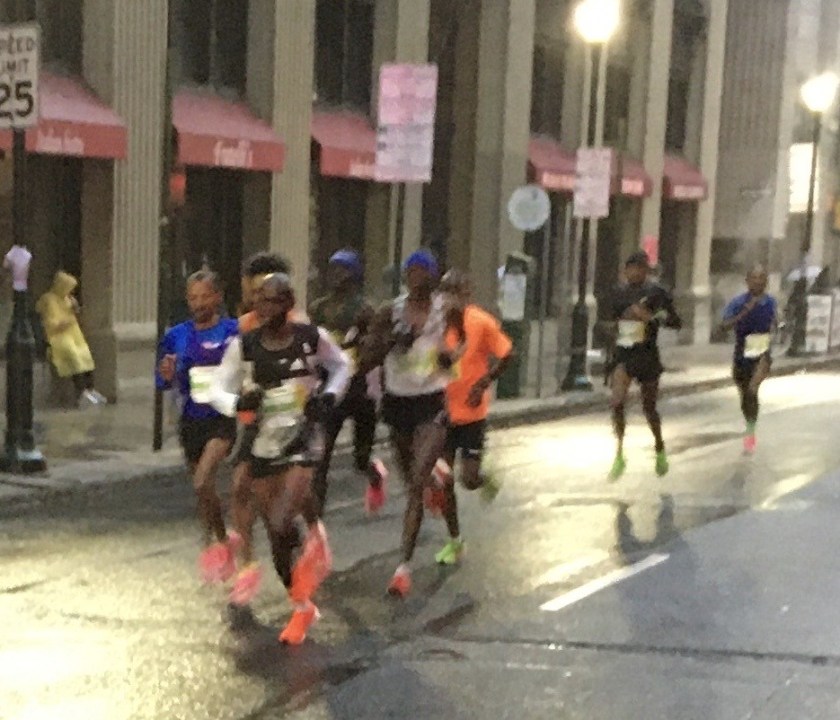
Blurry but you get the picture, the top 8 at Sunday’s Philadelphia Marathon, at 6 miles and all wearing the new shoes. In fact, about 18 of the top 20 were wearing the glow in the dark canoe shaped contraptions. For a marathon, you can’t argue with that. The technology works and runners know it.

However, despite some skepticism, I’m not going to be a Luddite and ignore something that has a clear advantage. I’ve held off, partially out of respect for the age group records, many of which were set a generation ago. However, I’ll be turning 62 next year and that window of opportunity to chase records in this age group is narrowing. So as I rehab and rebuild this winter, I’ll be keeping an open mind about the shoes and will consider the options as the big spring races approach.


Weighing in on the Salazar Story and Women’s Athletics

We have had a remarkable, maybe unprecedented, couple of months in track and field. Going back to the controversial selection of Doha for the World Athletics championships, to the breakout world best marathon performances by Eluid Kipchoge (1:59 in a time trial) and Beatrice Chepkoech the next day with a 2:14, shattering Paula Radcliffe’s record by almost a minute and a half. And then the discussion has been much about the shoes.

However, the biggest buzz has been about Alberto Salazar and the downfall of the Nike Oregon Project (NOP). That part is long overdue, as the revelations came out several years ago, but we had to wait as the behind the door proceedings between USADA and Nike played out in arbitration. There were no new major revelations out of that inquiry from what was in the press in 2015, but it was satisfying to see that all come to closure with a 4 year ban for Salazar, with shutting down NOP, and resignation of the Nike CEO who was clued in on Salazar’s testosterone testing schemes.

We likely got just 10% of the iceberg of what really went on there, at least among the tight inner circle of the coach and some athletes, and we’ll have to be satisfied with that. There was some good follow-up last month with whistleblower Kara Goucher on the Clean Sport Collective and other podcasts and articles.

Then the other week Mary Cain finally spoke out with a shocking 7 minute video published by Lindsay Crouse and the New York Times. Cain broke away from NOP right when the big stories of crossing the ethical lines of sport were coming out, and I thought–and likely most others–she left because she did not want to be associated with such a program. As a teen, who by then was struggling with performance compared to 2012-2014, we thought she’d seen enough of the gray area and decided to go back home.

Salazar has long been thought as kind of jerk from his interviews and press conferences at his peak as a runner in the early 1980s, to stories of how he and some of his teammates treated other younger athletes at the U of O. So maybe it shouldn’t be surprising to hear Cain’s account of Salazar’s obsession with her body weight, ensuing verbal abuse and telling a still maturing teenage athlete to take diet pills. But it was shocking nonetheless.

Since then former NOP athlete and Olympian Amy Yoder Begley revealed her years of degrading treatment under Salazar from 2007-2011, primarily due to his perception of what she should look like even though she was at the very lower limits of body fat for an adult female athlete. Following that, and lot of ensuing discussion, former Stanford All-American and Nike runner Lauren Fleshman penned an opinion piece in the NY Times about her own struggles with body image and weight toward the end of her college career and early years as a pro. While she did not blame her coaches (Vin Lanana was her college coach) she did call out for more female coaches in the sport.

I’m all for that. While more women coaches have stepped in at the college and high school levels, and many club-level and private training groups have women coaches, they are still far outnumbered by males. And at the pro level, top female coaches are not at all common.

However, as important as it is to close that gender gap it sort of misses the mark. Because what is needed is open discussion and dialogue now, and continued education of coaches and athletes to rid us of the idea that a runner can’t be too thin. Running, even at the highest levels, is still about keeping healthy. And athletes crossing that line, be it through overtraining, doping/gray area performance enhancing activities (e.g., thyroid or asthma medications, whether they need it or not for their health), or training and competing under nutritional deficits. These all can have life long implications for athletes, and we need to make sure that we are on the healthy side of the equation. Otherwise, it’s not worth it.

1. How I Set Up for a 2:35 Marathon Debut

Preamble: Marathons are a bigger deal today compared to the 1970s and 80s, at least in terms of participation and general interest. And it seems that anyone serious about doing a marathon is a either strong adherent to a plan (e.g., Pfitzinger, Daniels, Hanson’s, Hudson, etc.) or they have coach and training team.

In this post I will take you back to a simpler time. We knew less, did not have fancy shoes and calorie count watches. Formal training groups and private coaching services were uncommon, and good training guides were not all that readily available. So a lot of us did things on our own. Here is my story.

Background – Heading into 1983 I had been running and training for almost six years, including four years of cross country and three of track at a small (NCAA Division III) school in the Midwest. In that program I had improved fairly quickly (running sub 10 for the indoor 2 mile after just 9 months of training as distance runner, and under 32 for 6 miles on the roads at 15 months into it) but my improvement plateaued and even backpedaled due to classic over training, poor nutrition, and stress from trying to wend my way through a school with high academic standards.

My last season of cross country in 1980 was mostly a disaster, and I ended it with an underperforming 27th place (of about 70) at our conference meet, and a 27:10 (on a very fast 8K course), and 110th place, a the NCAA Regional Championships. The team environment that last year was somewhat toxic. As disappointed as I was to close out that way, I loved the sport and vowed to keep running.

However, my running cratered even more in that first year out of undergrad. I believe the overtraining had resulted in some muscle damage and it took more than a year for my body to return to normal. I raced about 15 times in 1981 and usually did not come that close to what I had done the previous year. My best mark was a 33:35 10K, about 40 seconds slower than my PR set the year before.

1982 didn’t start any better, as I had ben working 50-70 hour weeks doing biological field work in Northern Minnesota, and running only maintenance miles. By the end of February I had put on 10 lb. I returned to my college for a weekend and my old teammates ridiculed me for the extra weight. I got back into shape quickly, however, and PRd at the 8K (26:35) in the spring. Later that year with just 6 weeks of focused training (after a summer of 40 mile weeks, but a lot of hiking at 10-12000 feet) ran a 1:13:05 half marathon at mile high elevation. That is still my all time best (sea level or altitude) at the distance, and equates to 1:11 or under at sea level.

At this point I had made two attempts to run a marathon. I broke down during a high mileage summer in 1980, after a string of 100 mile weeks, about three weeks before the Paavo Nurmi Marathon in Hurley, Wisconsin. And in 1981 I was trying to prepare for Grandma’s Marathon in Minnesota, but ended up with tendintis in my foot about four weeks out. Those non-starters aside, at the end of 1982 I felt stronger than I had in three years, and felt that I should attempt a debut in Denver the next spring.