I am a long time runner and coach and I'm here to write about it. I have blogged some before (years ago), but that site is now archived. My plan is to write some personal reflections skipping around the 40+ years of my running career, probably some race reports. However, I'd like to spend a fair amount discussing current events in the world of running, and likely dishing out on some coaching and training advice. I have some opinions--okay a lot--and like to share those. rws_58@yahoo.com
Here are my obligatory PRs, all set way back in the 1980s and 1990s:
3K - 8:54
5K - 15:34
8K - 25:35
10K - 32:11
15K - 49:41
1/2 marathon - 1:13
marathon - 2:34
Now I'm a senior, yes a Senior (60+)! age group runner and here are my 60 and up PBs over the past couple of years:
1 mile road race - 5:15 (former American road record)
5K - 17:28 (USATF masters champion)
8K - 28:12 (USATF masters champion)
15K - 54:43 (Gasparilla 15K)
1/2 marathon - 1:17:49 (World Masters Champion)
Preamble: Marathons are a bigger deal today compared to the 1970s and 80s, at least in terms of participation and general interest. And it seems that anyone serious about doing a marathon is a either strong adherent to a plan (e.g., Pfitzinger, Daniels, Hanson’s, Hudson, etc.) or they have coach and training team.
In this post I will take you back to a simpler time. We knew less, did not have fancy shoes and calorie count watches. Formal training groups and private coaching services were uncommon, and good training guides were not all that readily available. So a lot of us did things on our own. Here is my story.
Background – Heading into 1983 I had been running and training for almost six years, including four years of cross country and three of track at a small (NCAA Division III) school in the Midwest. In that program I had improved fairly quickly (running sub 10 for the indoor 2 mile after just 9 months of training as distance runner, and under 32 for 6 miles on the roads at 15 months into it) but my improvement plateaued and even backpedaled due to classic over training, poor nutrition, and stress from trying to wend my way through a school with high academic standards.
My last season of cross country in 1980 was mostly a disaster, and I ended it with an underperforming 27th place (of about 70) at our conference meet, and a 27:10 (on a very fast 8K course), and 110th place, a the NCAA Regional Championships. The team environment that last year was somewhat toxic. As disappointed as I was to close out that way, I loved the sport and vowed to keep running.
However, my running cratered even more in that first year out of undergrad. I believe the overtraining had resulted in some muscle damage and it took more than a year for my body to return to normal. I raced about 15 times in 1981 and usually did not come that close to what I had done the previous year. My best mark was a 33:35 10K, about 40 seconds slower than my PR set the year before.
1982 didn’t start any better, as I had ben working 50-70 hour weeks doing biological field work in Northern Minnesota, and running only maintenance miles. By the end of February I had put on 10 lb. I returned to my college for a weekend and my old teammates ridiculed me for the extra weight. I got back into shape quickly, however, and PRd at the 8K (26:35) in the spring. Later that year with just 6 weeks of focused training (after a summer of 40 mile weeks, but a lot of hiking at 10-12000 feet) ran a 1:13:05 half marathon at mile high elevation. That is still my all time best (sea level or altitude) at the distance, and equates to 1:11 or under at sea level.
At this point I had made two attempts to run a marathon. I broke down during a high mileage summer in 1980, after a string of 100 mile weeks, about three weeks before the Paavo Nurmi Marathon in Hurley, Wisconsin. And in 1981 I was trying to prepare for Grandma’s Marathon in Minnesota, but ended up with tendintis in my foot about four weeks out. Those non-starters aside, at the end of 1982 I felt stronger than I had in three years, and felt that I should attempt a debut in Denver the next spring.
January 1983 – I rung in the new year without a lot of running miles. I’d been putting in about 40-50 miles a week since the half in October, plus some cross country ski training with the Colorado State University Nordic club team. But that was maybe one or two sessions a week over December and January.
At the time I was back in school, at CSU studying biology and planning to go into graduate school by the following year.
February 1983 -I did one Nordic race, a 15K in Steamboat Springs against collegiate and club racers. My technique was not good, equipment worse, and was pretty far back in the standings, some 12 or 15 minutes behind the leaders. So I shelved the Nordic scene for a better time (that turned out to be the next year).
Around President’s Day weekend I reviewed my training log and realized I had not run over 55 miles in a week since late September and my longest run had been no more than 12 or 13 miles. However, I had gotten out on the skis once or twice for about 2 hours. The Mile High Marathon in Denver was less than 3 months away.
I cut the skiing and ran 50 and 55 miles over the last two weeks and upped the long runs to 14-15 miles.
School that semester had some challenges, but I was doing student lab research as part of my curriculum and had a lot of flexibility. I had become a better student, and did not feel the same pressure as I had as an undergrad.
One thing that did not suffer was my social life. I had four rather hard partying housemates who liked the night life. So every weekend (sometimes starting on Thursday night) was a party, and we usually centered it around music with concerts in Denver (Neil Young), Boulder (Stray Cats), and Fort Collins (The Blasters, The Suburbs) plus many local and regional acts. That all involved a lot of drinking (beer mostly for me, my housemates were much less discerning with what they consumed or inhaled) and one or two late nights a week. The results were frequent weekend runs on 5 or 6 hours of sleep, while hung over.
So while my study and work habits had improved, and running balance (not overtraining) was better, my weekend lifestyle had regressed to sophomoric levels. I was 25 going on 19 in that aspect.
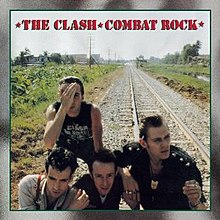
March 1983 – I ramped up the weekly mileage to 60 and 65, and gradually increased the long runs. I got to 70 miles and 18-19 by the end of the month. I wasn’t doing any workouts until the last week of March, just running 7-10 miles a day and doing the long runs, all at 7 minute pace or so. Also got in a few days of alpine skiing in Aspen over spring break, with a St. Patty’s party in Aspen village, singing The Clash’s Rock The Casbah as we bar hopped.
Big album on alt radio as well as MTV in the early 1980s.
April 1983 – A month in which it all (rather improbably) came together. I started thinking about goals for the upcoming marathon. A 2:40 seemed conservative but reasonable. With that breakout half marathon the previous fall, pace charts indicated I could do better but with a limited build-up my goal was to finish the full and to have that as a launching point for more serious efforts in the future.
Until 1982-83 Prince was kind of a cult rock and R&B hero, but not known well outside of the upper Midwest.
About six weeks before the the marathon I started doing weekly workouts, starting with 6X 1/2 mile at 10K effort and building from there. Some workouts I remember, were 4X1 mile in 5:20, and 2X2 and 1X 1 mile at about 5:20-5:25 pace, but the emphasis was not on pace, more on keeping at what seemed to be 10K effort. I also mixed in some mid-week longer runs of 12-14 miles, about every other week.
U2 was my big find of 1983, and bought their debut album soon after it hit the shelves at the record store.
In early April I went down to Denver and did a 10K – 5K double in Washington Park as a training effort. Don’t try this at home (kidding because actually it worked I think). After a 3 mile warm up, raced the 10K (34:06) in race flats, took a slug of water, ate a banana, switched into my training shoes, and jogged for about 45 minutes (6 miles, mid-7s +/-), and ran the 5K at 5:50s pace. I was feeling a little numb and seeing stars even as I lined up (low blood glucose). The road seemed wavy, but I held on for a low 18s. 19 miles for the morning with 9.3 at quality. That set me up well for fending off a bonk.
I went home after that and ate a box of cookies and a pickup load of food.
Mileage wise, I topped out at about mid to upper 70 mile weeks for a few weeks and did three long runs of 20 miles. The first one was just steady 7:00 pace. The next two involved marathon pace. First time was 10 miles at 7:00 pace, then 8 progressing from 6:20s to 6:10s-6:00. And the final long run (about 3 weeks before the marathon) started with 10 miles at 7:00 pace and finished with 10 at 6:00 pace. With that I knew I could run under 2:40.
Every weekend was a party weekend, and for a bit I dated an undergrad who drank more than me and only went out because I paid for all the drinks. That relationship did not last very long
On the last weekend of April, two weeks before the marathon, I entered a local 10K (part of it on the now renowned Fortitude 10K course), and this would be my final tune-up and test. My goal was 5:20s pace. A couple runners went out quickly and I just settled into my own private Northern Colorado pace as we wound around Old Town Fort Collins. Nothing felt difficult that day, and while I never did reel them in, and the gap at the end was only 10-12 seconds. I finished in 32:58. Compared to my sea level PR of 32:54, that was a relative jump of about a full minute–and in fact for altitude I had skipped the 33s altogether, as my previous 10K efforts had been in the 34s.
Winter/Spring Training Program 1983 – To summarize my training. Six weeks of build up, easy-moderate miles by feel, starting from mid-low 50s to 70 miles a week. Then about six weeks averaging at 70 – 75 (range ~65-77) with one workout of longer reps at 10K effort, and a weekly long run building to 20 miles with up to 10 at marathon pace. Other than that, mostly 7-10 mile days with a mid-week longer run about every other week.
The sub 33 10K at the end of April was well under my goal, and a friend who was a national class race walker called to remind me that the marathon equivalent would be 2:32 or 2:33, which would be a very competitive time for Denver. That was exciting to hear, but also a little unnerving.
With finals and the marathon coming up I didn’t go out and party or stay out late the following weekend, probably the first time all semester. However, my housemates decided it would be a good idea to have a tequila party, and ended up doing tequila slimes, where they smeared limes and globs of avocado on their forehead before each shot. I ended up being nanny and made sure the house stayed on its foundation.
Somewhere along the way, was it an article or something someone said, I decided to go caffeine free. Went almost cold turkey, maybe with a two or three day transition. I had heard a million times by then, you don’t change things up immediately before a big race, but at the time it seemed like a reasonable idea. So I went through that final week of taper, which is always a maddening endeavor, feeling off.
On the eve of the race, I was nervous and so dragged my friend out for a beer. I think I had the better part of a pitcher, maybe three or four beers. This was rare for me to have drinks the night before a race, but not without precedent. The night before my best college cross country race, I was visiting back home and went out for beers and dancing the night before and had stayed out until 1 AM. Rolled into the race with barely a warm up and placed top 10 overall out of 80 runners, and was 2nd runner on our team that day.
But for a marathon? Wouldn’t recommend it.
Buzzed or not. I barely slept that night.
On race morning I did have a couple cups of caffeinated tea. Plus a bit of a hangover. My mom was living in the suburbs so we drove over with her and a couple friends.
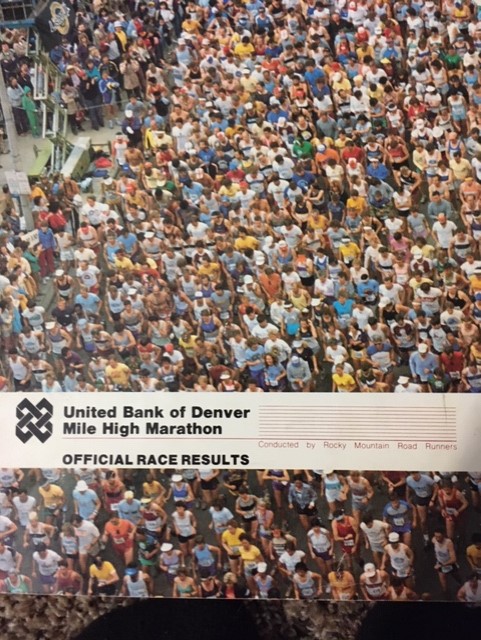
Nearly 2,000 runners lined up on Larimer Street in downtown Denver, and I took a spot on the front row with a race plan as simple as my training. Run about 6:00 pace and see how it goes, bottom line goal was to break 2:40. High end goal was low 2:30s and make the podium.
2000 runners lined up, a big turn out for a marathon in 1983.
The course would head east from downtown, circuit City Park and return for a loop in the city canyons through half way, and then turn to the south and pass through Washington and Cheesman Parks, before returning to downtown.
I settled into what seemed like a reasonable pace but was surprised to be so far behind that I already wrote off a podium finish. Came through the mile in 5:40 and I heard someone say we were in about 40th place! Way too fast.
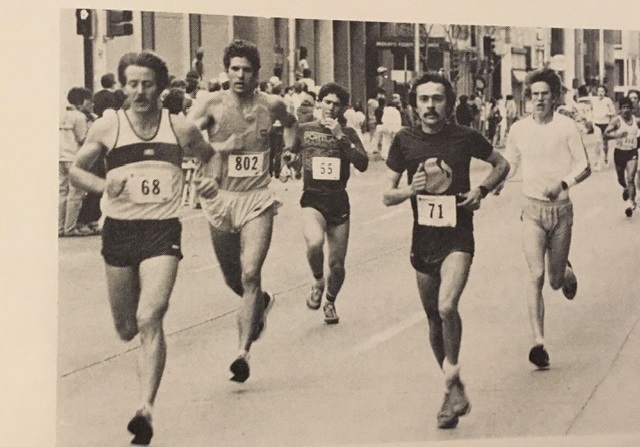
Lead pack in the early miles, the two favorites on the right set a fast (5:15-5:20) pace in the early going, but faltered by mid-way. Relative unknown Bill Aragon (far right) would run 2:28 for the win.
I immediately slowed down to 6s, the lead group pulled away, and a couple dozen other runners went on by and also ran away.
The second pack still way ahead, I ended up catching four of the five in this group (#55 placed 4th overall).
The beer wasn’t sitting well with my stomach either. I was thinking this was not going to be my day. Came through 5 miles in about 30 minutes and I couldn’t stop burping every mile or so, and it was worse after an aid station. Back then we had no gels nor energy drinks, we had water and ‘Gook’ (Gookinade, an electrolyte drink). But I dutifully watched my pace and took two drinks at each aid station.
I had to pee. No fucking way was I going to stop at a porta potty.
I kept going, and heading back to the city noticed that I was picking of a fair number of runners. We sped down the 16th Street Mall, which was line with hundreds of spectators. I soaked it up, and like a high jumper or long jumper in a stadium threw my hand up and mugged around a bit so they would cheer louder. It worked and I felt energized. An hour in, the fuzziness in my head was going away.
We looped through the downtown blocks and ran by the start line and more crowds at 13.1, which I hit in 1:18 and change. Just a few ticks under 6:00 pace, and I was in the top 30.
Heading south on Lawrence Street at 15 miles I noticed my quads were getting tight in a way that has become all too familiar in a marathon, but this was the first time I had felt that sensation. However, I did not have to go pee anymore. The 6:00 miles kept rolling by.
Into Washington Park at 18-20 miles, those quads got more tight. I had to stop, lie down on the grass and stretch them out. Ten or 15 minutes later, while exiting the park area, I had to do it again and for the first time since the second or third mile I was wondering if I would be able to finish. However, I got up both times and moved right back onto pace, energized because I was catching passing the faster starting runners. I came through 20 miles in just under 2 hours. Every minute or two, I’d catch a runner. Go by and work on the next.
Despite the sore quads and growing fatigue I also noticed that my splits were getting faster, with some into the 5:50s. The last three miles were grinding but ecstatic because I knew I would finish and finish strongly. The gaps ahead became longer and I ran that part almost all alone, somewhere in the top 20. It did not matter.
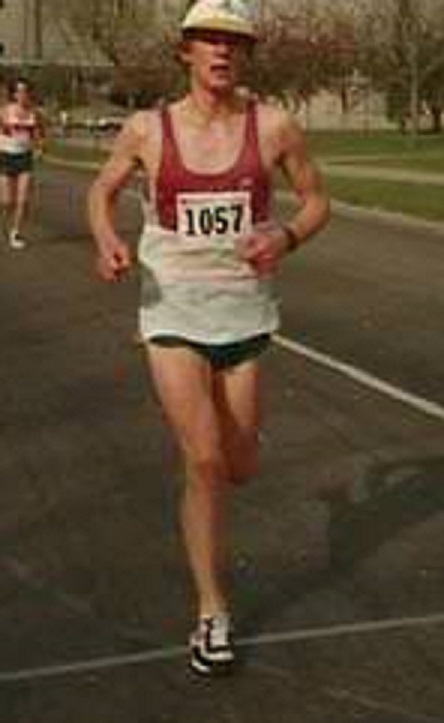
Unseeded with a four digit bib number, in the closing miles and holding onto 5:50s pace.
Approaching downtown for the final time, the temperature had climbed into the mid-60s, warm but I was not uncomfortable. I dropped a 5:40 for the 26th mile and strode through the finishing throng, with a couple fist pumps and a big smile.
Final meters!
2:35:49 – 14th place (and my only negative split in a marathon)
No coach. No training program other than what I had figured out on my own. Short build-up with moderate mileage. Having way too much fun on the weekends. Making a couple fundamental errors in the final days. And did I mention the altitude? I could look to running 5 or more minutes faster at sea level, at the same effort.
I had broken out, and had come a long ways from the 16 minute 5K, 27 minute 8K runner I had been in college. I looked forward to even better days ahead.
Just the other week I described my fall and comeback from 2016. And was actually going to follow up with some detail of the masters dream seasons of 2018 and 2019. However, here I am drifting among the flotsam and jetsam of 2019, which ended abruptly the other week in Tulsa, OK.
Tulsa was the springboard that launched this journey onto the national masters circuit. So this is a story of bookends.
2017 Breakout
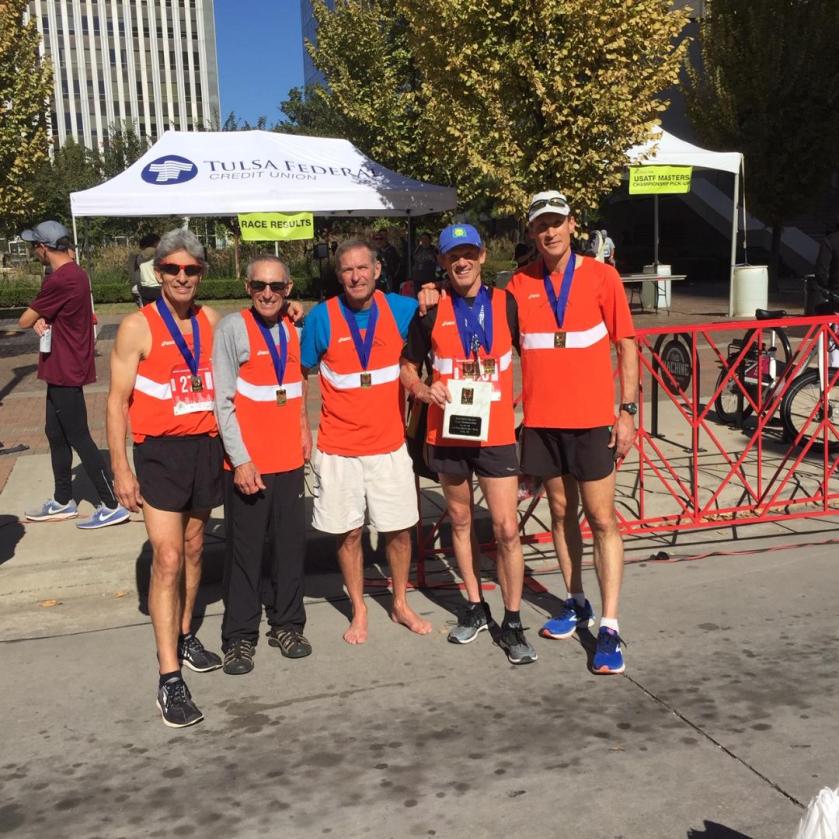
Although I had done the USATF Club Cross Country championships a few times, Tulsa 2017 was my first USATF masters road race championship. Still running as an independent for Boulder Track Club, I traveled with my new mates on the Boulder Road Runners 60+ team. We had a blast, despite some issues with jerseys.
Funny in hindsight. A cardinal rule on the USATF masters circuit is that team members must have the same singlet/jersey. No exceptions.
The team had just switched its uniforms but one of the guys didn’t get his in time, so we spent the afternoon chasing down appropriate race attire so the team could remain eligible. After much debate and some running around the city, the team ended up wearing red Route 66 Marathon singlets, with BRR penned on the front and back. Everyone held their breath as the officious USATF official, who had scolded us all the afternoon before, checked the makeshift uniforms, and gave them the okay.
In the race I was still in the 55-59 age group, but only a few months shy of 60–not where you want to be in a championship race. Plus the field was intimidatingly deep. On a cold blustery morning I started evenly and wound my way through the pack and locked into an age group 3rd place by about 5K, with one guy just ahead, and one only a few seconds back. Even though my legs went numb from the cold and wind, I held on for 55:29 finish, and age grade of 89.5% to finish 3rd in the overall age grading and 3rd in the age group. These were my first podium finishes at the national masters level. Despite one bad injury on the BRR team, they dominated to win the team race and clinched their claim on the 2017 national title. BRR claims USATF age group title at 2017 team champs on a chilly morning
Riding the Wave in 2018 and 2019
That event set me up well for the breakout years of 2018 and 2019, where I went on to win a string of consecutive USATF age group national titles on the roads and some world masters championship medals.
We returned as a team in 2018 and dominated the day, and I won the individual title as well to close out the year with a sweep of USATF masters championship road races. I had added two more in 2019, on top of two runner-up spots in cross country, and came into Tulsa with 390 points on the grand prix. All I’d need was a 4th place finish to win the title.
August through late October had gone well, and even a bit dialed back on training and racing load compared 2018 because I had wanted to be more fresh this time. I was confident that I could still round the hilly circuit in under 56 minutes and break into the 90% age grade range to win that overall title (I had been 2nd twice).
Raced hard but winning felt easy in 2018. 2018 15K age group championship team.
Tulsa 2019
All was good the other week, and I had no issues in the training block, running between 59 and 69 miles over the 8 week period, I felt healthy and strong, planning on 6:00 minute pace for the race. I cut back on my long run on the Saturday before and did a final tune up on Tuesday, just a few reps of 2-3 minutes at goal pace and a couple pick ups. Jogged back, felt solid.
Wednesday I ended up running on the treadmill because an early snowstorm had a arrived. Plan was an easy hour give or take. 30 minutes in, my lower back and glute got a little tight, but I thought nothing of it but slowed down to 8:10 pace. At 40 minutes I noticed it wasn’t going way, and I slowed a bit more, an cut the workout short at 45 minutes. When I got home it definitely hurt. And I hopped into a hot bath and took some ibuprofen.
I reconsidered overnight, but decided to make a go of it. And while the results were a disaster, it’s a good thing that made the trip.
I did not run a step until Saturday morning but all I could to get ready. Ibuprofen every 4-6 hours, lidocaine patches as needed, hot baths–including right before the race (those seemed to help the most).
I warmed up with an easy mile and 2 minute surge approaching race pace. It felt tight. But I felt I could run at least 6 or 8 miles, enough to carry me in with a good lead for the stretch. My main competitor has been running 18:20 or 18:30 for 5K, which is my 15K pace, so I felt I could hold him off, and if not still run under 60 minutes and ahead of everyone else.
At 8:50 we were off! 100 master runners for the 2019 finale! I was not uncomfortable but surprised at the fast pace of some starters–some going out well under 6:00 pace even though you’d expect them to finish in the 65 minute range (closer to 7s). I hit 2 miles in 12:08, just a couple ticks off of last year’s pace and felt that I could sustain this effort, if not a low 6s pace, for the duration. However, just after that I heard rapid footsteps, and the women’s leader Fiona Baily was soon on my heels. We had a number of turns and some rolling hills and I just ran by feel. But that 3rd mile (which I missed) was a 6:24. She pulled way, wearing the most talked about shoe ever, the Next%s and I got to thinking that indeed there must be something to those. And in the 4th mile another guy passed me back, also wearing Next%s.
Those two pulled away and I was running alone, with splits of 6:03 (some downhill) and 6:24 (rolling), and that 5th mile I was starting to feel actual (rather than tightness) pain in my lower back and glutes. It was taking a lot of concentration just to keep going. I was slowing. On the long downhill toward the river the 2nd woman Melissa Gasek caught me, and she said she’d buy me a beer if I helped her catch her competitor Bailey, who was a block or so ahead. I picked up the effort, feeling like I was on sub 6 pace, but each stride was stabbing. And after a few minutes, just had to drop back. My 6th mile was a 6:40 on a stretch that I covered in 5:50 last year.
My race was in trouble. Somewhere around 6.7 to 7 miles, by then only running a 7:30s pace, the first competitor in my age group passed by. I stopped just before the long bridge that spans the Arkansas River, thinking of just dropping out. A pack with two more more age group competitors ran past, asking if I was okay.
Not.
So my was my own title going down the drain, but the team’s 2nd place was also in jeopardy. If I did not finish, we would lose our grand prix podium standing. So I decided to go the extra mile on the out and back portion over the bridge. And resumed running at 9 to 10 minute pace. At about 8 miles I had to walk for a half mile, but somehow I as able to resume a very slow jog to the finish.
68 minutes with final 5K of 29 minutes. That was brutal. But by finishing the race, we held onto 2nd place on the day and for the grand prix. I do feel the effort was worth it. Even though I lost the individual title that day, in a worst case runners scenario, by finishing the course I also held onto a 2nd place. It’s a bitter pill to swallow but had a great three year run leading up to this race. And it masters running, being at the top usually means you are going to crash down from time time. Limping in at the finish in 2019
I could barely walk for the next two days and it has taken two weeks and some realignment therapy to even start feeling normal again. Onto more rehab, cross training, and plotting for 2020. Don’t get mad. Get even!
Listen to the pod and take in a really nice interview with Jeremy, from 4:45 to 2:27 marathon in 2 years!
Ken Goe needs to eat some crow!I don’t know what Nike pays Oregonian sports writer/propagandist Ken Goe, or if he gets personalized androgel massages from Alberto himself, but he has been a shill for Nike and the Nike Oregon Project for years.In 2016 or 2017 he wrote in the Oregonian that the investigation was “ongoing” for more than a year but no decision. i.e., lalalala,we’re hearing crickets here in Niketown. Goe did report on the ruling from the USADA investigation and arbitration over this past month, indicating the Salazar ban but with the general undertone that these are but small infractions, like Al Capone getting sent to prison for tax evasion, not for being a gangster. Well, we can slant this another way using the same analogy. Capone was a gangster and a thug who did lots of bad gangsterish and thuggy things. Well, Alberto’s actions are very likely the tip of the iceberg of what went on with NOP. In particular, the androgel experiments on his sons to test how much lotion it would take for Galen to be sabotaged. What? Sounds like spin and doublespeak. The latest straw, is that NOP is being rebranded under assistant coach Pete Julian with half of the same athletes. They did not waste any time on that. But there is a shadow over Beaverton and it’s likely to stay until they really clean house.
The US Olympic Marathon Trials will be in Atlanta, GA on February 29, 2020. Some news from September is that the top 3 go (no IAAF time qualifiers needed now), and the Trials organizers smoothed out the course, taking out some of the turns and large hills. So it should be a faster race. Also, the Olympic marathon next August will be in Saporro, Japan not Tokyo. So the weather will not ba as brutal as predicted.
The favorites by qualifying time Jordan Hasay 2:20:57 Chicago Marathon Chicago, IL 2017 Amy Cragg 2:21:42 Tokyo Marathon Tokyo, JPN 2018 Sara Hall 2:22:16 Scotiabank Ottawa Marathon Ottawa, CAN 2018 Emily Sisson 2:23:08 Virgin Money London Marathon London, UK 2019 Kellyn Taylor 2:24:29 Grandma’s Marathon Duluth, MN 2018 Sally Kipyego 2:25:10 Berlin 2019 Bates, Emma2:25:27 Chicago 2019 Molly Huddle 2:26:33 London Marathon 2019 Aliphine Tuliamuk 2:26:50 Rotterdam 2019 Desiree Linden 2:27:00 Boston Marathon 2019 Stephanie Bruce 2:27:47 Chicago 2019 Lindsay Flanagan 2:28:08 Chicago 2019 Nell Rojas 2:28:07 Grandma’s Marathon 2019 Allie Kieffer 2:28:12 New York City Marathon New York, NY 2018 Laura Thweatt 2:29:06 Chicago 2019 Roberta Groner 2:29:09 Marathon Rotterdam 2019 Taylor Ward 2:30:14 Chicago 2019 Sarah Sellers 2:31:49 Chicago 2019
Who’s on form, who is not Hasay – Coached by Salazar/Nike Oregon Project. Was said to be healthy for the Chicago build up, but often been injured. Has barely raced in 2019. Dropped out at Chicago after just 3 miles due to hamstring.
Cragg – Defending Trials champion, 7th at Rio Olympics, and Bronze medal at 2017 World Championship. Hasn’t raced in a year and a half and said to be injured. Chances are dwindling.
Sisson – On a roll, with a 2:23 debut last spring; has as good of a chance at making the team as anyone, and maybe the favorite to qualify.
Hall – Wife of Ryan Hall, has been on road racing tear over the past two years. Racing a lot on the roads and winning several national championships. 2:22 in Berlin a breakout race.
Taylor – Surprise of 2018-2019. Looking very fit as of summer 2019. Based on recent form also a good possibility for top 3.
Kipyego – Former NCAA champion for Texas Tech University and was 5th in the 2015 World Championships 10000 m (right behind Molly Huddle), running for Kenya, will probably be in the top group in Atlanta.
Huddle – Most talented distance runner (10K and up) in the US over the past 5 or 10 years (like 28 national championships), but hasn’t put together a great marathon. Almost certain to make the 10000 m team later in the year, and should be top 5 in the OT marathon unless something goes awry.
Bates – Emma Bates is a runner to watch. She’s still young (27) and made her debut last fall with a 2:28 on the fast California International Marathon, and winning the USA championship. Ran 2:25 in Chicago the other week.
Tuliamuk – Like Huddle, super talented at 10K to half marathon and would have a good chance if one of the top runners has an off day.
Bruce – Like Sara Hall a prolific racer and fierce competitor and a runner who has peaked in her mid-30s. 2:27 at Chicago. Has a chance at making the team.
L. Flanagan (no relation to Shalane) – Been on the scene for a number of years, and with a 7th and 2:28 PR at Chicago Marathon this month has improved her chances. Was not wearing Vaporfly or competitor prototypes, but a training shoe–Lindsay Flanagan 2:28 in trainers!
Linden – With the Boston win, probably now the most famous marathoner of the bunch. Has made two Olympic teams, but with NYC and Boston Marathons in the mix in 2019-20, may not even line up or take the OTs seriously.
Rojas – A triathlete with a good running background (father was USA champion in 10000 m back in the 70s and she ran at Northern Arizona University), Rojas had the break out race that Gwen Joregensen was expected to have. Ran that earlier this summer with the 2:28 at Grandma’s.
Kieffer – PRd just last year at the fairly tough NYC course but has struggled with injury and coaching changes since. Talented and iconoclastic/somewhat provocative, but probably a long shot to make the team.
Groner – at 41 the oldest in the field. Placed a remarkable 6th for USA at the World Championships marathon in Doha, Qatar.
Others who could be in the mix –
Gwen Jorgensen who won the Olympic triathlon in Rio and has run sub 32 for 10K and dipped under 1:11 for the half marathon. Also Elaina Tabb (qualifying with a 1:10 half).
Laura Thweatt, ran a debut 2:25 at London a few years ago (and top 10 all time USA) but had injuries. A top 5 at USA road championships this summer and the 2:29 in Chicago is encouraging.
Early Predictions (subject to revision!) Who is going to be? What a great field for the Trials next February. Deepest ever and there are no given favorites. Hasay might have been, but after the Chicago DNF and turmoil surrounding her coach, now banned, and training group, now disbanded she’s not a given. Here are my pics for top 3, with 2 on the wings:
Sisson ready for prime time (Runners World photo)
Sisson, 2. Hall, 3. Hasay. With Taylor and Bates mixing it up for a podium spot should one of the top 3 not have a good day or not line up.
Here is the list of most of the favorites, based on time from the IAAF charts. Next February there might be a few others in the mix, who qualified last year in a marathon or qualified with a half marathon.
2:06:07 Galen Rupp 2:07:56 Leonard KORIR 2:09:09 Scott Fauble 2:09:25 Jared Ward 2:10:36 Jacob RILEY 2:10:37 Jerrell MOCK 2:10:53 Parker STINSON 2:10:56 Andrew BUMBALOUGH 2:11:10 Matt MCDONALD 2:11:14 Matt LLANO 2:11:14 Scott SMITH 2:11:38 Brendan GREGG 2:11:42 Noah DRODDY 2:11:44 Wilkerson GIVEN 2:11:54 Diego ESTRADA 2:12:10 Bernard LAGAT 2:12:15 Andrew COLLEY 2:12:25 Augustus MAIYO 2:12:39 Brogan Austin
Rupp – Probably a toss up. If he’s healthy and the NOP controversy has settled, then he’ll be a favorite if not the favorite to make the team. But coming off major reconstructive surgery last year, and losing his coach and program just a few weeks ago due to a doping scandal, he might not even line up. He held on to 2:08 pace through 23 miles last week in Chicago before dropping out.
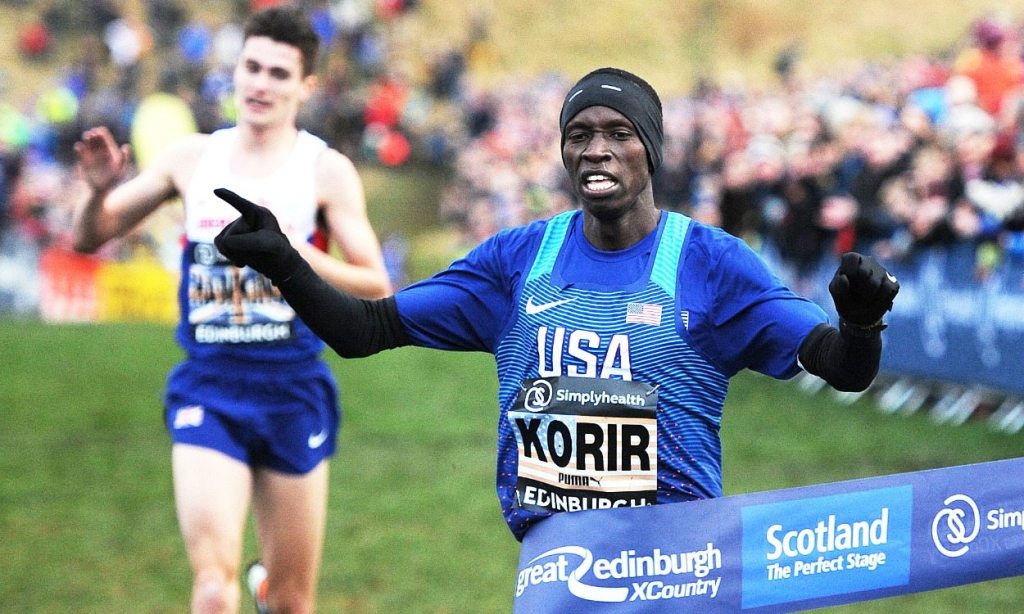
Korir – Moved to the US from Kenya about 10 years ago and ran NCAA track and XC for Iona. Ran a sub 2:08 debut in Amsterdam yesterday, fastest in American history. He’s on the upswing and has been strong on the track and roads the past few years with the Army team (WCAP). Likely to make the team in either marathon or 10000 m or both.
Fauble – 2:09 and top American (7th) at Boston this year. If Rupp doesn’t run Fauble has a real good chance at making the team. And even if Rupp does run, he’s been getting stronger each year and would battle the others for that 3rd spot.
Ward – 2nd best American at Boston (8th) and not far behind Fauble there. Ran on the 2016 team in Rio and was 6th overall in the Olympics. That’s a pretty good feat and shows he’s a gamer. He is also running NY in a couple weeks and that may or may not affect his training going into the Trials. Ward, like Fauble, is a strong favorite to make this team.
–we might almost be done here–could easily come down to these four, they are a notch above everyone else.
However, there are a number of exciting newcomers and later bloomers who could step in (and if history is any guide, it’s often someone that is off the radar a bit who steps up on the big day to make the Olympic team).
We’ll just jump in with the next three on the list: Riley, Mock, and Stinson. Jacob Riley at 31 is a journeyman runner running for Hanson’s with Desi et al. early on, and has had a number of injuries, including the same injury and surgery that Rupp is coming off. He ran a 3 minute PR last week in Chicago to place 9th and place as the top American. Jerrel Mock is just 24 and unsponsored. He ran at Colorado State and was an All American, but did not have a strong senior year and for the past year and half has been on his own. However, he’s been placing high at a number of big races, including USA 20K championships, Bix 7, and Utica Boilermaker. The 2:10 at Chicago will get him a sponsor. Parker Stinson has shown a lot of potential over the past few years, but his race tactics haven’t been great (going out fast and fading). But he’s now coached by Olympian Dathan Ritzenhein and has tempered his early pacing. He ran even splits to break 2:11 in Chicago.
And that brings us to two more competitors not on this list: Ritz himself and Chris Derrick, both high school and college running legends who have had injury plagued pro careers. Ritz has a 2:07 PR but that was some 7 years ago, and he’s now in his late 30s. So just getting to the start line is a big deal. They say talent doesn’t go away, but he’s a very long shot to even make the top 6 or 7 in Atlanta. Derrick showed much promise as a high school phenom and college All American at Stanford (running 27:20 for 10000) m. And he won the USA XC championships in 2015. But he’s hardly been healthy since, and broke his foot in a road race a few months ago. Making the starting line and placing in the top 15 would be a good day for Derrick who is still under 30.
Last but not least is the wily old man, Bernard Lagat. At 45 he ran a 2:12 marathon this summer in Australia for an American masters record. He’s won Olympic and world championship medals in mid-distances and has been a strong road runner. He’s had some controversy in the past but remains a popular presence on the circuit. A few months ago, he was actually considered as a contender. Not likely with the newer runners stepping up. But he IS Bernard Lagat and he could surprise us all by making yet another Olympic team.
Others to watch out for: Shadrack Kipkirchir, Korir’s teammate has a 27:07 10000 m PR. Should he line up in Atlanta, he’d have a good chance at making this team.
Favorites
Korir winning Edinburgh XC against World and Olympic 4th place marathoner, Callum Hawkins of Britain (Athletics Weekly)
Korir, 2. Rupp, 3. Ward – 4th and 5th ready to take a spot if one of the early favorites does not run or lets up an inch: Fauble and Mock
The title here, a bit tongue-in-cheek, is my motto if not an outright battle cry for coming back from an injury. I had a lot of time to think about that in my 2016 rehab and comeback.
I fell on August 6 and had surgery about three weeks later. I could only hunker down for the first week, but got in a few short walks. Hobbled around in one of those big super slings with the hefty arm pad. I got on the exercise bike at the fitness center within a few days and started out with 20 minutes a day, was up to 45 to 60 minutes within no time, and after two weeks I added 30 minute walks a few times a week. In late September I got clearance to start up on the eliptical trainer (hand free of course).
The big break came in early October when they said I could start running easy a few days a week. I ran outside a couple times but was told to stay on the treadmill, and for the most part I did that. Felt great to be back running again. Through October and November of that year averaged about an hour a day of cross training and running, thinking a lot about what I wanted to accomplish in 2017.
In the meantime we moved from 5,500 feet elevation in suburban Denver, into to the foothills at over 7,000 feet. This has proven to be a big bonus. A little more hypoxia for 12-15 hours a day means more red blood cells and more oxygen carrying ability. This, along with the diet changes earlier in the year were two of the three factors that got me onto a track that have allowed me to reach levels I would not have dreamed of.
In December of 2016 I was up to 40 miles a week, following rehab routines to the T, and without the doctor’s approval jumped into a snowy 10K race with my son (was still supposed to be running indoors at this point). I ran that in 39 minutes, outkicked by my son.
In first comeback race, Mikko takes down Dad with a half K to go. Shhhh. Don’t tell the doctor!
I finally got full clearance from the doctor in early February. Ran a few low key local races as tune-ups, and had my sights set on a March New York Road Runners 10K in Central Park. In that race I started cautiously, not really knowing where my fitness was, but by 2 miles locked into a 5:50 pace, and finished in 36:08, my fastest 10K since 2009 (8 years) and 89.9% age grade (a PB). Three weeks later I ran the Platte River Half for the third year in a row and posted a 1:21, a course PB, and the next month a 2:58 at the Colorado Marathon, to win my age group and BQ by more than 55 minutes. And to cap off the comeback of 2017–in which I got more than even–we traveled back to Alaska following our son’s graduation from college. There, I ran the Midnight Sun run in 35:43 and for the first time ever nabbed an age grade of >90 percent. Comeback Mission Accomplished!
September 2017, a new state half marathon record for 55-59 age group! 1:18:40.
To close out the year, I traveled to Tulsa and ran the USATF 15K masters championships, and ran 55:29 to place 3rd in the 55-59 age group and nab my first age group medal a bronze. Six weeks later, I returned to the Club Cross Country Championships in Lexington, KY in the biting winds and 20 degree temperatures placed 5th, bumping up three spots from my last outing in San Francisco two years earlier.
2016 had been a rough ride with some great times, but 2017 was better than I had dreamed of. In 2018 I would turn 60 and couldn’t help but look forward to that
I started this blog in 2016, with just a couple posts. It was a year of some good running, but interspersed with a couple of health issues. Here is a run down from late 2015 to summer of 2016.
After ending 2015 with some decent efforts, a 1:21 half marathon in Washington and a relatively solid showing at the USATF masters championships in San Francisco, where I took 8th in my age group, I looked forward to 2016 with some high hopes. Although I had hoped to be top 5 in SF I was pretty happy to run sub 37 minutes on the course at Golden Gate Park and to finish near or ahead of some pretty good runners in my age group (I was 8th in the age group and 25th/415 in the age grade catergory). In the back of my mind, however, was the thought if I ate a really good diet and shed some pounds I could move up some.
Start line at the 2015 USATF Masters 10K championship in San Francisco.
Trying to finish strong at USATF Masters 10K XC on the way to a 36:54.
As the new year got rolling, however, I could not get on track. It was more difficult getting out the door. Long runs were a grind, and easy runs were almost painful. My whole body ached. And my workouts and races fell off from the previous year. I was running nearly a minute slower for 8K and 10K, and recovery between hard efforts dragged on for weeks instead of days. I was getting in the miles (55-60 miles a week), hadn’t gained any weight (150+/-) from previous years and felt that I was eating okay although knew there was some room for improvement.
The kicker came at the Platte River Half Marathon in April, a key spring race. I had run a 1:22 there the previous year–fastest 55-59 year old time in the race’s 15 year history. But in the 2016 race I felt somewhere between off and awful. Although I did win my age group again and was happy about that, the time was only 1:26. I could not figure out why I was training the same amount, doing similar workouts, but feeling fatigued every day.
I went to the doctor for a physical. Everything checked out okay, but they ordered a blood test. I thought it might be a Vitamin D deficiency, or maybe iron, or even testosterone. But who knew? A few days later I got a call from the physicians assistant who said that two things stood out, very high cholesterol (265) and a high A1C (3 month level of blood sugar) of 5.9, indicating that I was pre-diabetic. What?
They suggested that I go on statins right away, but also gave the option that I could try to work on my diet and get follow up test in about 6 weeks. So that’s what I did. I cut out weekly pizza and burger, processed lunch meats, near daily sesame bagels, and snack food like chocolate, cookies, chips. Instead I ate more nuts and fish, stuck to only egg whites, and gobbled up more whole grain food in place of processed wheat.
By 3 weeks I felt better, and at 6 weeks I got the 2nd blood test where the cholesterol had dropped a remarkable 60 mg to 205, and AIC fell a bit to 5.7. I felt good, and proceeded to win my age group at Bolder Boulder 10K with 38 minute 10K. It was about the same time as the year before, and I felt better than I had since the end of 2015. I had turned the corner.
The highlight of that year was a 12 day trip to Scandinavia, with a day and a half in Iceland and then 10 days in Norway and Sweden. I joined up with about 15 runners who had lived or were otherwise connected with Alaska to run the grueling 4 day St. Olavs Loppett (350 km, 170 miles) from Ostersund Sweden to Trondheim Norway. I raced about 24 miles (6 miles a day) and by the end, felt like I had run full marathon!
With Tamara at Tannforsen Waterfall in central Sweden, 2016.
Running an 8.3K leg in the St. Olavs Loppet, June 2016.
After recovering for a few weeks I started my prep for the Bellingham Bay Marathon, where my goal was a sub 2:55.
Prior to this week, August 2, 2016 was the last time I posted on this blog. I had planned to continue with stories of some of my early running days, interspersed with updates on running adventures. However just a few days later, on August 6, I had a freak fall while warming up for a 10 mile run. I tripped on a rock fell into a pile of other rocks on an old creek bed. The pain was immediate and searing. I could barely get up, and a passerby had to walk me 0.1 mile to a curb for Tamara to pick me up. I thought I had broken my collarbone figured I’d be out for 6 weeks or so while it healed. Actually it was a shoulder dislocation, resulting in a torn rotator cuff and torn labrum. I would need surgery and 6 months of rehab.
Does anyone even blog anymore? It seems so passe' now. We see Twitter (not a great way to communicate but incredibly popular)), Instagram (a bit better), Facebook (No!), and of course various message boards. And of course podcasts and vlogs are all the rage. But blogging? Well, I'm going to give this another shot.




 BRR claims USATF age group title at 2017 team champs on a chilly morning
 Limping in at the finish in 2019


 rrunnin234