Recapping the NCAA Cross Country Championships Part I: How the System Has Changed

The NCAA Division I cross country championships are usually one of the best and deepest races of the year in the U.S., but the event rarely gets the attention it deserves. However, I think this year was a good step in bringing the event more to the forefront.

The NCAA System Past and Present

The NCAA system is not perfect and for decades there has a been a lot of criticism that the college leagues are really not the best way to develop distance runners in particular. While our sprinters and a fair number of mid-distance runners have developed well and thrived at the world stage, the outcome for those running 5K and up has been more mixed over the past 40 years. Yes, many top NCAA runners have become Olympians, but only rarely have they gone onto podium at Olympics or World Championships (if that is a measure of success). If you consider making a final at that level a success (I would), then the record is better. Nevertheless, the argument for a long time has been that the European or East African club systems are better.

For cross country at least, there have been some improvements in the U.S. over recent decades. And, despite a recent investigation on body image/body measurement protocol for cross country runners at CU Boulder, I think CU’s approach to racing has reformed how the system works. Back in the day (say 1960s-90s) most programs would have weekly meets starting in September and going through mid-November so runners would typically race 10-12 times a season. Maybe a good coach would pull some of the top runners out of some smaller meets along the way, but they all ended up racing a lot, while into a full training block, not to mention university course work and student life. That was a lot to take on for an 18-22 year old aspiring to be world class.

At CU coach Mark Wetmore typically took a more measured approach. The Buffs would hold a team time trial in late August, to see who was fit enough to run with the team, but some runners sometimes would not race until the home opener in early October at the erstwhile Rocky Mountain Shootout (ca. early 1990s – 2016). They’d do a big invitational or two in October, race conference, regionals and nationals. So any one healthy varsity runner on the team might only race three to five times in a season, not 10 or more.

That worked, and from the late 90s and into the 2010s CU won many national championships and were a consistent podium finisher at the big show in November. Other schools began catching on and emulated CU’s model.

Meanwhile, the NCAA, like the rest of our society became more and more quantitative-oriented and instead of hosting the regional championships in November and taking the best two-four teams per region (depending on how strong the region was), they implemented a points/ranking system based on a handful of large invitational meets. So rankings going into regionals played more into team selection. The result of that is even fewer small or mid-sized meets in a season. Dual meets went out by the 1990s, and since 2015 or so, a team might run at a September invitational, a super meet in October (Pre Nationals, Nuttycomb in Madison, Wisconsin, or the Cowboy Jamboree in Stillwater, Oklahoma). And then just conference, regionals, and nationals.

The points system is a bit arcane, although there are now objective regional and national rankings which you can follow through the year. The end result, however, is that teams are not over-racing. In addition, individually, many of the top programs (e.g., CU, Northern Arizona [NAU], Portland, Oklahoma State, Brigham Young University [BYU]) are more interested in the longer-term aerobic development of an athlete, rather than what they can contribute right away as an incoming freshman–that puts a lot of pressure on a new recruit to keep their scholarship. Rather, the CUs an NAUs and BYUs of the world typically redshirt their incoming freshman runners, and often do not expect them to contribute significantly in cross country for the next two or even three years. They just do a lot of miles, building from their high school base (often lower mileage and higher quality in the U.S.) to higher something like 80-100 mile weeks by their later years in college.

This makes for better teams and long-term development for aspiring pros. And that’s why we are seeing some amazing team performances at the championships, where some squads are able to score their top five runners as All-Americans.

The Hype for 2022

If you follow cross country at all, this year has been all about two young female runners: High school legend and track NCAA champion Katelyn Tuohy running for defending champion North Carolina State and relative upstart Parker Valby from the University of Florida, who had a solid high school career (sub 5 minute mile in 2019) but who burst onto the national scene last spring (2nd at the NCAA 5000 m in 15:20 to Tuohy’s fast closing 15:14).

They did not race head to head all season, however Tuohy was undefeated going into Saturday’s championship while Valby was also undefeated and she ran some blazing times in the mid-season, leading some to speculate that she was in 14:40 5K shape. Fit enough to blow Tuohy out of the meet venue in Stillwater.

In addition to that there was some good team hype, with the speculation of whether NC State could hold on for another championship, or would the tightly packed team University of New Mexico (with the top five runners finishing within seconds of each other at most of the meets), be able to split up NC State’s squad enough to win on points.

The men’s team and individual races were also wide open, with Stanford leading the rankings most the year, followed by BYU and host Oklahoma State, while Northern Arizona was only ranked fourth, and were considered something of a longshot to win. Individually, pre-race hype considered any number of men that could make win. The names bandied about most were Charlie Hicks of Stanford, Nico Young NAU, Isai Rodriguez and Alex Maier of OK State, Casey Clinger from BYU, and Dylan Jacobs running for Tennessee.

One thing for sure, the winner and podium finishers would be college stars, no matter what happens in the future.

ESPN a New Addition

Until the early mid-1990s the only way you could follow NCAAs was to be there in person (I watched the championships in Madison, Wisconsin back in the late 1970s), or track down a summary article in Sports Illustrated, a brief blip with top 25 lists in USA Today, or maybe a local paper from the host site if you could get your hands on one. A more thorough Track and Field News article wouldn’t arrive in your mail box for another six weeks.

In the 2000s it was more like logging onto Letsrun, the snakepit of the American running scene, while one of the brojos or a minion of theirs posted text updates from a computer–those were crazy times but at least you could get some close to real time updates while the race was happening.

Flotrack stepped up in the early 2010s and actually did an okay job, although the coverage was the quality of a couple college bros grabbing their cell phones and offering up some wobbly glimpses of the unfolding races. I also think the NCAA itself stepped up for a few years and they provided some decent, free, online coverage of the races.

Then came Flotrack again and the dark years. Their production quality hardly improved but somehow they were able to wrangle a multi-year contract with the NCAA, and they provided sub-standard coverage at a $20 per month service fee, in which you were pretty much locked into for the entire year. I heard many stories of those getting locked in with no way out. Meanwhile, the coverage itself on race day would often freeze-up mid race. If anyone else tried posting their own feed YouTube it would be shut down with in minutes. So, for several years the best I could do was go back to 2002 and follow Letsrun posts, and get text updates from those on hand or others watching the online feed. What a mess.

Finally, last year I think, NCAA grew up and got a better contract for the championships. So this year ESPN took over. I already subscribe to RunnerSpace and Peacock for running and track coverage and was reluctant to try ESPN, but at $9.99 a month and NCAA XC is my absolute favorite event to watch each year so why not, I’ll give it a try and I signed up on Friday.

I didn’t regret it! Next up Part II: The Races

Reconciling with Failure

This is going to involve some perhaps weird introspection and navel gazing.

According a friend/acquaintance Kevin Beck who writes the rollicking, often acerbic blog “Beck of the Pack” running blog, a successful marathoner should be able to run a marathon at roughly equivalent levels as other distances.

At one time I could, running 10K and half marathon at 32:50 and 1:13 at altitude, and followed by a 2:34 marathon. So just slightly off a calculator prediction. However, that was decades ago. Since turning 60 I have run under 1:20 three times for the half marathon, and the equivalents for those would be in the mid 2:40s (2:43 for the 1:17 I did in 2019). And this year’s rather ordinary 1:21 would be low 2:50s if I was on board the successful marathon train. I have not been able to break 3.

Fail?

I now have friends and acquaintances questioning my validity as a runner because not only am I not close to an equivalency for shorter distances, I have been unable to break 3 hours in my past four attempts.

Weather has been A factor in all four of those races, particularly of course while running the infamous Boston Nor’easter of 2018, where I could only manage a 3:12 (and big positive split) into sustained 20-25 mph wind and rain.

Grandma’s last year was warm (60s) and humid and we never had the benefit of a tail wind. Cross winds mostly, resulting in 3:02. This was my first marathon cycle since 2018, and I didn’t get that rolling until March/April of 2021 following a year of cutback (40-50 mile weeks) while coming back from an injury and taking it a little easier due to little or no in-person during the first year of the COVID pandemic. I held sub 3 pace (barely) through about 22.5 miles but couldn’t hold it together once we got into the city where there were a lot of turns. I had online and in-person friends questioning my race that day. “I thought you/he could do better.” Nevertheless, I won my age group.

Fail?

Boston this year was the best of the bunch, both performance-wise and as an overall experience. We had perfect 40-50s temps, but a light headwind of 6-8 mph the entire way. I kept it (reasonably comfortably) under 3 hour pace through 24 miles. It was the 25th mile that got me. As we rounded by Fenway and the giant Citgo sign, that wind picked up substantially, I say to 15 mph. So while I kept the effort the same my pace slowed from 6:50s to 7:20. The result was a 3:00:18. I crossed the line with mixed feeling. I ran with just a 1 minute positive split, on a course and day when most were in the 5+ minute range. I just had one off mile, which effort-wise was not off, I just slowed due to the pesky wind on that stretch.

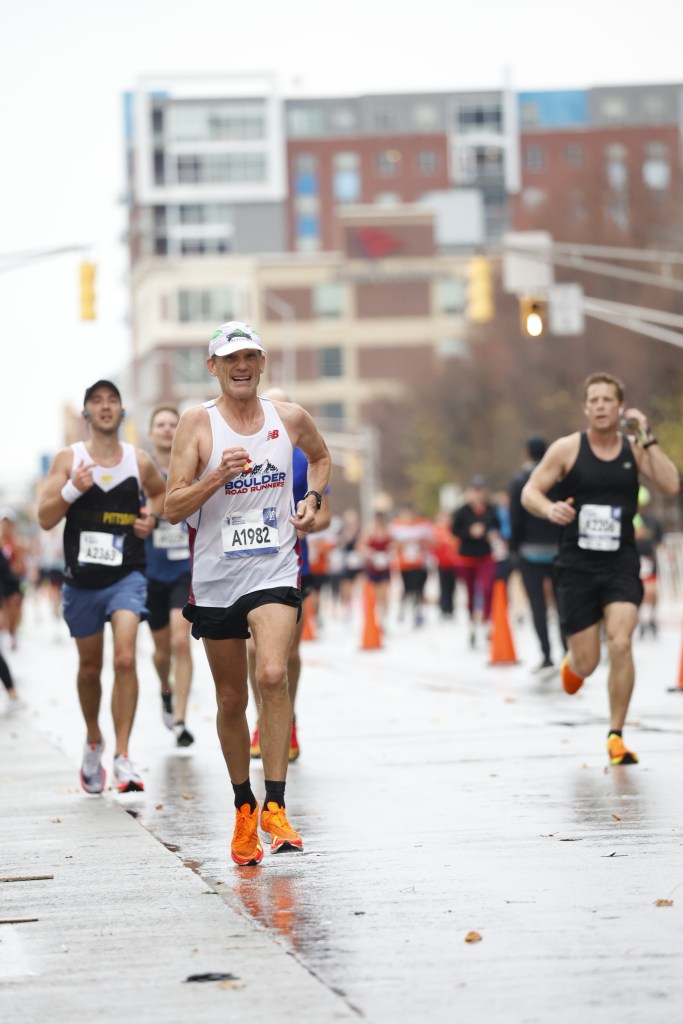
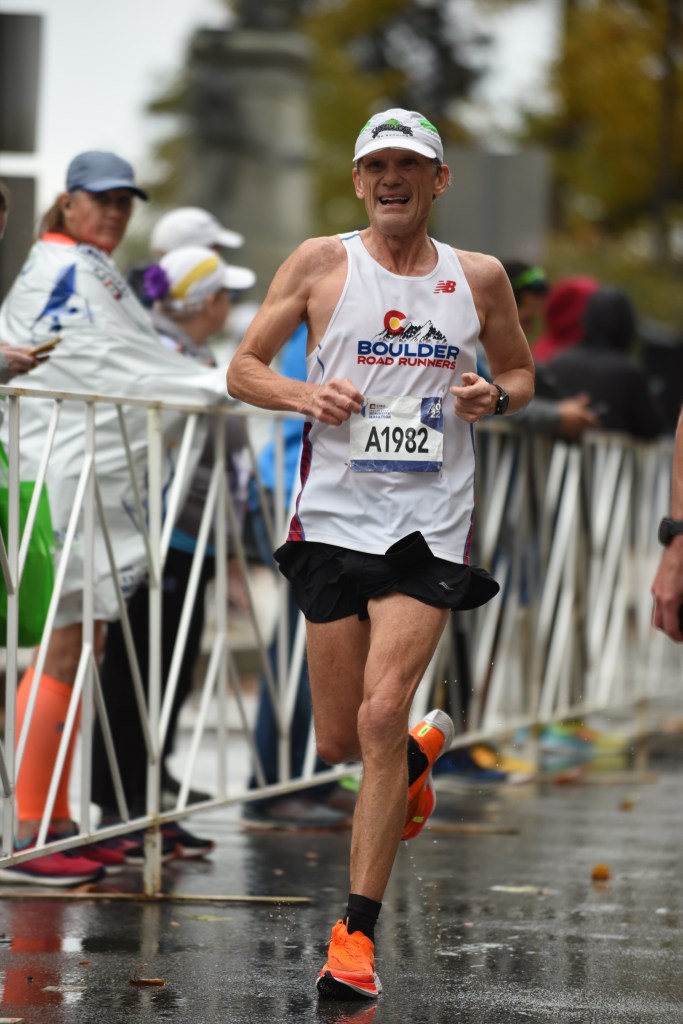
And last week was last week. I ran better than any of my three previous attempts, steady and in control through 23 miles. Yeah it was getting harder after 20, but 7:00 was not bad and I was confident I would hold that. Nope. The wind was my wall. Hats off to the dozens of runners who could and did hold the pace to finish under 3.

So I’m a bit perplexed and downtrodden. This was a good effort, at 85.7% age grade on a bad day, that’s a 2:22 equivalent. Nevertheless, it still feels like a failure of sorts because I did not get the job done.

And got my ass kicked in the age group department as well, finishing more than 3 minutes behind a competitor who DID manage to hold onto race pace through the gale and rain over the final 3 miles.

Here’s a bit more about that. Who was that guy? I did a little sleuthing and a little more. Very surprising results. He (Jeff) ran a 3:19 in 2018, and 3:07 at Boston in 2021 (hot and humid), but Indy was an 8 minute PR. That’s huge. I also found a smattering of other results for this 64 year old (same age as me), and he did have a couple ultras (50 milers) but other race times well behind what I have been consistently doing, so 19s for 5K, low 40s for 10K, and high 1:29for the half. Congrats to that Jeff! And he’s going to be a force to reckon with next year once we turn 65.

My 3:01 was the third fastest Men’s 60-64 time in Indy’s 15 year history. But it was 2nd place on a day I would have been certain that anything under 3:05 would probably win!

Fail?

Although some friends might think so, I don’t see that as a failure at all. I did not meet my time, but competitively I ran a good race. Jeff just ran better through the finish. You cannot control what others do, especially in a big mass event where you often do not even know where they are out on the course. Moreover, in a marathon even if you are an elite, you still have to run your own race for that day.

So I’m coming up short. Some friends have said that maybe I should consult “more successful” age group marathoners. As if they’d help!

I think I’m doing the right things, with a mix of consistent mileage with requisite long runs and workouts, including marathon pace. Could I increase to 80 mpw? Or would that be too much? Should I add in more marathon pace, say 10-12 miles in a 20 miler? Or is that too much? Those are some of the things I’ll try to sort out over the next 6-8 months, before my next marathon build.

In the end, I don’t count any of these as failures, I just did not break through.

Dissecting Indy

That was a whirlwind trip to Indianapolis for the Indy Monumental Marathon, with barely 24 hours from landing to take off and 26.2 rather difficult miles of running. And I must admit that I’m still trying to reconcile with what happened.

The big story of course was the weather with a massive front moving through the country over the weekend, hitting central Indiana just as we were lining up on Saturday morning. Temps in the 60s (not bad, could be worse could be better), some rain (also not bad, depending), and insane winds steady at 15-20 mph on Friday and Saturday and gusting to 40 at times. That was the story.

My training block could hardly have been better as I ran a dozen weeks in the 65-73 mile range, had five 20 mile plus long runs, and the only glitch was catching a cold three weeks out and it took two and a half weeks for that to clear. This was one of my most solid and consistent marathon build-ups and there is not much I would change other than maybe polorazing a few of those weeks to something like 80-60 rather than 66-73. But really, who knows if that’d make a big difference in overall fitness.

Nevertheless, I felt I that I was in 2:56-2:57 shape going into Indy, and maybe challenge the age group course record of 2:57:07 set in 2018.

The Goal

Sub 3. Not for a Boston qualifier, at my age 3 is well under the standard but to run a sub 3 at age 60+. Sub 3 is something I have been chasing for five years (last one was a 2:58 in spring of 2017), with four attempts: 3:12 at Boston in 2018 (facing wind, rain, and cold), 3:02 Grandma’s last year, and 3:00, Boston last spring. In each of those races I had the fitness to run sub 3, but just didn’t put it together. Well my first Boston was a gargantuan weather shit show and everyone was off their pace by a lot that day. Grandma’s and 2022 Boston were in the would-shoulda-coulda category although I do think I gave both my best effort. Just a small lapse at mile 24-25 cost me that sub 3 last spring.

The goal of of sub 3 also plays into things like longest duration between sub 3 (only 10 or 11 so runners have spanned more than 40 years). At 39.5 years, this would put me in the top 15 of all time. In addition, there is the five decades sub-3 category (5DS3), which is a little more attainable if you started late in the 80s and can hang on to early 2020s. I ran 2:34 in 1983, 2:44 in 1999, 2:54 in 2008, and that 2:58 in 2017.

So yeah, to me this has been a big goal for the past few years.

Travel and Prep

The trip was relatively smooth. Maybe could have flown out Thursday and had all day Friday to relax (my fancy Garmin told me that Friday had been a high stress day); HR in the 100s on my flight as we hit a fair amount of turbulence over Kansas and Missouri as that front was making its way eastward! But again, with a 2:15 flight and only one hour of time change I felt arriving the afternoon before wasn’t too bad.

Got checked in, picked my packet at the expo, and did a short shake out run by the Convention Center. Dinner at 6, just a couple blocks away, and relaxed for a couple hours before turning in at 9:30 Central. Sleep, sometimes an issue before a marathon, wasn’t too bad and my biggest source of anxiety was not the distance or the weather but knowing I would only have an hour between finishing (assuming I was finishing in about 3 hours) before having to check out, and the finish area was 1/2 mile away from the hotel.

Early morning I had breakfast of a bagel, oatmeal (granola bar soaked in hot water), and some caffeine. I listened to some psyche up music, with Eminem’s Lose Yourself, Led Zep’s Battle of Evermore, and Black Keys Lonely Boy as the headliners, followed with a looping version of Depeche Mode’s It’s No Good because I like the beat.

It started raining about 30 minutes before the start and the wind kicked up, just as the forecast predicted.

The Race

I put it all out there and held pretty close to plan. If I could do it again maybe would have stuck with Plan A, which was to run the first half at pace, but controlled so to have plenty of energy for the second half. I thought 6:45+/- was a good pace, but from 13 to 15 or 16 I was thinking about easing up to about 7:00 to see how that goes–all I’d need to do is run 7:00 for the second half and I could finish under 3.

The first half went right according to plan, although I never felt comfortable. It was still very dark over the first couple miles, and with wet pavement, and a thicker crowd of runners than I had anticipated the first 5 miles were like driving through heavy freeway traffic during a wet rush hour. However, my breathing felt fine and if I did pick up pace a bit, I’d drop back some.

Once we got out of the city center and onto straight streets, heading north things opened up a bit, and when the half marathoners split off at about 7, we were more into a line two-three runners wide, not 10 abreast in a big crowd.

It would rain intermittently, but that served as cooling effect so was mostly fine with that. I did notice that the trees and branches were not bending substantially from the wind, and the short headwind sections we had in the early miles didn’t feel bad, so maintained some hope that this would hold on our 90 or so minute return to downtown.

My pace was fairly consistent and I was keeping my heart rate below 145, so that first half could not have gone better as I came through 13.1 in 1:28:23, 6:44 per mile. I had been running with a group of about a dozen runners for several miles and we turned back south at about 13.6 miles. And this is where I had to make a decision, to stick with Plan A and back off the pace a little to conserve some energy for the finish, or stay with the group and draft as much as possible.

I stuck with the latter. It did not make a lot of sense to back down, because I would be losing some ground at 7:00 pace but for the most part would also be bucking the wind on my own as the group pulled away and other people would pass and gap me. So I went with the pack. I don’t know if this was a fatefully wrong decision or not. Our pace only slowed slightly into the wind (which wasn’t all that bad yet), running 6:45-6:50. However, looking at my heart rate data after the race, even though I was drafting most of the time (80% at least) my heart rate was now into the 150s, which is getting into threshold effort. I knew I was breathing harder and hoped this would be sustainable. We hit some decent rollers in the 17-19 mile range but I got through those just fine.

The roughest patch so far was mile 20 which was on a bike path more or less directly into the headwind, and I found myself in no man’s land for a bit. But tucked in with some other runners, holding a 7:00 pace and not feeling too bad as we turned to east for several miles.

From mile 20-23 I really though I’d hang on and be well under 3. Was running right at 7:00 pace and was at a projected 2:58, and it seemed like my energy level and stride were holding just fine. I took a final Maurten gel at 35K, just 30 minutes to go!

I think I was feeling it by then as our pack had dissipated, as some runners pulled away, some others were catching me, but I was passing people as well. Holding on.

At 23.5 we turned south on Meridian Boulevard, and I only needed to cover 2.7 miles in 20 minutes. I didn’t do the pacing math, but figured I could hold whatever it took. Within just a couple blocks, however, I knew I was in trouble. The wind was just horrible (20-25 mph sustained with higher gusts) and I just could not move through it. I tried focusing on stoplights ahead to keep focus, and a times tried to latch onto passing runners, but anyone passing seemed to be heading for the barn at 6:30-7:00 pace and I could no longer do that. So no drafting, and with that wind my pace slowed to 7:50s.

The most disheartening moment of the day was when the sub 3 pace group, a peleton of 50 runners, went by with maybe a mile and a half to go. I tried to hang, but they also were moving too fast and I didn’t even make it a city block in their slipstream. At that point I knew I wasn’t going to break 3.

All I could do was to keep running and not give in to walking. I had no kick or energy at the end. I felt defeated as I crossed in 3:01:16. Walked maybe 50 meters before I started uncontrollably dry heaving for a minute or two, so I laid down on the wet pavement until the guy from the banana table helped me up and sent me on my way toward the gear pick up tent. I just talked to one person, a guy whom I had run with from about 9 to 22 miles before he pulled away. Other than that I was just in my own silent disappointment and slight nausea. Marathons, we do these for fun?

I did make it back, slowly, to my hotel and got to my room by 11:40 with barely enough time to shower and get dressed before the noon check out time.

Aftermath

I don’t know, that was rough. I do think I really put it out there but the weather did me no favors. Of course there were other runners, who I had been with through 22 miles, finishing 2-3 minutes ahead but I just think that stretch just hit me as my reserves were on E. Under less extreme conditions for the finish of a marathon I think I could have hit 7:20 and held on.

A couple things I could have done differently would be to stick to plan A and slide back a little until I got picked up by the sub 3 pace group, they were probably no more than 30-40 seconds back on the return. I could have drafted more when the going got really tough. I also could have programed my watch to bleep when I got into the mid 150s so I’d know I was redlining or about to. It was at 159-160 on miles 20-22, that’s getting toward 5K level of cardiac output. But at the same time, marathons are also about keeping momentum, and I did not want to lose the good flow I had from mile 5 to mile 23.

So who knows? It’s over and I have to move on. Maybe someday I’ll pat myself on the back and tell myself that even though I came up short it was still a heroic effort on a very challenging weather day.

I’m not there yet.

Looking forward to eight or nine months of non-marathon training.

XC Crash and Burn

I don’t think an off race is necessarily great for the soul or a profound learning experience unless you find something along the way that generate those outcomes. Often a rough race is just that. Nevertheless, it was somewhat frustrating to not be “on” for race day. It happens.

My primary goal races this fall were the 12K road championships in New Jersey last month and the upcoming Indy Monumental Marathon. The XC championships in nearby Boulder would be final tune up and hopefully a feather in my cap, an opportunity to win another medal team (hopefully gold) and individual medal (any would do).

I was definitely buoyed by the 15K road race in early October, arguably the second best race of 2022, with an 87% age grade at mile high elevation, converting to approximately 90% sea level. So the fitness was there. Leading up, I had been tired and maybe off a bit but things clicked that day and I felt ready. The next two weeks were the best of this training block and I got in two 20 milers both with some marathon pace work–running sea level goal paces at altitude for 6-7 miles and feeling pretty strong.

Ten days before the XC champs I went to the race venue at Harlow Platts Park and did a fartlek-progression effort of 4X5 minutes at CV effort and 3X 2.5-3.5 minutes at V02. And I felt strong. However, at a week out (following my last 20 miler of the cycle) I felt a little achy when I got home and by was coughing. By Sunday I knew I had a cold. It was mild at first, with just some gunk in my throat but on Tuesday night I couldn’t sleep well. It wasn’t covid, but maybe the RSV that is going around. I took it easy for the rest of the week, hoping I’d be over it by Saturday. I wasn’t.

I lined up for the 2 PM start, 75 degrees, feeling a little out of sorts, not out of body but my head was not there. I would set the pace with teammate Mark, Tim wanted to his own thing and run for the win. We started out fine and my breathing was fairly good through about 1 half mile, but Mark picked it up and after that it was mostly a gradual slide backward. I picked off a few runners on along the lake and up up the first hill (just before the mile) and as planned accelerated on the long (400 m) downhill.

I nearly caught Mark and was only a second back. My heart rate average was a reasonable 145 through the mile. But by the bottom my breathing went to hell, and I knew the last 3K would be rough.

Turns out my HR had climbed to the 160s, which is above V02 max, just under my maximum of about 165. And I would run the rest of the way under this duress, even though my pace had slowed to tempo on on this already slow course (6:50s). I held onto 4th for the age group through two miles but a sea level runner caught me and I didn’t have much fight. I tried to keep in contact over the hill and accelerated again, but could not hold that effort and fell back.
With three of us in the top five I knew we had the team title locked which was great. However, with just 400 to go another runner from Boulder–who I think has only finished ahead of me once in 8 years (and that was my first race back here in 2014, on the same course no less, when I wasn’t yet altitude acclimated).

I finished roughly and commenced hacking, wheezing, and sneezing for the next 24 hours. The effort set me back four days, symptom-wise. Fortunately, however, I bounce back by Sunday afternoon and have gradually improved since then.

We took the team title, which was a big goal. That’s three wins and a third for the team on races I have done this year and we take 2nd in the best of five series for 2022. Not 100% what I wanted, for this race or for the series but that’s racing. Some days you are on fire and some days your lungs and throat are on fire.

I’m not sure where the future holds for the team racing, let alone the USATF Grand Prix Circuit but no doubt I’ll be lining up for some races next year.

Racing Strong While Cranking Out the Miles

Actually last week was not a huge one volume-wise with 65.8 miles, but I did have two big lifts. I was very tired from the previous week, when I ran 71 miles following the 12K race and East Coast trip.

Following that I took Monday off from running and only did 20 minutes on the bike trainer to flush out my overtired legs. The week included two very easy 6 mile trail runs and no actual workouts (interval or tempo runs). However, on Wednesday I did 22+ miles in 3 hours (at sub 8s), which was necessary for next month’s marathon. So backed down a bit, but certainly was not a recovery week.

On Sunday I had a 15K training race.

I call it a training race because I’m kind of worked through it with minimal cutback, but the effort is more than just a workout. It was an equivalent to a mid-term test and my plan was to run about two miles a little slower than goal pace, then see if I could settle into a stronger pace and see how long I could hold it.

There are often several half marathons a week in Colorado, and I often do a half during marathon build-up. I also like the idea of doing a 15K or 10 mile because those are not quite as taxing as a half. It gives you just as much information but recovery is much quicker.

The Race

The event was Denver’s version the Hot Chocolate 15K (they also offered 5K and 10K) at Washington Park, a few miles south of downtown. Wash Park is one of the best places to run in Denver and I thought the timing for a test effort was ideal.

The course is fairly flat with some rolling, but it has less than 200 feet of vertical over the 9.3 miles. That’s as good as it’s going to get for a circuit type course here. Race day weather was also about as good as possible, 53 F, a little humid and overcast, with little or no wind.

They started the 5K first and there were many thousands in that race, going off in waves. Forty minutes later the combined fields of the 10 and 15K races lined up with about 1600 runners. I lined up near the front, in the past this event had offered prize money and enough to draw in some elite runners. I felt safe lining up in the 2nd row. The goal was to run 6:30-35 pace for 2 miles and then into the 6:20s with the hope to break 60 minutes (6:26 pace), which would be a very good day at altitude (86% age grade).

After the initial shuffling around over the the first few hundred meters I tried to keep my pace and effort in check as we wound through the park and passed the mile in 6:33. I found a pack of four other runners in the second mile and tucked in with them. As we rounded into the mile 2 (12:00) one of the guys just ahead moved ahead so I took the pacing duties. He was the only one who went with me, running a couple steps behind as we picked off a few fast starters while a couple packs ahead pulled away.

The second chase pack in the 2nd mile at Washington Park.

Tamara my cheerleader said I was in 18th, but I knew several of them would be running the 10K. And sure enough I saw the lead groups make the turn around; the guy I had been running with said he sort of wished he had run the 10K instead of 15. We ran side by side through 5K (19:51) and onto the 1st Avenue out and back. He gapped me by a bit on the long almost straight 1.5 mile stretch from the turn around to Speer and the second turn around near 6th avenue. A woman runner was about 5-6 seconds ahead, holding a steady pace. We hit a couple 6:20s in there and I knew I was under 1:00 pace! And feeling decent. Just before the turn-around at about 5.5 miles the road dipped under a wide under pass (at least 200 meters wide). I stretched out my stride and caught the woman as we made the turn.

The next 1.5 miles was a gentle climb (about 80 feet), so would offset the net downhill we had enjoyed for a few miles. My pace slowed but I kept up the effort, although told myself that the half way point is 10K, not 7.5K. Came through 10K in just a tick under 40, 38:58 on my watch (38:59 officially). And felt pretty good through 6.5, but then I could feel the labored breathing come on as we had a hill just after turning off Speer Boulevard/ 7 miles in.

Soon we merged with the 10K runners, those running slower than 10 minute pace. There was a bike lane to the left of the lane the runners were taking, so rather than dodging and weaving around a relentless stream of slower runners on the course I took the bike lane, and that was a good choice. And I only merged when I had to as we moved to Downing Street at mile 8. I was laboring pretty hard at this point, and if it had been hot or if I had gone out any faster in the early stages I would have slowed considerably. Here it was only somewhat of a slowdown with a 6:34. A guy passed me (moving at low 6s) with about a mile to go, which gave me some focus even though he was pulling away. The 9th mile was a 6:27 and I managed to kick in at 6:05 pace to finish officially in 59:33.

Is that a smile or a grimace? Had stomach issues over the final 0.1 mile.

So 6:24 pace. I’m pretty happy with that! 87.05 age grade and depending on which altitude conversion factor you use, it’s arguably 90% (NCAA conversion formula would have it at 90.2%). If I use a 10 second/mile slow down that’s still 89.6%. So I’m calling it 90, which is as good as has been this year with the Syracuse half and altitude mile in Boulder as the other races in that range.

Fitness-wise it puts me onto a realistic sub 3 hour marathon range and that’s the primary goal for this fall.

Coming up Short

Background

The By Hook or By Crook 12K on Sandy Hook, NJ was the penultimate event of the eight race 2022 USATF Masters Grand Prix road and cross country series. And we had everything on the line. Our masters age group team, the Boulder Road Runners, had been leading the series, comfortably, all year. However, Shore Athletics of New Jersey, the race’s host, had been running a stealth campaign. By May we realized that we would need to finish first or second in this race–or beat our East Coast rival team. If they won or beat us by two spots they would take an insurmountable lead into the final race next month at on our home course. It was that simple.

Although we have (arguably) the best 60s+ team in the country, with the most depth, getting three healthy runners to line up and race has proved most challenging. Adding to that, the Pikes Peak Marathon and Ascent were scheduled for the same weekend. That immediately took out two of our top three runners. In our favor however, the rival team would also lose its top runner to Pikes Peak.

Early in the year I decided to run this event, one of only two in the fall (the remainder were in the winter and spring), but Mike was the only other teammate committing to the 12K. At team meetings in the spring and summer I did some cajoling and asking for others to step up, but maybe was not emphatic enough. Adam was the only one who expressed a serious interest but he had an event scheduled for the day before, so travel would be a challenge.

After some last ditch asking around in August it actually looked like only two of us would be traveling to New Jersey, but Adam’s event was moved to another date and he would join us. Just three amigos, up against the host club large enough to field an A, B, and C team.

Who would come out ahead?

The Match Up

On paper we were confident we would match up well against the host. We had beat them handily at the half marathon championships in March, with me going 1:21, Adam 1:26, and Mike 1:29 to their 1:19, 1:31, 1:32. However, in Syracuse they were missing Michael, one of their top consistent runners (he ran 47 minutes in the 12K last year), and they had a couple of newcomers. In 2022 Henry has been running as well as Rick their top runner–the one doing Pikes Peak. Henry has run a 5:08 mile, 17:15 5K, and 2:55 marathon this year. We didn’t have much info on the other guy Carl, but Adam felt confident he could beat Michael and Carl. We were hoping for something along the lines of 45, 48, 50 for the three of us, compared to 44, 48, 50 for the other guys–comfortably in second place and we all had a good day maybe a first and thus locking up the team title in our favor.

Personally I came into the week hoping for another Silver medal to match last year’s (by 0.2 seconds!), but at the last minute Nat from another East Coast team signed up. Nat has been setting records and winning everything in sight since turning 60 over the summer. So Bronze would be the best I would do.

I chose not to look at The Running Professor’s blog on the night before and I’m glad I didn’t. He predicted that Nat, Henry, and another 60s newcomer Jeff would go 1,2,3 for the age group, leaving me the eldest of the bunch (turning 65 early next year) out of the medals.

Time-wise I was hoping to improve on last year’s 45:51 which was a pretty good race, but I felt ready for a 90% age grade this time (would need a 45:30). I do think I was in shape for that, but the weather did not cooperate. For strategy I had a combo plan, not to get sucked up into too fast of a start but also to keep in contact with other top runners in my age group, particularly Jeff whom I had not raced as well as a Ken and Rick who are in the 65-69 age bracket. The often go out fast, last year Ken was a good 12-15 seconds ahead of me at the first mile, which I did right at 6:00.

Sunday was the warmest day of the week and by the 9:30 AM start it was 70 degrees with 88% humidity (dew point 64) with a 12 mph crosswind that favored runners going out, but more of a headwind on the return. With that tailwind at the start, I thought I might have some leeway, but plan was 6:00-6:05.

The Race

I was bumped back to the 4th or 5th row at the crowded start. Took a step after the gun and started my watch as I crossed the first timing pad. First mile was fairly fast, Ken was just a few meters ahead and he was chasing two or three very quick starting women in the 55-59 age group as the pack strung out. The two leaders in my age, Henry and Nat were 100 meters ahead in no time, and I could see the orange bib of Jeff as we rounded the first turn at about 0.8 mile. He was already 15 seconds up and I figured I was in 4th. I crossed the mile in 5:57, a little faster than I had wanted but we had the tailwind and Ken was 5 or 6 seconds ahead and those women were right at 5:50 or a little under.

Normally I’m couple minutes ahead of those women in a race 10K or longer, so what the heck was up!? The were actually leading the entire women’s race at that point, along with the eventual winner who was from the 40-44 age group.

There wasn’t a lot of movement in the second mile as everyone maintained their position, but I could see Ken slowing up, dropping off the pace of the fast-women. I was at 11:56 at 2 miles and passed Ken soon after, he said his hip and hamstring were bothering him. I encouraged him to keep going. The pack with the lead women was just ahead and I set to work on that group, Jeff was about 20 seconds up. The other guys in my age group were way out of sight. Could I catch him for a podium finish?

By the time we got to the turns at the far end of the course, with a couple of ups and backs, I had passed the pack with the lead women and had gained a little bit on Jeff. After 4 miles we hit a stretch of bike path and by the time I got off that and onto the road, I was gaining quickly on him as he fell off. He walked a bit and I caught him near mile 5. Trying to hold steady, I was feeling hot but also that headwind. I knew I was slowing but by this point it was just a matter of keeping a steady effort. There were two guys just ahead. I caught one (Atlanta TC) in the 6th mile but the other stayed just 5-6 seconds ahead. We turned west and my 6th mile had slowed to 6:20 (36:40 split), and into headwind. My watch read 38:01 for 10K. I took a sip and dumped water at the final aid station, choosing not to look back as we made the final turn with just under 2K to go.

Then it got hard. I heard footsteps, I tried to pick it up, but they kept getting closer. It was the lead woman, she was in the 40-44 age class. I stuck with her for maybe 0.1 of a mile, but with just a mile to go let up some and she gapped me. This would be my lapse for this race and I started running on my heels, always a bad sign. I was breathing hard and feeling the heat. I decided to just relax a bit and not let anyone else catch me, but this is the same stretch where Joe caught me last year and we had our epic duel for the Silver and Bronze.

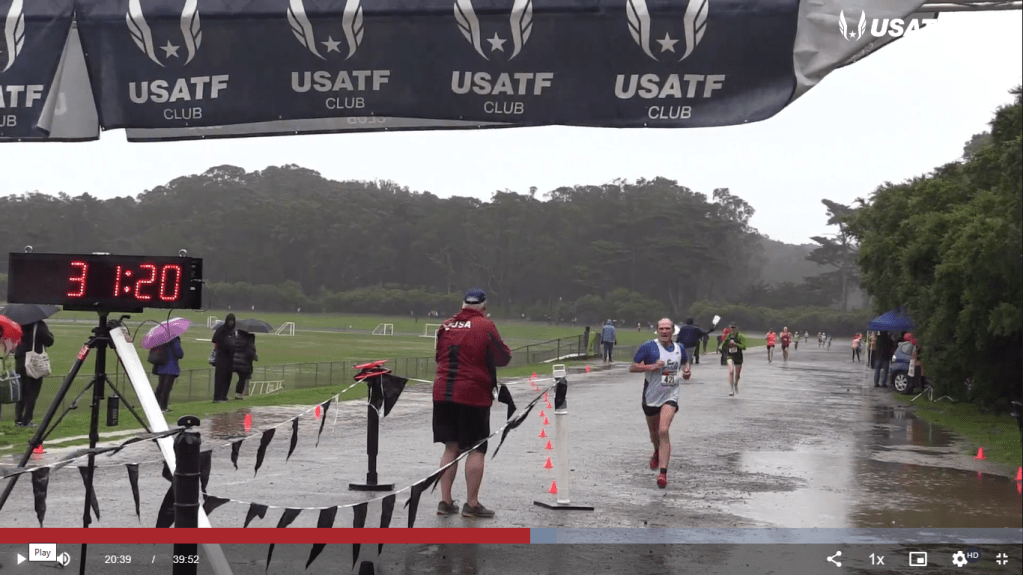
There was no one behind me. However, with a half mile remaining (following a 6:36 7th mile) I heard more steps. It was the Atlanta guy (age group 55-59) whom I had passed in the 5th mile. Enough lagging on my part I would not let him get ahead, and I picked it up back into race pace (which was about 6:20) and he stayed there just a few seconds back. And with about 400 to go I ratcheted my pace up and started a full kick with over the final 200 or so meters. Crossing the line I was surprised to have lost so much time and to see 46:20 on the clock, a full 30 seconds slower than last year.

That was a little disappointing, short of my goal of 90%. It was that 6th and 7th mile that did me in for any time goals. Nevertheless, everyone had the same conditions this year and maybe I could just throw direct comparison out. I did hold on for the Bronze, as Jeff finished some 25 seconds back.

That was my 14th USATF individual medal in the past five years. In that time the only time I did not finish on the age group podium was when I was injured at the Tulsa 15K and had to walk-jog the last 5K to ensure that our team could hang onto 3rd place that day, as well as keep on the Grand Prix podium.

How would we do as a team?! Adam crossed a couple minutes later in 49:30, that was slower than he had wanted but he looked strong. I chatted with some other runners but kept looking for Mike. Shore’s second runner was 2 minutes behind me, and then there third and fourth rolled in, just after 50 minute. No Mike. By 55 minutes I knew Mike was in trouble and so were we as a team.

I wandered back onto the course several hundred meters and found Adam, someone indicated that Mike was walking some fairly early into the race. We were shooed back to the finish line by an officical, Get some water she admonished us! People are collapsing out on the course today.

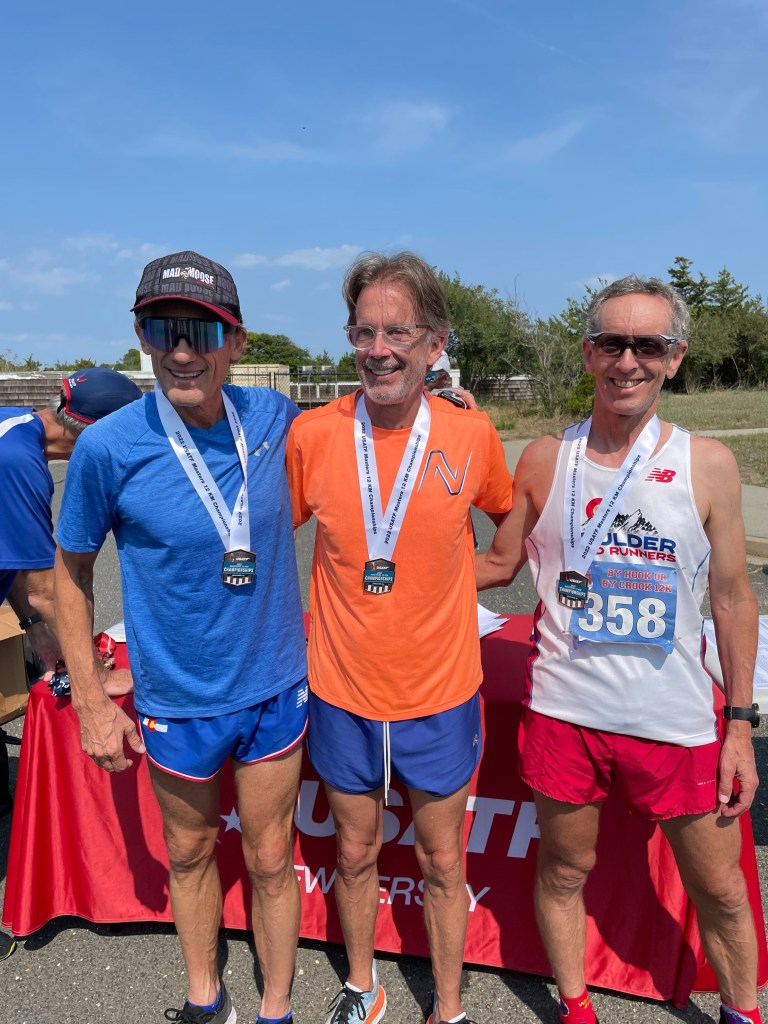
At just over one hour we spotted Mike, jogging gingerly. He had pulled his hamstring. He apologized, but even though that dropped us down to third in the team standings I felt there was no need–I have been there, a lot of had. The three of us showed up and ran to our best on this day.

If there is any disappointment with Sunday’s outcome it is that we could not get a fourth runner. No one else could or would make the trip. We all have our own agendas in a given year, and can’t make every event, but this was one where we really needed some help. The best we can do for the year is a second in the Grand Prix.

5K languish continues

Although training has gone well summer, with three months of 60-70 mile weeks now, and I have had a smattering of good races over the past couple of years I have not put it together for 5K since 2019. That was my last good year for 5K, when I ran 17:28 on a hot hilly course in Atlanta for a USATF masters championship and a couple months later 18:06 at 5000 feet elevation here in Colorado.

A few weeks after that I developed an injury, followed by several months of rehab, a global pandemic, and eventual gradual return. I have not done any 5Ks at sea level since Atlanta 2019, and best results at altitude in 2020 and 2021 were no faster than 18:45.

This July I managed a 19:07 in Fort Collins on a fast course and 19:28 in Denver on a slower route. For those efforts I was just getting my base back following recovery from the Boston Marathon in April and a bout of covid in May. Now with another two months of base work/marathon training and a 5:26 mile on the track last month. I felt ready for a 5K breakout this week as a final tune-up for next week’s 12K road championships. So not only was I hoping for a season’s best and sub 19, but a best in three years, i.e., 18:40 or faster. Why not?

The base is there, and now the speed. But I’m jumping ahead.

Snippets from the Training Block

With a marathon in November I only dallied in speed training in August but it was enough to enjoy a pleasant surprised with that mile.

I have not done much 5K specific training this summer, but have consistently hit that range of pace (around 6:00/mile) in progression workouts, including a challenging Michigan workout the other week–5.5 miles of faster work with alternating track repetitions, each shorter and faster, each interspersed with a tempo mile. I hit 6:10, 6:00, 5:55, and sub 5:20 for the 1600, 1200, 800, 400, on the track, and the tempo segments were at 6:22-23. That workout at 5500′ elevation indicated I might be in 18:30 shape.

However, since then I have been a little tired. And while I kept up the mileage at 68-71 miles a week, with long runs of 16 to 20 miles, I have backed off some on workouts. I have been running on tired legs, but also felt ready to take on a hard 5K effort this weekend. I decided to work through this race (with a seven day running total of 74 miles through Friday) but ran an easy double on Thursday only ran 46 minutes at 8:30 pace on Friday. So I felt reasonably ready

Race Day

Weather has been quite hot–record breakingly so–over the past couple of weeks, with highs in Denver into the upper 90s every day, and even to the mid-upper 80s up in the foothills. However, on Friday, the temperature dropped precipitously and did not exceed 60, and by Saturday morning it was raining and misting and only in the mid-upper 40s. Good racing weather, and while warming up I was lamenting that this wasn’t a cross country race. Perfect weather for that!

The course wrapped around Sloan’s Lake in Denver, with some twists and turns. In fact this year’s version, altered due to some construction in the park, featured several (I think) rather ill-placed hairpin corners. One at 0.1 mile after a downhill start and another at 3.0 miles. They easily could have eliminated those turns if they had us go southeast from the park to the lake path, and then we would go into the park at an easier angle at the finish. Made no sense.

Also, with the construction on the south and southeast side of the lake path they had to re-route us to the road for a couple of blocks. Again, there were a couple of sharp turns and curb hops to navigate around that. That’s not really the race’s fault, but just another thing. And finally, at about 2.4 miles you have this jetty with a couple of weird zig zags and yet another 180 degree turn. This is a typical feature of the course and I’m not sure why they do that other than to add on a few tenths onto the loop.

Everyone running the race has do navigate these diversions, but time wise each of these will add a second or two onto your race time. Otherwise, it’s a fairly flat and fast course on cement bike path.

We lined up at were off at 8:30. I tucked into about 10th place right away, but after that first hairpin a slew of runners shot past.

Off to a fast start!

I checked my watch a couple times over the first half mile and saw some 5:45/5:55 instantaneous paces, so I tried to check my speed. I wanted to go under 6 for that first mile, and run a little more aggressively than my previous outings this summer (going out in 6:10-6:20 on those occasions). Within a kilometer the most other other runners (except one) who had shot ahead early on started coming back one by one.

There was no mile marker by my watch buzzed at 5:58, right as we hit the construction detour and a slight incline onto the street. I was probably in about 12th place, but already feeling the pace. And I figured sub 6 would be a stretch today, so I just tried to maintain effort for the rest of the way. I picked off a couple more runners as we rounded around the south and west side of the lake at 2 miles (12:12).

At the jetty out and back (about 0.1 mile each way) I tracked past most of front field (the race leader was already well on his way to the finish). Back onto the main bike path with just a half mile to go the next guy up was a good 20 seconds ahead, but I had two whom I had passed in the second mile in fairly close pursuit (within 5 or 6 seconds of me). Wasn’t feeling anything great but knew I could hold this effort and have a little more for the kick. And I would need it!

As I rounded the final turn at 3 miles I could see one of those guys just 3-4 meters back. I maintained my effort for a few seconds, then increased my cadence on as we rose a few feet in elevation, as I neared the crest with less than 100 meters to go I tried an all-out sprint and thought I had him. But with maybe 40 meters to go he popped a strong surge and got a couple steps ahead in an instant! I can’t do that anymore, and could not respond. Initially I as annoyed a bit, no one likes to be outkicked, especially with such a short distance to go. But that’s racing and if I had wanted to put him away I should have done so earlier than I had tried.

I hate getting outkicked!

I finished in 19:09 and 9th place. The time was 20-40 seconds slower than I had hoped to run. Again, I was disappointed at first but as the day wore on I figured it was a decent enough effort.

I had splits of 5:58, 6:14, 6:17, and 40 for the final 0.1. My heart rate was at the 150-52 range (>90% max) for the final 16.5 minutes of the race. So I ran at my max. Looking back, going out a little less aggressively at the start (say 6:05 pace) might have left a little more in the tank for miles 2 and 3 and an overall faster finish. However, then again it is sometimes also good to test your limits at a low-key 5K race.

As far as age grading, that was an 85.8% age grade and easily the best overall for the day (second best being an 81% by Jay another competitor in my age group). Converted to sea level that would be an 88.3% and and 14:31. So considering that I worked through this race, it’s not bad at all. The fitness is there, even if the 5K sharpness is not. It was a good day!

Thanks to the Denver 5K crew and volunteers for making this a good quality event for the city.

A Tale of Two Miles

Excluding a few injury-bound years over the past 35-40 years I have raced or time trialed a mile or 1500m almost every summer. Going back to the mid 1980s I think I missed 1997, 2002 and 2003 due to injury and maybe just skipped 2015 and 2016 because I was focused on other distances. Running a mile all out is a good benchmark, but I don’t always like it.

I actually enjoyed racing the mile from the mid-80s to early 90s, and learned to embrace and channel any pre-race anxiety into excitement and running at top end speed for some four and a half minutes.

However, I was never a star miler, and never even came close to breaking 4 minutes let alone 4:20. My altitude converted all-time best converts to a more modest 4:26.

Colorado Mile Season

July and August are mile season in Colorado. Each week you can find a couple mile/1500 m races on the Front Range. I opted out of some of the bigger ones this year. I started with Boulder Road Runners (BRR) summer track and field series 1500 m on August 4, and the Carnation Mile in the Denver suburb of Wheat Ridge nine days later. The 1500 went better than expected and I decided to enter the mile at final BRR meet on the 18th.

The Carnation Mile

This was a low-key road mile on 38th Avenue in Wheat Ridge, on a point to point course. We had an 8 AM start on one of the hottest weekends of the year. We arrived early and I jogged the course to get a feel for the course. It was fairly flat but had a couple of low grade slopes at about 1/2 mile and at about 3/4 until the final block before the finish. The course only gains 21 feet in elevation, but at 5,400 feet in elevation those small risers were the main factor.

In the middle of my warm up, at about 7:35, the race director announced there would be a delay due to some issues setting up the automatic timer at the finish line. So I wrapped up the last few minutes of drills and strides and waited. 8 o’clock rolled around and passed, she announced they were still working on it. I did not want to have an over extended warm up so like most everyone just stood around waiting, figuring we’d get a 5 minute heads up.

Nope. At 8:15 they said to line up, they were ready to go. I had enough for a quick half block pick up and jog back. Maybe 30 seconds of moving and they lined us up. They had a wave start format, not unlike mid-pandemic, 25 per wave based on estimated finish time. I submitted a 5:30 and was seeded 13th (#13 on the 13th), and was hoping to run mid-low 5:30s and maybe win the masters division and $75.

The race

No gun, and she just said rather quietly on your marks, set, go! We had a wide street to ourselves, and unlike in single or double file as in a track race we were spread out across 60 feet of boulevard.

Former US champion road racer Fernando Cabada (2:11 marathon personal best) took off like he had a rocket pack and everyone followed. Even though I was a ways back I think my first couple hundred meters were fast. By a third of the mile, however, I could feel that my legs were tightening already. And breathing wasn’t great. The finish banner looked no closer than when we started and I knew that the next 3 minutes would not feel good.

Start at the Carnation Mile

I had noted a spot about a half mile from the start but did not check my watch. The banner was still a long way off. At least a minute or more seemed to have gone by and I figured we were approaching 3/4 mile so I did peek at my watch, 0nly 0.64–this was proving to be tough. And I knew I had little or no acceleration in my legs, and lungs were starting to burn.

Up the small incline and I could feel my pace drop off, no doubt to over 6 minute mile pace but there wasn’t much I could do about it. With Cabada far into the lead, a group of about six runners had pulled far ahead and were stringing out. I gradually passed two runners over the final third of the course, but the going was slo-mo. Finally, with just about a 0.1 mile to go, with the finish in sight, and more favorable terrain (flat), I accelerated the best I could.

In the stretch at the Carnation Mile.

Aftermath

Finish result: 8th in my heat (would finish 9th for the day as a young high school runner from a later heat ran faster), and 5:42.8. Third masters, and had netted a $25 envelope of cash and three carnations. My time was a good 5-10 seconds slower than hoped, and wow did this hurt more than most races.

I was once scolded by a former elite runner for discussing “hurt” and “pain” in a race, and he said I should coin it more as discomfort. For the most part he was right and for the past 25 years have taken that admonishment to heart. However, within a minute or two after crossing the line–and running through a lot of discomfort over that final half mile–I felt pain. In my stomach, throat, and chest. I started dry-heaving, and then my throat and chest seized with some asthma. The air quality was unfavorable with high ozone that morning and I think that’s what got me.

I couldn’t run for about 20 minutes before being able to jog lightly to the car to use my inhaler. Tamara and I used the winnings for breakfast. By the time I did a mid-day shakeout high up in the foothills, and away from the city air, I felt fine.

Post hoc takedown

This was a fun community event starting on the Carnation Festival parade route, and I hope that the tradition can continue and the race can grow. Offer prize money and good runners will show up!

I was disappointed in the time, and yes a bit surprised to undergo some discomfort that spilled into some actual pain (may 5 on a scale of 10) for 10-15 minutes following the race. I wondered how much faster would have if we had run the opposite direction. Maybe 5:32? 10 seconds seemed like a lot and I didn’t express that out loud, or online.

Boulder Road Runners Track and Field Series Meet #6, Boulder Colorado.

Thursday evening. I had been in a dark funk for the previous 24 hours and that only grew as the day went on. I even posted online that I now hated the mile and it was time to hang it up. I wasn’t having fun.

Arrived at Potts Field at 5:30, it was 85 degrees and sunny, with just a light breeze from the northwest. The CU Boulder campus under the Flatirons is always a nice setting so my mood lifted a little, and a bit better upon along seeing a couple of my teammates. We would be running a 4X400 relay later and that’s actually more what I was looking forward to.

Still, I wasn’t really looking forward to this mile.

I’d be in the slower heat and wasn’t sure what I would do, maybe 5:35-40?

After a warm up and strides, I lined up with the second fastest seed time in this heat, with a young girl on the inside and a 40 year old masters runner who had finished just ahead in the 1500 two weeks earlier. With 19 runners in the field I did not want to get tangled up, so as we waited for last minute instructions I decided to go out quickly for the the first 80-100 meters.

The race

The young girl in lane 1 started quicker than I did over the first 20 m and took the lead, and the masters runner tucked in behind her. I could sense others on my heels but I was firmly in 3rd over the first lap, the pace didn’t feel too fast or too slow. The lap clock was broken and no one was calling splits but I got a quick look at my watch at about 405 meters, and it was just turning to 81. Maybe a bit faster than I had planned but drafting behind others makes the going feel a bit easier. We rounded the third turn and on the backstretch straightaway the masters guy took over the pace, and I followed.

Another masters runner (just turned 60) was right behind me and the announcer said that the three of us were pulling away from the field. I just tried to relax through the second lap. I didn’t get an actual split but my watch timer was at 2:46 at half-way. Sometimes in the mile I feel a burning sensation in my legs on the second lap, as the lactate builds. On Thursday I felt fine and at 900 m in, I could sense that the leader was slowing, so I took over, and just ran to see what I had. Focused on my form and popping off my feet while running relaxed as possible.

I don’t specifically train for the mile, but through much of the year do some 15-20 second pick ups or strides while on a run or just after a set of longer reps or tempo run. So I’m not unfamiliar with the effort and biomechanics, just not used to holding that pace for several minutes at a time.

The sound of footsteps behind had fallen back.

Over the last lap I planned to wind up the pace every 100 m over the last 300, like I did in the 1500 two weeks earlier. But this time there wasn’t much acceleration left so although my effort increased, the pace didn’t. As always for the mile the final 100 meters were grueling.

Post hoc takedown

Crossed the line in 5:26.9. My best mile result since a 5:26 at the Pearl Street Mile in downtown Boulder in 2019. I only ran 5:33 in 2020 (solo time trial) and 5:33 on the track in Denver in 2021. This is encouraging for a number of reasons.

Summer of 2019 was the last time I really felt sharp and in shape, so to run a time in the same ball park now three years later was a surprise. Age grading it’s my best mile ever, 87.74% using 2020 factors, and if you account for the altitude 90.17.

After all of that negative thought for the day leading up to the race, as soon as the starting gun fired I just put it on autopilot and ran by feel.

So now will I quit doing the mile? Ask again next year.

4X400

Doing the end of season 4X400 was the big draw of this meet and the part I most looked forward to. I had more than an hour of recovery. Eight teams lined up under the twilight, most had funny names. At 60+ we were named “No Grabby Hammy” and running a 400 at our age you don’t want to pull anything.

I only have a sketch our splits, as my fancy watch did not record them, but Tim opened with a surprising 62-high. Mark brought it back with combined 2:12, I didn’t get Adam and my split but think it was at about 3:25 when I got the baton and crossed the line with a lap to go. Sprinted for 50 m, eased up a bit for about a 100 and then tried to accelerate slightly. I think I slowed on the homestretch. We crossed in 4:33.9, 5th place, which was about 20 seconds faster than we had anticipated.

After the fun with Adam, Mark, and Tim. No torn hammys.

Out of my brain on the train

Inside outside, leave me alone
Inside outside, nowhere is home
Inside outside, where have I been?
Out of my brain on the five fifteen
(The Who)

Following the Bix 7 last weekend I took it easy for a couple days and then overcooked myself on Tuesday, running 16 miles on a morning when the temperature climbed from an already warm 82 degrees t0 90 by the time I finished. I actually felt good through about 13 miles, then things got real as I could feel my core temperature and heart rate rising faster than Jakob Ingebrigtsen finishes a 1500. I did finish it out, but felt nauseous and wrought for the rest of the day.

After an easy double on Wednesday I ran a 25 minute shakeout on the treadmill Thursday morning trying to figure what lap paces to run for the evening’s 1500 m in Boulder. My only sub 6 this year was last weekend’s 5:47 final downhill mile at Bix, so I didn’t know what to expect. Add to that expected temps in the 90s. So figured 87-88 and then bringing it down a bit for the next to laps, with finish of 60 for the final 300. So maybe 5:18-20.

The race was part of the fifth (of six) Boulder Road Runners Summer Track and Field Series, which have been a staple on Potts Field since the early 1980s.

The forecast for Thursday was for a high of 93 in Boulder and about 89 at race time. Nope. At 6:30 PM the temp was 95. But it was a dry 95.

I was not motivated.

My teammate Adam showed up as they made the first call for the 1500 and said, “Be like The Who, 5:15.”

Took me a second because I have listened to that song maybe three times since the year 2000–but it clicked, Out of my brain on the train on the five-fifteen!

The idea was intriguing but that seemed a little fast given the conditions and my less than rested state this week. I didn’t think that was in the cards.

They lined up 10 minutes early and I almost missed final call, doing my last stride out on the homestretch (give me a break, hadn’t run a 1500 since 2010, only the mile). I think there were 13 runners lined up and I was seeded toward the end. Not only was I the oldest by 15 or 20 years, I think I could have been a grand parent to two-thirds of the field, and most of them were young girls 11-14.

Gun went off and I veered to the inside lane, maybe too fast not taking the entire 100 m tangent. Had a stumble as another runner cut in just ahead, he said he was sorry. I checked my watch at a 100 and was 20 sec, way too fast so settled back as the field pulled away. I must have been second or third to last at the lap (84) and a good 15 meters behind the next runners. So even 84 was too fast, especially on such a hot evening, but there I was getting left in the dust by the field.

I did not catch my 800 split but did cross 700 m at 2:28 according to the digital clock. I had picked up one of the young runners, and then another on the next lap. That was about it for passing anyone.

Picked it up slightly with a lap to go and around the curve, but planned only to start kicking with 200 to go. I tapped my watch at three laps (4:15) and set my sights on the next two runners still 15-20 meters up. With 250 to go, I did not feel like going into a full sprint yet so decided to wait until the final 150. On the curve I picked up my knees and cadence and worked into whatever I had for a sprint finish. I didn’t quite catch them but was close!

A volunteer came up an took my tag and showed me her watch time, 5:15!

Out of my brain, following the train!

In spite of the baking temperatures that was actually pretty fun and this month I’ll take two attempts at the mile, hoping for better conditions and with a goal of sub 5:30. An injection of mile pacing should help for longer road and cross country this fall.

Bix 7 the Return

Some of this is rehash from another post that I made a few years ago, but it also includes a bit of earlier history of Bix and the Eastern Iowa running scene in the late 1970s. Scroll down to my race report from the race last Saturday.

After 42 years I finally returned to run a classic summer road race, the Bix 7 in Davenport, Iowa. It was a pretty sleepy event in the 1970s, a sidekick to the Bix Jazz Festival. The race grew each year after its inception, and by 1978-79 it would have several hundred entrants with some good local and regional talent. Road racing was growing fast back then, but there were no professional runners nor any prize money at these events, although it was well known that top runners would get under the table appearance money and incentives from sponsors.

The 1980 race put Bix on the map because the Olympic boycott left some runners without much to look forward to. Bix invited the King of the Roads Bill Rodgers that summer and the instantly race tripled in size, to 1,800 finishers. Over the years Rodgers and scores of elite runners returned every July and the race grew to more than 10-times that to over 20,000 and it became a mainstay on the elite professional race circuit.

But I’m getting ahead of myself.

Eastern Iowa Running Scene (and beyond) – 1970s

The Bix Biederbecke Jazz Festival started in Davenport in the early 1970s and soon after (1974) the race was added. I first heard of the race in 1978, when I was a sophomore in college. I spent the latter half of the summer training in Iowa City, where I had gone to high school. I had started running with a group of former and present University of Iowa runners. With several 4:00 to 4:05 milers in the group, they much more talented than I was (my best at the time were 4:37 for the mile and 9:57 for 2 miles) but they let me tag along a couple times a week. Former Hawkeye Gregg Newell was the social glue to keep the group going, and he mentored me some along the way as I was still pretty new to running. We did some killer workouts on the roads and golf courses around Iowa City and sometimes would go out for a beer afterward.

That summer Gregg got 2nd at Bix to John Lodwick a post-college runner who had grown up in Iowa. Lodwick had placed 8th at Boston that spring with a strong 2:14 (he later went on to run 2:10).

Gregg said he wanted some revenge. He heard that Lodwick and Jeff Wells (2nd to Rodgers at Boston in 1978) would be headlining Armstrong’s Adidas 10K in nearby Cedar Rapids in August. So Gregg got us all fired up to run as a team for Eby’s Sporting Goods, his employer and a rival to the race’s sponsor, the Cedar Rapids-based Armstrong’s Department Store. He got us singlets and we trained as a group at least three times a week.

Race day was in late August and we all ran great. Wells edged out Gregg for the win (28:13 and to 28:19) and Lodwick took 3rd in 28:32, and our Eby’s team took seven of the top ten spots, with me placing 10th in a PR 31:50 (it turns out the course was probably short by 30-40 seconds, but it was still a huge PR as I had only run 5:30 pace for 5 miles on the road the previous fall). Wells and and Lodwick were well known on the road circuit by then and Gregg was on the edge of making it to the big time.

Over the winter of 1979 I went out to Colorado for skiing and planned to stay in Boulder for the summer to train with some college teammates. However, within my first week there–just days before the inaugural Bolder Boulder–I stepped off a curb while running on the CU campus and snapped a bone in my foot. My the summer training plans were shot and I was working a restaurant job I didn’t like, so I gave Gregg a call to see if he had any openings at the new Eby’s branch he was managing in Moline, Illinois just across the Mississippi River from Davenport. He said sure.

So I hobbled up onto a Greyhound bus and headed back east. The company had paid for Gregg’s two bedroom apartment in Moline that year and he was generous enough to let me stay there for the summer.

Gregg raced most weekends and had his own unique training system, running low mileage but higher intensity, with a long run or race, and a of couple tempo runs at 5:00 pace but not much else. He had been a 3:46 1500 m runner at the University of Iowa and had been All-Big Ten a couple of times, but was injured a lot in college. His his low mileage training allowed him to excel on the roads after college (1:01 for 20K) and cross country (All-American) off of probably just 20-30 miles a week.

During the summer of 1979 Lodwick and Wells were not in the area, but Gregg had some good local competition. In July he came back for Bix and this time he won! He had gone to high school in Davenport won the state meet in the mile in 1972 (4:12) and was something of a local hero.

A few weeks later I went back to my college and after that only saw Gregg a few more times. He was always positive and encouraging.

The next summer I got into the best shape of my life training or a marathon in Wisconsin, and ran a 1:09 20K just the week before. Against my better judgement my teammate convinced me that long run the following day would be good training for our upcoming marathon (Paavo Nurmi in Hurley, Wisconsin). The run was torture, and felt a popping in my hip. Bix was just a week later but to go Bix anyway. I did not run much that week hoping my hip would get better. I hitched a ride to Davenport from Madison and stayed with Gregg. I ran the race at a tempo effort (5:40s) but the hip was only worse, so had to take some time off.

With Rodgers and several other top runners in the field Gregg did not win in 1980, but was 6th. Rodgers was a huge draw for the race, and afterward he spent more than an hour in a packed auditorium taking questions from everyday runners. From that day on Bix became a big name race, largely due to its partnership with Rodgers.

Moving On

I saw Gregg only once or twice after that visit. In the fall our cross country team had a meet in nearby Monmoth, Illinoisand we had lunch at the same mall where Gregg worked, so we stopped by the store.

He looked at me an laughed, saying “Look what the wind brought in.” He also showed up to our Division III Regional cross country meet in Rock Island in November. We maybe stayed in touch here and there with a card, but I did not return to Iowa much after college and not to the Quad Cities at all.

Later I learned that Gregg had passed away in 1989, at just 34 years old. That was very sad news, as he was very kind and giving and loved nothing more than to share his running with others.

The Quad Cities running community respected Gregg and his loss was hard on many people. Bix remembered him. They retired the bib number 5 because he had five top ten finishes at the race, and they created the Gregg Newell award given every year to the fastest runner from the Quad Cities.

The Return 2022

I had only been though the Quad cities a couple times since the 1980 but hadn’t stopped in. It all looked familiar last week, maybe more run-down due to the ensuing economic downturns (the 1980s Farm Crisis, 2008 recession, Covid). After picking my bib, we stayed in Rock Island, just mile from the start. Rock Island in particular seemed hard hit.

Davenport, Iowa and the Mississippi River from Rock Island, Illinois.

Race day dawned pleasant in the low 60s with high clouds, by race time the temperature had climbed to 69 degrees with a dew point of about 65–extremely good for Bix. I lined up near the front of the second corral, just behind the elites. They held us there for what seemed a long time before counting down.

I planned on pacing myself up the infamous Brady Street hill (1/3 of a mile at 9% grade), only accelerating over the top and into the second mile. I think I did that pretty well, with a 6:28 first mile split just after the first couple of turns onto Kirkwood Avenue, a wide tree-lined boulevard that winds back toward the Mississippi over the 2.5 miles.

If I made a mistake on Saturday it might have been pushing that 2nd mile too hard, as I caught my instantaneous splits at 5:50 or faster a few times (plan had been to maintain 6:00-6:10), that was 5:57. Through half way I settled and maintained about 6:20 pace, dreading the two big climbs on the return. First one after 3.5 was hard and I split 4 at 25:13, a little off from goal pace (25:00 would have been about where I would like to be), but I wasn’t thinking too much about that, because I knew the next two miles would be very challenging with a gradual (2-3%) but relentless ascent. Those splits were 6:33, and 6:34 and I dropped as many places as I had made up.

Where’s Waldo in the mix at the start of the 2022 Bix 7?

I recovered quickly once we crested at 6 miles (I heard 38:10), and tried to open it up over the fast descent and flat finish on 2nd Avenue. That was a fun stretch and I picked up a few spots to finish in 44:07 (6:18/mile). So not too far off my self-seeded 6:15, but a bit more than my higher end goal of sub 6:10.

I really enjoyed making the return to Bix 7 and hope to come back, maybe go for the age group record next year (new age group!). I also spent some time reflecting on those early days and of course the positive influence of my old friend Gregg.