I am a long time runner and coach and I'm here to write about it. I have blogged some before (years ago), but that site is now archived. My plan is to write some personal reflections skipping around the 40+ years of my running career, probably some race reports. However, I'd like to spend a fair amount discussing current events in the world of running, and likely dishing out on some coaching and training advice. I have some opinions--okay a lot--and like to share those. rws_58@yahoo.com
Here are my obligatory PRs, all set way back in the 1980s and 1990s:
3K - 8:54
5K - 15:34
8K - 25:35
10K - 32:11
15K - 49:41
1/2 marathon - 1:13
marathon - 2:34
Now I'm a senior, yes a Senior (60+)! age group runner and here are my 60 and up PBs over the past couple of years:
1 mile road race - 5:15 (former American road record)
5K - 17:28 (USATF masters champion)
8K - 28:12 (USATF masters champion)
15K - 54:43 (Gasparilla 15K)
1/2 marathon - 1:17:49 (World Masters Champion)
Inside outside, leave me alone Inside outside, nowhere is home Inside outside, where have I been? Out of my brain on the five fifteen (The Who)
Following the Bix 7 last weekend I took it easy for a couple days and then overcooked myself on Tuesday, running 16 miles on a morning when the temperature climbed from an already warm 82 degrees t0 90 by the time I finished. I actually felt good through about 13 miles, then things got real as I could feel my core temperature and heart rate rising faster than Jakob Ingebrigtsen finishes a 1500. I did finish it out, but felt nauseous and wrought for the rest of the day.
After an easy double on Wednesday I ran a 25 minute shakeout on the treadmill Thursday morning trying to figure what lap paces to run for the evening’s 1500 m in Boulder. My only sub 6 this year was last weekend’s 5:47 final downhill mile at Bix, so I didn’t know what to expect. Add to that expected temps in the 90s. So figured 87-88 and then bringing it down a bit for the next to laps, with finish of 60 for the final 300. So maybe 5:18-20.
The forecast for Thursday was for a high of 93 in Boulder and about 89 at race time. Nope. At 6:30 PM the temp was 95. But it was a dry 95.
I was not motivated.
My teammate Adam showed up as they made the first call for the 1500 and said, “Be like The Who, 5:15.”
Took me a second because I have listened to that song maybe three times since the year 2000–but it clicked, Out of my brain on the train on the five-fifteen!
The idea was intriguing but that seemed a little fast given the conditions and my less than rested state this week. I didn’t think that was in the cards.
They lined up 10 minutes early and I almost missed final call, doing my last stride out on the homestretch (give me a break, hadn’t run a 1500 since 2010, only the mile). I think there were 13 runners lined up and I was seeded toward the end. Not only was I the oldest by 15 or 20 years, I think I could have been a grand parent to two-thirds of the field, and most of them were young girls 11-14.
Gun went off and I veered to the inside lane, maybe too fast not taking the entire 100 m tangent. Had a stumble as another runner cut in just ahead, he said he was sorry. I checked my watch at a 100 and was 20 sec, way too fast so settled back as the field pulled away. I must have been second or third to last at the lap (84) and a good 15 meters behind the next runners. So even 84 was too fast, especially on such a hot evening, but there I was getting left in the dust by the field.
I did not catch my 800 split but did cross 700 m at 2:28 according to the digital clock. I had picked up one of the young runners, and then another on the next lap. That was about it for passing anyone.
Picked it up slightly with a lap to go and around the curve, but planned only to start kicking with 200 to go. I tapped my watch at three laps (4:15) and set my sights on the next two runners still 15-20 meters up. With 250 to go, I did not feel like going into a full sprint yet so decided to wait until the final 150. On the curve I picked up my knees and cadence and worked into whatever I had for a sprint finish. I didn’t quite catch them but was close!
A volunteer came up an took my tag and showed me her watch time, 5:15!
Out of my brain, following the train!
In spite of the baking temperatures that was actually pretty fun and this month I’ll take two attempts at the mile, hoping for better conditions and with a goal of sub 5:30. An injection of mile pacing should help for longer road and cross country this fall.
Some of this is rehash from another post that I made a few years ago, but it also includes a bit of earlier history of Bix and the Eastern Iowa running scene in the late 1970s. Scroll down to my race report from the race last Saturday.
After 42 years I finally returned to run a classic summer road race, the Bix 7 in Davenport, Iowa. It was a pretty sleepy event in the 1970s, a sidekick to the Bix Jazz Festival. The race grew each year after its inception, and by 1978-79 it would have several hundred entrants with some good local and regional talent. Road racing was growing fast back then, but there were no professional runners nor any prize money at these events, although it was well known that top runners would get under the table appearance money and incentives from sponsors.
The 1980 race put Bix on the map because the Olympic boycott left some runners without much to look forward to. Bix invited the King of the Roads Bill Rodgers that summer and the instantly race tripled in size, to 1,800 finishers. Over the years Rodgers and scores of elite runners returned every July and the race grew to more than 10-times that to over 20,000 and it became a mainstay on the elite professional race circuit.
But I’m getting ahead of myself.
Eastern Iowa Running Scene (and beyond) – 1970s
The Bix Biederbecke Jazz Festival started in Davenport in the early 1970s and soon after (1974) the race was added. I first heard of the race in 1978, when I was a sophomore in college. I spent the latter half of the summer training in Iowa City, where I had gone to high school. I had started running with a group of former and present University of Iowa runners. With several 4:00 to 4:05 milers in the group, they much more talented than I was (my best at the time were 4:37 for the mile and 9:57 for 2 miles) but they let me tag along a couple times a week. Former Hawkeye Gregg Newell was the social glue to keep the group going, and he mentored me some along the way as I was still pretty new to running. We did some killer workouts on the roads and golf courses around Iowa City and sometimes would go out for a beer afterward.
That summer Gregg got 2nd at Bix to John Lodwick a post-college runner who had grown up in Iowa. Lodwick had placed 8th at Boston that spring with a strong 2:14 (he later went on to run 2:10).
Gregg said he wanted some revenge. He heard that Lodwick and Jeff Wells (2nd to Rodgers at Boston in 1978) would be headlining Armstrong’s Adidas 10K in nearby Cedar Rapids in August. So Gregg got us all fired up to run as a team for Eby’s Sporting Goods, his employer and a rival to the race’s sponsor, the Cedar Rapids-based Armstrong’s Department Store. He got us singlets and we trained as a group at least three times a week.
Race day was in late August and we all ran great. Wells edged out Gregg for the win (28:13 and to 28:19) and Lodwick took 3rd in 28:32, and our Eby’s team took seven of the top ten spots, with me placing 10th in a PR 31:50 (it turns out the course was probably short by 30-40 seconds, but it was still a huge PR as I had only run 5:30 pace for 5 miles on the road the previous fall). Wells and and Lodwick were well known on the road circuit by then and Gregg was on the edge of making it to the big time.
Over the winter of 1979 I went out to Colorado for skiing and planned to stay in Boulder for the summer to train with some college teammates. However, within my first week there–just days before the inaugural Bolder Boulder–I stepped off a curb while running on the CU campus and snapped a bone in my foot. My the summer training plans were shot and I was working a restaurant job I didn’t like, so I gave Gregg a call to see if he had any openings at the new Eby’s branch he was managing in Moline, Illinois just across the Mississippi River from Davenport. He said sure.
So I hobbled up onto a Greyhound bus and headed back east. The company had paid for Gregg’s two bedroom apartment in Moline that year and he was generous enough to let me stay there for the summer.
Gregg raced most weekends and had his own unique training system, running low mileage but higher intensity, with a long run or race, and a of couple tempo runs at 5:00 pace but not much else. He had been a 3:46 1500 m runner at the University of Iowa and had been All-Big Ten a couple of times, but was injured a lot in college. His his low mileage training allowed him to excel on the roads after college (1:01 for 20K) and cross country (All-American) off of probably just 20-30 miles a week.
During the summer of 1979 Lodwick and Wells were not in the area, but Gregg had some good local competition. In July he came back for Bix and this time he won! He had gone to high school in Davenport won the state meet in the mile in 1972 (4:12) and was something of a local hero.
A few weeks later I went back to my college and after that only saw Gregg a few more times. He was always positive and encouraging.
The next summer I got into the best shape of my life training or a marathon in Wisconsin, and ran a 1:09 20K just the week before. Against my better judgement my teammate convinced me that long run the following day would be good training for our upcoming marathon (Paavo Nurmi in Hurley, Wisconsin). The run was torture, and felt a popping in my hip. Bix was just a week later but to go Bix anyway. I did not run much that week hoping my hip would get better. I hitched a ride to Davenport from Madison and stayed with Gregg. I ran the race at a tempo effort (5:40s) but the hip was only worse, so had to take some time off.
With Rodgers and several other top runners in the field Gregg did not win in 1980, but was 6th. Rodgers was a huge draw for the race, and afterward he spent more than an hour in a packed auditorium taking questions from everyday runners. From that day on Bix became a big name race, largely due to its partnership with Rodgers.
Moving On
I saw Gregg only once or twice after that visit. In the fall our cross country team had a meet in nearby Monmoth, Illinoisand we had lunch at the same mall where Gregg worked, so we stopped by the store.
He looked at me an laughed, saying “Look what the wind brought in.” He also showed up to our Division III Regional cross country meet in Rock Island in November. We maybe stayed in touch here and there with a card, but I did not return to Iowa much after college and not to the Quad Cities at all.
Later I learned that Gregg had passed away in 1989, at just 34 years old. That was very sad news, as he was very kind and giving and loved nothing more than to share his running with others.
The Quad Cities running community respected Gregg and his loss was hard on many people. Bix remembered him. They retired the bib number 5 because he had five top ten finishes at the race, and they created the Gregg Newell award given every year to the fastest runner from the Quad Cities.
The Return 2022
I had only been though the Quad cities a couple times since the 1980 but hadn’t stopped in. It all looked familiar last week, maybe more run-down due to the ensuing economic downturns (the 1980s Farm Crisis, 2008 recession, Covid). After picking my bib, we stayed in Rock Island, just mile from the start. Rock Island in particular seemed hard hit.
Davenport, Iowa and the Mississippi River from Rock Island, Illinois.
Race day dawned pleasant in the low 60s with high clouds, by race time the temperature had climbed to 69 degrees with a dew point of about 65–extremely good for Bix. I lined up near the front of the second corral, just behind the elites. They held us there for what seemed a long time before counting down.
I planned on pacing myself up the infamous Brady Street hill (1/3 of a mile at 9% grade), only accelerating over the top and into the second mile. I think I did that pretty well, with a 6:28 first mile split just after the first couple of turns onto Kirkwood Avenue, a wide tree-lined boulevard that winds back toward the Mississippi over the 2.5 miles.
If I made a mistake on Saturday it might have been pushing that 2nd mile too hard, as I caught my instantaneous splits at 5:50 or faster a few times (plan had been to maintain 6:00-6:10), that was 5:57. Through half way I settled and maintained about 6:20 pace, dreading the two big climbs on the return. First one after 3.5 was hard and I split 4 at 25:13, a little off from goal pace (25:00 would have been about where I would like to be), but I wasn’t thinking too much about that, because I knew the next two miles would be very challenging with a gradual (2-3%) but relentless ascent. Those splits were 6:33, and 6:34 and I dropped as many places as I had made up.
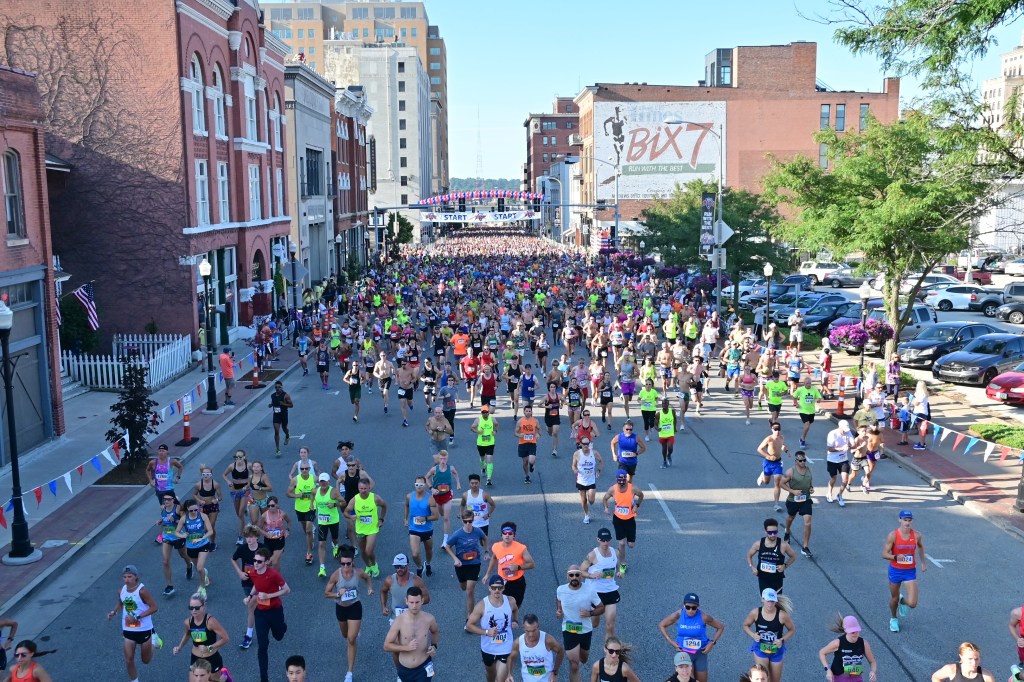
Where’s Waldo in the mix at the start of the 2022 Bix 7?
I recovered quickly once we crested at 6 miles (I heard 38:10), and tried to open it up over the fast descent and flat finish on 2nd Avenue. That was a fun stretch and I picked up a few spots to finish in 44:07 (6:18/mile). So not too far off my self-seeded 6:15, but a bit more than my higher end goal of sub 6:10.
I really enjoyed making the return to Bix 7 and hope to come back, maybe go for the age group record next year (new age group!). I also spent some time reflecting on those early days and of course the positive influence of my old friend Gregg.
The two and a half month return to form continues. I finally think I am turning the corner fitness-wise. Progress over the first month following covid was slow but detectable. I felt better on the second month but any visible gains (based on time or effort) were incremental. I ran C race (workout/progression) in June and two B races (no taper, but made a full effort in July).
The C race was a 10 mile out and back on Father’s Day (June 19). I started out at marathon effort (low 7s, even though I figured I wouldn’t be able to hold that for 26.2 on that day) and gradually picked up the pace. The out and back course had an elevation gain of about 300 feet over 5 miles and then returned, so the 4th mile was a progression in effort not time. On the return I averaged 6:30-6:40s, and the last two felt close to all out. So 1:08, and I figure about 4 minutes off from what I would have done in March or April.
On the 4th of July I did a 5K on a fairly flat course (elevation 5000 feet). I took it out cautiously (about 6:18) and picked it up, following with 6:09 and 6:06. Although I only got 2nd in my age group, and did not quite get my goal of a sub 19, I was relatively pleased with the progression-type effort and improvement from two weeks earlier. In the meantime
I have upped mileage from 40s in late May to 60s by July, and feeling pretty good physically (no issues with injury or overtraining or fatigue) but not quite feeling back. Workouts have been going okay, mostly hill reps and tempos and easy runs, with weekly long runs getting into the 13-15 mile range.
So on Sunday (17th) I signed up for another 5K as a tune-up. I ran doubles all week, but only ran an easy 5 on Saturday. The course was also fairly flat with just a few small rolling hills at Washington Park in Denver. I felt confident that I would be able to run under 19. However, within the first mile I was breathing harder than I’d like early in a 5K and only run 6:10 pace. We had a slight headwind for a half mile and I figured I could make up some time once we turned north. But that didn’t work out either, as I went 6:10 and 6:17 for my first two. Over the last mile had a small pack (3) with Mark my age group rival just a few seconds ahead. One of the guys dropped off (he said his hamstring was sore) and only made small in roads to Mark’s gap (maybe getting to about 4 seconds with a kilometer to go), but back into the park he pulled away a bit and even though I picked it up considerably over the last few hundred meters, I was about 6 seconds back (19:25) at the finish.
It wasn’t terrible, but I thought it felt like an 18:55 effort-wise. So have some more work to do.
Just this week, however, I am finally starting to feel better. Did a nice easy-effort 15 miler on Monday, and today 25 minutes of threshold running, starting with a 7-8% hill climb for the first couple minutes (like Bix course, which I’ll run next week).
Let’s see if I can hold 6:15 pace for the 7 miles. If I can do that, I’m back. If it’s 6:25 or so, then nope, I’m not.
Held it off for nearly a year and a half, but last month finally came down with Covid-19.
Days 1-2, felt like allergies, I ran a little but just short recovery runs.
Days 3-5, okay I’m sick. Nothing terrible but fever, aches, and chills. I slept a lot. Maybe 12 hours a day.
Days 6-8, gradual recovery but I did not run
Days 9-14, I started out with 15 minutes of walk-jog and built to some easy runs of 20-25 minutes. Heart rate was still high so I kept it slow. On Day 13 I took a second test and was still positive. I also took a nap every day.
Days 15-21, continued with some easy runs. Not feeling terrible, not feeling quite right. It was mostly lingering in my head and sinuses. Finally on Day 21 I ran 6 miles and could feel that it had mostly cleared up.
Days 22-35, gradually have up running. Up to an average of 50-60 minutes a day with some light workouts. My best workout was yesterday with 21 minutes of reps at threshold effort, averaging about 6:36/mile. Maybe 10 seconds slower and to tell the truth that felt a little harder than a normal tempo workout. However, it was 8 or 9 seconds faster per mile than the previous week.
I lost about a month of training, but legs, lungs, and everything else feels good. Just a little sluggish and slow to return to form.
Let’s see if I can race this month. At the latest, planning on a 5K on July 4.
This race’s history probably ranks among the top non-marathon event in the U.S., and in its glory days in the 70s-00s it featured a who’s who of American and world class road racing, World record holders and numerous Olympians/Olympic medalists Frank Shorter, Bill Rodgers, Henry Rono, Arturo Barrios, both Yobes and Lisa Ondieki, Edna Kiplagat, Anne Audain, and Colleen DeReuck have all won there. While still a mainstay on the US circuit, with solid professional prize money it does not quite retain its status of the earlier road racing era. I have always wanted to do this race, going back even to its early years when I was still in college. It was on my radar in 2020, but then the pandemic hit and the race was also canceled last year.
Training and Prep – Post Boston, not much. I took a few days off and plodded a few miles for five days and then on Thursday did about an hour with a short set set of 1 minute pick ups to blow the gunk out of my legs. Travel was a bit rough on my body and I felt way off on Friday and Saturday after arriving to Washington. We drove from Seattle and stayed overnight in central Washington so we could explore the state a little, and got into Spokane on Saturday afternoon.
I (almost) got to meet race founder and 4th place (should be 3rd) Olympian Don Kardong, as he picked up his bib at the same time. Everyone at the table lightened up when he appeared! But by the time I got mine taken care of, he was gone. We stayed at a downtown hotel on Riverfront Park, within an easy walk to the start.
Race – They do a great job with the logistics, with color coded waves and each block has it’s own side street to access their place in the starting area. I got a 2nd seeding, behind the elites. Race morning weather was perfect at low 50s, just the slightest of a breeze (maybe 3 mph), and sunshine.
My original plan was to go out at MP or just a little under and progress, but by the afternoon before the race I decided that tempo/LT effort should be fine (6:15 or so) for a 12K, and hope to close fast over the flat last couple miles and then close on the fast downhill final stretch.
Per usual, the start was a bit of cluster, especially over the first mile or so, where it seemed pretty narrow.
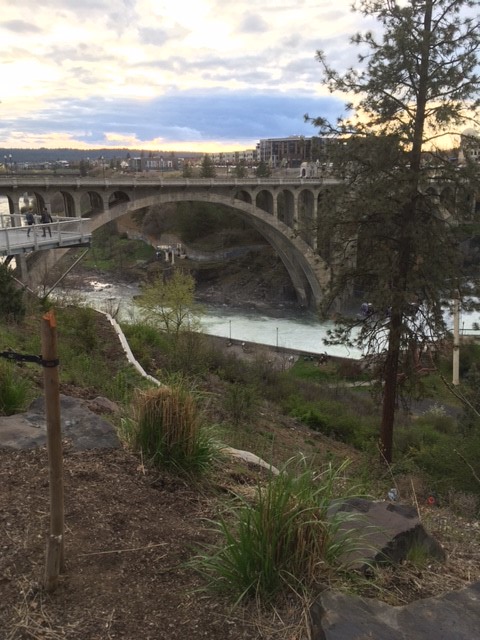
The course follows the scenic Riverside Drive for about 3.5 miles before turning turning north and then back east to downtown through neighborhoods. There are two major hills, first one (Cemetery Hill) starts at about 1.5 miles after a substantial drop and actually climbs for more than a mile. So it’s a grinder, and I found it tougher than the more famous Doomsday Hill at 4.2 miles. The latter hill is at 5% but only for 0.3 or 0.4 of a mile. However, I can see where at the elite level it’s often the make or break part of the race.
I was right at 6:15 or so for the first 2 miles, and by then the field was fairly strung out, single file or clumps of two or three runners every 5 of 10 meters.
I slowed to 6:30 up the long Cemetery hill, and then 6:12 dropping to the bridge toward Doomsday, on which which I kept a sub 7 (apparently top 4 all time for my age group on Strava, so going back 10 years or so). I felt fine and in control on the hill but I think it took some out of my already somewhat weary legs and body. Over the next two I could only muster 6:20s, and I lost a few places. On stretch before the final turn a few more younger runners passed by, and I made the turn onto Monroe (last 0.3) and kicked it in with at 6:06 pace over the final 0.46 miles.
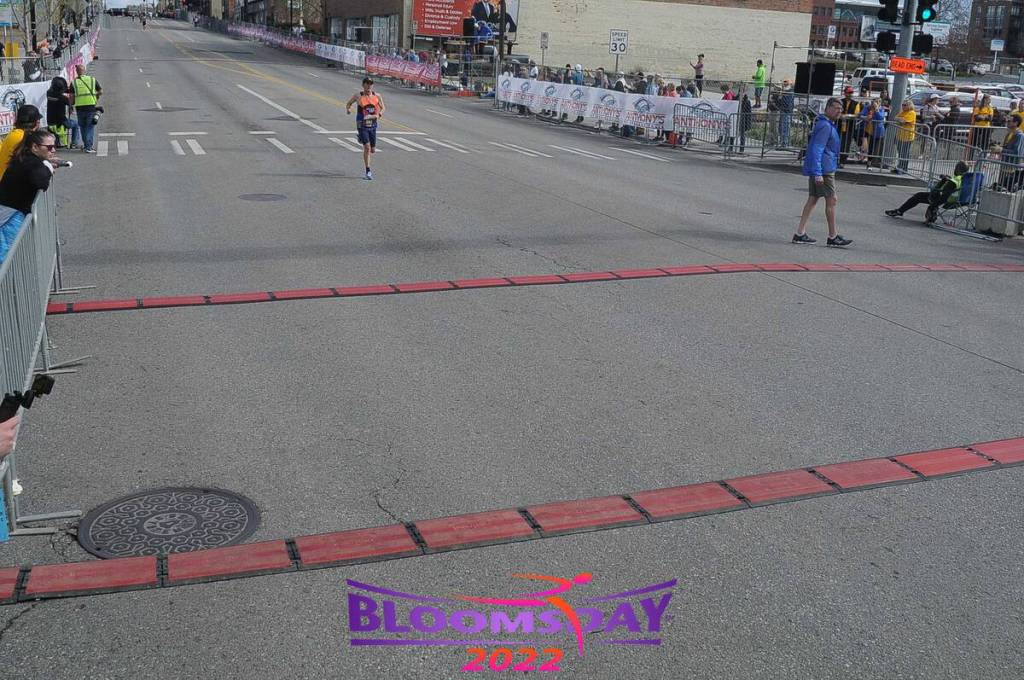
Thin crowd at the fenced off finish area–a sign of our times.
That was a blast and I look forward to returning with fresher legs and maybe go for an age group record next time. As it was I won the age group and for masters overall was 2nd in age grading for masters men (too bad they don’t give out a little prize money for that).
Summary and Post-script – The men’s elite race was exciting with a back and forth finish between Charles Wanjiku (Ken) and Reid Buchanan (USA) both in 35:08, while Birakurit Degefa (USA? by way of Ethiopia) a 2:22 marathoner dominated. New pro Makena Moreley (all-American at CU Boulder) was a solid 2nd.
Maybe a post-covid hangover, but the field was down to 20,000 participants compared to 40,000-50,000 in previous years/decades. Nevertheless, this was a great/super-organized event. They have it dialed in perfectly. I have seen better post-race party atmosphere and more crowd along the way (say Bolder Boulder or Boilermaker), but this is a first class event and I think they usually have good weather.
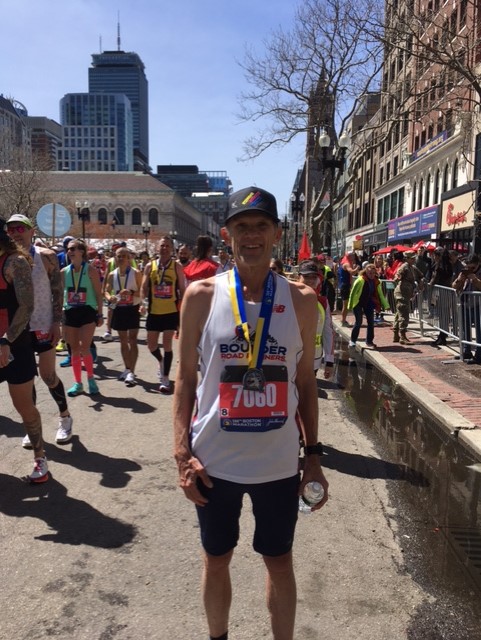
Here is a quick photo journal from Monday’s Boston Marathon
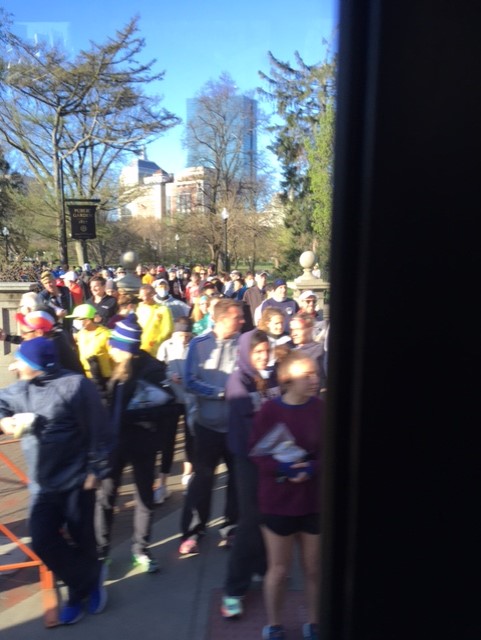
Team Moose: Me and Elijah moments before we headed to the start. Heading to Hopkinton, runners lining up in the Boston Common. Race pic! All smiles making the final turn onto Boylston. Done! 3:00:18That’s a wrap, runners make their way to hotels, automobiles, or the subway after finishing.
I’ll spare the graphics but my training cycles now involve managIng bunions and black toes. Not that I’m getting old or anything, although it didn’t used to be that way. Especially the bunion part.
No complaints here, this was a good marathon buildup. Think about it, any time you can finish a marathon build with no dings or forced cutbacks you are doing okay. Here are some thoughts and nu here on how it went.
PhaseOne
After a mid-December break from racing on the roads and cross country. I jumped into some volume for a couple of weeks with running and xc skiing, and by early January I embarked on a six week block of double doubles, sort of a modification of the Norwegian system used so successfully by the Ingebrigsten family and before that that country’s former 5000 m record holder Marius Bakken.
Now obviously I’m not in my teens or twenties, nor am I world class. Just an older runner who likes to train and sometimes tinker with things. Nevertheless, I gave it a shot while considering my age and biomechanical state, bunions and all.
Rather than jumping into two days of double threshold sessions each week—with some 20 to 30 minutes of effort at lactate threshold effort for each workout—I started out easier than that. The first sessions were just 3X 4 or 5 minutes in the mornings at about 20 or 30 seconds per mile slower than threshold pace. So in my case I started out at a little over 7 minute pace and finish a little under 7. With warm up and cool down the early sessions started at 30 or 35 minutes of running.
In the afternoon of workout days I did a short warmup and ran hill repeats of about 1.5 to 2 minutes and jogging back down. I started out with just four repeats and added some each week.
By the fifth and sixth week I was up to 6X 5 minutes in the mornings and 7X or 8X 2 minute hill reps in the afternoon and a total of 90 minutes of running for the day. I did not do many long runs yet but cross country skied up to 2 or 2.5 hours once or twice a week.
Phase Two
By mid-February I cut back on the doubles and did a weekly single mid-long run of 10 to about 13 or 14 miles. I also reduced the xc skiing and increased the distance of long runs to 19-22 miles.
Although I did some work at marathon pace it was not a lot. On tempo days I often mixed in reps or continuous pacing for 30 to 45 minutes at an effort between marathon and half marathon. And on long runs I ran a fair amount at steady state effort so slower than marathon but faster than easy. Rather than being satisfied with 20 miles as my longest efforts my three longest runs were 21 and 22 miles. Hopefully that will help hold off hitting the wall until later in the race.
Week
Miles
Time
Long Run
1
53
7:05
14
2
56
7:28
15
3
46
6:32
31K xc ski
4
61
8:07
17
5
61
8:05
19
6
57
7:50
19
7
70
9:20
17
8
66
8:53
22
9
70
8:10
17
10
51
6:38
17
11
64
8:44
22
12
70
9:20
18
Weekly training volume and long runs starting in early January 2022.
I had the Syracuse half on the calendar since last fall (even before that, but it was delayed due the pandemic and scheduling issues) and started the training block over the final days of 2021. The goals were to help our team win the age group title and keep us in the running for the national Grand Prix for 2022, and to run a 90% age grade.
It was a good build-up going from the 50s to low 70s, while mixing in cross country skiing once or twice a week from late December through mid-February. Also added some short workouts on the spin bike to add a bit of volume to get some blood flow to reduce soreness between training sessions.
I also did six weeks of double threshold sessions, starting at 10-15 minutes marathon pace type work in the morning and then 10-15 minutes of threshold to 10K effort hill reps in the afternoon. By the end of that phase the workout were 30 minutes of progression reps, and about 15-20 minutes of hills in the afternoon. I stopped the doubles in early February, once my long runs got into the 2+ hour range, and shifted to a more marathon-type training mode, focusing on long run and mid-long runs every week, with some tempo training worked in.
Another thing that made this training block a bit different was that I did not have any actual races or race effort time-trials. I did a 10K at threshold effort in January (39:45), a 20K xc ski race in February, and intended on 5K tune up on the weekend the half but that turned into a 3.8 mile tempo/fartlek due to poor course marking in an event where everyone ran off the course.
Pre-race
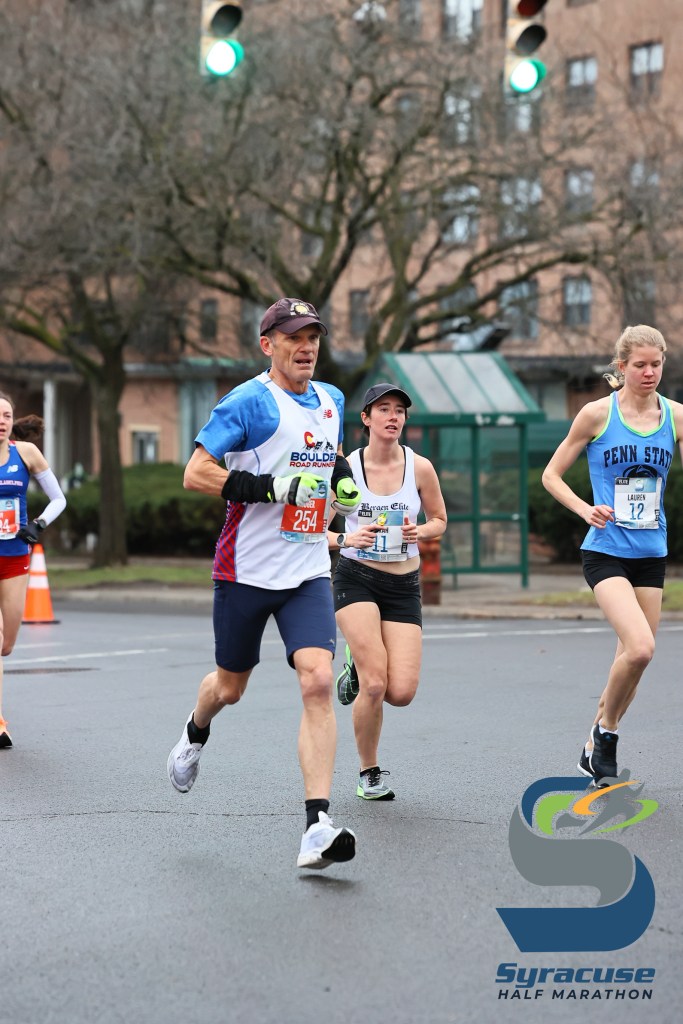
Arrived to Syracuse Friday afternoon with Adam, one of my teammates, and we drove the course on Saturday. I’m glad we did that, because it’s nice to know what’s ahead on race day. Off schedule from the travel, I woke up at 3 AM (1 AM Colorado time) but did get in about 5 hours of sleep ahead of that so it wasn’t too bad. There were heavy rains Saturday night, but we hit it just about right with cool (mid-40s), damp and cloudy, but with a steady wind.
Race Day
Wore half tights, t-shirt, under my singlet, arm warmers, and gloves. I probably didn’t need the arm warmers but if it had rained they would have been useful.
Settled into 6:20s for the first 2 miles (including big uphill). 5K split was 19:20. And 10K was 38:18. I averaged 6:10s through 7 or 8 miles on the rolling neighborhood streets. This was on goal pace, but also at that feeling where it’s comfortably fast but you are also wondering if you can hold it. I avoided any big surges. Tried to tuck in on the stretches with the headwind, but also set the pace a couple times. There were about a 4-5 of us trading places.
Somewhere early-miles, already rolled down arm warmers.
There was a long downhill at 7.4 to 8.4 miles and that was just over 6:00 pace–it probably would have been faster but was into a headwind. Miles 9-11 were flat and not too bad although I was also just trying to hang on. 15K was 58:08 and 10 mile just over 62.
This was our pack of three, from mile 9 to 13.
Our pace started heating up with our pack of 3 after mile 12, and that was a 6:00, fastest of the day. I was hanging on pretty well, but with just about 200 or 250 meters to go, my nemesis dry heaves started acting up and I had to slow just to finish. I’d spend the rest of the day with a bad stomach.
Near the finish, and feeling it!
Post-race
Cheered my teammates in (they did 1:26 and 1:29) and we did a couple miles for a cool down. They headed inside and I had planned to do another 5-10 minutes but got dizzy so stumbled back to the convention center for food and the awards.
With Adam and Mike following the race.
We won the team title by several minutes (top 3 score, based on total time) and we have a strong lead in the series. One or two more wins and we can lock up the title this year. That was number one goal. Added bonus was a 90% age grade and 2nd overall for that (only three men from all age categories did that on Sunday). So yeah, the trip was worth it and some wooziness was a decent trade-off.
I have already posted a fair amount on my background so won’t get into a long narrative here. Instead, I’ll put it into a table.
Age Range
800
mile
5K
10K
Half Marathon
Marathon
U20
2:08
4:41
16:24
37:30 (xc)
no time
no time
20-39
2:03
4:25
15:15
32:11 (31:45)
1:13 (1:11)
2:34 (2:29)
40-49
2:09
4:39
16:21
35:03 (34:03)
1:19 (1:17)
2:44
50-59
2:21
5:01
17:01
35:43
1:18
2:54
60+
2:33
5:14
17:28
36:20 (37:31)
1:17
3:02
Best Race Time by Age Group (times in parentheses are altitude conversions)
The above times are not super great by any means. I started out kind of slowly at 18-19 (was 19 when I ran my first 800 in a whopping 2:11). I did have some rapid improvement at age 20, but then plateaued for almost four years before breaking out again at age 25. From 25-33 were my peak years, and most seasons could at least realistically go for a PR.
Twenty years ago I used to say I had no regrets about those earlier years. However, now with additional perspective I do wish I had made a few more serious attempts at the half marathon and marathon in my late 20s to mid-30s. I think I could have brought those times down. In fact my half PR was my debut at the distance off of just 6 weeks of focused training. And as I blogged earlier, the build-up to my marathon PR had a lot of holes in it.
I also wish I had found a good training group or coach at the time. I have been 100% self-coached since college, but in my 20s could have used some guidance and people to train with.
Comparatively, my age grade times are off the charts, but unless you are over the age of 45, age grading is just a lie and and an excuse. Also have some head-scratch issues with some of the online runners these days, break 17 for 5K/2:52 for the marathon after some 5-10 years of running and they are acting like 13:45/2:15 guys. Something you did years before they were even born doesn’t really count, and age group/age grading is simply shrugged off. So I’m an 18 minute/3:02 guy now. Better to a noob where you can PR every race or two. Maybe some of these blokes could give a nod once in a while.
Some friends in a chatroom recently had a conversation about their earliest races, pictures, and online results. Meanwhile, I was also thinking about my earlier days to today and progression/regression. I have talked some about the past here so some might be a rehash but maybe some new stuff.
Part 1: The Early-Early Days ages 7 to 17
For the most part I was active and involved in some sort of sport at least part of the year. My first race was at age 7 at a summer camp in Boulder. I guess I was one of the faster kids and they put us in a 4X 50 yard shuttle relay at the university track. I remember a lot of teams and heats and we got a 3rd place ribbon, which I kept for decades, and it still might be in a box or folder somewhere. That was 1965.
In the 4th grade I remember running the 50 yard dash in gym class. We just ran it, not thinking about time. “You guys are slow,” the coach admonished. “9 and 10 seconds for the group of you.” But that was it. No do-over.
In 5th and 6th grade, I had a competitive group of friends who followed track and field, following the epic 1968 Olympics, and our gym teacher emphasized the annual city wide track meet. I ran the 50 yard and 4X 50 relay, and did the long jump. As a 5th grader I ran 7.2 for the 50 in gym class, and about 7.5 in the city meet. And in 6th 6.9 (once) but did not break 7 at the city meet, and did not advance from the prelim. In the long jump, I could do about 11 feet as fifth grader, 12 in 6th. Not good enough to place at the meet (a kid from my class 6.0 for the 50 and jumped 14 feet to win both events). I think we got a 5th in the relays one year and 4th the next year with our super-fast anchor man.
Over the summers we would go to the university track and do some high jumping and sprinting. My friends were pretty good at the high jump, going over 5 feet, I wasn’t. Then we built a pole vault run my back yard. Using a broken metal bar from the track as our pole, and broom sticks as the stands, with yarn as the bar. We learned some technique and were jumping in the 5-6 foot range.
I only did one year of junior high track for our small school (there was no team/season for 8th grade). There, I ran the 100 yard dash (about 13 seconds high), 440 yard relay, long jump (13 feet), and pole vault 7 feet. I might have scored a point or two, but not even sure of that (we got last or second to last at our conference meet and I know I didn’t score there).
Our school closed at the end of 8th grade and I was disappointed not to have a track season. However, we did some makeshift vaulting. Starting with trimmed tree saplings as poles and the curb on our cul de sac as the box. Not sure what we had for a stand. That worked for a while, but got a little dangerous for with the curb and concrete, so we moved to my front yard. I took an old mattress and dog pillows (my made several large ones) as a landing pit. We somehow obtained an old pole from our school–not sure how we got a hold of that! I got up to 7 or 8 feet. But other than that didn’t run a step, and for the better part of a year did nothing else athletic. Got heavy, 5′ or 5’1″ (in shoes) and 100-110 lb.
In the spring of 9th grade I made some life choice changes (I quit playing the bass guitar which I was really bad at and started studying more) and got back to being an active kid again. I started vaulting in our yard that spring. My neighbor joined me and he ended up getting quite a lot better (13′ something in high school). We ordered a flexible pole set for our weight, built some stands with peg holes at 2″ increments from 8′ to 10′ and bought a couple bundles of foam rubber, which we stuffed into large burlap bags and then put the bags into a large net. So we had a 10′ X 10′ landing mat! I don’t think I did get over 9 feet, but close. I did run a little bit to “get into shape” but it wasn’t much a couple miles here and there over a month or so. In gym I ran low 6s for the 50 yard dash and about 1:45 or 1:50 for the grueling 600 yard run, as part of the Presidential Physical Fitness test.
As a sophomore I was a lot more active, playing touch football on the weekends with friends, and pick-up basketball several times a week. I decided to go out for track and do the pole vault and long jump. Most of the running I did was a half mile for warm up every day, and then maybe jog out to the field event pits. I avoided workouts, like 100s or 200s, that they wanted us to do and would make myself scarce when called to run. I got up to 10′ in practice and 9’6″ in a meet or two, and 16’3″ in the long jump. Scored a couple sophomore points and stuck with it, even though I had some head issues (anxiety) and skipped a couple late-season meets rather than deal with that.
Junior year I kept the active lifestyle and played even more basketball, maybe five-times a week, including playing on a rec league team once or twice a week. Did some running in the gym and at home, but just a few miles here and there. However, I didn’t go out for track. I did one all-comer’s meet after the regular season had ended and officially got my 10′ vault and improved another foot in the long jump to 17’3″.
For about a month I picked up running.
Inspired by Bill Rodgers winning the Boston Marathon in April, and setting the American record and then having Pre die barely a month later I ran about every other day while we were on vacation in Boston and upstate NY. I kept it up for about a week after returning, but the hot-humid Midwest summer proved to be awful enough to thwart a sustained effort, and I didn’t even consider going out for cross country.
I did do club soccer–first ever year for our school–started by a couple of friends over the fall, and of course pick-up basketball and rec league during winter. I was just 5’8″ and 125-30 lbs at the time, and not terribly good with dribbling. But I could bob and weave okay, and could score some. And if I timed a run and leap just right I could sometimes outrebound guys 4″-6″ taller, and they hated that.
I did a little bit of running over the winter, 15-20 minutes in the field house doing steps or indoor track, and thought about going out for track which would start just after my 18th birthday.
I have no pictures or clippings from athletic pursuits during this time in my life. Those elementary school ribbons sat in my desk drawer for decades, but not sure what happened to them after my parents were gone.











 rrunnin234