The remarkable couple months in running continues, with the Salazar ban and (sort of) dissolution of his team, the Nike Oregon Project (NOP), followed by Mary Cain’s revelations a few weeks ago, sparking a body weight Me Too movement of sorts. The seven minute video has gained world-wide attention and resulted in widespread discussion in print and various forms of media, which in the long-term will be good for the sport. Not to mention Eluid Kipchoge’s sub 2 marathon and Brigid Kosgei’s smashing 2:14 the next day, leading to weeks and weeks of speculation about the shoes. So I guess I’ll chime in on that.

I’m not really jumping on the bandwagon enthusiastically here. I’ve been happy with my Adidas Adios Boost (Adizero for 5K to half marathon and Boston for Marathons) over the past five years. About two years ago when the Vaporfly 4%s arrived on the market I was intrigued a bit but was completely turned off by the market manipulation by Nike, with its limited release of the product. Playing hard to get to create more buzz and increase demand.
As masters runner knocking on the door for some American age group records (5 seconds shy in the 8K, 23 for 15K, and 45 seconds short for the half marathon) I supposed I could have benefited from these or the Next%s in the past couple of years, but still I haven’t taken the plunge. The shoes do seem to work for a lot of runners, and there is no denying the evidence, but I can’t tell if my reluctance is anti-Nike (which seems to own the sport, dominating rankings, headlines–both good and bad–as well as governing bodies like World Athletics (IAAF) and USATF). How do you spell conflict of interest? Or if it’s the concept of what effectively appears to be a spring-loaded technology that actually gives an extra few percent of return.
That just doesn’t seem right, and wondering where this will all end. Are we going to be seeing average runners with 4-6 inch platform shoes bounding with 10 foot strides down the streets of Chicago, New York, and Boston in a few years? And when (or if) will the competitors like Adidas, Brooks, Hoka, Saucony, New Balance catch up? They all seem to be three or four years behind the behemoth out of Beaverton, Oregon.
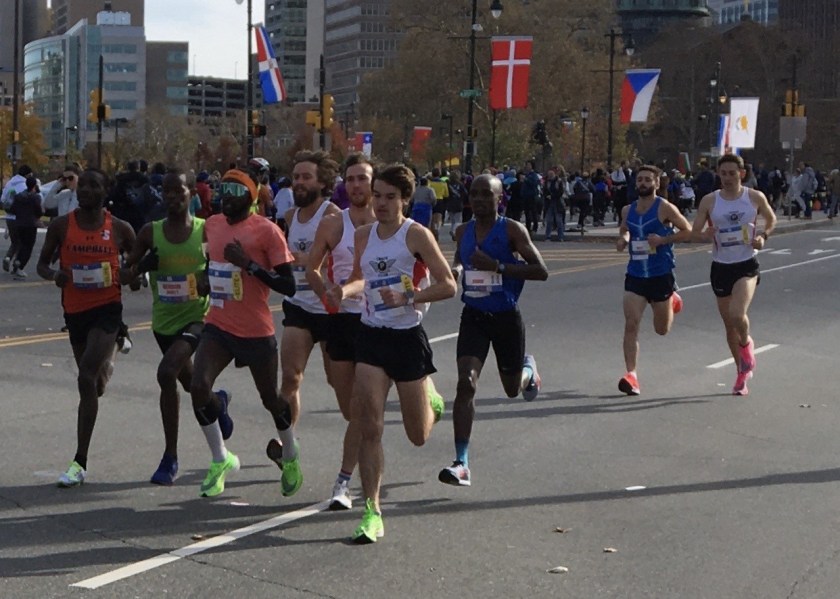
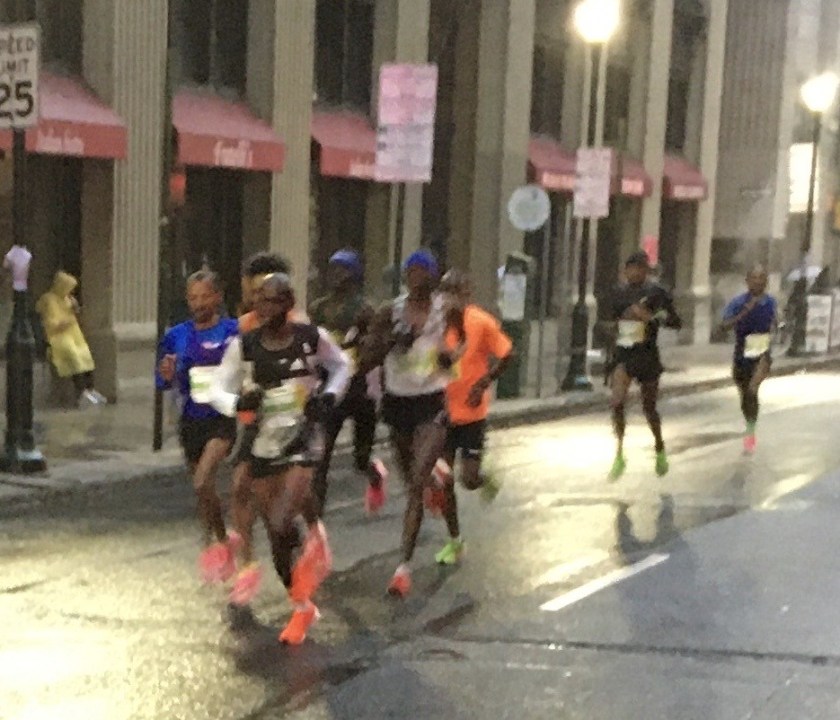
Last weekend I traveled to Philadelphia for the marathon weekend, to attend the half that I did not run because of the injury. However, my son did run and had a good time of it. We also had a great weekend there, visiting museums and sites (my great great great great grandfather is buried 20 feet from Benjamin Franklin), and also enjoyed taking in some of the racing.
Before we continue. True confession, prior to the debacle in Tulsa I was leaning toward getting a pair of 4%s for the Philly Half. But with that point rendered moot, I can hold off. Nevertheless, here are a couple of photos and some thoughts on race weekend.
However, despite some skepticism, I’m not going to be a Luddite and ignore something that has a clear advantage. I’ve held off, partially out of respect for the age group records, many of which were set a generation ago. However, I’ll be turning 62 next year and that window of opportunity to chase records in this age group is narrowing. So as I rehab and rebuild this winter, I’ll be keeping an open mind about the shoes and will consider the options as the big spring races approach.
 rrunnin234