Indoor Track at High Altitude: Out of the Comfort Zone

I never really loved indoor track, although when I ran in college there were some exciting moments. As a freshman I won my heat in the 600 yard dash at our conference meet, after two guys got tangled and fell and I hurdled one of them as he was sprawled on the track. The next year I ran my first ever 2 mile and won! I only ran three seasons as an undergrad maybe 15 meets total. And only race twice since then, in 1981 just after graduating and in 1991.

In other words, I’d rather be skiing!

My 2024 ski endeavors have been a wash with bad snow or bad weather, getting sick, a winter race schedule, and other things popping up. I think in the future I’ll get into more skiing.

I will be racing the USATF masters 5K on the roads next week, and at last month’s cross country championship I really felt my lack of speed, 6:20 pace felt like a sprint and my competitors just pulled away easily on that 8K course. So I have added a bit of speedwork to prepare for that 5K and decided to cap it off by running a double at the USATF Mid-America regional championship in Colorado Springs. The meet was slated for the relatively new indoor facility at the University of Colorado-Colorado Springs (UCCS) on Sunday (elevation 6250 feet). I figured that would have some effect on the my speed but I live at over 7000 feet and train mostly at about 5500-6000 feet, so figured that wouldn’t be too much of a stretch.

However, on Friday there was a shooting on the campus, two people were killed, and the university cancelled all activities for the weekend, including the race. That’s a terrible thing. Not the cancellation, but the shooting.

The USATF organizers moved quickly and the near Air Force Academy (AFA) agreed to host the meet at their venerable track, set at 7075 feet on the beautiful campus situated next to the foothills. That’s amazing that USATF was able to make that happen in just a matter of ours. The only real downside was the elevation difference and the Academy’s notedly old track. So I knew each race would be a grind.

First up, the 3000. My goal for the UCCS track was to run around 11:00-11:10, although I figured that might be a stretch, my last 3000 (outdoors in Boulder at 5300 feet) in 2021, was only an 11:09. But I’m an optimist and felt I could click off 44-45 second laps and make it happen with a good kick at the end. That would put me near the top fastest age group times in the world for the 2023-24 season even at altitude.

My friend David Westenberg ran 10:32 in December and while I wouldn’t be close to that, an 11:00 would compare favorably with a conversion factor to 10:36. Close at least.

3000 Meters 11.2 laps

Seventeen runners were entered and with a couple scratches 15 lined up, five women and ten men. They lined the women up on the inside lanes. With a seed off 11, I was on the far outside, so rather than that I lined up behind the two fastest looking guys.

The AFA track is an odd 268 meters, with long straights and tight curves, exactly 6 laps per mile. With the higher elevation I figured 60-61 per lap would keep me in the 11:15 range, so not too far off my original goal.

The gun fired and I immediately dropped to about 12th place. We strung out and I tried to relax, although I had the thought of just sprinting out to run with the leaders for a couple laps. I knew that would end up being rather painful so kept my head.

Off the line, near the back (Lane 1 Photos)

2nd lap pondering my sanity to run an indoor meet at 7000′

The first lap was right at 60, so not bad, then 2:02, 3:02, 4:03. I picked off a few runners in the early laps and there was a big gap (80 meters up to the next two). Split the mile at about 6:05-06 and was actually feeling pretty good. But on the 7th and 8th laps I could feel the effort increasing and I slowed to 62s-63s through lap 10. I did through down my best kick over the last lap and was under 60. And crossed in 11:27. It was a positive split, but I’m not disappointed to finish in 6:08.9/mile pace, which would be 5K goal pace at 5280 feet in Denver or Boulder.

Dead Last in the Last Mile

Not as ominous it sounds, but this was the last race on the old track at the AFA Field House. They are going to shut it down next year and build a new track, no doubt a banked 200 m oval that will have a state-of-the-art surface. It will certainly be faster than the current version. Maybe I’ll give it a shot in another 30 or 40 years. Maybe not!

After a 10 minute cool down I relaxed for a couple hours in the infield and tried to track some cross country ski World Cup results online, from races taking place in Minneapolis.

In the afternoon I warmed up outside for another 10-12 minutes and did a few pick ups. Eleven runners had signed up for the mile, but the attrition rate was pretty high and only six of us lined up. I was the oldest by 15 years and it showed. The other five runners gapped me immediately and I ran the entire race far off the pace. For this one I just wanted to run relaxed for the first couple of laps and then bring the pace down. I was hoping for 5:45 or so, but would be happy with a 5:50 considering the double and the elevation.

It pretty much went according to plan, as I was just under 2:00 after two laps, 3:57 at four laps, and with about 300 meters to go I started my version of a kick, covering the last lap in about 56 to finish dead last in 5:51.4. My slowest track mile on record (by 16 seconds, I ran a 5:35 at the Mile High Mile in 2021, 5:42 on the road at the Carnation Mile in 2022). That’s okay, I got what I wanted out of it.

Vexed Again in Cross Country

Recent Past 2013 – 2021

I have had a good run over the past decade of masters/senior competition at the national level in road races and cross country. It all started in 2013 with the USATF Club Cross Country Championships in Bend, OR. After a decade in Alaska I ventured to the lower 48 for an attempt at a national title. Going in I thought I could medal, but it wasn’t even close. I was 6th in the men’s 55-59 age group, and a good ways off the podium. However, the fire was lit and less than a year later I had moved back to my home state of Colorado. The reasons for the move were financial, but also to live in a better winter climate. The skiing was great but months of darkness and weeks of -40s or -30s, with a 6 month winter had been enough and we needed a change.

Cross country has been my favorite, since my first season as a college runner in 1977. I scored top a couple top 5s (2015 and 2017) and several podium finishes including a 2nd and 3rd at Club Cross Country in 2018 and 2021, and a 2nd at US Nationals in 2019. That was followed a couple months later with a 3rd at the World Masters cross country championships in 2019. So that four year span from 2017 to 2021 were really good, and I came to expect a medal at national meets.

Since 2021, however, things have taken a step back in cross country and I have not been competing at the level I would like. Maybe some bad luck and bad timing, but maybe also fitness.

In 2022, I felt really I had a great chance for a medal at the US Masters cross country championships in Boulder, but came down with and ill-timed cold virus just four days before the race. I held onto 4th place for about 2.5 miles but faded to 6th over the final stretch and that was my worst finish at a national championship since 2015.

A couple months later (five weeks after a marathon) I finished way back in 14th at Club XC in San Francisco. However, there were some mitigating factors. Coming off the marathon I was not sharp, and age 64 that was my final race in the age group. It also happened to be the best field ever for the age group at any race. There were Hall of Famers and world or national record holders finishing out of the top 5 or 10! That was just a crazy day in hurricane winds and driving rain and sort of an anomaly. Nevertheless, no excuses the results stand.

2023 and 2024 the Struggle Continues

The types of woes that struck me in 2022 have continued in 2023 and now 2024. I did not do US Nationals last January and instead skied and trained back home. I also skipped the 5K masters championships which were held in Florida on the same weekend as the Chicago Marathon. I wasn’t at all disappointed to miss that (93 degree heat index), we had perfect weather for Chicago.

Three weeks later after the marathon, probably against good judgment, I wanted to get back to cross country and entered a 4K in Boulder, and that was a disaster, as my heart rate spiked to 95% after just a kilometer and I struggled to run 6:45 pace (not much faster than marathon goal effort) for 2.5 miles of agony on an unseasonably cold morning. I simply was not recovered. Two weeks following that disaster I ran the Colorado USATF championship and although it went better than the 4K, I could not break 20 for the rolling 5K, and was significantly slower on the same course than the previous year when I was sick. It felt like I was breathing through a straw. I did win my age group, but got beat by people I am normally well ahead of.

I opted out of Club XC, held in Florida (again), and decided to do US Nationals in January, figuring that an extra six weeks of training time would be better following what had been a long, but largely successful 2023. I figured I would be a shoe-in for a medal in Richmond and might actually feel disappointed if I didn’t win. I knew the guys lining up and felt I could beat them.

However, I do respect my competitors and know that you can’t take anything for granted. I won three road titles last year but on each of those days I was at 100%. And to tell the truth, running cross country is more difficult than the roads, and the competition tends to be stronger and deeper at most cross country championships. Runners like to show up to these championship races at their best.

The Lead Up and the Race

I hadn’t raced since the Thanksgiving Day fun run 10K, where I ran decently on a cold blustery day in Wisconsin in a 39:15. It was a great way to close out 2023. And it was a few seconds faster than the time co-favorite David Westenberg had run earlier in the year. I was also pretty happy with the last two months of training for the year, building to 60+ miles and in December I mixed in a few days of XC skiing and spin cycling. The base-build was on.

Things kind of dropped off after Christmas, however. We were supposed to ski on our New Years trip to Flagstaff, but there was no snow so instead of three out of five or six days on the snow I got none, and while I maintained running that week I did have to cut back to about 55 miles. I got in a solid workout at 7200 feet in Flagstaff, CV effort in the 6:30s and was pretty happy with that.

And a few days later, back in Colorado I had a good progression effort, and felt that if I can run 25 minutes of reps in the 6:20s-30s at altitude I should be able to run 6:15-20 at sea level. Right?

Then I got sick. I picked up a bug on our return trip on the 1st or 2nd of January, and by the weekend I was having trouble wit breathing. I took off two days completely and ran just 3-4 miles a day for three more days. Fortunately it wasn’t Covid. Just a cruddy chest cold that ended up more as a head cold after the first few days. I took it easy until Friday the 12th, when temps dropped to sub zero, and got in a good weekend of treadmill sessions with tempo, long run, and CV reps on Friday, Saturday, and Monday (MLK Day). Although I was still having to clear my throat all week (and into race weekend) I was feeling pretty good on those workouts and on the recovery days.

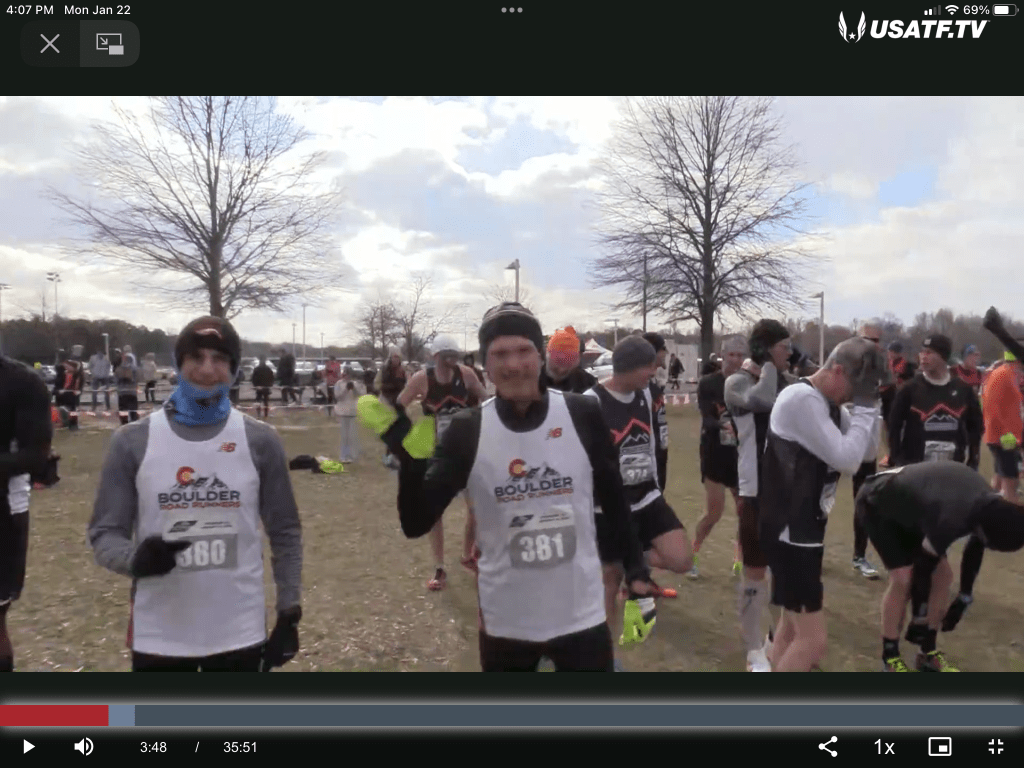
I lined up on the cold blustery morning at Pole Green Park confident that I could run well under 6:20/mile for the 8K race. I was nervous, but also relaxed, like let’s bring this on and see what everyone’s got!

I darted off the line quickly for 50 meters, and settled into my pace. The lead pack swallowed me up quickly, before the course narrowed by 600 meters.

It was a little tight through those early turns, and I was already breathing hard. I could see two of my rivals, Ken Youngers and David Westenberg pull away, by a km the already had 10 seconds on me, and I knew then that this was going to be a tougher than expected outing. I was running 6:15-20 pace and it felt like 6:00, as my heart was racing and I was breathing hard. They were already pulling out of sight by the first lap at 2K, I might have seen David’s bright green hat bobbing but he had 20 seconds on me by then and knew I wasn’t going to catch him.

Hit rock bottom emotionally at 3K when Tim Conheady in my age group passed assertively as I mumbled to myself (somewhat audibly), “this just not my day”. Tim broke away and had put on 8-10 seconds by the half way split, as I really struggled with that part of the loop with a few hills and headwind. He stayed 10-15 seconds up the rest of the way.

It seemed to gain on a few stretches but would hit a bad patch and his lead maintained.

I threw down a hard kick over the final 300, into the wind, and bent over almost throwing up as I crossed the line, just passing an injured Ken who had thrown out his back after a stellar 4 miles.

For a while I thought I might have finished 3rd and on the podium but it was not to be, as a runner (unknown on the USATF masters circuit) from the local VA region was just behind David for the silver medal. Tim was 12 seconds ahead of for third, and I was 4th, Ken 5th crossing just a second back.

That was a very good field, perhaps best ever for a USATF championship at our age group.


My mile splits were approximately 6:18, 6:25, 6:31, 6:38, 6:27, which is about on par with what I might do on a tempo run at Crown Hill Park at 5500 feet elevation. So yeah, I’m a little disappointed. Looking at my heart rate, it shot up to the high 150s by 1/3 of a mile (at about 6:10 pace), and 160 just before 2K. 160 is not sustainable for more than a couple minutes for me.

So bottom line, maybe not quite recovered from that cold, plus overall fitness–that ability to sustain a hard effort–is not quite where it needs to be for to compete for a title at a national championship event. I’m a little disappointed that I didn’t fight a little harder for that thirds spot, but he passed and gapped me at just the right time and if I had fought and faded I would have finished 5th instead of 4th. You have to live with those decisions.

My work over the next two months is cut out pretty well: Get healthy (stay healthy! No colds), get stronger with a string of 8 to 10 hour weeks, and get comfortable running some reps at sub 6 pace for 2-4 minutes in workouts.

20 Years a Comeback: Part 2

After hitting rock bottom in 2002 and 2003, which ended with a tonsillectomy and about eight weeks of no running, I gradually made my way back in 2004. However, by January and February I was running pain free up to four or five times a week. Most of the runs were short, in the 3-5 mile range, but I felt good. As tough as it was to get those tonsils pulled, a bonus was I felt that I could breathe deeper, get in more with each intake and exhale more. That may or may not have occurred at a significant level but breathing sure did feel easier, not to mention not having those perennially sore and pocked tonsils in my throat.

In February I did my first ever snow shoe race at Eldora, and cross country skied a couple 10K skate races–my first ski races since 2002. I was nowhere near top shape but it was great to be huffing and puffing at 8,500 to 9500 feet elevation!

Late in the month my boss walked with me across the CSU campus and asked if I would be interested in moving to Fairbanks, Alaska as an environmental planner. The incumbent had recently left the position and they were looking to fill it. Think about it, he said.

I did not take him that seriously, but mentioned to my wife and kids over dinner that night. We kind of laughed it off. Her parents and my mom lived in the Denver area, less than 90 minutes away, and we figured we would be staying in Colorado for years to come.

A few weeks later, my boss brought up the transfer again. This time less in passing, in fact he was direct. The environmental project that we had worked on for two-and a-half years was wrapping up, and at that time there were no big projects on the horizon. The Alaska job would be more stable, if not indefinite. Our client, the US Army Alaska would need a couple of planners on its staff just for day-to-day operations. He could not guarantee a long-term stable position in Fort Collins, but the Fairbanks position was there for the taking. He sweetened the offer which would give me a substantial raise, plus cost of living, to move to Fairbanks with my family. He offered to fly me up there to talk to my co-workers, whom I had already worked with for a couple of years and knew fairly well, and suggested that I bring Tamara along. So we took a late March trip to the north.

It was a record breaking 82 degrees F when we boarded our jet from Denver to Seattle, then Fairbanks. We arrived at 2 AM amid light snowfall and -26 F in Fairbanks. I thought no way, would she want to spend any more time in the north than this four day trip. However, we explored the area, contacted a realtor and looked at houses, and went to dinner with the co-workers. They really wanted me to move up and work with them. By the second day we were sold on the idea. A huge step to make when you are in your 40s and have two kids in school.

Spring Racing 2004

By late March I was running five or six days a week and picked up a copy of Pete Pfitzinger’s Road Racing for Serious Runners, and decided to do the Colorado Half Marathon in May. I had been running consistently for three months and had built up to 40 miles a week. I had not run a half marathon in five years, and in fact had only done one other half in the previous 15 years! I knew I could finish, but figured I would be well off my altitude best of 1:13, as well as the 1:19 I had run five years prior.

I built up to 50 miles a week, more or less following the plan and in April did a 5K and 5 mile tune race, about two weeks apart. Although I was well off the times I had been running in 1998-2000 (sub 17, low 28 respectively) it was great to line up healthy and to see what I could do. I ran 18:13 for the 5K in Loveland. And then at the 5 mile Cherry Creek Sneak (once a seasonally huge race in Denver, with 20,000 participants racing three distances) I ran just over 29 minutes and placed in my new age group.

At the half in May, I knew I wasn’t yet ready for prime time racing, but gave it my best shot. I ended up running just under 1:22 and placed third in the masters division, which was a surprise because northern Colorado boasted a deep contingent and this was one of the biggest springtime races in the area.

Although I have done a ton of racing in the years since, including huge races and national or international races, still have that plaque and it sits on the top of my bedroom bookshelf signifying my comeback.

North to Alaska

A few days later I loaded my car with gear and a bunch of scientific journals that I had collected in 1990s (I still had some hope then of returning as a research biologist), and drove up to Alaska. After a few weeks I flew back and picked up the family and we drove north together.

I kept up my running, but scaled back and missed a lot of days, maybe doing only 25-30 miles a week. Just a week after after arriving back in our new home of Fairbanks I entered the Midnight Sun Run, Alaska’s biggest race, with some 4,000 participants. I expected something like Bolder Boulder, which was 10X as large, but the Midnight Sun Run, starting at 10 PM on the summer solstice weekend, was more like a mini-version of Bay to Breakers.

I did not expect much out of myself competitively, maybe a top 15 or 20/ After just 2 miles I found myself in the top 10, and by 4 miles I was fighting for a top 5! I ended up finishing 6th place and as first masters in about 36:50. My first age group win in five years.

The running club there held a seven race series every year and I jumped into the track mile (5:08), another half marathon, this one mostly off-road (1:22), and a tortuous 16.5 mile race that dropped 1800 feet on trails and back roads. I made some new friends in the masters running community and all they could talk about was Boston Marathon–which they had done many times each, running 2:40 into their 40s–and the upcoming Equinox Marathon in Fairbanks, it was Alaska’s oldest and toughest marathon with 18 miles off road and trails, about 8 miles on pavement, and 3,300 feet of elevation gain and loss. Totally gnarly, and a Fairbanks institution.

Over the summer, despite huge historic forest fires (over 5 million acres in Alaska burned that summer), I was able to build to 70 miles for couple weeks and was in the 55-65 miles per week range for more than two months. I been on some hilly back-country long runs, up to 23 miles.

It was in this summer that I decided that I would not back down from training and racing in the future. Both of the long-term injuries I had endured in my late 30s and mid-40s had followed an extended break from training, although I had run some I had only done minimal miles. In the future I vowed that unless I had to ease up due to injury or illness, they’d have to drag me away kicking and screaming from running.

I also changed my approach. Rather than a modified Daniels with two or three quality workouts on an otherwise mid-mileage week (50 had been the standard for more than 15 years) I embraced the easy lopes on forest trails and roads, with usually just one workout a week. But even then, I found Pfitz’s quality workouts to be a little too taxing. I did his 9 miles of tempo at half marathon pace and 14 at marathon pace in an 18 mile run, but recovery was slow from those efforts.

The work paid off for the Equinox, as I finished top 5 overall, and ran 3:12 on a very cold morning (never even got much above freezing).

The rest of the way

We spent nearly 11 great years in Alaska. I ran the Midnight Sun Run 10 times, winning my age group each one. I did the local series at least six times, and never won it but had several top fives, and ran the Equinox five times, winning my age group on four of those occasions (the time I didn’t win it was a big deal, the times I did win it wasn’t–local personalities and such came into play), and I set an age or age group record on each of those races.

Plus I skied as much as anyone could want. In fact, I think by 2014 I’d had enough and had carried the skiing as far as I desired. It was time to move on with work and sport.

I moved back to Colorado at the end of 2014 and Tamara followed six months later while our younger son was finishing high school. Moving back to altitude, with better weather, allowed for more consistent year-round training. The skiing became a cross-training add-on just 15 times or so a year. For the most part, I have stayed healthy (save a very painful shoulder injury and surgery). I have run in nearly 30 USATF national road and cross country championships, dozens of local races, and several top tier road races across the country, including Boston and Chicago Marathons, the Lilac Bloomsday, Bix 7, Utica Boilermaker, as well as the World Masters half marathon and 8K cross country.

Career-wise it was a good move (for the most part), and definitely for running.

I have run about 45,800 miles from the beginning of 2004 through 2023, and have put in over 100,000 miles in my lifetime. I haven’t really wrapped my head around that one yet!

In 20 years?

Can I keep running? How long? Will I keep racing and training? I can’t answer these, but hope to keep it going for as long as I can and as long as I enjoy the grind.

20 Years a Comeback: Part I

This is partly recycled from a few years ago when I chronicled my earlier running path over the decades and phases of my life. However, I am revisiting the story because it has now been 20 years since I found my way back to running and racing following several years of injury and unfortunate events.

Y2K The Crumbling

First, I guess you have go back 25 years. After four years of steady decline, I enjoyed a nice resurgence at age 40. I built a base and stayed healthy and managed to achieve my primary goal that year of breaking 4:40 in the mile, and beating the local favorite in the Amherst, MA Masters Mile that summer. And for the next two years things went pretty well, I ran a marathon, won my age at Bolder Boulder in 2000, ran dozens of races, and stayed healthy. Until I didn’t.

By late spring of 2000 I was nearing the end of the second year of a post doctoral research fellowship with the USDA in my hometown of Fort Collins, CO. Everything seemed to be going great. The research was interesting and rewarding, and I was actually getting paid a decent wage for the first time in my career. We had one kid getting ready for kindergarten, and another precociously about to start pre-school before turning 3.

I was just wrapping up a spring of racing highlighted with a 27:13 8K at the Drake Relays road race and winning my age a month later at the huge Bolder Boulder on perhaps the hottest day ever for the race.

I was enjoying my post doc, doing research on bird repellents and bird behavior. I had a couple of publications and was just setting up for a new three-dimensional phase of the research in the lab. However, I found that there would be a gap in funding and no guarantee that that the project would even continue. With a family to support I had to take an offer with a nearby private company specializing wildlife toxicology and disease.

There were parallels, and the CEO, Dick, promised that I would be able to continue with the repellent research. So, with some trepidation, I took what was seemed to be effectively a lateral transfer into the private sector.

I hated it immediately.

Looking back I could have gone back to the USDA to finish the final three months and to apply for the extension to the fellowship. I definitely should have but I decided to make the best of the new situation, with the hope it would get better. I was a Ph.D. with years of experience, but they immediately put me under the wing of 25 year old woman with a B.S. degree and a bad attitude toward men. She did get canned after a number of months, but even then things hardly improved. Within two weeks the CEO told me to stop thinking about doing any of my previous research, that my time was all his now. And so it went for 15 months.

After some 12 years of being fairly independent at work, doing my job without someone breathing down my neck, I had lost control of my destiny as a scientist, and I had to do what they said and they way they said to do it. My stress levels were off the charts, and within a month of starting my new job I was a basket case.

I continued to run but by the end of summer my knees were bothering me on every outing and I was not doing quality workouts. Maybe 30 miles a week, mostly just running. I jumped into a couple track races and and 5Ks over the summer, and in the fall I did run two cross country races. However, my body was rebelling due to stress, poor sleep, and general unhappiness with what my career had turned into. The running suffered, my mile time that August was 6 seconds slower than the previous year, and by fall I was running 5K a good 30 seconds compared to what I had done in early summer, before making the switch.

In spite of the decline in performance, running was a good stress release and I frequently took my lunch hour (timed to the minute) by going out for a 4-6 mile run on dirt roads near the lab. Although that was a relief, my knees hurt on every run.

2001 was no better, and actually worse on my knees. I stepped back even more on training over the winter and focused on work and family. I’d get out a few times a week and got in some cross country skiing on weekends. I had gained about 10 pounds over the previous year, and ran Bolder Boulder off of 20 miles a week, running two and a half minutes slower than the exceedingly hot day of 2000 (fitness-wise close to a 3 minute drop). Over the summer I did improve somewhat, but could only muster a 37:40 at the Colorado Run (more than two minutes slower than I had done a couple years earlier).

Within months of starting that job I started making applications for other jobs. In the end I had helped bring in over $200K in grant money to the lab, and the agreement had been to raise about half of that in a year. At the time I did not know that the grant money had already been awarded to the lab, but after 15 months of unhappy tenure there, Dick the CEO brought me into his office and laid me off, saying that I had not done enough for the grant writing, saying with a straight face, “We have hit an economic downturn, due to 9/11,” (this was just two weeks later) and he added. “You just didn’t get the job done.”

Actually Dick, I did get the job done. You were just a greedy and deceitful psychopath.

Although it was a huge relief to be away from that company and its toxic atmosphere (he had fired about a third of the professional employees in my time there) there was some damage. Two weeks later, while I was still waiting for the first unemployment checks to keep our family afloat, a former coworker drove up to a local race with a new car. Another part of the deal when I first signed on was that I was to get 7% of the grants as a bonus. The coworkers got the bonus, I didn’t.

Fortunately, I landed a new job at Colorado State University within a couple of months and we did not have to move.

2002-2003 Knees Are Shot

In 2001 I hit a career rock bottom. For the better part of 20 years I had worked to be a research biologist, working as a technician, getting a masters, working in the field and as a research associate at a major university, years getting a doctorate, and scrambling as a post doc. I felt I had been on the cusp for several years, but the other side of that was an abyss.

I took the first job that was offered, it was a down grade really, as an environmental policy/writer position. But it would pay the bills and ultimately lead to a more stable, (usually) less stressful lifestyle. No more paper chase, get grants, and publish or start over. I still have some regrets about making this shift in mid-40s, and do miss the excitement of doing research (sometimes it was drudgery, particularly the publish part).

Nevertheless, at the end of 2001 I embarked on a new career path, but I soon moved up, getting a team lead position after just a few months on the job. However, my running had yet to hit the bottom.

Sometime around the end of the year, I was on an easy but snowy 45 or 50 minute run along the foothills and I twisted my foot on a slippery rock. I heard something go pop but it not hurt that much until I got home. That injury to my posterior tibialis only compounded the knee problems. While recovering from the twisted foot I spent some time in the gym and did some leg weights, thinking that would build up my quads and ease the knee pain.

After a couple weeks, and cross country skiing while on my first work trip to Alaska, I resumed some easy running. Maybe 10 days later on a blustery January day I decided to hit the track and a set of 200s at a moderate effort, maybe starting at around 40 seconds and bring it down to 36 or so. Not that hard, starting at about 3K race effort and finishing at mile/1500 pace. On last repetition two, in the set of eight, my knees tightened up and got sore.

That little session pretty much ended running for nearly a year and a half. Actually, it wasn’t just that session. The prior year and a half of personal stress, unaddressed knee problems, and the tendon tear to set it up.

I rested and waited for three weeks with not much improvement, so I went to the orthopedist, who was getting up in years but had been world renowned in the 1970s, 80s, and 90s. His first response was that maybe I should give up running and take up kayaking–which was sort of funny, he had said much the same in 1984 when I visited the same clinic for a lingering hip/piriformis issue.

His advice was to take NSAIDS for a few weeks, ice it every day, and come back in four to six weeks if it doesn’t get better. I followed two out of three but forgot to schedule another appointment. So I just spent half a year before going back in. I just stopped running, and did little bit of light skiing, and some cycling or swimming. Passively biding my time with the hope that things would improve. I would try to run a little bit, but not regularly, maybe 20-30 minutes here and there, and my foot and knees did not improve much.

When I finally did go back, the doctor was incredulous that I hadn’t been in sooner. He prescribed some anti-inflammatory medications and up to 12 weeks of PT, which I did in two bouts a couple months apart.

The PT helped some, but only marginally. By the end of 2002 I had run maybe 200 miles, the lowest since high school, and gained the 10 pounds I had lost in the summer of 2001.

After a year of not being able to run I still followed the sport, but now as a fan. I missed it and there was no end in sight.

Much of 2003 was a blur with work and family life. Every two months I would have a one or two week trip to Alaska, and the land was growing on me. My co-worker (and tormentor) Pat had grown up in Anchorage and thought his hometown was great, the cosmopolitan epitome of the state. The Interior and Fairbanks, where I was spending half my time, were the desolate pits. But I found the openness and big sky of Fairbanks to be somewhat appealing.

In 2002 and 2003 I got most of my exercise by bike commuting. It was 6 miles to the campus and our office. It would take 18-20 minutes to get there, mostly by bike path, in the morning. With a 200 foot elevation gain back home, my ride on the return was more like 25 or 30 minutes. I rode in 3-4 days a week, as long as the weather was good. On weekends I rode on the back roads and trails in the foothills for an hour or two. The running was not coming around but cycling actually felt pretty good.

Over a couple weekends in the spring of 2003 I did some long hill climbs with a runner friend who also did some cycling. I left him in the dust on the climbs and he encouraged me to give cycling a try. I was not planning on hard core mountain biking or road cycling, but checked the race schedule and found some summer hill climbs at the ski areas, 5K to 8K and climbing 800 to 1000 meters. My debut would be in mid-June at Winter Park.

At about that time I had two friends, from out of town and completely separately ask the same question almost word for word.

“So it looks like you’re done for good with running?”

I was disappointed to hear them ask that but seeing how I had hardly been able run for 17 months, I can see why.

My friend Tim, the second person to ask, had just traveled from Oregon run Bolder Boulder as a destination/bucket list race. Coming from sea level he thought the event was incredibly difficult, if not horrific. I had a couple beers with him and his wife as we swapped stories. The next day, slightly hung over from the two pints (they were strong pints I might add). I went out for a ride to Horsetooth Mountain, it was a 2000 foot ascent from our place, with the last 3 miles climbing some 1500 feet on a steep trail.

Near the top, at about 7000 feet of elevation, there was a particularly steep pitch on the rocky trail. I stalled and couldn’t get my foot out of the clip fast enough and fell over, cracking my wrist. I was in a cast for 6 weeks, thus ending a mountain biking hill climbing career that never began.

Now what?

I said the heck with that, and started running again. Just easy miles at first but jumped into the Father’s Day 5K in Fort Collins. My kids ran the 0.5K fun run and had a blast. With my blue cast I ran a 19 minute and finished with a smile.

The road back was not smooth. I ran about 20 miles a week, and some days my knees were okay, but then they’d ache for a few days and I would have to rest or cross train. I did a couple 5Ks that summer, running an 18:26 at sea level in Anchorage, now 2 minutes slower than I had done three years prior and an 18:30 back in Denver, a slight improvement if you account for the mile-high elevation. After three or four months of running, I wasn’t back but feeling better.

At work things were heating up as we were preparing our revisions for an environmental impact statement. We had a big week-long meeting in Fort Collins with government agencies, and that was the most stressful week since I had started. I got home that weekend and had a sore throat, and my defective-pock-marked tonsils were swelling. So I went to the doctor, thinking it was strep throat. I tested negative and the doctor sent me home. Overnight my tonsil grew to the size of a ping-pong ball, nearly closing my throat. I had to go to the ER and have the abscess drained, with no anesthesia. That was the most painful minute in my life!

I had to stop running, and had my tonsils removed two weeks later. In early November. Having your tonsils taken out at age 45 is rough. I had to isolate at home for 15 days. I couldn’t eat any solid food and could barely sip a warm or cold drink, jello and ice cream were the only caloric foods I could take in.

Fortunately, the work schedule was not too hectic after my extended break. I was able to start running about a week before Christmas. I had lost about 10 or 12 pounds following the surgery, and an added bonus was that I felt without the tonsils partially obstructing my throat I could take more air with each inhale. On New Years Day I ran a local 5K in just under 19 minutes. I had no base but felt pretty good. I did not know it but that was the beginning of my comeback.

Looking back it’s interesting that it took a fall off my bike and a middle-aged tonsillectomy to get back on track for running.

A Turkey Wrap To Go

Racing in 2023 is a now a wrap, on Thursday I did the Berbee Derby 10K in Madison, WI with our son and future daughter-in-law. It was all good.

After Chicago I made the decision to pass on December’s USATF Club Cross Country championships in Tallahassee, FL in favor of doing the Thanksgiving race in Madison. This will be the third US championship in four years, fourth in five years. I went twice, in 2019 for US Nationals and 2021 for Club XC. Let’s change the venue!

Also, our team was at best lukewarm to travel and we may or may not have even been able to field a team, let alone one to match our victory in 2021. Enthusiasm for the BRR men’s 60+ is at an all-time ebb. Maybe with a little nudging and enthusiasm we could have put together a solid team, but no one else was chiming in, so I just let that one lie and decided to visit family and have some fun with a sea-level 10K.

Recovery from Chicago was tougher than I thought, with one disastrous (three weeks post-marathon) and one fairly mediocre (five weeks after Chicago) foray with local cross country. However, I did get in some solid weeks of training including those races, with 60 mile weeks and some decent tempo runs and repetition efforts (8K-10K effort). I was hoping for 38 or under, but as last week rolled around I kind of felt 38-39 might be more realistic especially since the forecast was for colder weather.

We flew out to Madison on Tuesday evening and had a nice 4 mile shakeout run at the Pheasant Branch Conservancy just outside of Madison on Wednesday. The rest of the day was spent doing some errands and getting ready for Thanksgiving. We did go to a brewery for a beer. I typically don’t drink on the day before a race, but this being the end of the year and on a holiday why not.

Race Day

At least it was not as cold as forecast a few days earlier (they were calling for a low of 18 and high of about 30 on Thanksgiving), but it was still fairly chilling at 32 F with a 10-12 mph wind out of the northwest. But it was sunny, and as long as you were moving it wasn’t too bad.

Did a 15 minute warm up with Mikko and his fiancee McCaleb, and we discussed our race strategies. I planned to go out in about 6:15-20, run the middle miles strong and just see what would be left for the hilly final two miles. Mikko said he’d go in about 6:30 and try to pick it up. McCaleb said she planned for 7:00 pace.

How did it go?

The first turn was only 100 meters after the start, and I took it cautiously in the back of that first wave (sub 7 pace) of a 100 or so runners. We made the turn and I checked my watch to see about 6:00 pace, so I eased up and Mikko took off. He pulled away steadily. I was probably in 50-60th place through most of the first mile, a gap formed as we headed north on Fish Hatchery Road into the wind and rather than lead a group of runners who might be slowing up, I surged a bit to catch the tail end of that group. Mikko was 6:05 and moving up (that would be his slowest mile split of the day) and I was 12 seconds back in 6:17.

That was on a net downhill, but into a headwind. I guess where I should have been, although at the time it felt a little quick. My breathing was in control, however, as we turned south in the 2nd mile and ran past the fish hatchery. We had a couple risers just before 2 miles and I backed off on those, not wanting to dig into my oxygen reserves too early, 2nd mile was 6:22. My thought was can I hold this for another 25 or so minutes? Mikko was out of sight by the end of the second mile, and I was in a no-man’s land. One guy had passed me in mile two and I passed a couple. But for the next three miles I was pretty much on my own with a single runner some 50 meters ahead and I could hear no one from behind.

On the bike path, and the flattest part of the course, miles 3 and 4 went by smoothly in 6:13 and 6:15. I felt pretty good, but kept my effort in check knowing there would be some hills in the fifth and sixth miles. We turned onto Syena Road just before the 4 mile marker and had our first real climb, a 45 foot hill over about 0.2 mile. It was over fairly quickly, and I eased up a little–2 miles left is still a long ways to go in a 10K.

Then I heard voices. A lot of chatter from maybe 40 meters back. I think they must have started in the 7:00 wave and were doing this a progression run. They were talking it up, and I actually looked back, cursing them slightly for I was on the edge and they’re having a lively conversation. And gaining.

They caught me at about mile 5 (6:18), but by then the chatter had quieted some. Looked like high school-aged boys and either their coach or a father of one of them. I hung on for a bit, but they were going sub 6 pace and I wasn’t able to sustain that.

The last mile would be the toughest. The biggest hill had about 50 feet of gain over 0.3, with the middle part at a 6% or 6.5% grade. I really had to slow my roll there, and might have lost a place or two. At the crest my stomach started turning inside out and I heaved a couple times. It took about 30 seconds of easier running to regroup. Over this stretch I was passing a couple runners, a couple would pass me.

We had two short (0.1) rollers over the last half mile, Tamara was at the bottom of the last hill (0.3 to go) cheering us on. I crested that rise and hit 6 miles just before making the final turn (6:28 mile). With the last 350 m a net downhill, swooping toward the finish banner I wound it up, still hoping to break 39, but rolled through in 39:11, 1st in age group by several minutes, 43rd overall out of some 2000 participants.

I’m still happy with the result. I paced well (GAP miles between 6:12 and 6:20) and ran at my fitness level. 86.4% age grade is down from the 90+ I was running earlier this year, but being six and a half weeks post marathon I felt good about it. It just takes some time to fully recover and perhaps more importantly to rebuild that aerobic fitness after such and effort an some downtime.

Mikko and McCaleb finished 4th and 3rd in their age group (Mikko missing 2nd by just 5 seconds) and were happy with their races.

I got to meet Joe, a long-time online friend, soon after the race and we chatted a bit before the shivers took over. Did a short, somewhat hobbling 1 mile cool down (my sciatic seemed to be acting up and my lower leg kept giving out), and hopped into the car to warm up and get read for the Thanksgiving meal.

In short, we had a great trip in to Madison and had a fun run on Thanksgiving. And that’s a wrap on 2023’s racing calendar!

Flowing with the Ebbs

Like the seasons in a year, running has its changes. Unless you are a relative newbie in your first few years of training, or have increased your training volume and intensity the fairly recent past, you are going to have ups and downs in training and fitness. That’s the nature of the sport, and most of us can’t be “on” all the time. However, if you like to race just for its own sake there is a good probability that you’ll have to deal with some ebbs in performance and when you are in an ebb you often need to be able to handle that with some humility and grace.

I am in such a state.

Coming off the Chicago Marathon last month I did not need to run a race this past weekend, and even less so doing the disastrous 4K two weeks ago, but there are not many opportunities to run cross country in Colorado and this is the season. Besides, the final race of the year for me will be a 10K on Thanksgiving, and being seven weeks after the marathon I hope to have had enough recovery time to run a good time, maybe 90% age grade which would be about 37:45.

Maybe I should take more of a definitive break from any quality work or training, but I signed up anyway for last weekend’s 5K Colleen DeReuck Classic, USATF state cross country championship knowing that I’m still not fully recovered from the marathon block and in particularly the race itself. Plus with winter ahead, late-November through most of January will be my break from racing, and when I’ll be doing a lot of training volume on skis as well as running. At least in my narrow, one-sided lens doing this little string of three races was logical and justifiable. Or maybe it is just a fools journey and I should take a longer break.

Training

My mileage has crept up following the first weeks of recovery, and two weeks ago with 47 and 52. With marathon taper and recovery, my six week average was only about 40 miles a week. Some runners seem to get a boost after a marathon block and run PRs or extremely well immediately following their big race. I am (and almost always have been) the opposite. Marathons beat me up and it usually takes a couple of months to feel right again.

There was a time (in my late 20s into my 40s) when 40-50 miles a week was all I would do, although I would make up for the lower mileage with two or three quality workouts a week, but I kept getting injured. Over the past 20 years I prefer to be 60+ miles a week, preferably averaging in the upper 60s with frequent 70 mile weeks interspersed with drop down weeks to rest for races.

I had a couple decent workouts, with tempo reps on hills and and reps progressing from threshold to CV (critical velocity). A couple weeks ago I did 20 minutes of 4-6 minute reps, and last Tuesday it was 2X 5 minutes at threshold followed by 4X 3 minutes at CV effort. That was actually a pretty decent workout, and I figured four days before the race would provide enough recovery if I took it easy for the rest of the week. I did, just running an easy 6.5 miles on Thursday and 4.5 Friday but maybe that wasn’t enough of a taper to be sharp for a Saturday race. I went in figuring to run fast than last year’s 20:36 (my worst race of 2022, when I had a cold), and thought a 6:30 pace (low 20s, which is what I did in 2021) on the tough two loop course in Boulder would be attainable.

A low 20s should be enough to win my age group by a large margin, as well as to beat all of those in the 60-64 category, as well as most in the 55-59.

That was the goal.

The Race

Although this was just a training race, I was nervous at the start because I know the course and it’s unrelenting nature and I remembered how difficult it felt last year. They held us on the line for the clock to tick to 9:45. The race was started by Olympic Gold Medalist Constantina Dita, who lives in Boulder.

I sprinted off the line for about 6 seconds and was near the lead momentarily, and then backed down into an even pace.

I have to admit it felt like 6:20 pace as we rounded Viele Lake and headed toward the hill, it’s less than 10 meters of climbing over 200 meters but in the middle it ranges from 6% to 9% grade, which is enough to take the wind out of you for the next couple of minutes. Fortunately, we only had to run it twice.

I had just worked my way through a pack of runners around the lake and led a group of about six or seven other runners up and over the hill. I just passed Tom from our rival team and I could hear people cheering for Jay, also from that team and he was just a second or so behind. Me of old would be 10 or 15 seconds ahead of these guys, but not on Saturday. Tom sprinted past at the crest and just after I split the mile in 6:38, and that was pretty much the only time I looked at my watch.

By the bottom of the long-gradual downhill (probably 400 meters) Tom eased up and I passed again, as we circled back along the ditch I could tell Jay was right on my tail. I maintained my effort but just before half way Jay went by. That was decision time, try to stick with him and grind it out for another 10 minutes or settle into my own private Boulder funk and at least keep some semblance of contact.

By the time we had rounded Viele Lake a second time Jay had mounted an 8-10 second lead and that pack had swallowed me up. But at least I was maintaining as we picked off a few others who had slowed.

The low point of the morning was hitting the hill a second time and slowing to a crawl on that steep section. Jay got a couple more seconds on me and I fell to the back of the pack. I regrouped somewhat on the long downhill, keeping in contact. With about 500 to go I surged some and pulled ahead of the group. There were three just ahead and then Jay still a good 10 seconds up. Over the I passed the three with about 300 to go, and rounded the final turn in a full sprint. I was 5.5 seconds behind Jay in 20:52, so 16 seconds slower than my virus addled time from last year.

Not as bad as two weeks ago, but somewhat like Bolder Boulder in the spring, not a great day. You have to roll with days like Saturday and accept the outcome.

Status: Build-back

My post-marathon recovery got off to a bumpy start, I caught a cold virus in Chicago, probably riding all those crowded trains or at the marathon expo on Saturday. Symptoms kicked in Tuesday, but by Friday I was feeling mostly normal, so this was a short-live and mild cold.

I took off five days from running, and started back up on Saturday the 14th with an easy jog in the woods and creek trails along Bear Creek. Since then I have run 6 days a week and added a little bit of cycling and core work. With weeks of 36, 47, and 52 I’m starting to get my legs under me again, but not without a setback last weekend.

Maybe against better judgment in hindsight, I signed up for a short 4K cross country race in Boulder. 4K is definitely too short for XC, but then again it once I got out there it felt too long. After a mild couple of weeks the weather turned cooler on Friday, with temps only in the 30s, and Saturday’s forecast was for colder yet, with about 30 degrees aby race time. However, when I arrived to the park in North Boulder it was only 24 and breezy with snow flurries.

The loop was really small, 1K, and 2X 1.5K (which was just the main loop with a couple fingers on the infield), but it was hilly and slow. No one ran particularly fast, I ran really slow. Plan was for a start at 10K effort 6:30s and then working down to 5K effort with a strong finish over the last km. I figured final time be in the 15s somewhere and imagined it would all feel easy.

That didn’t happen and it wasn’t.

My first km was about where I had expected 4:10 or so, but I felt slow off the bat, and within a couple hundred meters I was struggling with my breathing. The first mile was only 6:48 (that’s just a few seconds under sea-level marathon pace) but I decided to ease my effort from that. For the rest of the way I only averaged 6:50s to finish as the last male and near the bottom overall (17th of 24 I think).

Looking at my heart rate data, it spiked to 159 (96% of maximum) in the first mile, and that is not sustainable for more than a few minutes. So backing down was the only option. It held at low 150s for the final 10 minutes of this cardiovascular debacle.

What happened? I think a combination of not being fully recovered/prepared (no speed work in five weeks), and the shock from the cold weather. All my other runs until Friday’s had been in the 40s or warmer, so 24 was a shock. No big deal.

This week I had a couple pretty good workouts, a set of hill/tempo repetitions on Wednesday, and a set of 10X 2 minute reps on rolling/hills on Friday. On these my heart rate held at moderate levels 140s for the tempo work on Wednesday 140s-low 150s for the shorter reps on Friday. These workouts indicated low-mid 39 minutes for an altitude 10K, low or sub 38 at sea level. I’d be happy with that this month.

Seems like Saturday was just an anomaly.

I do have another cross country race next weekend (five weeks after the marathon, and that’s still kind of soon), and a 10K road race on Thanksgiving. I’m not too concerned about the 5K, it’s more of a tune-up. The 10K, I’d like to run faster than my 12K split of 38:00, from September.

In the meantime I’ll keep upping the miles, into the 60s for a couple weeks. I’ll cut back for the turkey trot, and then winter base really kicks off, hopefully with some cross country skiing every week. Ten hour weeks, with two workouts on average, will be the standard from December into spring.

My Past Three Marathon Training Blocks

This week I am going to take a look at my three previous marathon blocks and maybe come up with something for future training.

The Chicago result earlier this month was disappointing and while I was out there over the final miles, struggling to bring it home, the thought of ‘this is it, I can’t keep doing these marathons’ did creep in. For the first couple of days following the race that was my plan. However, by Day 3 I was thinking, nah I have to keep going for sub 3 at least a couple more times. Or until I can’t.

There are things I can improve upon. First is training, which I will cover today. The next two, diet and mental training, will also factor in. In my case, I don’t think either of those are as big as the training component.

Overall Approach and Feel to These Marathons

First caveat is I am not sure if I am at all a ‘natural’ marathoner. There are both physical and mental aspects to that. The natural marathoner might not have a lot of fast twitch muscles and their stride is very efficient, so they can run for 2-3+ hours and not develop as much fatigue over the stretch. As far as the mental component goes, they often like the longer runs and center their training around running for a long time.

In some contrast, with decades of aerobic training think that i still have a fair amount of fast twitch muscle fibers that are easily activated. That’s how I was able to run within 3 seconds of the American age group record for the road mile last summer, and over 90% age grade, with minimal speed training, I did just a few speed-oriented workouts in the four weeks leading up to the race. I don’t really like racing the mile, let alone a 5K, but a few times a year I’ll throw down some training and within a few weeks I’m fairly ready.

Not so fast with the marathon!

While the range of about 8K to 25 or 30K (30 minutes to maybe 2 hours) of hard running are my sweet spot, once I get over that 2 hour range things get harder, and that even includes fairly easy effort running. Through much of the year I cap off m longer runs at 2 or a little over (usually 16-17 miles), only venturing further when starting a marathon block. (winter xc skiing is an exception, but even then a 2:20 or 2:30 venture at 9000 feet elevation is not an easy task).

There are probably biomechanical and physiological factors at play. My wife is my best critic on form, and she says that my running technique has actually improved since my 30s-50s, when I was often cross country skiing for half the year, but I don’t have an efficient marathoners stride. More like a 10K runner.

As far as the feel part of it goes, since moving back to altitude nearly ten years ago, training for marathon pace (MP) has been somewhat vexing. Based on shorter races, MP should be around 6:40-6:50 (or even 6:30s as recently as a few years ago), and in my head that should feel fairly easy in training. It doesn’t. While threshold pace at 6:20s-30 pace feels fairly reasonable for up to 20 or 30 minutes, running 6:40-6:50 in a long run or mid-long run is a challenge. And once I get to sea level on race day, 6:50+/- does not feel at all comfortable. I can hold it for about 2:00 or 2:10, and then things start coming apart.

That’s my marathon conundrum.

Overview of Recent Marathon Training Blocks

Before I get into some problem-solving, in this section I’m going to break down my three most recent training blocks, going back to Boston last year. I’ll say right up front, that was my best marathon as age 60+ runner and I came agonizingly close to that sub 3, missing the mark by just 19 seconds–most of which I lost in a windy stretch in the 25th mile. I took a gradual start and overall just felt good that day.


Boston 2022

This Boston training block, averaging 62 miles included three weeks at 70 miles or more, and three long runs of over 20 miles. Plus I did a mid-long workout on 10 of 13 weeks. As far as workouts are concerned, the first six weeks included double threshold, modified for me. By the end I was doing 30 minutes of threshold/sub threshold reps in the morning, and 12-16 minutes of hill reps in the afternoon, roughly at 10K to CV (for me 8K) effort. That is more intense than my typical base work, but it seemed to have paid off with a 1:21:42 half marathon on a hilly course, about a month ahead of Boston. That ended up being my best race of the year.

The marathon itself went fine. I locked into 6:50-55 pace early on and held it through about 24 miles, where I hit that wall of wind near Fenway, and dropped to a 7:30. That knocked me out of the sub 3. I was overall happy with the training, execution, and outcome of the race.

WeekMilesLong RunMid-long
Run
160.913.612.6
269.715.4
370.519.211.9
457.617.312.9
568.818.710.2
670.519.210.5
759.815.011.3
849.120.711.3
970.722.112.4
1051.716.712.7
1146.316.2
1259.721.4
1370.518.113.4
taper 149.2
taper 231.2
Total Miles810
Average62.3

Indianapolis 2023

For the most part this was my best training block of the three, I had four weeks of 70 or more miles, although I did not peak quite as high as I wanted. However, I ran five long runs of 20 miles or more, that’s the best I have ever done, and that’s going back to my 20s. Looking at the data, I did lack some on the mid-long runs with just seven of 13 weeks having a run of more than 10 miles. My best build-up race was a 59:30 15K at mile-high elevation, equivalent to about 57:30 at sea level (or 1:22 half marathon). It was all good, but I caught a bad cold three weeks before the race and I did not shake the congestion and feeling bad until just four or five days before the race itself. I had to cut back on quality of training although the volume stayed steady.

That may or may not have affected the race. What did affect it was one of the worst weather days I have had for a race, and other than Boston 2018 the worst for a marathon. The race included off and on rain and sustained winds of 15-25 miles per hour, with the worst being a headwind into the last 3 miles, and I went from 6:45 pace through 22 or 23 miles to 7:45, and ran a 3:01:24. So Indy ’22 was a mixed block, good training with a health glitch toward the end, and a horrible weather day that I could not overcome in the stretch.

WeekMilesLong RunMid-long
Run
163.315.711.7
252.7
362.316.313.3
470.017.4
562.718.6
668.316.0
768.720.110.6
87016.011.4
948.910.1
1071.020.113.7
1165.122.6
1268.720.613.4
1373.120.5
taper 143.7
taper 231.5
Total844
Average65.0

Chicago 2023

This latest cycle was also something mixed. A lot went well, but in the end something just wasn’t right. I ended up a little under my goal of 65 miles a week. The main caveat I see with this block was four consecutive weeks at a bit lower than I normally would have wanted, in July and August. In mid-July I developed some sore knees, I think from hill running and light body work (dips and lunges). In there was a race and two weeks of travel to Europe, where I just didn’t put in the miles–time and terrain limited the volume. Lot of hills and mountains and I didn’t want to overdo it.

The race itself, I just never felt good at 6:55 pace, felt tired. And in the end I could not hold it the pace and effort required for sub 3. This was my most disappointing of the three marathons, and actually one of the more discouraging that I have run (CIM’s 3:00 in 2005 and falling apart at Equinox in 2006 were the only two I felt worse about).

I’m just going to move on.

WeekMilesLong RunMid-long
Run
165.217.210.3
266.918.6
364.111.2
452.419.3
548.4
645.016.2
756.019.0
870.020.311.8
969.017.3
1077.022.313.0
1172.820.313.2
1255.8
1368.017.413.o
taper 144.3
taper 229.2
Total811
Average62.4

Looking Ahead, What I Can Do Better?

I’m probably going back to Indianapolis next year to give it another shot. What can I do better? I think more volume will be the key. Nothing fancy. Just a steady 10-12 weeks of 70 plus mile weeks and maybe four or five 20+ mile runs and steady diet of mid-long runs (more consistently than the past two blocks).

So there’s the plan.

Chicago Marathon Finding the Blue Line

Quick story: I finally made it to the Chicago Marathon after two DNSs (2007, 2020), but lined up and finished in 2023.

Some Background

I had three main running goals for 2023: attempt for an age group record for the 25K road race; win the overall age group title for the USATF Masters Grand Prix (best 5 out 8 races over the year); run a sub 3 at Chicago and thus join the exclusive 40+ year sub 3 span club (fewer than 20 runners have done this). That was pretty audacious but entering a new age group allows for wild goals.

I achieved the first two with a 1:40:39 25K last spring, breaking the previous record which had stood since 1991) by a minute. And I capped off the second goal last month with an age group win at the 12K masters championships in New Jersey, finishing the year with three firsts (12K, 10 mile, and half marathon) and two seconds (1 mile and 5K).

While those two could hardly have gone better, I knew the marathon would be tough. For reasons that I’m still working on my performance level has dropped off at the marathon level. After running 2:58 in 2017, my past four attempts have been 3:12 (bad weather), 3:02, 3:00, and 3:01 (more bad weather).

A big reason I want to break three is to run 5 Decades Sub 3, and as of this year make the rather exclusive club of attaining a 40+ year span between first and latest sub 3. Ian Mickle of California just extended his span to 46 years 76 days, the new record. I ran my first sub 3 in 1983 with a 2:35, and then 2:44 in 1999, 2:54 in 2008, and 2:58 in 2017. At 34 years even, I’m ranked 50th. Only 15 runners so far have recorded 40+ years.

Training

My three-month training block prior to taper went about as well as I could expect, averaged about 63 miles a week, with a high of 77 in September, and 5 or 6 weeks in a row of 70 miles a week in August into September. I will follow later with a training summary for this marathon block.

Travel and Pre-race

Flew out on Friday with Tamara and we stayed in downtown Chicago to minimize logistical issues, but it was still a challenge just to get around. I think if I do a major city event like this again, I’ll fly in on Thursday to give an extra day to adjust.

Race Day

I did this as part of the Abbott World Marathon Majors masters championships, where you have to qualify based on time from the previous year. Last year’s times put me in the top 10 or 15 in the rankings, and I figured that a top 10 would be achievable, maybe top 5 so that was my secondary goal.

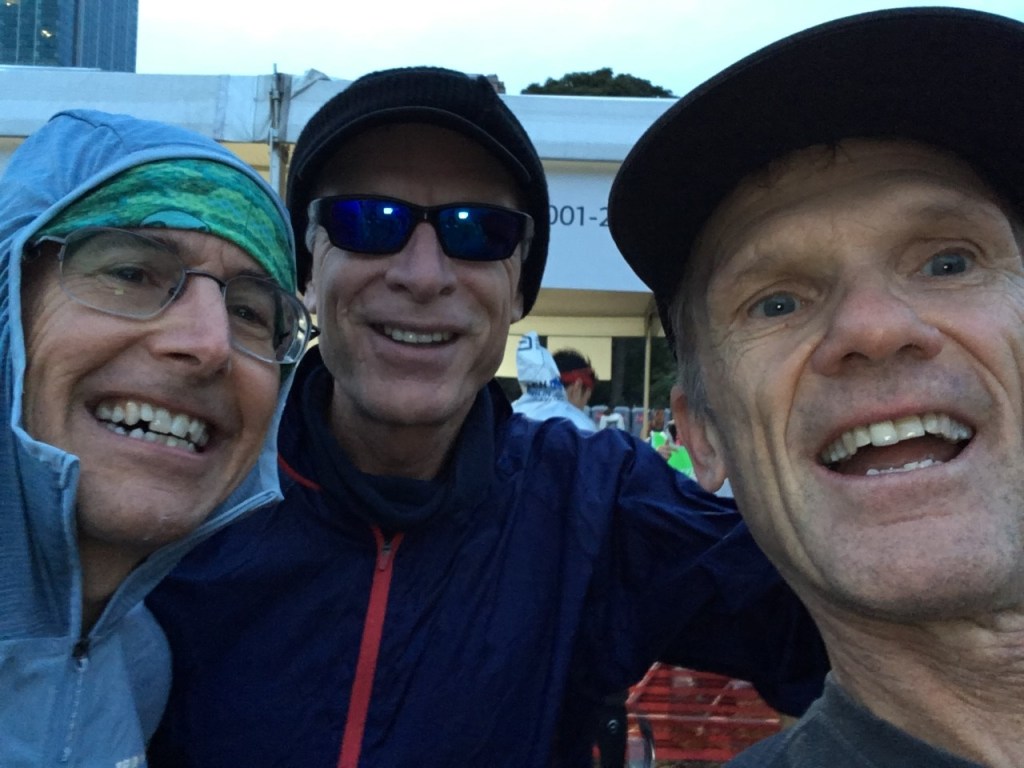
I met up with my clubmates Tim and Paul (in photo) above. Both are highly competitive masters runners, Paul finished 2nd at last year’s WMM age group championship, and Tim was 3rd in his age group at Chicago last year.

Race weather was as perfect as you can get (read men’s world record on the day!), mid-40s at the start and a slight breeze, and high clouds. To start I decided on gloves, arm warmers, and an old t-shirt under my singlet, so if things warmed up during the 3 hours I could peel and drop layers.

I arrived at the corrals at a little after 7 but waited to 7:15 before squeezing up as possible far into Corral B as possible, and lined up 20 0r 30 meters behind Corral A, just behind the 3:05 pacers. I wasn’t too nervous waiting, more excited, as I peeled off my throw away sweats as the final count down to the elite wave ensued.

Finally at 7:34, almost 5 minutes after the elites went off, I crossed the start line and we were off!

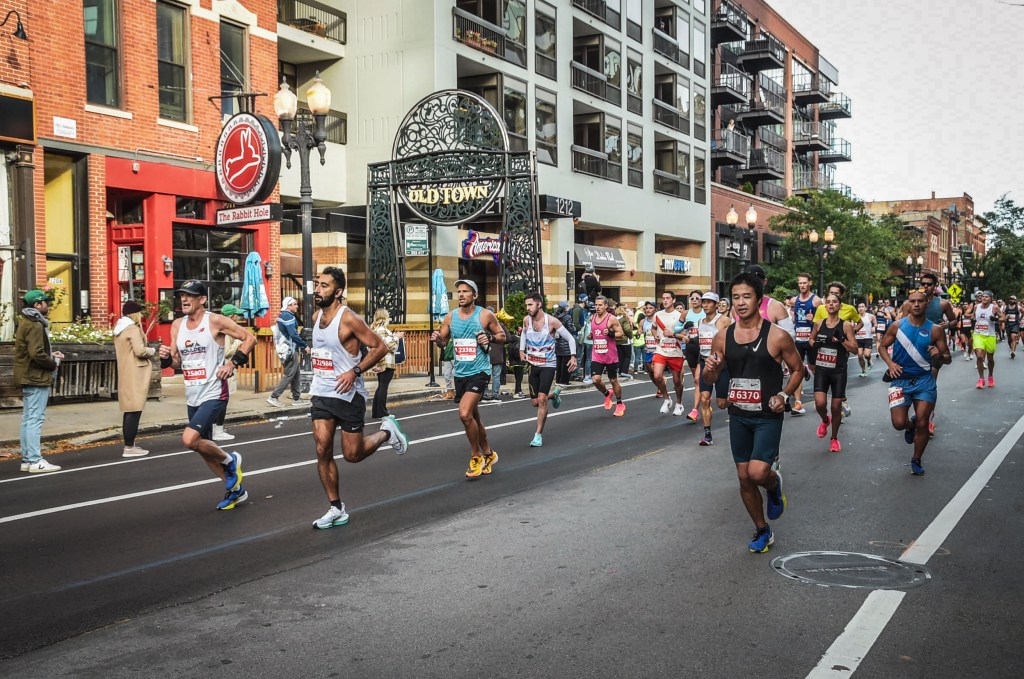
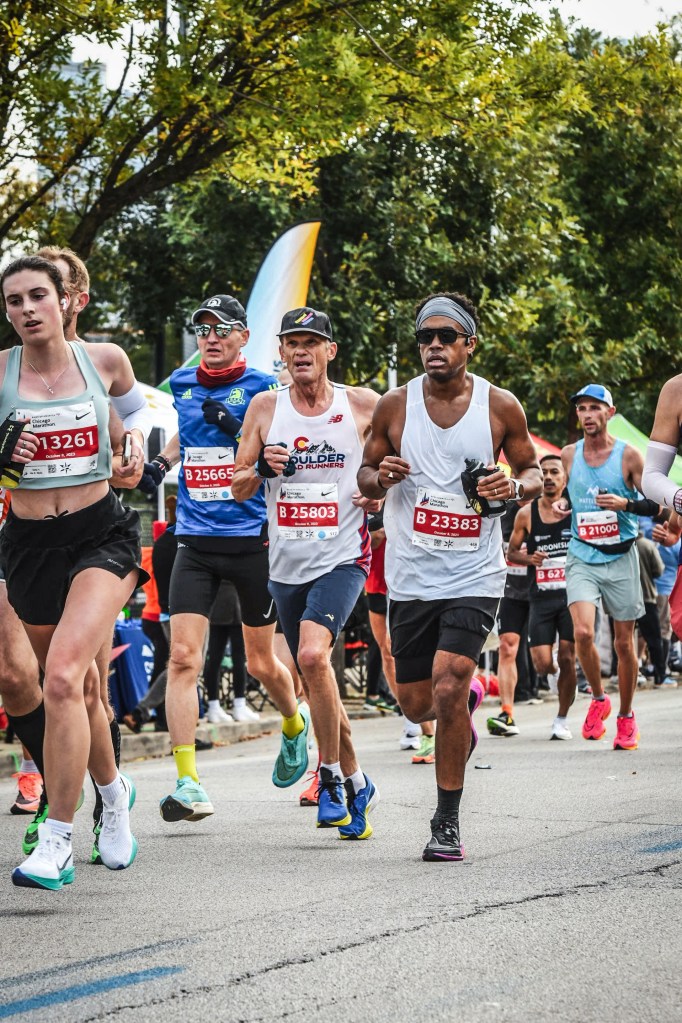
The first four or 5 miles were the noisiest I had ever experienced and that includes Boston and NYC marathons. So many people! And so many runners going at the same pace, you couldn’t really slow down or speed up.

I never felt great on Sunday, my legs were slightly tight from the beginning, and while breathing was fine my legs were never comfortable. We were running 10 or 15 wide on the streets of downtown, with runners just a meter behind and ahead. It was tight and I had to watch my feet.

5K – 6:57/mile – noise tunnel with lots of turns through downtown

10K 6:52/mile heading north along LaSalle and Stockton Drives we strung out a bit, running 3-4 wide and the noise abated some, although there were people lined up and cheering the entire way.

15K – 6:53/mile. I only was able to see the long blue line on the pavement after about 15K. A marathon tradition, the blue line depicts the shortest possible route on the city streets. Therein, I kept my eyes on the line.

Half – 6:53/mile. I had little clothing glitch at 11 miles when I peeled off my undershirt and attempted top put the singlet back on and had to have someone re-pin my age group identifying back bib, which had come loose and that cost about 15 or 20 seconds. I was 1:30:16 at the half. The pace was not easy, but it was not uncomfortable. I just wondered if I could sustain the pace for another half.

30K – 6:53/mile. I probably felt best from about the half through 20 miles, and felt like I could get under 3. Just past 18 miles an older man with a megaphone announced Kelvin Kiptum’s world record of 2:00:35. That was inspiring and kept me going. However my upper glute/back were getting a little tight by 19 and that may have been setting up for what would come over the final miles.

35K – 6:59/mile. Here I had my first real warning shot, with a quick sharp cramp in my upper calf at about 21 miles so I eased up to 7 minute pace for a bit hoping to hold off anything worse. Doing the math, started reconciling with maybe not breaking 3 today. I could live with a 3:00 or 3:01. Just keep going.

40K – 7:42/mile. This 5K segment was where I ran into trouble. I really had to slow down after 22 miles as my inner thigh muscles would cramp up whenever I tried to keep the pace at around 7:00, so I had to shuffle.

42k – 8:33 pace. Over the final stretch, I had to walk a few times for 20 meters or so to calm the muscle spasms in my thighs.

I was so grateful see signs indicating 800 and then 400 m to go.

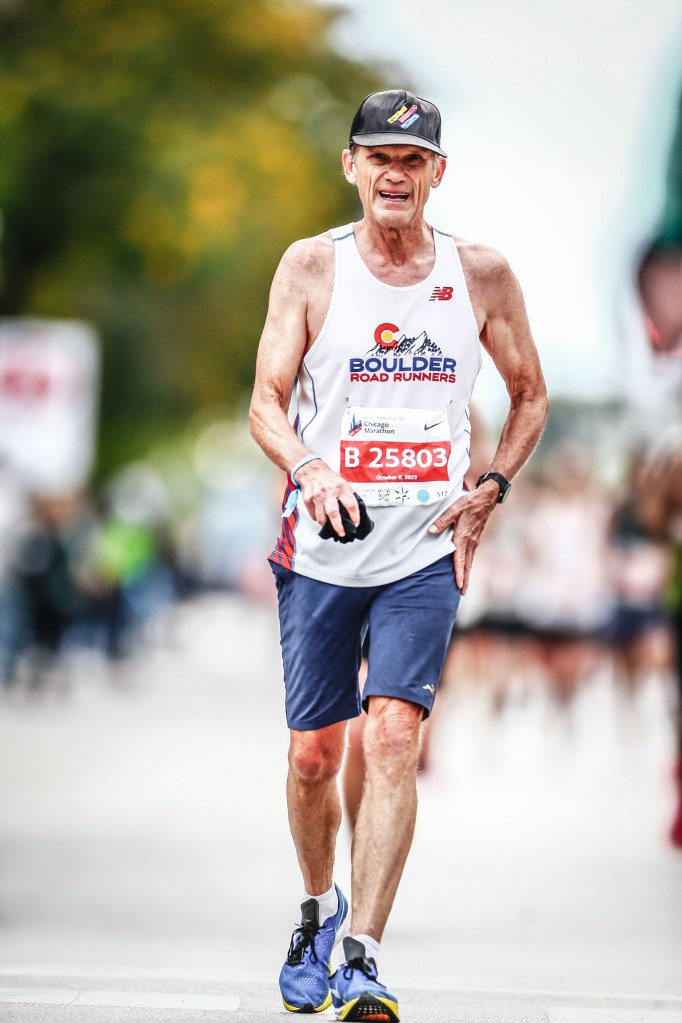
Finish – 3:05 (7:04 pace). This was not what I had hoped for. While happy to have finished the race (on fumes) I was initially disappointed in the outcome. Nevertheless, I was 6th for my age group and 2nd American in the Abbott World Marathon Majors masters championships. I can’t complain too much. To have a less than perfect race and still place decently in my age group at an event like this is a pretty good silver lining.

Aftermath

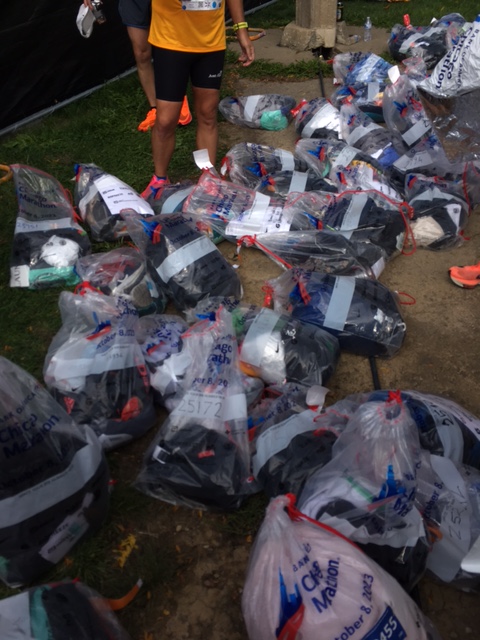
I had a terrible calf cramp while walking through the finish area, but two volunteers helped me up and walk it off for about 5 minutes and after that I was okay. Getting my gear bag back at the Abbott tent took 90 minutes of pure frustration as they didn’t have the volunteers to properly sort the bags, so it was a free-for-all.

I was disappointed for the first couple of days following the race, not sure if I even wanted to do another marathon. However, as the events of the weekend sunk in, I can step away happy finisher of the Chicago Marathon, and I’ll be back for a couple more cracks at sub 3.

USATF Masters 12K

I entered 2023 with three primary goals for running and racing: run five USATF Grand Prix races and win my age group for the series, attempt and set an American record for the 25K road race, and run sub 3 at Chicago. Two down one to go.

The Grand Prix

The Grand Prix circuit began about 12 or 15 years ago, and it involves eight races across the country ranging from the road mile to half marathon, with five road races and three in cross country.

Points for races go 100 for 1st, 95 or 2nd, 90 for 3rd and on down to 20th place. To win you have to run at least five races because even if you won four and scored 400 points, someone else could place 4th or 5th five times and come out ahead. By the end of the season, scores can be surprisingly tight for the overall title.

I went five for five in in the series in 2018 and won the title with a perfect score. In 2019 I was 2nd at Club XC and US Nationals XC, and had two road wins. I also medaled at WMAs but those points did not count for the Grand Prix back then. I skipped a couple races in the late summer in favor of focusing on the 15K in Tulsa, and I just needed a top 5 or 6 or so to win the title. However, my hip gave out a couple of days ahead of the event and even though ran anyway, I had to walk the last 5K and did not place high enough to win. That stuck with me, and has been an extra motivation for 2023.

It is not easy to win the series. You have to show up and just making it to five races is a big commitment. The East Coast athletes do have an advantage as often five of the races are in the Eastern Time Zone. West Coast has it the toughest because of the travel, while Rockies and Midwest it’s somewhat in-between. USATF really needs to find a way to make this more equitable.

For 2023 I have had two 1sts (10 mile and half marathon, scheduled a scant two weeks apart last spring) and two 2nds (5K in February and road mile in June), and had a good lead, with 390 points. However, I did not take anything for granted, I wanted to be prepared.

Summer Training Block

After the road mile in June I set my sights on marathon training and the 12K. I did two races in July, a 5K on July 4th, and Bix on the final weekend of the month. In July I got in a couple weeks into the mid-60s, but had a bit of a hitch with some knee tendinitis from hill running and ancillary strength exercises. So in the two weeks before Bix I did a fair amount of cross training (3 hours a week) and dropped my mileage to 50 and 40. Bix went well and I won my age group by several minutes and (unofficially in my mind) set an age group record with a 45:15 on the hilly course in Davenport, IA.

Then we had two weeks in Europe, where I didn’t miss a day of running but did cut back on volume, so there I was 40-55 miles. A full month of 40-55 miles wasn’t ideal with an October marathon in mind, but I kept it rolling and managed a couple of solid long runs.

Back home in mid-August I had one of my better blocks that I can remember, with weeks of 70, 72, 77, and 73 with no hitches. In addition I did a weekly track session, doing reps of 800 to 2400 m, and of course with weekly long runs and some mid-week long runs.

For the week of the 12K I did cut back to 45 miles in the 6 days leading up to the race. A hard core coach would probably not want me to do that, but I wanted to go for a good time in New Jersey for the 12K, in particular for age grading where you can win some money if you place in the top 5, but that’s a high bar. Seconds matter and you usually don’t know where your competitors are because they maybe minutes ahead or behind you. With another 65 or 70 mile week, I felt I might not be fresh enough to compete for a top 5.

Racing

One of my teammates fell ill just before the race, and so I traveled alone and we did not have a team. I put that aside and focused on the race.

Race day dawned cooler than the previous two years, and due to several athletes being taken to the hospital last year, they moved the start back by 30 minutes. That’s still not enough, a 9:00 start in mid-September, it’s still going to be get warm most of the time. It was 65 at 9, cloudless, and we had a slight NW breeze (maybe 5-6 mph). Best conditions in three years.

In the past two years I went out at about 6:00 or just over for the first two miles and then spent the rest of the way just hanging on. I think my fitness is fairly even to those two seasons, but at 65 two years older is two years older. I decided to run my first mile in 6:10-6:12. I was somewhere back in the mid 60s at the mile (about 280 runners in the race).

photo credit: Jason Timochko

After we made the first turn at 2K (pictured above), I turned it up a bit, and was just a bit over 6:00 pace in miles 2 and 3. The 4th mile has a lot of sharp turns, but you can see where others are. I had been passing runners one by one, but mostly running in no-man’s land. At about 3.5 one of the runners whom I had passed came back and encouraged, cajoled, and harassed me to run faster. Those splits were at about 6:10. The 6th mile (mostly straight, with a slight tail wind) was my fastest of the day, at 6:00. The last 1.4 miles of this course are always a grind, and I was just hanging on, as temperatures were climbing slightly. At this point there was hardly anyone left to catch and no one behind, although one runner did come up with about a mile to go, on the very long straight stretch to the finish.

I kept to within 5 or 6 seconds, and then threw down the biggest final kick I could, to finish in 45:36. More than a minute faster than last year and 6 seconds better than in 2021.

So I was pleased. Won the age group by several minutes, and was over 90% for age grading. I thought that was enough for top 5, but it was 6th, I needed a 91%, and was about 15 seconds shy of of that. However, with age grading it often feels like rolling the dice because you have no control over how others are doing and you don’t see them on the course.

photo credit: Jason Timochko

On to Chicago in two weeks!