If I were a Nike-sponsored athlete I’d probably get a reduction in pay, but as an amateur age group runner it doesn’t matter much. So how’d it go for 2021?
Second half was better than the first. But before getting into that a bit, here are some numbers to check off. Total miles run: 2800 (if I get in 20 miles between now and Friday), and combined ski-run miles a little over 3000 (as long as I get in two ski outings this week). Something like 440 workouts total (including some easy cycling, which I don’t count on the running tally). I did more doubles this year than usual.
January through June
Last winter I kept the mileage in the moderate level (45-55 mpw), plus a ski outing or two each week. The early season was capped off with the “Virtual Birkie” 43.7K, which I did in 3:03 at 8700′. That build-up was fun, and makes me think about returning to ski loppets some day–maybe in a couple of years.
I spent the first half of the year working toward Grandma’s Marathon in Duluth, MN. It was one of the first major races to open up during the second year of the pandemic. I got up to 75 miles and had a good string of 65-70 mile weeks in April and May. Best race of the spring was a 1:25 half in Loveland, about an hour north of here. Following that I was a little disappointed with the track and road efforts, which I treated as tune-up efforts for the marathon.
Grandma’s was a great experience and I had a decent, but not great, race. I trained for a sub-3 and by all indicators that seemed attainable. However, I just didn’t have it on race day, and after 22 miles at 6:50 pace I couldn’t hold it and finished in 3:02, with a positive split of 2 minutes. The best consolation was to take first in my age group, so not a bad day.
Races for First Half of 2021
3/27 – Runnin’ O the Green 7K, Denver, 26.26 [socially distanced] (1st)
After the obligatory few weeks of recovery I ramped up quickly for a summer and fall season. The plan was to peak for the USATF 12K masters road championships in New Jersey, first championship race in a year and a half, and hopefully a fall half marathon.
Training went as well as you could expect, as I typically ran between 55-65 miles through November, with a race every couple of weeks to keep things interesting. Did most of the training on my own, but hopefully 2022 will involve some more collaborative outings with teammates and friends. I pretty much go by feel, but regularly mixed in tempo/threshold runs or repeats (20 to 45 minutes of faster running), and repetition workouts of 15-25 minutes at CV to V02 max effort, often closing with a few fast reps of 20-60 seconds (i.e., 100s, 150s, 200s, 300s on the track or trail). Long run of 12-15 miles each week. The remaining days were either recovery (at least twice a week) of 45-60 minutes easy on trails, or endurance (65-80 minutes, often somewhat hilly and also on trails).
My training and racing may not impress a +/- 30 year old working to break 15 or 16 minutes for 5K (let alone 14!), but for me into my 60s (technically mid-60s this year) it worked. I stayed healthy and most races went well. I think the Mile High Mile in the end of July and Fortitude 10K in September were a little weak, but the others went about as well as could be expected (even though I always came out of those thinking I could have done a little better–we all do that, right!?).
The year’s highlights (in descending order) were: (1) Running on the winning team for the USATF Club Cross Country Championships in Tallahassee. That’s been a lifetime dream, to take the team title at a cross country championship (was on a couple winning teams on the roads a few years back). (2) The 1:23 half in October (apparently 2nd in the USA for my age group (?) according to Mastersrankings.com) in Fort Collins, what I consider my home town (lived there 22 years). That was probably my best effort of the year (and best age grade score at 88%, even though it was at altitude). (3) Two podium finishes at USATF championship races, holding out for silver (barely) at the 12K road race in New Jersey, and moving through the field with teammates to place 3rd at Club Cross Country this month.
Races for Second Half of 2021
7/24 – Colorado Springs Classic 10K, 38:46 (3rd)
7/31 – Mile High Mile, Niwot, 5:37 (2nd)
8/6 – Mile High Mile Series 3, Englewood, 5:33 (1st)
After several months away I’m back. We sweltered through summer, although this year we had a bit of a monsoon season with enough rain to keep most of the local fires away. However, big fires in California and the Pacific NW made up for that and we had poor air quality through most of July and August and into September. I ran through most of it, and just did most of my running fairly early before the ozone got worse.
July and August
Following a three or so week recovery from Grandma’s Marathon I picked things up a bit for the second half of July, with weekly workouts and long runs of up to 13 miles. At the end of the month I did the state championship 10K road race and managed to run 38:46, and was reasonably pleased with that effort as a bit of a rust buster and 45 seconds faster than my 10K attempt in May. Ran 240 miles in July.
August was a good month and I put in 274 miles with a interval sessions and tempo runs every week, plus long runs of 12-13 miles. I also raced three times, but those were short races. On consecutive weekends I did the mile (5:37, 5:33) on the track and following that back to the roads for a 5K. That was supposed to be a 3K on the track but I did not get my entry in on time (the USATF Colorado/Race Director as a stickler on mail-in entries only, must be received a full week ahead of time). Normally I am supportive of local and national USATF, but that was lame.
Anyway, did a season’s best of 18:48 on a course in Centennial with a climb most of the last mile. Not bad, it was a good tune up. Congrats to Arapahoe HS girls, as they won the 5A state championship this weekend!
September and October
I schedule two big races in September, the Fortitude 10K in Fort Collins and the USATF masters 12K road championships on the Jersey coast. The Fortitude race was somewhat tempered because we traveled to Iowa for a wedding ceremony over the weekend. Got back the afternoon before and I felt a little flat on race day, with a 38:47, not quite getting a season’s best. So that was a bit of a disappointment. I did win my age, though. I think 3rd in the age group.
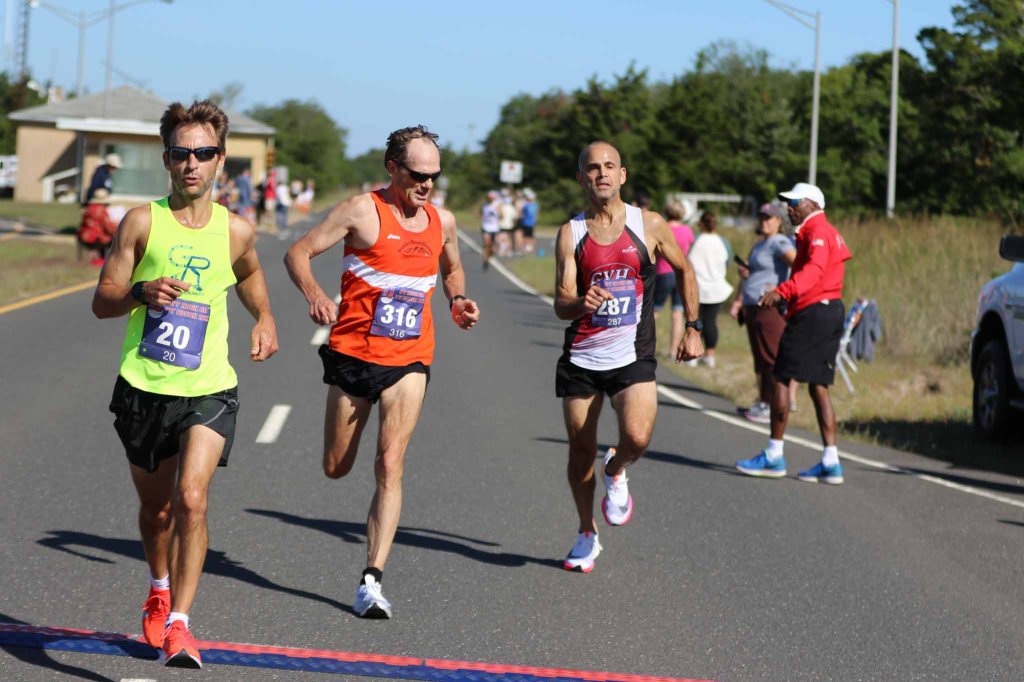
The race in NJ was to be The Big One and I trained for 90% age grade (45:00). My workouts through August indicated I was ready for that. CV reps at 6:00-6:05/mile pace, tempos at 6:20+/-, and V02 reps at sub 6. The course at Sandy Hook National Recreation Area was as flat as you can get and the competition would be good. I set out to run 6:00 mile. It was a good race but with a stiff 12 mph wind for the first 3.5 miles, combined with 70 degree temps with 70% humidity was enough to temper my pace. I only managed a 45:48 on the day (88.3% age grade) but hung on (barely) for a 2nd place finish after a furious kick.
Kicking it in for age group second place at the USATF 12K championships at Sandy Hook, NJ.
I wanted a bit more, but was not disappointed with the race. I figured this would be the best of the year. However, also felt that I had plateaued since May. The workouts were always a step ahead of the race results and I wondered if I was pushing too hard, trying to force my fitness.
With the travel and cutbacks I ran 221 miles in September.
I didn’t really adjust the subsequent training paces, as I generally run by feel even on the track. However, I took four weeks off from racing but kept the tempo runs and interval sessions going, and upped the long runs a bit to 13-15 miles. Got in some good weeks of training, but nothing stood out. Nevertheless, a 4X 2K threshold session at Washington Park with a clubmate was encouraging, I averaged about 6:19/mile which is just about what I did in March 2019 before going to Virginia Beach to win the USATF 8K age group, and then just a week later going to Poland to medal in the cross country and half marathon events.
Also telling was that it took all week to recover from that workout, so I just ran easy effort until the following Saturday to run a preview of next year’s USATF XC championship 5K to be held in Boulder. I was 4th place masters, but ran only 20:03 the slowest 5K race I have ever run. But I wasn’t discouraged because I know I ran decently for that day.
I set my sights on last weekend’s Colorado Half Marathon back in Fort Collins, and set a challenging pace: to run faster than the 6:22s I did in Boulder. That seemed a bit audacious, but felt doable if I had a good day.
And a good day it was, even though it didn’t always feel like it! We traveled up to the old hometown on Saturday afternoon and took in some sights, including the house I grew up in for my first 10 and a half years. That was fun.
Race day was chilly, with 39 degrees and only warming up to the mid-40s by races end. We started at sunrise.
The field was not deep, but I briefly found a pace group for the first mile as the top 15 or so took off at 6:00 pace or under. Our pack split the mile at 6:26 but the others were saying that that was probably too fast for them, so I took off closer to my pre-determined pace and clicked off a series of miles in the low 6:20s. However, I was not feeling very sharp. I didn’t cut back much for this race (59 miles for the week) and my legs did not feel fresh. However, I wasn’t slowing down and actually started feeling better by 5-7 miles, even though there was a big hill in the middle of that. Onto the bike path in LaPorte at 7.5 miles, I was gaining some on a couple of younger (college age) runners.
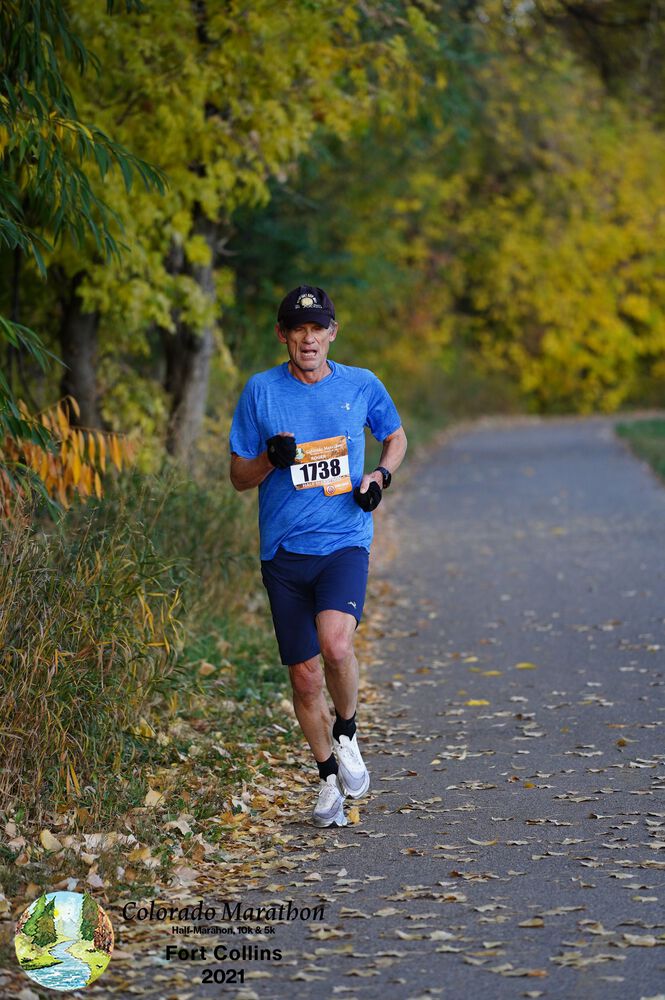
But at mile 10 (62:58) I ran into the mid-pack 10K runners on the bike path at their turn-around, and I lost track the two guys just ahead. From some frustration came some stomach discomfort starting at 11.5 miles. I held on and slowed only slightly, running the last 5K in 20:08 to finish in 1:23:06, 1st in age group and 1st masters, 13th overall. That’s 88.3% age grade at altitude, which is better than 90% at sea level. Best race since 2019.
Colorado Half 1:23:06, 1st Masters 1st 60-64 age group.
I took it easy this week, with one good workout on Friday and a fun group run in Boulder on Saturday, to cap off the month with 265 miles.
What’s Ahead?
I’ll do Colorado USATF 5K XC and road championships in November and considering the Club Cross Country championships in December before shutting it down for the year. I’ll see how it goes next weekend in Boulder.
No excuses for no blog posts in months. Just haven’t been focused (actually I have written several drafts but have not posted in months).
I last posted mid-vaccine surge, while just starting my build up for the marathon. So how did that go?
Miles and Miles but Not Many Trials
As far as build-ups, this was one of the best with nary a niggle nor cut back. The only hitch was that I did delay upping the miles due to getting the Covid vaccines in March-April. I was probably more affected by the first one than the second. I tried a 6-7 mile run on day 2 after that one, and had to turn around after less 2 miles at 9:30-10 minute/mile pace.
Here is the summary.
Week
Miles
Workouts/Races
Long Run
Time (include cross training)
1*
47
CV reps (15 min, at 6:12); 4.3 mile race (6:13)
8
8:03
2
59
3.5 mile tempo (6:20s)
15.2
9:44
3
63
CV/speed 6X600, 3X300; Tempo 7 miles (6:35)
16.1
9:24
4*
56
CV speed (4.5k 6:00/5:24); Cruise (3X1 at 6:14)
17
8:39
5
60
CV 4X 800; Half marathon (1:25:17)
16.5
9:07
6
58
CV 4X 800; Race 3000 m (11:09)
18.2
9:29
7
70
CV 7X 800 (avg 3:01)
19.4
11:02
8
64
Tune up fartlek; 5000 m race (19:07)
15.5
9:01
9
72
6 mile tempo (6:32); 13 mile MLR
20.2
10:23
10
74
4X1400 (10K pace); 11.7 mile MLR 21
21
11:12
11
60
Tune up speed 6X 300 m/200 float; 10K race (39:30)
17
8:03
12
70
Progression 13 (with 10 going from 7:07 to 6:30s)
20.2
9:15
Average
62.5
*Covid shots
Overall, not a bad 12 week block leading up to the two week taper in June. Getting the Covid vaccines did set me back a bit those early weeks and instead of 46 and 56 those weeks might have been closer to 60 and 70. Nevertheless, I had no other hitches. So no complaints.
Workouts
My workouts went as well or better than expected, averaging low 6 minute pace for CV reps, 6:10-15 for 10K pace, about 6:20 for threshold, and 6:30-35 for longer tempos. If I had to do it again, I would have done one or two more workouts at 10K effort with longer reps, instead of CV at 600-800 m. The rationale was to be 5K ready with some 6-8 weeks to go, and then shift to more pure marathon-type training. However, I think longer, strength based reps, might have been better.
Races
Mixed bag on the races, and the results left me a little perplexed–more or less the point of this entry. My early 2021 races (10K in January, 4 mile in February), including the March 4.25 mile St. Patty’s run were a fair amount slower than expected, more like tempo pace from previous years. I wrote off the sluggish St Patty’s run to being just five days after my second Covid vaccine, to to mention it was a solo effort off a wave start.
Next up the half in April, which turned out (by a ways) to be my best race of the spring. 1:25:17 in Loveland. It was also a wave start, but I was in a the fastest wave of 25 and could see where all my competitors were. Had hoped for a low 1:24, but was satisfied with the result–first real (non-time trial) race in 18 months.
I probably should not have entered the 3000 m track race just 6 days later, but was excited to get back onto the track. Ran 11:09 after a start where everyone went out too fast, and even though I was dead last ran an 84 1st lap, when it should have been 4-5 seconds slower. Two weeks later, fully recovered I figured an 18:40 or faster 5000 would be reasonable. Had some bad weather, 15-30 mph winds and only could muster a 19:07.
No excuses for Boulder on the Run (socially distanced Bolder Boulder) 10K. Met with a dozen or so club mates and expected to be well under 39 (maybe 38:30 if things went well). However, I felt flat by mile 2 and more or less struggled to hold a 6:20s pace to finish in 39:30.
Grandma’s Marathon
With a decent build up but only a so-so set race results. I adjusted my goals. Earlier I was thinking sub 3 would be in the bag, and maybe 2:52-55. As the race approached I added 5 minutes to that, with 2:57 as high end and realistically a 3:05 would be acceptable.
Race day was good–a bit warm at the start (low 60s and sunny), and the rolling start a little weird (started in the 1100s and had to pass some 800 runners in the first 10K), but other than that it was a really good day for a marathon and the race organization was great. The middle part of the race was cool (high 50s) and with a breeze off the lake. I barely got under 3:00 pace (1:30:12 at the half and 2:17:08 at 20 miles) but just clicked off steady miles through 22. Then things got hard up and over the overpass (Lemondrop) hill, and the last 2 miles things kind of fell apart. I finished in 3:02:08. Not terrible, but not what I had trained for all spring.
Aftermath
I’m somewhat disappointed with the time, but was happy to walk away with an age group win–but barely winning the 60+ as a guy 2 years older in the 65+ age group was only 3 seconds back (and breaking the age record by 5 minutes). Overall, I’m not going to whinge much, because seriously just having the opportunity and health to go out and run 26 miles at sub 7 minute mile pace is pretty good.
Three weeks later I’m regrouping and planning out the months ahead. I’ll get a health check up (overdue) soon, and already into a recovery build up and have a few races scheduled for the summer (looks like 4 races): 10K, 5K, 10K, 12K. I’m thinking of doing Boston Marathon in the spring, but that depends on a few things like a potential setback from a foot thing (Tailor’s bunion), if it requires surgery. Meanwhile, will press ahead for the next two months with a training system that has worked in the past; if that isn’t working by mid-September I’ll take a hard reset and maybe try something different.
In the U.S. there have been 113 million covid-19 vaccinations to date, so after a slow start at the beginning of the year it’s really taken off. And based on projections from health officials and on the news, vaccination rates will accelerate even more so over the next couple of months. On social media lots of selfies or posts of arms and cards to show it. Everyone will have their own story to share. Here is mine in words. Selfie not included.
Phase 1 – Vaccinations for my age group opened up on March 5, but they said you could start applying over the week before that. So I set up an account on the second day that we were eligible and started doing searches for commercial pharmacies or mass sites right away.
For 2 weeks I saw nothing, and called the Hotline again last weekend. They suggested another provider, and said to just keep trying. I did that for a couple of days with no more success than before, so my son offered to assist as he’s on a break from his studies. Monday nothing. Tuesday morning nothing.
On Tuesday I saw on Facebook that friends here were getting in, so I asked one how he got in. Got a few tips and spend 90 minutes basically refreshing King Soopers and Safeway sites over and over. I got a hit! But as soon as I clicked a confirm button it disappeared. Then another. Same thing. Finally I got onto King Soopers and got a third chance! This time they gave me a 15 minute window to complete my form and to confirm a second appointment.
Stop!
No second appointments available at this time. Clock is ticking down. WTF? Talk about a catch-22. I called my son and showed him the screen. Nothing we could do, and time ran out. I spent another 10 or 15 minutes searching, but decided to give up for the morning and get back to work.
Bing! 15 minutes later a text. He got me an appointment in just a couple of hours. I did a quick workout showered, had a bite to eat and headed down for the appointment.
How did he do it??!! He said he got onto Twitter and Reddit which had posts that said you should have as many screens as you can and as many sites open and to just keep clicking and refreshing until something comes up. So he had two screens and 25 sites open for a couple of hours that morning. That’s what it takes.
Phase 2 – Once I got to the Safeway it all went fairly smoothly. Arrived at 1:50, 10 minutes ahead. There were already 4 waiting in line. We each checked in a few minutes before 2 and lined up again. By 2:15 I was in and out, instructed to hang around the store for 15 minutes–so what are you going to do? Shop of course (and my cynical side lets me think that’s why the system is so chaotic, that they are going the commercial route with most vaccinations so you’ll go into the store pharmacy and buy stuff). Good plan, I guess, but a centralized appointment system sure seems a lot better. This was the Wild West, or maybe digital Darwinism.
Phase 3 – What was my reaction? The shot stung a bit more than your average flu shot, and my arm was immediately sore, like if my wife had punched me a good one after I had been teasing her. By evening I was a little achey so I took a couple of Tylenol at about 8. I woke up at 2 feeling stiff and some aches in my joints and muscles. Tried to go back to sleep and barely did before our alarm went off at 5. So I was tired all day, and the aches persisted.
I did 30 minutes on the bike trainer in the morning and felt, decent at that. At 3:30 went for a run, and really felt it there. Legs were like lead the entire way. Starting out feeling stiff is normal now, and my first mile is often 9:00 or 9:30 before I can get rolling at low or sub 8s. On Wednesday I could go no faster than about 8:20, and that took some effort. I ran an hour (maybe should have stopped at 30 minutes)–so actually a pretty good day considering.
Still ached last night and took 2 Tylenol before bed. Again woke up at 2, and this time almost fell over, feeling woozy and off balance. I took 1 Tylenol and went back to bed, sleeping lightly until the alarm went off at 5, maybe getting another 10-15 minutes after that.
Otherwise, feel good today. No aches and I think my body is adjusting. Plan on a 1:30 to 1:45 run today, but will cut that short if I’m not feeling right.
Looking Ahead
Phase 4 in 3 weeks, appointment at 2 PM at the same Safeway. By the time I’m fully vaccinated and antibodies have had time to build immunity (April 20), I figure there will be at least 120 million fully vaccinated and more than 200 million with at least one dose. And by middle or end of May? Hopefully reaching herd immunity, despite some 30 million to 50 million refusing to get a vaccination.
In the year of the pandemic I have had no breakthroughs but no break downs. And while I haven’t set or approached any mileage/volume personal bests either, it has been a decent year for holding steady. I’m in better shape, and maybe even better physical health than this time last year. Mental health? Maybe let’s talk about that later.
Summary for a Year of Shutdowns
Here are the numbers. I have run nearly 2,600 miles since the pandemic was officially announced in March 2020. Add another 300 miles of cross country skiing and a few hours of cycling, which I just started picking up on early this year. Getting close to the 400 hours I would like to be at. Workouts have gone fairly well, and while not spectacular with the aid of the “super shoes” (Saucony Endorphin Pro and Endorphin Speed), for the past several months have come close to matching what I was doing in 2018-19, with tempo paces at 6:20s and CV in the low 6s (although for the past three months the weather has not often exactly been conducive to faster running on workout days).
Nevertheless, due to the lack of racing over the past 4-5 months I’m not sure where my race fitness is. In fact, practically no clue. My last real race was in November. I attempted a hilly 10K in January, but either that course was tougher (some 350′ of hills) or I just had an off day. Result was a very slow time. My scheduled race in February was canceled/postponed due to cold weather (sub zero) and wind chill (sub teens) at race time. So I missed that opportunity.
And this weekend a planned 7K is doubtful because we are expecting 2 feet of snow in Denver (up to 4 feet where I live). So foiled again. Hope this one is rescheduled to next week.
So I’m encouraged by some aspects (consistency and getting in some decent workouts) but very disappointed not to have some racing, which I do for fun and to test where I’m at. Won’t even go into no sea level racing over the past year, as I’m not traveling until I get a vaccination.
But while those parts might be somewhat in question, if not sources of frustration, I’m glad to have had a relatively decent an consistent season of weekly cross country ski outings, going back to late November. Had some weather issues there, but the highlight was doing an unofficial virtual Birkebeiner 43K in 3:09, at Snow Mountain Ranch, near Granby just skiing casually but steady.
One more addition to the compilation part of this update. We purchased an exercise bike last month. I started adding a couple sessions of week on our old bike trainer, to beat the weather and as a slight supplement to running to add in some extra cardio workouts. However, that system was creaky, with a 35 year old bike and 20 year old training mount. The new bike has none of the fancy electronic elements like Peleton or Zwift, just a standard Schwinn (made by Nautilus) with a digital timer/speedometer. So I’ve been putting in a few 25-30 minute sessions a week. Combined, been hitting 9 to 10.5 hours a week of training since early February. It will add up.
Now what am I throwing out?
Second half relates to what I have jettisoned. I think it’s largely related to the pandemic, and being isolated. I have had social media presence for decades really, going back to the late 1990s, but the ever-shifting sands have made it less palatable. Having less fun with it.
Facebook has been hit and miss, I kind of got into it, say 2009-2o14. But I shut it down for a good 5 years, opening up some although cautiously at the end of 2020. It’s good to have to get some updates (necessary sometimes, e.g., some race directors communicate and manage through Facebook), I just don’t like posting there a lot. Instagram is definitely a Millenials thing, especially the Stories line. Even though my dear son said I post quite well for a Boomer I’d rather do some nature and natural resources-type posts than selfies and stories about running. So I check in, post judiciously.
Strava. Strava is simply Facebook for runners and cyclists. And I think it’s actually destructive and counter-productive. Segment chasing, gathering kudos, and stalking your competitors, it is all really for the birds. I stopped the auto-feed last year following all the histrionics with their shutdowns, ransom, and “upgrades” which were really downgrades for non-fee paying customers. Now I just post a couple workouts a week, when I feel like it. If Strava goes under, or entirely behind a paywall I’d be perfectly fine with just letting it go to the trash bin.
Our masters club. We had a series of Zoom calls, but also a bad email chain of covid denial last summer, with several club member saying that thousands of deaths a day is just overblown media hype. Bad juju. I haven’t quit the team, but haven’t gone out of my way to make those monthly calls. I think I may be off the correspondence list, because haven’t heard anything from them since late January or so. Not sure when things open up how much or if I’ll be traveling with the Boulder Road Runners “elite” senior team. Still have some good friends there, some I’m less sure about.
Forums and message boards. I was in some of the very early versions of online communities, going back to the mid-1990s when we had Track and Field List Serve. Similar formats. Got in on the earliest chatrooms by 1998, preceding the infamous Letsrun by a couple of years. It’s been good and bad. Nice way to make connections and friends, but that seems exceedingly difficult in this age as we are no longer meeting in real life. In addition, I think while cliques have always been a big part of these (like junior high and high school), if anything it’s more entrenched now. I don’t know if it’s me or just the cliques, but I’m tired of it, so in 2021 I have been shutting down my participation on some long-time message boards like CH Runners (spun off of old Cool Running, which was the rage in the early 2000s), said Letsrun, and Reddit. I have just felt more and more, that I have few friends in those venues and those number dwindle with each month. In fact, seem like a lot are just showing off and patting each other on the back, rather than actually interacting, exchanging ideas, or stories.
And of course Letsrun is more about trolling as a platform for the racist, misogynist, hate everything alt right. But I’ve been a participant in one of its long-running masters thread for a long time, and over the past 6-8 months practically no interaction with anyone. Just the same two or three old blowhards going on and on about themselves. Often talking the talk–oh I’m turning 50-60 next year and I’m going to break 3 hours and place to 5 in my age group at Boston. And then they over-reach. Get hurt. Disappear. Reappear a year or two later. Repeat.
And so it goes. I’d rather talk to myself here, in this venue than try to interact with those who barely acknowledge anyone outside their clique, or BPFF (best posting friend forever).
A year into this pandemic–a little over ten months from when it really hit in the US–I’m still struggling to find my voice. It’s complicated. Or maybe not. This is going to be a top of my head entry, so let it free flow.
I am beginning to think that more and more social media and its many derivations are demon-possessing the lot of us, and the issues are just compounded during this time of social isolation.
For the past decade or more I have thought, occasionally out loud, that I sure do miss the the 1980s and 1990s. From popular culture, to lifestyle, and social interaction those days seemed much better than recent years. Remember Y2K, when everyone freaked out for months that the computers would default, which turned out to be something of a joke and a hoax? Nevertheless, since then things have spiraled downward. Sure we are more connected than 25 or 30 years ago, but are also more divided. Unrecognizably so. That’s the big picture stuff, if you think about politics and our social milieu. What about running–which is the focus of this blog–are we doing any better? I’ll say yes and no.
YESWE ARE DOING BETTER
Our level of knowledge and ability to share is ahead of 25 years ago. I was in on some of the first waves of running social media. In the mid-90s we had Track and Field List Serve to for hard cores to discuss the sport and 1-800 dial-ins to catch up on the European meets. They might show Pre, Oslo, and Zurich on a weekend special but not much more than those. If you had cable Marty Liquori had his weekly show to cover some road race highlights, and you’d get the occasional network broadcast of major track meets or road races.
Otherwise, some local papers would cover some of the events and of course the running magazines like Running Times and Runners World (the latter was the butt of jokes going back to even before 1980, even though it did often have some good articles and profiles).
There was a mixed bag on training guides, Higdon was the standard for newbies and Daniels came out with his first edition in 1998. Lydiard had been out for decades, and there were many other good ones and sometimes out on a run with friends you might kick around some of the ideas from these books.
Running isn’t all that complicated and the basic theory hasn’t changed a whole lot in 50 years. However, runners have improved since then (men’s 10K record has dropped some 40 or 50 seconds, marathon by almost 5 minutes) and depth is so much greater. And a lot of that has been accomplished through tweaks in training more speed for more of the year, better understanding of biomechanics and ancillary training to be stronger and more explosive, nutrition, and of course in the past few years shoe technology. One of the biggest changes is in online media and the ability to have up-to-date information at their fingertips, and then be able to share that information instantly. So we know more and have greater ability to share, and overall that’s where the sport has improved from top elite performance down to the more grass-roots local level, including high school and college running. So kudos to everyone involved in those aspects.
NO WE ARE DOING WORSE
The Early Days
Now this is where I start to feel lost. I really think social media is messing with our heads and fucking us over. On the positive side of that at least with running we are not fighting with misinformation and division. I think the issue is more subtle but it is also isolating if not divisive, although not on a tribal level of my side vs. yours. It’s more personal and down to the individual, almost each and every one of us level. At least of those who participate and play the game.
Let me just say that I’m huge admirer of the likes of Jerry Schumacher, coach of the Bowerman Track Club, who is said to disdain social media and all of its trappings. Me? I’ve been wrapped up in forums and what not since the late 1990s.
However, back in those days we just had a few forums and there were no rules, or we made them up as we went. Participation was not high at most sites and finding your niche was not all that hard. I found the Competitive Runners Forum on Runners World online, and we soon branched off onto our own. I still on occasion run into and poster from those days. Then things got bigger and little more rough and tumble with Letsrun and CoolRunning kind of taking the lead, and you would re-invent or adapt to the new medium.
Blogs became more popular in the early 2000s, so just maybe I’m still stuck in that 1997-2006 era. We were sort of the pioneers, and this was all new. It was sort of fun days except that it took an hour download any videos and live feeds were unavailable for most of us. But we could connect and exchange ideas, both in shorthand quips or barbs on a message board or in more thoughtful long posts, sometimes rants. And blogs were for more even detailed introspections or reports.
Modern Social Media
As with our online social interactions, Facebook along with other platforms like youtube (initially slow to catch on, now the rage), Instgram, and Strava have completely transformed how we interact. We still exchange ideas and experiences, but now it’s quick little soundbytes and remarks and everyone wants to see the little red “like” buttons pop up. It goes from pros and Olympians down to your local 20 or 25 minute 5K runner, and it is more about look at me and what I did today!
I left high school behind nearly 45 years ago, and never missed it much, but the past 10 or 12 have sometimes felt like going back every time I get onto a social media site. In the running, it is becoming less about what really what you do (maybe unless it’s setting a world or national record, or qualifying for the Olympic Trials or Boston Marathon), in exchange for more about getting those likes because for maybe 30 seconds you might feel good. Social media is a perpetual popularity contest and that mindset has spilled over to online forums.
Current or ex pro runners and amateurs with some media and advertising savvy now make a living or a chunk of it by the number of followers they have and number of likes they get.
I for one don’t really want to play this game at any level–yeah it’s nice to have a handful or two friends give a thumbs up or way to go–and I do not want this to be a driving force.
A handful of my high school friends and I have been having biweekly Zoom talks since last spring–one of the best things that has happened for me in this pandemic–and one thought that with my background as a master running competitor I could create a youtube presence and have a big following and make money.
Not in my DNA. I don’t think I can do that.
I still like to write, to get some thoughts out there and to exchange ideas, but the space and platforms for that are highly limited in this era. I play the game but lightly. Likes be damned. However, the loss is that the interactivity of communication in recent decades has gone in favor of the like button.
I finished college 40 years ago this month. Grinnell College of 1980.5
I graduated a semester later than my class because over the winter of 1979 I ski bummed in Steamboat Springs. Washing breakfast dishes in the morning and skiing in the afternoon, something like 110 days straight of skiing.
The Roaring 80s
After graduating I nearly stayed at Grinnell to work as a graduate assistant coach with a new coach of the track team. He had a stipend all set up and I could live in a dorm room for free. That coach was the now well known Will Freeman, author of Peak When it Counts (Peak When It Counts : Periodization for American Track and Field (4th ed): William H. Freeman, Freeman, William H.: 9780911521627: Amazon.com: Books), and several other training manuals. Had I known Will would accomplish so much as a coach, maybe I should have stuck around for a semester or two. I was leaning toward staying, but talked to a couple of my biology professors, and they said why stick around? You need to move on. So with mild regrets (then, maybe now) I did.
What follows is a guide to how I have spent my life since that decision, which I mad in early December 1980.
I went home to my parents’ house in Colorado and started looking for work as a wildlife biologist. The beginning of the Reagan era was not a good time to seek employment with the federal government, not to mention that we were in a recession and a period of malaise.
1981-84 I took a course in ornithology at CU Boulder, and found that wolf biologist David Mech was giving a lecture on campus. In his hour long talk he mentioned that he was looking for field technicians, with a degree and willing to work hard. The next day he gave a seminar, and I handed him a resume’ and letter of interest, and a week later he called back and asked if I could start in April! So I worked for Mech and “The Wolf Project” in Minnesota for a year.
Then I came back to Colorado and picked up the schooling with a summer at CU at their Mountain Research Station near Nederland, and CSU for the academic year enrolling in undergraduate courses in wildlife biology. Summer and fall of 1983 I worked for the US Forest Service back in Steamboat Springs, but over the winter I bucked my 1979 desires to ski bum again, and went back to CSU for another semester. By then I had amassed enough credits and experience to apply for graduate school, and I landed a research assistantship in the Department of Natural Resources, studying food habits of elk and deer. I started the program in the summer of 1984.
1984-86. Stayed in Fort Collins working with tame elk and domestic goats, feeding and mucking pens every day and many weekends while taking classes and doing research. That’s also when I met Tamara, an animal enthusiast, and she was smitten the moment that I told her that I had done research work on wolves and elk.
1987. I wrapped up my thesis over the winter, while taking one last stab at ski bumming. This time as a Nordic racer where I competed on the Rocky Mountain circuit and national championships. We got married and I needed a job.
1987-89. I landed a technician job with the Bureau of Land Management in Nevada, and we packed our bags on the 4th of July and moved out to the middle of nowhere in the high desert. I collected grazing data, worked on a couple of wild horse gathers, and did a season of habitat mapping. They offered me a career position, but we decided that Nevada was not for us and I applied for graduate schools and jobs across the country.
1989. I ended not going to graduate school right away, but landed a job as a research associate at Cornell University in New York, doing work on deer damage to ornamental plants in urban and suburban areas.
What race is a dozen years older than did the Boston Marathon? Also, it allowed women’s competition before Boston. This race also has featured a deeper field throughout much of its history, and until recently has been more competitive at the top. In fact, this race was long a proving ground for future Boston winners as well as Olympians, some of whom went on to win Olympic medals.
Look no further than USA Cross Country Championships.
The event started in 1883 when Thomas Delany covered 4.25 miles in 26:30 in New York City. A long (too long) 81 years later Marie Mulder ran 2K in 6:51 in Seattle, Washington to win the first women’s championship. Although the race has not been continuously held (there were no championships in some years in the 1890s at early 1900s). Men’s races have ranged from 4K to 8 miles, although most years it has been 10K (6 to 6.5 miles). Women have run from 2K or 2 miles in the early years up to 8K, with 6K being the most common distance.
The format has changed many times, and going back to the advent of the IAAF (now World Athletics) era in the early-mid 1970s, there have actually been two USA cross country championships each year. One traditionally in the fall, and starting in 1974 a second championship was added, usually in January or February, to allow qualification for the IAAF World Championships. (more on that later)
Until 1920 most of the championships were all held in New York City, with Buffalo, NY (1901, along with the Pan American Exposition), and Boston 1917 being the early exceptions. Since 1930 the championship has been held at venues all over the country, from Florida to Washington State.
Who Are the Champions?
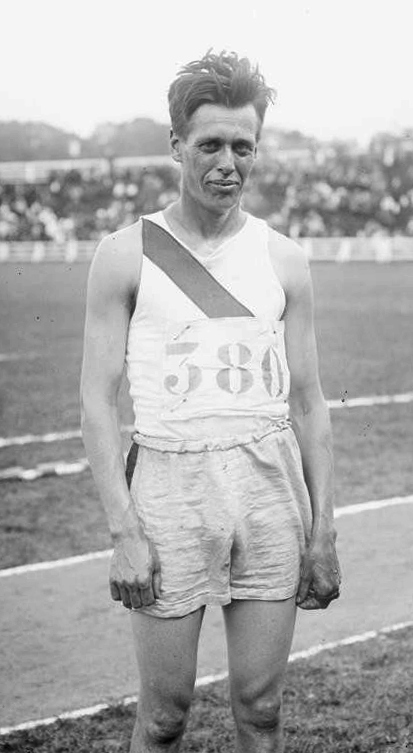
Fred Faller 1919 Champion
Men
Edward Carter (1885-88, and 1892) with five championships was the first multi-champion, with his fastest being 41:35 for 8 miles. George Orton of Canada was the first international winner, running 6.25 miles in 35:58 in 1897, and Orton won again the following year.
Here are the most notable multi-winners after 1890.
(read this article if you have a few minutes!), from Alamosa, via Evergreen, Colorado.
Women
Although the addition of the women’s even did not begin until the 1960s, the women’s cross country championships preceded the running boom by more than a decade. And, like the men there have been a series of multi-winners.
9—Lynn Jennings – 1985, 1987-93, 1996
6—Deena Drossin – 1997-2002 (mix of fall and winter championships)
Doris Brown Heritage was the pioneer, with four wins in the early years, and along the way won the International Cross Country Championships five times, and placed 5th in the 800 at the 1968 Olympics—at the time the longest event at the Olympics–with a 2:01.9.
Later, Deena Drossin (Kastor) won seven championships, both in the fall and the spring, on her way to winning an Olympic medal and setting the American record in the marathon. Likewise, Olympic Silver medalist Shalane Flanagan won six titles, all in the winter championships. They were all greats.
However, no one, male or female has matched Lynn Jennings who won nine cross country championships in her career, and those vaulted her to three IAAF cross country championships, and a and Olympic medal in the 10000 meters. https://trackandfieldnews.com/wp-content/uploads/2019/01/lynn_jennings.pdf
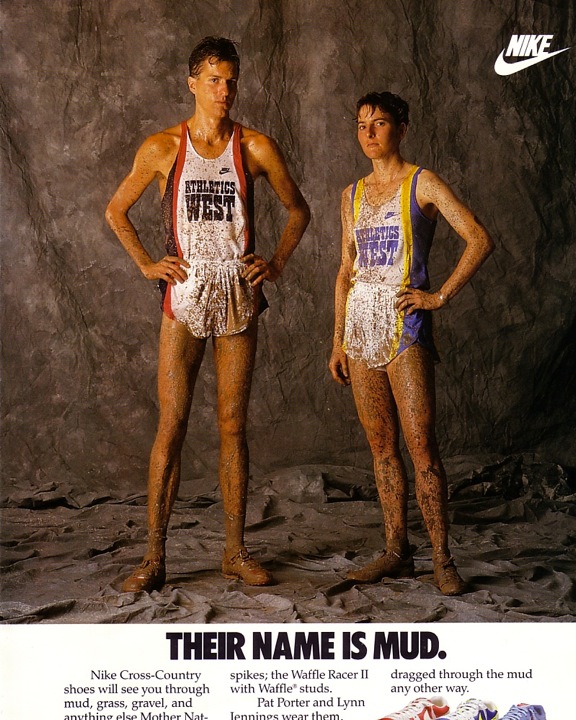
Porter and Jennings, early 1990s
Race Formats
From its beginning until the IAAF era (early 1970s) there was one US Championship a year. But when the World Championships were started, a winter “trials” was added, and now it serves as a championship in its own right.
Traditionally, the fall championship was held on the Saturday after Thanksgiving. The ultimate high-level turkey trot. However, starting in 1998, USATF changed the format and created the Club Cross Country championships, usually two weeks later. This race is more diverse, and prior to that time, the overall winner and top 25 (All-American) were the prestige goals, and any team competition was more of an afterthought. Media-wise the fall race received more attention and participation, while the winter event was small but elite event, a prelude to the World XC Championships.
The Club XC Championships emphasize teams, and participation more, and with open men’s and women’s as well as masters (from 40 on up) competition the event usually includes five separate races (Two open men’s races, two men’s masters events, women’s open, and women’s masters).
The winter championships are held in January or February, about six weeks ahead of the World XC championships. Frank Shorter (15K) was the first winner of this race, but typically the men’s race has been 12K. The first women’s winter championship was not held until 1997 when Olympian Amy Rudolf captured the 4K and Nnenna Lynch won the 8K. From 1997 through 2005 the world and USA winter championships had two distances for men and women. Men ran 4K and 12K, and the women ran 4K and 8K.
From 2006-2019 the format has one fall race for men (10K) and the winter race (12K), and for women it has been 6K for fall and 8K in the winter.
The 2020 fall and 2021 winter championships were canceled due to the coronavirus.
My Experiences
I started following the US championships in the late 1970s, and Kenny Moore (Olympic marathoner and author of Bowerman and the Men of Oregon) always had a write-up of the event in Sports Ilustrated. Track and Field News would always follow up a month later with a detailed report and would usually list 60 or 80 of the top 100 runners. But the race always seemed to be on the other side of the country, and over Thanksgiving weekend so post-season and not a great time to fly across the continent.
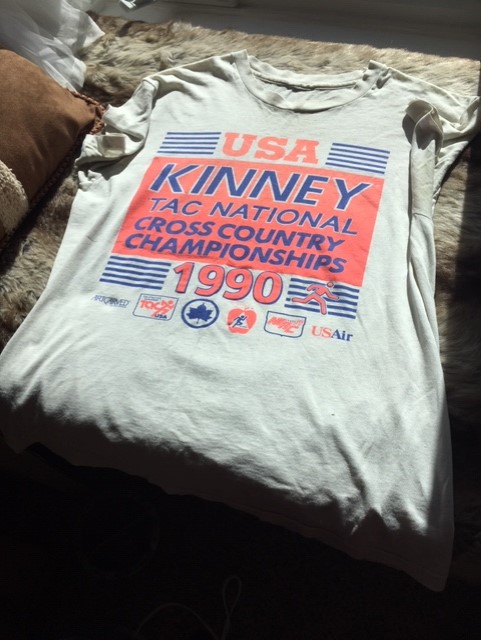
However, in 1990 we were living in upstate NY and the championships were held at the historic venue at Van Cortland Park in New York City. Talk about the top bucket event of all time! I wouldn’t miss it. Our club ran an XC series that fall and I tried to get the teammates together, but no one else wanted to run. However, my wife had won the women’s division of that series and was up for it.
The race had about 300 men and 200 women. The women went first. Lynn Jennings dominated again, and my wife was about 50th—I wish she had been able to run a year or two earlier (placing 2nd and 3rd at very competitive regional championships in 1988 and 1989), but she still ran solid in 1990.
Pat Porter had his eight-win streak on the line. As I was stretching a half hour before the start upstart Bob Kempainen plopped down next to me on the field and started his own routine. He had finished 2nd place before and I said good luck. Kempainen went on to break Porter’s streak that day, running the course in 30:23 about 8 or 9 seconds ahead of Porter. I would run about 35 minutes and was somewhere in the middle, high 150s or low 160s.
I would not return to any championship cross country for another 23 years. And it changed the trajectory of my life.
After a decade of living in Alaska, I saw that the 2013 fall Club Cross Country championships would be in Bend, OR, not too bad a of a flight. My son was a college student near Seattle, so we met for weekend. It was the first time I had ventured out of Alaska in the winter since I had been there. Some runners in Bend were complaining about the snow on the course and blustery weather. I was thrilled to have 8 hours of daylight and 40 degree temperatures in December! Just a couple months later I started applying for jobs in the Lower 48 and within a year landed a transfer to my homes state, just a few miles where I was born.
I have since competed as a masters in winter 2015 winter (solo) and fall (masters team 7th), 2017 fall (solo), 2018 fall (team 3rd), and 2019 winter (team 2nd) and got a couple age group podiums and a team medal in the process.
I would have run this year, scheduled in for Golden Gate Park in San Francisco (next weekend), at one of the best venues in the country in a great city. I raced there in 2015 and think that the participation is highest of any of the races in the rotation (last year’s race at Lehigh, PA was also well-attended).
Club XC is still the big event, with up to 1,000 open men and 500 women, typically 400-500 runners in the masters (age 40-59) men’s race, and another 200 or so in the 60+ race, and 300 for women masters. However, the winter championship is now the more competitive of the two, with open and junior World Championship or international teams at stake.
Since Club XC was canceled, as well as our state association championship last month, I did not do any specific XC training this fall, nor any XC racing.
Maybe 2021 will be better for us all and we can return.
Questions!
Did you run cross country in high school or college?
If you did, when was your last XC conference, regional/state or national championships?
Do you belong to a club or team that has cross country on the calendar?
Do you have any mudder pictures or epic XC stories of your own?
After nearly a year into a pandemic and six and a half months of writer’s block it may be time to put some things down again. I have been working from home for nine of those months, and have not had a lot of in-person social interaction outside of family, other than doing the essentials like going to the store. Hopefully, with new treatments and a vaccine in sight we’ll be winding down by next summer and this will be behind us.
At the time of my last posts in April we were all new to this and still trying to figure things out. However, back then there was hope that things would be better by mid-or late summer, although even then many knew the reality was that things would not approach normality until we get a vaccine.
So here we are. Probably in a worse state than in April, even here in Colorado which up until a few weeks ago had done fairly well.
Training
Back in April I was still in build-up and preseason training for time trials and virtual races. I ended up with two seasons of sorts. May to July 4 was the first, then took an easy few weeks, and have been running steady from mid-July through now.
My philosophy through all this has been not to take risks and to train at about 85-90% capacity both in volume and workout intensity. That aspect has worked and I have been very consistent. In the May-June block I ran 50-55 miles and got in a couple workouts a week. That started out well, but after a couple of race efforts in time trials I plateaued quickly, and by the end of June realized that I did not have enough base to continue racing.
So after a brief taper and recovery over the first week or so of July, I upped the miles to low 60s and cut back on workouts for about a month before resuming a routine of typically two workouts a week, while maintaining the mileage. Since the second week of July miles have ranged from 51-65 per week, with most weeks above 60. And I have consistently done CV and tempo workouts. It’s all been solid, but I haven’t pushing.
Racing
Although I am reasonably satisfied with the training, and think it’s about what I should be doing, racing has been less than satisfactory. I set out to run an age grade of 85% or more from the mile to half marathon. In the spring block I kicked off with a 15K solo time trial, and was reasonably happy with that; not quite reaching my goal of under an hour, but on a blustery day ran 1:00:40 at 5500′, with Tamara’s support and cheering.
Next up was a 10K on Memorial Day, part of a masters virtual series that we set up, and also as a virtual Bolder Boulder. I got really fired up for that event, even though practically no one else was in sight and ran 39:47 on a flat course at 5100′ north of Denver. So I reached my goal of a sub 40 at age 62, but a far cry from the low 38s on the tougher course in Boulder.
In June and into July I set my sights on the virtual mile with the Brooklyn Mile, and a virtual 5K over 4th of July as the second event in our three race series. Those were a wash. I picked a so-so course for the road mile and a lousy day with an 8 mph headwind for a third of the way and cross wind for the remainder, and could only muster a 5:33. Two days later I tried on the track but tanked at 800 meters and just ran in the last two laps, posting a 5:47.
The 5K a couple weeks later did not fare any better. I felt flat and ran 19:17, so far off the 17:28 at sea level last year, or 18:05 at altitude in the fall. So rather than fight it, went back to basics with the training.
Phase II went better. I ended up doing two in-person trail half marathons in Grand County (elevation 8500′-9100′ each) in August and September, another 10K for the virtual series (38:50, taking nearly a minute off the time from May), and two in-person 5Ks in Denver, with 18:56 and 18:47. The capstone was to be a 10 mile race in October which cropped up a few weeks earlier, and it was slated for a fast course in Loveland. However, we were struck with a blizzard that day and I decided not to make a risky drive to run in poor conditions there, and ran an impromptu half marathon time trial (after already putting in 5 miles that morning) in 1:28:30.
I have one more race on the schedule, another in-person 5K in Denver later this month, and hope knock off another 10 or 15 seconds off of the previous efforts.
Race Result Summary
So how’d I do with the age grade goal (all times at 5100′-5500′)?
Without a race season to look forward to and assess along the way a lot of us are looking back. I’m going to review 30 years past and 1,700 miles away (with tens of thousands of running miles and miles moved in between) to Ithaca, NY 1990.
I was in my second of three years working at Cornell University as a wildlife researcher, doing deer damage studies in people’s back yards on the hillsides near Cayuga Lake. This was one of my favorite jobs and Ithaca, was a great place to live.
That and I miss the 1990s.
We had a good running community, my wife Tamara and I were running with the High Noon Athletic Club, based on the Cornell campus. Our first year in Ithaca had gone well running-wise, and Tamara had dominated the Central New York running scene, by winning most of her races, setting records, and PRs almost every race. Her highlights of 1989 included winning the Empire State Games 5000 meters in 17:08 and placing 3rd at the TAC (The Athletics Congress, now USATF) New England cross country championships behind a couple of future Olympians. I will write about Tamara’s remarkable run in a future post.
My running also had gone well, although maybe more run of the mill (back then I was known as Tamara’s husband). I PRd in the 3000 m (8:54) and ran my fastest sea level 5K with a 15:34 on a very steamy morning (dew point 70s) to place 6th in that race.
The year did not end great, however, as my first job was stressful and I injured my back and shoulder from a fall while XC skiing in December. However, I switched jobs at the end of the year and got back into doing field work. I also had the entire winter to heal and rebuild a base through XC skiing and racing.
Spring – Inspired by a Legend
As usual I had a good cardiovascular base from the skiing, but had gained a few pounds over the winter. Tamara would tease me, saying that I ran like a duck due to all the skate technique training I had done over the winter, with only minimal running.
With just a few weeks of training under my belt, my debut that spring happened to be the Billy Mills Fun Run. With, yes, THE Billy Mills. It was on a chalk marked course on sidewalks, roads, and bike paths through the lands and agriculture part of the campus. I ran about 16:35 and was 3rd, a podium finish. At the awards I got to go up on stage and shake Billy’s hand–he asked what I ran and said that was a good time. The 1964 Gold Medalist gave a talk about his experiences growing up and at the Olympics and we watched his biographical movie Running Brave.
While I wasn’t super stoked about my time, a minute slower than the summer before, it was a inspirational start to the season. My running fitness got better with each workout. A couple weeks later I ran and won the Syracuse Mountain Goat road 3K (the accompanying 10 mile was much more prestigious) in a 9:10, and two weeks later ran 32:27 at the Lilac 10K in what was the last time this was a professional race. I placed 35th, while 10 runners went sub 30 that day. That was a deep field and was happy with that result.
Prepping for the Empire State Games
I was 32 years old, and 10 years out of college and somehow got the idea that I would return to the 3000 meter steeplechase, an event I hadn’t done since my final college track race. Now at the elite-professional level we frequently see steeplechasers competing into their 30s. However, it is not common for a middling post-college runner to return to the event on a whim a decade later. I did like the challenge, and it felt cool practicing the barriers. I had planned on running about a 9:50 for the qualifier and figured that would be an easy in to the Games, which would be in July-August.
I practiced hurdles and barriers every week for about six weeks and felt confident going into the race. However, I didn’t count on a Divsion I runner from the Southeast Conference returning to home to run a sub 9:20, and found myself battling it out for the other spot with two other runners. I held onto 2nd for most of the way, but got bogged down on the last water jump with dead legs and landed thigh deep i the water, slowing to a near standstill. Two competitors shot by and I came in 4th with a 10:03. It was a PR but a disappointment.
The next day I was was more discouraging. Landing in the water pit 7 times had caused a tear in my plantar fascia, and after a doing hilly 7 miler with friends I was hobbling.
Rehab and Revenge – Summer 1990
This was my first bout with PF, but I got a lot of good advice from Tamara and friends so I set out for a good stint of rehab, while coaching her over the summer as she easily qualified for the Empire State Games in the 5000 meters again.
We had a hot and muggy summer. I wore hiking boots every day at work because they offered good support for my foot, and I could walk pain free. For exercise, I swam a little and biked a lot. At first rather easy but as the weeks went on, I would go for 2 hours on the weekends and do speed/hill work and tempo (threshold) sessions during the week. I remember finding a big hill south of town and doing intervals, close to all out for 2-4 minutes a rep to simulate a tough 5K workout.
The cross training went quickly and by the end of July I could walk pain free in light shoes. So I started jogging. Just a few days after starting up my clubmates called and asked if I would run with them at the Manufacturers Hanover 3.5 mile corporate challenge in Syracuse. Umm. Okay. Maybe. With just a week or 10 days of running easy, I could handle 3.5 miles, but wasn’t so sure about the foot.
I felt surprisingly good that day and ran 17:59 for the 3.5 miles (5:08 per mile pace) and was 5th overall. Better yet, with four of the top eight finishers our scruffy band of university employees and grad students upended the heavily favored General Electric corporate team. They were so pissed off at us! They even tried to get us disqualified because they said the university was not a corporation. After an official review our status was kept and we were regional champions for the day and would get an all-expense trip to New York City for the championship in October.
The race effort did not set back the PF at all, and I kept running. My fitness came back quickly. A week later, I time trialed a 4:32 mile, closing in 2:12.
September – Enchanted Momentum
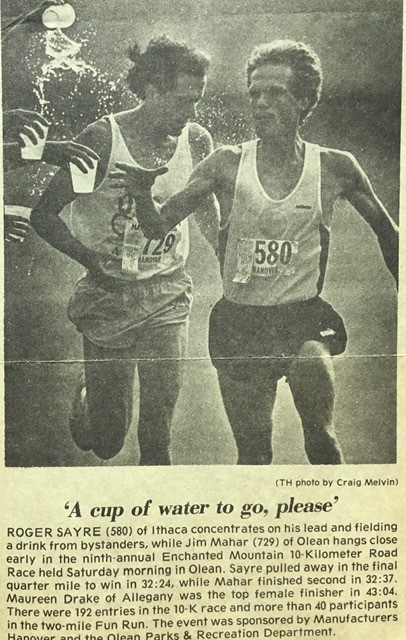
Those running two months were some of the best I had experienced. I was only putting in an hour or so a day of training (usually just 6 days), but everything just clicked. Over Labor Day weekend, we traveled to the southwest part of the state for the TAC regional 10K road championships for the Enchanted Mountain 10K in the town of Olean. The race had both individual and team categories–but that year no prize money so some of the faster runners were not there. Had a good duel with the local favorite and former champion, and eked out a win in 32:24 a season’s best. Our team won as well.
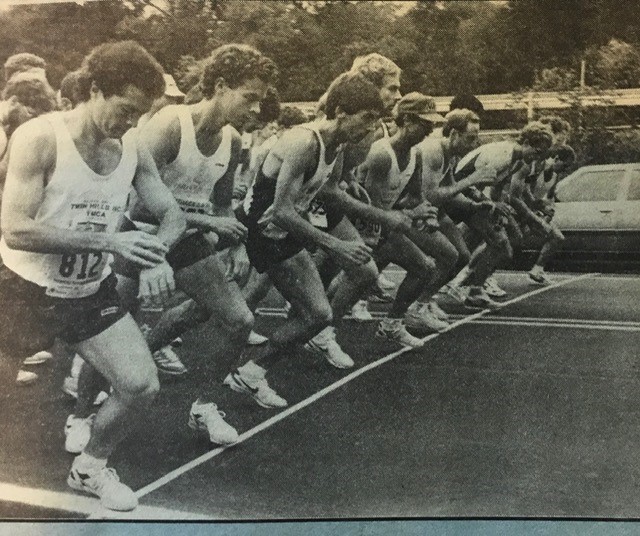
The following week I ran the 5 mile at the Ithaca 5 and 10 and took 2nd in 25:43, a personal best (still stands).
Start of the 5 mile race at the 1990 Ithaca 5 and 10. Left to to right: 1st can’t remember but from out of town; High Nooners Dan Peck, Scott Jones (winner of race), Tony Farquhar, Rick Hobeke, Doug Burdi, me (2nd).
We had some good workouts with club mates, and on the first weekend of October we were on the jet to New York City at a fancy hotel on 5th Avenue. I remember running by Trump Tower on our shakeout run. Blech then. BLECH now.
The corporate championship (now known as JP Morgan Corporate Chase) had teams that had qualifed at races from all over the country, plus hundreds of other teams from the city and NYC metropolitan region. More than 3,000 runners were in the race. It was a very competitive event, won by sub 4-minute miler Steve Ave (he played Tunisian Olympic silver medalist Mohamed Gammoudi in one of the Prefontaine films). Second place that day was 2:10 marathoner Pat Peterson, known for his somewhat awkward running style. I set out to run 5:00 per mile, and ended up just over that in 17:41 (5:03 pace) and about 40th place overall. Our team took 7th out of some 500 teams. GE sent their best runners on a coed team. The women were nice and cordial, the guys still hated us. It was all good.
Competitively, and time-wise those were the highlights of that year. However, next up would be cross country.
Cross Country
Following the flurry of races over a couple of months, coming off an injury no less, I backed off the intensity and just ran for a couple weeks. Seeing how I wasn’t logging a lot of miles (+/- 50 a week) I didn’t see a need cut back on volume. That year, Pete Glavin a former Rutgers runner from Rochester created the Upstate New York Cross Country Series. It still exists as the Pete Glavin Cross Country Series. Pete had so much enthusiasm and put together five or six races a year for post-college runners in the region. We’d get between 50 and 70 runners per race, and Pete and his family would sign us up and oriented on the course, and he’d jump in usually placing in the top 3 or 4. We lost Pete to brain cancer some years ago and miss him. Tamara and I still talk about him every fall.
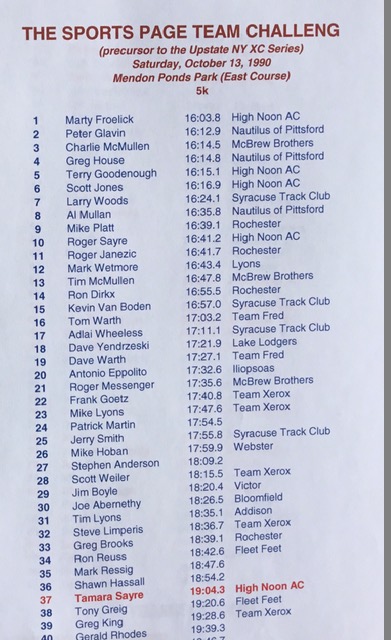
So I missed the couple of races of the first year of the series, but did all remaining races in 1990 and 1991. I think I ran four of the races in 1990, all in the Rochester area. We had a great (dominating) team and I don’t think I was better than 4th on our team.
Results from the Upstate NY XC series–check place numbers 10 and 12! Can’t remember if Wetmore had the pony tail or not, but think I outkicked him in the stretch.
We had four guys who had run low or sub 14s in college, and three of them were still running mid-14s at the time. Marty Froelich, Scott Jones, Mike Bunsey, Terry Goodenough, and Karl Staven. Plus we had a half a dozen other very solid runners from the club showing up, often enough to field an A and B team.
November – The Intensity Catches up
At the series championship in mid-November I was barely hanging on to my early season fitness. With moderate miles, weekly training sessions at 5K pace (repeat 800s to miles) plus tempo runs, and racing almost every other week since August I could tell my body was getting tired. I remember that last race, I think it was a 6K at Cobbs Hill Park in Rochester I faded a bit over the stretch. Phew! Both men’s and women’s teams won the championship, and Tamara won her first series title. What a great way to wrap up the season.
One more race, though. The TAC (The Athletics Congress, now USATF) National Cross Country Championships that year would be at the fabled Van Cortland Park in New York City. If there ever was a bucket list race that was it. I tried to talk the other guys from our team to enter, but they’d had enough for the season. So Tamara and I traveled to northern New Jersey, where we stayed with my aunt and Uncle and cousins, whom I rarely got to see.
Although I caught a cold a few days before and didn’t have a great race, just being there made it a great outing. While stretching and getting my spikes on just before the race, future two time Olympic marathoner Bob Kempainen plopped down next to me and did the same. Kempainen would beat 8 time champion Pat Porter that day, ending one of the greatest streaks in USA distance running history. I was about 5 minutes back, somewhere in the third quartile. However, running at Van Cortland with all the buzz along with the cool breeze was a thrill that I shall not forget.
That’s how 1990 ended. Even with the mid-summer injury, I probably raced 20 or 25 times. Didn’t rack up a lot of miles, but did get a couple PRs, a regional championship, and a five race cross country season. If all of this were today, I would probably approach the training and racing differently, but for back then it was all good.
Postscript – Times Were Changing
Professional road racing and big-time road races were still new, and in 1990 we were barely a decade into the running boom. Looking back, things changed quickly in the early 1990s. Early corporate sponsors pulled back and prize money races became less frequent. The 10K was still a prestigious race and often considered to be key race in anyone’s racing year, not an afterthought or stepping stone race from 5K to half or full marathon. Americans were still competitive on the world scene and dominant at domestic road races. It was a time of gaudy neon colors in gear. Chartreuse. Fuschia. Hot Pink. Florescent green or orange. The women runners either had big hair or a boy cut, hardly any of the now ubiquitous ponytail. Men sported mullets–okay that wasn’t such a great thing–or the shaggy look. Races often supported charities, but they were not managed by corporations. However, most importantly, the older we got, the faster we were! (battle cry of the aging road warrior in the late 1990s and early 2000s).

 rrunnin234