Update and a Training Race

Post-Marathon Recovery

My post-marathon recovery has been middle of the road, there were no setbacks and it hasn’t dragged on but there has not been a fitness boost. I find it interesting how some people come out of a marathon supercharged and they set huge 5K or 10K PBs in the weeks immediately following a marathon training block and race. That has never happened to me. Only once or twice have I felt decent within a month after a marathon. That just shows how everyone has their own physical and mental response to the long event.

Weeks 1, 2, 3: Recovery with a Big R

I took off a few days of running or aerobic activity other than walking the dog a few times a day. Then I cycled for a couple days. Ran on Day 6 post-marathon, so I had reasonable, but not extensive break. I got in about 14 miles in that first week.

Fortunately we got some early snowfall (in fact much of it while were away in Indianapolis for the marathon) and I was able to incorporate some cross country skiing for cross training (and for its own effect), with three days of skiing in November and now twice a week in December.

The air is thin at 9000 feet but it’s refreshing.

I rolled back into running on the second week back, with 43 miles of easy running and a short ski outing at Breckenridge. On the third week I put in 49 miles of running plus a 15 km ski at Frisco, my old stomping grounds (ca. 1986-87). I did my first tempo effort, just a short 15 or so minutes of effort at 6:50 pace or so on trails on the day before Thanksgiving.

I did have a bit of Turkey Trot FOMO, I kind of wanted to do a race on Thanksgiving but knew I was not mentally or physically ready to line up after a long 2024 campaign. Skiing that day was a good alternative. No traffic no crowds on Thanksgiving day.

Weeks 4, 5: Some Volume

I got my volume mojo back in December with a couple decent weeks. However, workout quality has been lagging.

Over the first week of December I ran 50 miles and got in two ski days of about 28 km (2.2 hours) for a weekly sum of just over 9 hours. I did a double threshold on the 4th. The AM part was actually a pretty stiff session with 4X 1 mile averaging about 6:30. That’s more mid-season level for me but I went with it. The PM part was a pretty mild 8x 30 second surge/30 second recovery on a gravel path. That day gave me some confidence so I signed up for a 5K for December 15.

The second week of the month (week 5 post-marathon) was more of the same, although truthfully I don’t think I felt as well as on the previous week. I did 43 miles of running and two ski outings of 12 and 21 km for a total of 9.3 hours.

My double threshold on Tuesday was a bit of a weather bust because we got several inches of snow overnight. I had to cut an AM treadmill session short when after 2X 6 min reps (plan was 4X) a guy with a cold lined up right next to me (3 feet away, no social distancing there!) so I bailed. And the second workout later in the day was supposed to be 8X 2 min at CV effort with a 1 minute recovery. But with the ice on the path it was 6X 2, 1X 3 and a fartlek within a fartlek because I had to slow down on the icy/snowy patches and then speed up on the dry stretches.

Running-wise the rest of the week was easy, but I did that 21 km of skiing on Thursday.

Training Race

On Sunday I signed up for the Ugly Sweater 5K in Denver. Silly theme, but overall it’s a well-managed race. Shoutout to Derek and Jessica for their series (although I miss the Winter Distance Series at Hudson Garden). Washington Park in South Denver is probably the best place in the entire city for a 5K to 10K road race. It’s almost flat. No traffic. And the road is wide enough to accommodate thousands of participants.

I kind of worked through this one, but was hoping to finish well under 20 minutes for 5K and to take home an age group award. It ended up being mixed on those goals.

The day was about as perfect as you can get here in December. It was cold overnight, and I was freezing on my 2+ mile warm up at about 30 degrees. But by 8:45 it had warmed up to the mid-30s and with full sunshine and no wind to speak of I suddenly felt overdressed with tights, double shirt, beanie and gloves. With 10 minutes to go I stripped off my tights and tossed the gloves and decided to be lightly dressed.

The plan was to go out in about 6:20-30 and then bring it down from there. I didn’t really stick to the plan.

I lined up in about the 4th row, should have been farther back. We started and I was almost immediately swallowed up by another dozen or two runners. I checked my watch at about 200 meters in, and saw that I was running at about 5:40/mile pace. Way too fast. So I eased up, and some more runners went around me. I tried to settle in. Checking again at about a half mile and it was still 6:10 pace. Still too fast. So I eased up some more. However, by then the damage had been done.

Start of the race, you can see my red cap between #1127 and the guy in the white singlet. Yeah, too far up at the start.

I split the mile at about 6:15 and decided to just hang onto the current effort for as long as I could. A pack of about 5 or 6 runners had formed about 20 meters ahead. Otherwise I was in sort of a no mans land as we headed north through the park. And that’s pretty much where I stayed the rest of the way. Breathing was a bit hard, I passed one young runner who was obviously overdressed in a sweater and Christmas pajama pants and a Santa hat. I just hung behind that pack through half way and 2 miles (12:46). There are two small hills before the lap (2.2 miles) and I kind of eased up on those, falling behind that pack a bit. Over the last hill just before the lap I tried to gradually increase my pace. I caught one runner, a younger woman. And we had ourselves a duel for the rest of the way.

End of mile 2, feeling the pain cave.

Felt that I was just hanging on with about a half mile to go, as we were lapping the back of the pack walkers on the west side of the park. I surged with about 600 to go, pulling ahead of my female competitor, but immediately felt that in my lungs so let up and she passed again. I hung back about 5 meters and then threw in a final surge with 300 to go. That didn’t last either and she passed me back before the final turn (150 to go). From then on I just tried to hold form and not throw up.

A final kick.

Final result: 20:11 for 3.16 miles, the course was a little long, probably off by 60 or 70 meters. I’ll split the difference between my Garmin and official time and call it 20:00.

Nevertheless, I believe that’s my slowest time in a 5K road race (about equal to the training race I did in September, but that was a definite tempo-type effort, this was a more of a concerted race effort.

It was slow but I am not disappointed. It was about what I could expect for five weeks after a marathon. An 83% age grade at 5200′ elevation. (3rd overall in age grading). I’m not going to complain. I enjoyed the morning and appreciate the race management and work that went on to host this late season event.

Update and Masters Half Marathon Championships

I promise that one of these days I’ll be putting up more content on training philosophy and such. Not just race reports. Soon. Soon I hope.

WMA Recovery and Subsequent Training

It took me almost a month to recover from racing and traveling to Sweden in August. I got sick and that took a few days to get over, and then just felt fatigued for a few weeks. So my mileage took a dip in early September. Not ideal for fall marathon training.

Wait, what?

Training profile since early August, low mark after I got back from overseas and had to take a few days off to recover from travel.

Yeah, I’m doing a marathon in November, date and location TBA! The three main race goals for 2024 were to run the 25K in May and attempt the American Record for my age (check), run at World Masters and medal in at least one race, win the cross country team title, and get a second medal in the half marathon (two checks out of three isn’t terrible).

Since mid-September I have been hitting 60-70 mile weeks with consistency and feeling okay. It wasn’t until the last week of September that I actually felt right again. The primary focus has been to build the long runs (from 15-17 miles over the summer, to 19+ miles). I have to admit that do not really like the long run, and maybe that’s the issue with my difficulty to break 3 hours again at this late stage of my running career. Anything over 2 hours is challenging, and I’m not sure it’s supposed to be that way or not.

I listened to Steve Sisson’s podcast last year and he went on and on about how the long run is the epitome of the training week. I get a little nervous for the long runs, counting minutes for the first few miles, then I might feel good until about half way through before feeling tired, sore, and often a little nauseous from the energy gels and sloshing belly. I conclude the day by feeling like a blob. A hungry blob, but a blob nonetheless.

Anyway, in September I did long runs of 16,17, 19 miles and felt best on the last one, which was about 10 days before last week’s half marathon. In this time I have not done many workouts, other than some tempo and pace work on the mid-long runs (10-13 miles with 4-6 miles of faster running on those). Other days have been either recovery (5 to 7 miles easy) or endurance (8 to 10 miles) with a few strides thrown in there.

Last Saturday I did 22 miles in 3 hours. That was a grind, but then again not terrible either. I felt better in the second half than over the first, and ran a pretty solid negative split (sub 8s) over the last 90 minutes.

My legs haven’t felt great, i.e., snappy or fast, since mid-August. But that’s marathon training.

The goal, again, is sub 3 to join that rare club of five decades sub 3 (5DS3), of which only a dozen or so runners have ever done. Let’s go!

USATF Masters Half Marathon Championships (October 5)

At six weeks after the WMA half I felt fairly recovered from that effort. Going into the race I had four solid weeks of marathon training in the legs and I was feeling it. The plan was to taper that week, and run maybe 50 miles total including the race, but unfortunately my main competition pulled out due to an injury. On paper at least, it looked like I could win this one fairly easily. So I kept the mileage at ~10 miles a day through Wednesday, and just ran an easy 3+ on the course on Friday, so I’d be a little bit rested. I don’t know how much good that did.

The course wound through Fort Benjamin Harrison State Park, outside of Indianapolis. Race day was as good as it gets, mid-50s with a light breeze.

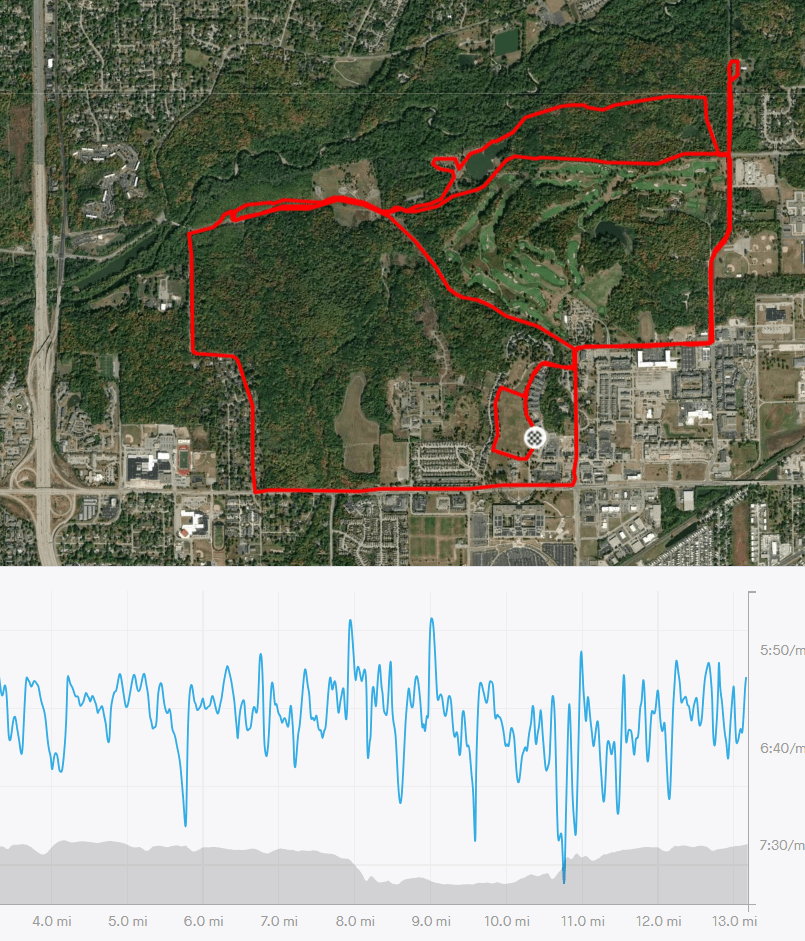
Half marathon course and part of the profile.

I expected the course to have two decent hills (of 80-90 feet) at about mile 3 and 10, but otherwise to be flat. The race profile showed that, but in reality bigger hills were more like 100 feet plus, and there were rollers the entire way, so instead of under 200 feet of vertical (fairly fast), it was more like 400 (and not terribly fast). That was okay, everyone had the same course and I generally do pretty well on hilly courses. I went in still thinking I could run under 1:24 and score an 90% age grade.

The Race

I knew from the very start that my legs weren’t feeling rested, there was no bounce in that first mile and the knowledge crept in that this might be a long day. The going was little tight through that first mile (which had six or seven sharp turns) but we strung out by the time we reached the rather long descent into the park itself. I was kind of leading a group of a dozen or so runners, including several in their 60s and two very fast masters women one 60+ and the other in her late 50s. We split the the mile in 6:22, which is about where I wanted to be, so I settled in through 5K (19:47). I was feeling okay through that point, and that was about it for feeling decent!

On the first big climb I fell back from the three or four leaders of that group, and could tell it wasn’t going to be a breakout day and that sub 1:24 (6:24 pace) would be tough to achieve. Nevertheless, I did fight back for a couple of miles, including a couple pretty decent drops and inclines on the four lane thoroughfare. They eventually pulled away, I thought I was slowing down, but that wasn’t the case. I was holding onto 6:20-6:25 pace but they sped up to 6:10 or so. Good on them. I ran much of the next 4 or 5 miles in my own private no-man’s land, although at about 8 or 9 we had a couple of spots where we switched back, and wow, there was quite a string of runners not far behind, and a big pack of 15 or so, going with the 1:25 pace group. At this point I was still on low or sub 1:24 pace (59:37 at 15K), but the big (1 mile long) hill, including a quarter mile at 10% grade called “Kill the Hill” was looming ahead.

A couple of runners caught up between miles 8 and 10 and we had a semi-pack strung out over 15 or 20 meters.

Knowing it would be a grind I eased up as soon as the grade increased a bit and held an easier stride until we reached Kill the Hill, where I shortened my steps and tried not to lose any more ground. I did not want more of those runners behind me to catch up and pass. I hung on but the damage was done with a 6:45 11th mile. There went sub 1:24.

Therein over the rolling last 2 miles I just kind of hung on, getting passed here and there by someone closing faster, but they were in the open race. My secondary goal with this race was to run strong but not dig too deeply–I did that in Sweden and will need to do that again next month in the marathon. I think I accomplished that. The 12th mile was a grind with a number of small hills and a net elevation increase (6:33). The last mile was out of the park and back onto city streets, smelling the finish, I could pick it up some and covered the last 1.1 at about 6:20 pace to finish in just under 1:24:30. 1st in age group and 89.5% age grade (2nd overall).

Maybe a little short of what I had wanted but still a good day, and haul (medals and cash). I went home pretty happy with the effort.

Moments after the finish, with Rick the 60-64 age group winner.

20 Years a Comeback: Part 2

After hitting rock bottom in 2002 and 2003, which ended with a tonsillectomy and about eight weeks of no running, I gradually made my way back in 2004. However, by January and February I was running pain free up to four or five times a week. Most of the runs were short, in the 3-5 mile range, but I felt good. As tough as it was to get those tonsils pulled, a bonus was I felt that I could breathe deeper, get in more with each intake and exhale more. That may or may not have occurred at a significant level but breathing sure did feel easier, not to mention not having those perennially sore and pocked tonsils in my throat.

In February I did my first ever snow shoe race at Eldora, and cross country skied a couple 10K skate races–my first ski races since 2002. I was nowhere near top shape but it was great to be huffing and puffing at 8,500 to 9500 feet elevation!

Late in the month my boss walked with me across the CSU campus and asked if I would be interested in moving to Fairbanks, Alaska as an environmental planner. The incumbent had recently left the position and they were looking to fill it. Think about it, he said.

I did not take him that seriously, but mentioned to my wife and kids over dinner that night. We kind of laughed it off. Her parents and my mom lived in the Denver area, less than 90 minutes away, and we figured we would be staying in Colorado for years to come.

A few weeks later, my boss brought up the transfer again. This time less in passing, in fact he was direct. The environmental project that we had worked on for two-and a-half years was wrapping up, and at that time there were no big projects on the horizon. The Alaska job would be more stable, if not indefinite. Our client, the US Army Alaska would need a couple of planners on its staff just for day-to-day operations. He could not guarantee a long-term stable position in Fort Collins, but the Fairbanks position was there for the taking. He sweetened the offer which would give me a substantial raise, plus cost of living, to move to Fairbanks with my family. He offered to fly me up there to talk to my co-workers, whom I had already worked with for a couple of years and knew fairly well, and suggested that I bring Tamara along. So we took a late March trip to the north.

It was a record breaking 82 degrees F when we boarded our jet from Denver to Seattle, then Fairbanks. We arrived at 2 AM amid light snowfall and -26 F in Fairbanks. I thought no way, would she want to spend any more time in the north than this four day trip. However, we explored the area, contacted a realtor and looked at houses, and went to dinner with the co-workers. They really wanted me to move up and work with them. By the second day we were sold on the idea. A huge step to make when you are in your 40s and have two kids in school.

Spring Racing 2004

By late March I was running five or six days a week and picked up a copy of Pete Pfitzinger’s Road Racing for Serious Runners, and decided to do the Colorado Half Marathon in May. I had been running consistently for three months and had built up to 40 miles a week. I had not run a half marathon in five years, and in fact had only done one other half in the previous 15 years! I knew I could finish, but figured I would be well off my altitude best of 1:13, as well as the 1:19 I had run five years prior.

I built up to 50 miles a week, more or less following the plan and in April did a 5K and 5 mile tune race, about two weeks apart. Although I was well off the times I had been running in 1998-2000 (sub 17, low 28 respectively) it was great to line up healthy and to see what I could do. I ran 18:13 for the 5K in Loveland. And then at the 5 mile Cherry Creek Sneak (once a seasonally huge race in Denver, with 20,000 participants racing three distances) I ran just over 29 minutes and placed in my new age group.

At the half in May, I knew I wasn’t yet ready for prime time racing, but gave it my best shot. I ended up running just under 1:22 and placed third in the masters division, which was a surprise because northern Colorado boasted a deep contingent and this was one of the biggest springtime races in the area.

Although I have done a ton of racing in the years since, including huge races and national or international races, still have that plaque and it sits on the top of my bedroom bookshelf signifying my comeback.

North to Alaska

A few days later I loaded my car with gear and a bunch of scientific journals that I had collected in 1990s (I still had some hope then of returning as a research biologist), and drove up to Alaska. After a few weeks I flew back and picked up the family and we drove north together.

I kept up my running, but scaled back and missed a lot of days, maybe doing only 25-30 miles a week. Just a week after after arriving back in our new home of Fairbanks I entered the Midnight Sun Run, Alaska’s biggest race, with some 4,000 participants. I expected something like Bolder Boulder, which was 10X as large, but the Midnight Sun Run, starting at 10 PM on the summer solstice weekend, was more like a mini-version of Bay to Breakers.

I did not expect much out of myself competitively, maybe a top 15 or 20/ After just 2 miles I found myself in the top 10, and by 4 miles I was fighting for a top 5! I ended up finishing 6th place and as first masters in about 36:50. My first age group win in five years.

The running club there held a seven race series every year and I jumped into the track mile (5:08), another half marathon, this one mostly off-road (1:22), and a tortuous 16.5 mile race that dropped 1800 feet on trails and back roads. I made some new friends in the masters running community and all they could talk about was Boston Marathon–which they had done many times each, running 2:40 into their 40s–and the upcoming Equinox Marathon in Fairbanks, it was Alaska’s oldest and toughest marathon with 18 miles off road and trails, about 8 miles on pavement, and 3,300 feet of elevation gain and loss. Totally gnarly, and a Fairbanks institution.

Over the summer, despite huge historic forest fires (over 5 million acres in Alaska burned that summer), I was able to build to 70 miles for couple weeks and was in the 55-65 miles per week range for more than two months. I been on some hilly back-country long runs, up to 23 miles.

It was in this summer that I decided that I would not back down from training and racing in the future. Both of the long-term injuries I had endured in my late 30s and mid-40s had followed an extended break from training, although I had run some I had only done minimal miles. In the future I vowed that unless I had to ease up due to injury or illness, they’d have to drag me away kicking and screaming from running.

I also changed my approach. Rather than a modified Daniels with two or three quality workouts on an otherwise mid-mileage week (50 had been the standard for more than 15 years) I embraced the easy lopes on forest trails and roads, with usually just one workout a week. But even then, I found Pfitz’s quality workouts to be a little too taxing. I did his 9 miles of tempo at half marathon pace and 14 at marathon pace in an 18 mile run, but recovery was slow from those efforts.

The work paid off for the Equinox, as I finished top 5 overall, and ran 3:12 on a very cold morning (never even got much above freezing).

The rest of the way

We spent nearly 11 great years in Alaska. I ran the Midnight Sun Run 10 times, winning my age group each one. I did the local series at least six times, and never won it but had several top fives, and ran the Equinox five times, winning my age group on four of those occasions (the time I didn’t win it was a big deal, the times I did win it wasn’t–local personalities and such came into play), and I set an age or age group record on each of those races.

Plus I skied as much as anyone could want. In fact, I think by 2014 I’d had enough and had carried the skiing as far as I desired. It was time to move on with work and sport.

I moved back to Colorado at the end of 2014 and Tamara followed six months later while our younger son was finishing high school. Moving back to altitude, with better weather, allowed for more consistent year-round training. The skiing became a cross-training add-on just 15 times or so a year. For the most part, I have stayed healthy (save a very painful shoulder injury and surgery). I have run in nearly 30 USATF national road and cross country championships, dozens of local races, and several top tier road races across the country, including Boston and Chicago Marathons, the Lilac Bloomsday, Bix 7, Utica Boilermaker, as well as the World Masters half marathon and 8K cross country.

Career-wise it was a good move (for the most part), and definitely for running.

I have run about 45,800 miles from the beginning of 2004 through 2023, and have put in over 100,000 miles in my lifetime. I haven’t really wrapped my head around that one yet!

In 20 years?

Can I keep running? How long? Will I keep racing and training? I can’t answer these, but hope to keep it going for as long as I can and as long as I enjoy the grind.

1. How I Set Up for a 2:35 Marathon Debut

Preamble: Marathons are a bigger deal today compared to the 1970s and 80s, at least in terms of participation and general interest. And it seems that anyone serious about doing a marathon is a either strong adherent to a plan (e.g., Pfitzinger, Daniels, Hanson’s, Hudson, etc.) or they have coach and training team.

In this post I will take you back to a simpler time. We knew less, did not have fancy shoes and calorie count watches. Formal training groups and private coaching services were uncommon, and good training guides were not all that readily available. So a lot of us did things on our own. Here is my story.

Background – Heading into 1983 I had been running and training for almost six years, including four years of cross country and three of track at a small (NCAA Division III) school in the Midwest. In that program I had improved fairly quickly (running sub 10 for the indoor 2 mile after just 9 months of training as distance runner, and under 32 for 6 miles on the roads at 15 months into it) but my improvement plateaued and even backpedaled due to classic over training, poor nutrition, and stress from trying to wend my way through a school with high academic standards.

My last season of cross country in 1980 was mostly a disaster, and I ended it with an underperforming 27th place (of about 70) at our conference meet, and a 27:10 (on a very fast 8K course), and 110th place, a the NCAA Regional Championships. The team environment that last year was somewhat toxic. As disappointed as I was to close out that way, I loved the sport and vowed to keep running.

However, my running cratered even more in that first year out of undergrad. I believe the overtraining had resulted in some muscle damage and it took more than a year for my body to return to normal. I raced about 15 times in 1981 and usually did not come that close to what I had done the previous year. My best mark was a 33:35 10K, about 40 seconds slower than my PR set the year before.

1982 didn’t start any better, as I had ben working 50-70 hour weeks doing biological field work in Northern Minnesota, and running only maintenance miles. By the end of February I had put on 10 lb. I returned to my college for a weekend and my old teammates ridiculed me for the extra weight. I got back into shape quickly, however, and PRd at the 8K (26:35) in the spring. Later that year with just 6 weeks of focused training (after a summer of 40 mile weeks, but a lot of hiking at 10-12000 feet) ran a 1:13:05 half marathon at mile high elevation. That is still my all time best (sea level or altitude) at the distance, and equates to 1:11 or under at sea level.

At this point I had made two attempts to run a marathon. I broke down during a high mileage summer in 1980, after a string of 100 mile weeks, about three weeks before the Paavo Nurmi Marathon in Hurley, Wisconsin. And in 1981 I was trying to prepare for Grandma’s Marathon in Minnesota, but ended up with tendintis in my foot about four weeks out. Those non-starters aside, at the end of 1982 I felt stronger than I had in three years, and felt that I should attempt a debut in Denver the next spring.

2. How I Prepared for My First Marathon

January 1983 – I rung in the new year without a lot of running miles. I’d been putting in about 40-50 miles a week since the half in October, plus some cross country ski training with the Colorado State University Nordic club team. But that was maybe one or two sessions a week over December and January.

At the time I was back in school, at CSU studying biology and planning to go into graduate school by the following year.

February 1983 -I did one Nordic race, a 15K in Steamboat Springs against collegiate and club racers. My technique was not good, equipment worse, and was pretty far back in the standings, some 12 or 15 minutes behind the leaders. So I shelved the Nordic scene for a better time (that turned out to be the next year).

Around President’s Day weekend I reviewed my training log and realized I had not run over 55 miles in a week since late September and my longest run had been no more than 12 or 13 miles. However, I had gotten out on the skis once or twice for about 2 hours. The Mile High Marathon in Denver was less than 3 months away.

I cut the skiing and ran 50 and 55 miles over the last two weeks and upped the long runs to 14-15 miles.

School that semester had some challenges, but I was doing student lab research as part of my curriculum and had a lot of flexibility. I had become a better student, and did not feel the same pressure as I had as an undergrad.

One thing that did not suffer was my social life. I had four rather hard partying housemates who liked the night life. So every weekend (sometimes starting on Thursday night) was a party, and we usually centered it around music with concerts in Denver (Neil Young), Boulder (Stray Cats), and Fort Collins (The Blasters, The Suburbs) plus many local and regional acts. That all involved a lot of drinking (beer mostly for me, my housemates were much less discerning with what they consumed or inhaled) and one or two late nights a week. The results were frequent weekend runs on 5 or 6 hours of sleep, while hung over.

So while my study and work habits had improved, and running balance (not overtraining) was better, my weekend lifestyle had regressed to sophomoric levels. I was 25 going on 19 in that aspect.

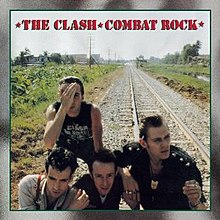
March 1983 – I ramped up the weekly mileage to 60 and 65, and gradually increased the long runs. I got to 70 miles and 18-19 by the end of the month. I wasn’t doing any workouts until the last week of March, just running 7-10 miles a day and doing the long runs, all at 7 minute pace or so. Also got in a few days of alpine skiing in Aspen over spring break, with a St. Patty’s party in Aspen village, singing The Clash’s Rock The Casbah as we bar hopped.

Big album on alt radio as well as MTV in the early 1980s.

April 1983 – A month in which it all (rather improbably) came together. I started thinking about goals for the upcoming marathon. A 2:40 seemed conservative but reasonable. With that breakout half marathon the previous fall, pace charts indicated I could do better but with a limited build-up my goal was to finish the full and to have that as a launching point for more serious efforts in the future.

Until 1982-83 Prince was kind of a cult rock and R&B hero, but not known well outside of the upper Midwest.

About six weeks before the the marathon I started doing weekly workouts, starting with 6X 1/2 mile at 10K effort and building from there. Some workouts I remember, were 4X1 mile in 5:20, and 2X2 and 1X 1 mile at about 5:20-5:25 pace, but the emphasis was not on pace, more on keeping at what seemed to be 10K effort. I also mixed in some mid-week longer runs of 12-14 miles, about every other week.

U2 was my big find of 1983, and bought their debut album soon after it hit the shelves at the record store.

In early April I went down to Denver and did a 10K – 5K double in Washington Park as a training effort. Don’t try this at home (kidding because actually it worked I think). After a 3 mile warm up, raced the 10K (34:06) in race flats, took a slug of water, ate a banana, switched into my training shoes, and jogged for about 45 minutes (6 miles, mid-7s +/-), and ran the 5K at 5:50s pace. I was feeling a little numb and seeing stars even as I lined up (low blood glucose). The road seemed wavy, but I held on for a low 18s. 19 miles for the morning with 9.3 at quality. That set me up well for fending off a bonk.

I went home after that and ate a box of cookies and a pickup load of food.

Mileage wise, I topped out at about mid to upper 70 mile weeks for a few weeks and did three long runs of 20 miles. The first one was just steady 7:00 pace. The next two involved marathon pace. First time was 10 miles at 7:00 pace, then 8 progressing from 6:20s to 6:10s-6:00. And the final long run (about 3 weeks before the marathon) started with 10 miles at 7:00 pace and finished with 10 at 6:00 pace. With that I knew I could run under 2:40.

Every weekend was a party weekend, and for a bit I dated an undergrad who drank more than me and only went out because I paid for all the drinks. That relationship did not last very long

On the last weekend of April, two weeks before the marathon, I entered a local 10K (part of it on the now renowned Fortitude 10K course), and this would be my final tune-up and test. My goal was 5:20s pace. A couple runners went out quickly and I just settled into my own private Northern Colorado pace as we wound around Old Town Fort Collins. Nothing felt difficult that day, and while I never did reel them in, and the gap at the end was only 10-12 seconds. I finished in 32:58. Compared to my sea level PR of 32:54, that was a relative jump of about a full minute–and in fact for altitude I had skipped the 33s altogether, as my previous 10K efforts had been in the 34s.

Winter/Spring Training Program 1983 – To summarize my training. Six weeks of build up, easy-moderate miles by feel, starting from mid-low 50s to 70 miles a week. Then about six weeks averaging at 70 – 75 (range ~65-77) with one workout of longer reps at 10K effort, and a weekly long run building to 20 miles with up to 10 at marathon pace. Other than that, mostly 7-10 mile days with a mid-week longer run about every other week.