Masters Track and Field Championships

Short version, 2,500 mile road trip (minus side trips in California), nine days, two gold medals.

I think next time we’ll fly. A week ago Sunday we had a flat tire before even starting the trip, which cost us five hours and had to stay in a motel in Salt Lake City instead of camping in Nevada. And in the middle of the week our car battery died, thinking it was a starter or alternator we took the car into the shop. That cost $300. Driving all those miles in 100 degree temps wasn’t pleasant either.

Road Trip

I do appreciate the scenery, however, so here’s a few thousand words in pictures.

Utah canyon country.

Rainbow over Provo, Utah.
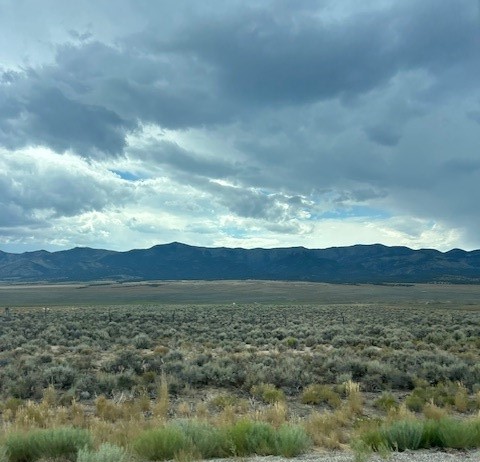
Egan Range, eastern Nevada.
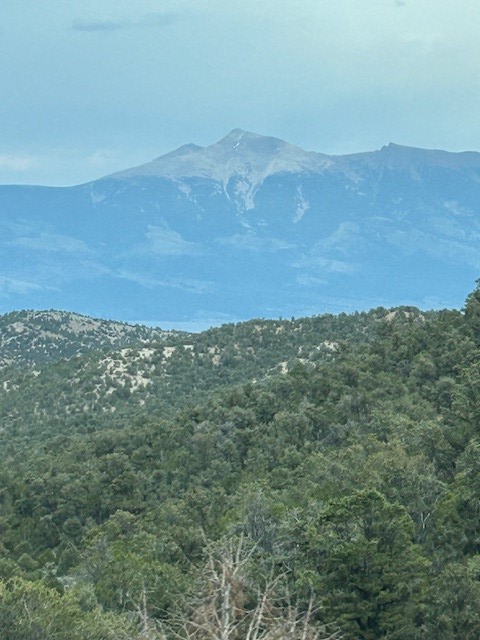
Mt Wheeler National Park, Nevada.

Campsite sunrise near Truckee, California.

The Agony of Setting up the 4 X 800 Relay

Ahh the relay. For the past year almost, our team has talked about putting together an age group team that could challenge for the American club record of 11:22. That only requires a 2:50 per leg and on paper we had the runners to do it. Months ago we sent out signals, and I was appointed the de facto coordinator. I don’t think I did a great job at that for this event. However, our “team” ages 60-69 is more a confederation of runners without a lot of cohesion. And less so post 2020-21 pandemic. Just say that there are some personal and political differences in this team, and some aren’t afraid to verbally smash you in the mouth if you happen to disagree.

Not to mention, injuries and health. It’s hard to get four guys in our age group healthy enough to line up, and a track race is all the more risky.

I spent months encouraging an cajoling potential relay members and typically got mixed responses. Two of us were committed, one seemed to be ready if we had a team, a couple were injured or not interested, and one had been battling off and on injuries over the past year and had the attitude that if we are not going to set a record then the travel is not worth it. I even offered space at my brother-in-law’s place in Sacramento as a incentive. In the weeks leading up to the championships we seemed to have settled into a quartet of four capable runners who on paper could pull it off.

Creating a mental form chart, I figured I could run under 2:35 on a good day, Dan capable of matching that, maybe faster maybe a bit slower. Jack was hoping for 2:40-2:45 or so, and Bob sub 3. Adding those up our best case indicated maybe 10:50 for the four of us. Reasonable expectation without a blow up by one of us certainly put us comfortably in a sub 11:20 (for example, a more conservative estimate would put us at about 2:35, 2:40, 2:50, 3:00 for a 11:05, still well under the record).

We had a handoff practice a little over a week before the race and all seemed well. Shots were fired on the weekend, however, as one of our guys complained of a bad foot. He’d said he would run, but it would be some risk. We really needed a back up, but had none. Nevertheless, Tamara and left town on Sunday thinking we’d all be good.

I was looking forward to racing the relay on Thursday.

On Monday morning we had just driven into Nevada and I got a text. One of our guys was out. No explanation. Just that he wouldn’t make the trip. Cold feet or injured? I spent the morning texting, to see if we could pull together a make up team. It was so frustrating. I just don’t like the attitude that either you must set a record or forget about, especially at such a late hour. That is just poor etiquette.

I told our teammate with the bad foot to stay home and heal up. Wasn’t worth it for him to travel that far and risk further injury for a make up team.

Fortunately, we had other teammates in the 60-64 category and rest of us came together and made a team of our own teammates, with four guys in the 60-69 range, with a couple in their 70s as back ups. We wouldn’t get a record but we could score points and medal in the event.

By the time we arrived in Sacramento on Monday evening the on again off again relay was back on, although not the age group line up that we had spent months trying to put together. Come on guys, it should not be this difficult!

Brutally Hot Sacramento

The temperatures rose into the 100s each day that we were in Sacramento, which made for some challenging race conditions. The mornings were actually reasonable, 60-70s until about 9 or 10 AM most days. But the afternoons and evenings were brutal.

We arrived on Monday evening so I had two full days to rest from the long drive and to get in a couple final runs. On Tuesday I did a light workout on the track, 4X 1000 at 10K goal pace, followed by a couple of quick 200s to prime for Thursday’s relay, which would be held at about 3:30 or 4 PM on one of the hottest days of the year.

Relay Race Day

I got us signed up in the morning, and our main competition were two teams from the same club in California. I didn’t expect much because our replacements were doubling that day, and had other races in subsequent days and they said they wouldn’t be going all out. I figured that maybe we’d get a gentleman’s Silver Medal.

Other than actually figuring out who would run and our order, the biggest question was what time we’d go. We actually expected to race after 4 or 5 PM, because there would be some men’s and women’s heats before ours. I got to the venue just before 3 and my teammates were already heading toward the staging area! There would only be two heats, each with about a dozen teams.

We lined up at 3:30, and I would go first. Although this was just a make-up team and we were running for points I decided to go all out because, (A) I had some pent up energy from the team falling apart earlier in the week, and (B) for some redemption from the previous week’s disastrous 2:44. I felt I could run under 2:35 and the question was by how much.

It was 102 degrees at race time with a light wind on the homestretch.

At the gun I cut in a little too quickly and slowly into the curve, and found myself at second to last place. In the backstretch I moved into 5th place and the pace felt easy. One guy from SoCal was a few meters up and I tucked in behind him, planning to pass him after a lap. But he slowed more on the home stretch so I passed him at about 350 meters, crossing the lap in 79. It felt a lot easier than the 77 second first lap at altitude earlier in the month!

At the gun.

From there I just wound it up, picking up my pace as I took the second lap.

Saving my final kick for the last 80 or 90 meters. I did feel some tightness with about 20 meters to go, but handed it off to Bob with a nifty negative split of 79-74. I am more than happy with a 2:33!
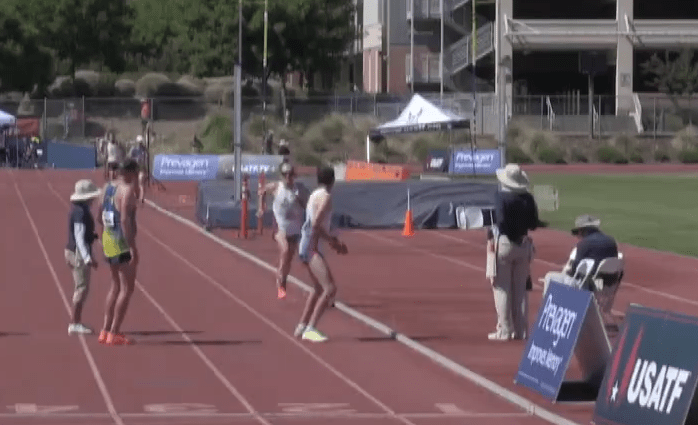
15 meters to go!

Bob kept it rolling with a 2:55 and the other Bob (who had already run some sprint prelims on Thursday and had the finals on Friday) cruised in a 3:00, and Adam took the final leg in 3:14, holding off a late charge from SoCal, and ensuring a surprise age group win for us in 11:41!
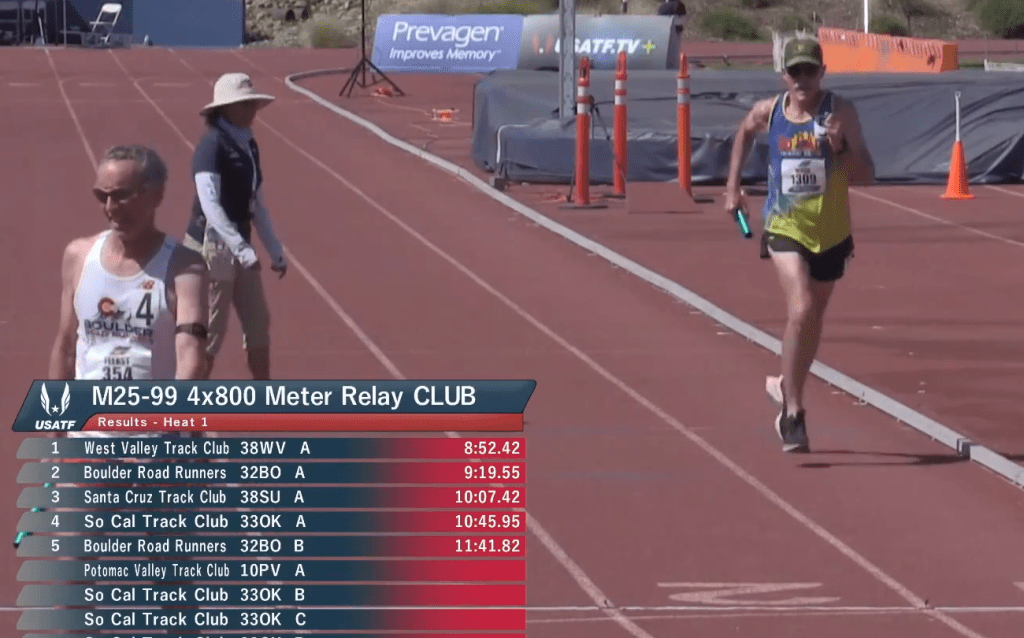
On the screen.

The relay was a big success! The aftermath less so.

After we crossed the line, I milled around the finish area for a few minutes and enjoyed the moment with my teammates and competitors. Soon after Adam had finished however, I started coughing and gagging. It wouldn’t stop. This went on for about 10 minutes and I realized I wasn’t going to make it back to the car, let alone back to the house to get my inhaler, which I had left behind. I usually bring it, but forgot on Thursday. So some officials pointed me toward the medical tent at the end of the straightaway and I asked for some assistance.

It was a little embarrassing to have the EMTs drive in, take my pulse and O2 readings, check my breathing. But it was a relief to get a mist of albuterol and oxygen to calm the attack. This took about 20 or 30 minutes and I missed the celebration with my teammates.

My chest and throat were tight for the rest of the evening and overnight but I was otherwise okay. I ordered a new inhaler as soon as I got home this week.

Saturday the 10000 Meters

The 10K is more in my wheelhouse as a race distance, but I have only run two of these ever on the track (both in 1991, when I ran a 32:11). You don’t have hills and turns on the track, and the going is more smooth but it’s more mental than on the roads or in cross country.

I felt fine for the warm up but was concerned about the heat. It was already in the upper 70s when we lined up at about 8:40 (79 degrees according to Garmin) and it had to be 5 degrees warmer on the track, with the radiant heat from the previous day.

My plan was to run about 3:50-55 per km/6:10 per mile to finish under 38:30 and if I was having a good day under 38. Seemed fair enough based on recent workouts and races, and because I usually perform a little better at 10K than 5K. That was probably a little over-optimistic. My pacing was supposed to be over 6:10 for the first 1600, maybe as slow as 6:20s, and in hindsight I should have stuck with that.

Two guys in their 60s went out quickly in about 90 for their first lap and I held back some and was about 96. An age group rival was right on my heels, almost clipping them. That made me uncomfortable, and run a second or so per lap faster than I would have.

The two 60-64 guys already had a gap in the first kilometer.

I ended up running a string of 91s and 92s, and for 2 kilometers, my California shadow was right there. If I slowed he’d slow. So rather than stepping aside into lane 2 and letting him pass I just kept going. I think in a normal temperature (say 50s or low 60s instead of 80 or more) I would have been fine with the pace. Finally, after five laps he fell off the pace. The leader was running steady 90-91s, and had built about a 20 second lead, and second was less than 10 seconds up. I also tried to maintain my effort but started to worked to reel them in. I crossed 3200 in about 12:20, so effectively right on pace, although I was running by feel then and not focused on times and splits.

The sprayed us each lap at the beginning of the back stretch the cooling water felt nice but it was a brief respite from the heat because the water would mostly dry off by the time you rounded the track again.

Although the two leaders were not in my age group, I treated it like a race that I wanted to win outright. I caught the second runner at 5K. He fell back about 10 or 15 meters and it seemed like I was gaining on first. And so it went. The 1600 splits in the middle of the race were both at about 6:15.

There was a water table on the backstretch but it was in lane 4 and you had to veer out and slow down a little to get your drink. I went for my second drink at about 7000 meters and my competitor seized the moment and scooted past–quickly. By the time we came around for the next lap (I went to the table again to grab a cup to throw some water on my head and shoulders) he already had put on 15 meters.

With less than 3K to go, I had my own race wrapped up as I was coming up to lap the second and third place runners from my division–that was good, but they were not coming back as quickly as I would like, which meant that I was slowing up. The 5th 1600 would be the slowest of my day, I only ran about 6:27. Although I fell back some against the younger competitors, I lapped my age group rivals on the 21st lap–I had it in the bag and all I had to do was hold on.
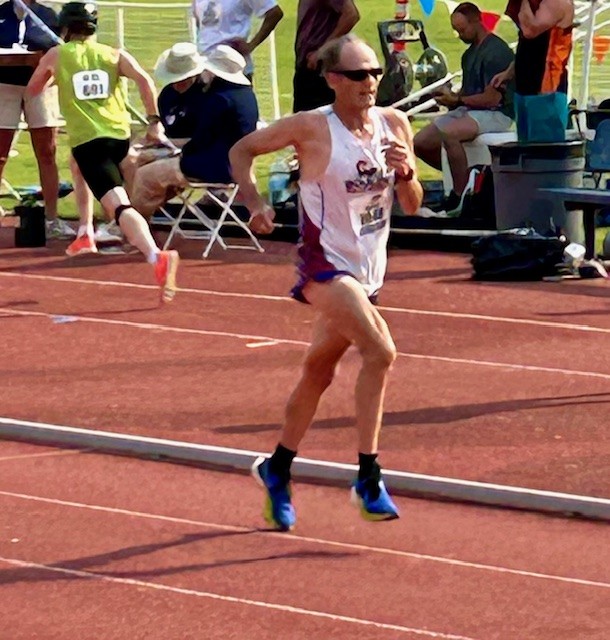
Sweating it out over the final laps in Sacramento.

I maintained for a few more laps and then picked it up over the final two, crossing the line in a very hot 39:16, nearly 30 seconds slower than the younger runners. But I had lapped the rest of the field. So perhaps not as fast as I’d like, but I’ll take the win, but I am with winning my age division by more than two minutes.
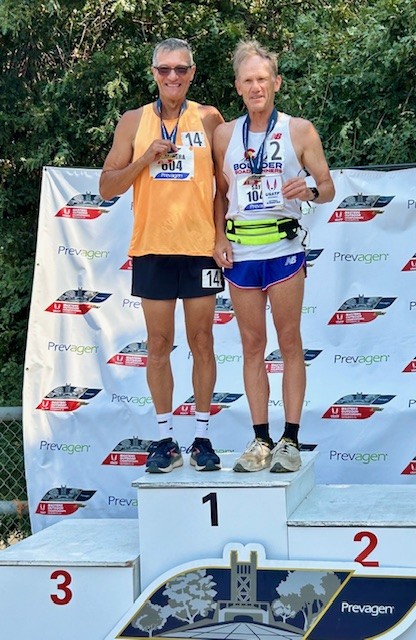
Age group winners! Javier caught the leader Scott with just a couple meters to go to win the 60-64 age group and I came out ahead in the 65-69 category.
Rapid Fire Race Month

Following a big month with a peak in May (25K) and Bolder Boulder 10K just two weeks later I recovered and just trained though June with no cut backs or races, managing about 60 miles a week.

Racing would resume in July.

Normally I like have my races scattered so that I’m focused and not fatigued from training. However, this month I decided to do five races in a span of sixteen days, although the slate consisted of two 800s and two 5Ks and capped off with a track 10000 m. That’s a lot of races but only adding up to 21.6 km, it did not seem like over racing.

Firekracker 5K, July 4

For the third year in a row I returned to Fort Collins for this race. I had no breakthroughs in June but no break downs, just a routine month which counts as a win. I did four consecutive weeks with a double threshold day (early in the week), a second workout day that was either tempo or fartlek, and a long run. And I mixed in a little bit of speed work here and there to get ready for the 800.

I was looking forward for the trip back up to Fort Collins, but kind of fell into a funk a day or two before. I think it was allergies compounded with new contact lenses with a poor prescription. Not to mention I retired from work/career less than a week ahead of the race. And of course extensive political turmoil that if you look at it, was just plain upsetting.

We spent the night in Fort Collins, so we wouldn’t have to get up so early on Thursday. I woke up that day feeling way off, and decided that this would be a non-race and that I would just tempo the first mile and progress from there. Per usual with this race, the first half mile is hectic and crowded, with several sharp turns a lot of fast-starting runners, some with dogs. I don’t know why a race with close to 2,000 people should allow dogs on leashes. It’s dangerous.

Finally, by the time we hit the north side of the cemetery on La Porte Street, just before 1 mile, things had strung out enough to relax and find a stride. Despite feeling groggy all morning and a little bit out of body, right up to the start, I was pleasantly surprised split the mile in 6:20 feeling pretty good. It helped that we had an unseasonably cool morning at 53 degrees, instead of the more typical +/-70 F. So I started moving up and picked off a string of runners including the leading leashed dog runners.

The 2nd mile was even better, which I covered in 6:10 and a good rhythm. So I kept it going as we swept by City Park Lake and the Park itself, and I held it together over the final half mile. I didn’t want to dig too deep because I would be racing an 800 m in just 36 hours, so I quietly accelerated to the finish with a 6:04 final mile, to finish at about 6:10 pace. The time was just 3 or 4 seconds slower than 2022. That day I was a little disappointed, but two years later I’m not complaining about 2024.

Final 30 meters of the July 4th 5K.

Track Series 800 m

Just a day and a half later I found myself trying to be up for my first official 800 m race in 15 years, and one of just a few since my late 20s. I gave the event a shot as a newbie runner when I was a college freshman–way back in 1977–but the 800 was never my event.

Our club was trying to put together a relay for US Masters Track and Field Championships in a couple of weeks and I thought that even though I wouldn’t be fully recovered, it would be a good idea to line up and race at least once. I expected we would have two heats for the men’s division and the slower heat would be won in about 2:30 as it was in the first meet last month. That’d be a high-end mark and I hoped to be in the 2:32-2:35 range on Friday.

None of that worked out. The race only had a dozen runners, nine were under the age of 30 and all would run 2:15 or faster. There were three old guys, myself, my club teammate (and putative relay partner Dan), and a gentleman in his 70s. Dan wasn’t planning to run at all, but his partner is a race official who saw my name so she signed him up after the entry deadline had closed. I was a little but what? Dan has a very competitive do-or-die approach to racing, often closing his emails with “Strength and Honor” whatever that means. He also stated several times that he would not go to US nationals just to win, it was get the American record or stay home.

Dan’s attitudes and mine sometimes clash. I was a little nervous going in, knowing how he likes to race (lurking and stalking and making a move later in the race), and that if I have an off day he can run me down. I don’t like losing to anyone in my age group at local races, including Dan.

We did warm up together, and of course the race was delayed by some 40 minutes. We lined up on the outside of the waterfall start. The gun went off, and the field sprinted away in a matter of a few meters. I laughed a little.

It was my last laugh of the evening. I could feel Dan’s footsteps behind me, but chose to focus on finding the right pace (figuring a 38-39 first 200 would be a good start). The leaders had 40 meters on me on the backstretch and footsteps behind faded but I had no I idea by how much. I was running totally alone–just what I didn’t want, this race was supposed to be a calibration.

I came through the 400 in 77-78, some 15 to 20 seconds behind the leaders and (later I would learn) 6 or 7 seconds ahead of Dan. At that point I was feeling okay, and hoping that I could hold on for another lap at that pace. However, after rounding the curve, with 300 to go, my legs started to tighten up. I picked it up there (in hindsight should have kept the effort even for another 150 meters or so), and I sped down the backstretch for about 80 or 90 meters. But with 200 to go my legs and lungs really locked up and I was just jogging the curve (probably at 3:00 pace). With a 100 to go, I knew Dan would be coming on strong so I threw down one last surge which I held for about 50 meters. Then I locked up one final time. I was moving forward but not fast.

Mu goal time was out the window, I wouldn’t be near 2:40, let alone 2:32-35, but at least I was holding off my teammate/rival. Five meters to go I had it. Four, three, one more stride! Nope! He got me with a meter to go! To lead for 799 meters and to falter, that was a bit of a slap in the face. But I deserved it, not being 100% rested and I ran a poor race tactically. I congratulated Dan, and moved on.

Two meters to go, not looking good!

State Championship 5K

I took my lump of coal on that one, and set out for a good week of training leading up to the 5K.

Going into race weekend my attitude wasn’t great, another rival had just turned 65 I figured I would be pressed in this one as I had been in the 800. However, that’s racing, and racing when you have good competition and a target on your back.

Race day dawned a lot warmer than in the Fort Collins race just nine days prior, by race time the temperature was in the mid 70s and climbing. With a number of solid competitors in the 60+ age division (no Dan this time), I resolved to go out competitively, but not too fast. We were off and I quickly settled into a 6:05-6:10 pace with two runners in their early 60s some 5 or 10 seconds up, and my new age group rival just behind me. The course is a sidewalk around a lake, so it’s fairly narrow. Just before the mile I passed the two age rivals, feeling solid, and I hit the mile in about 6:06 looking ahead and trying not to think about those in my wake. That split was quite a lot faster than the 6:20 I did in Fort Collins, but this course was flatter at the start. So I pressed on into mile 2. I only picked off a couple runners for the remainder of the race, primarily just holding my position.

2nd mile was 6:10 and the trail had a switchback with a mile to go, and there I could see that my age rivals were well behind. That gave me the rare opportunity to hold back a little bit on the final mile, which I ran in 6:15. I did kick it in over the last 150 m to finish in under 19 minutes for the first time at altitude since 2021. The course was said to be a little short, but close enough. Job done.

Making my way to the final stretch in the 5K.

Three races in nine days, two good 5Ks and a poor effort at 800. Would that be enough (or too much) to be ready for Nationals, which would start 1,200 miles of driving and only five days later?

20 Years a Comeback: Part I

This is partly recycled from a few years ago when I chronicled my earlier running path over the decades and phases of my life. However, I am revisiting the story because it has now been 20 years since I found my way back to running and racing following several years of injury and unfortunate events.

Y2K The Crumbling

First, I guess you have go back 25 years. After four years of steady decline, I enjoyed a nice resurgence at age 40. I built a base and stayed healthy and managed to achieve my primary goal that year of breaking 4:40 in the mile, and beating the local favorite in the Amherst, MA Masters Mile that summer. And for the next two years things went pretty well, I ran a marathon, won my age at Bolder Boulder in 2000, ran dozens of races, and stayed healthy. Until I didn’t.

By late spring of 2000 I was nearing the end of the second year of a post doctoral research fellowship with the USDA in my hometown of Fort Collins, CO. Everything seemed to be going great. The research was interesting and rewarding, and I was actually getting paid a decent wage for the first time in my career. We had one kid getting ready for kindergarten, and another precociously about to start pre-school before turning 3.

I was just wrapping up a spring of racing highlighted with a 27:13 8K at the Drake Relays road race and winning my age a month later at the huge Bolder Boulder on perhaps the hottest day ever for the race.

I was enjoying my post doc, doing research on bird repellents and bird behavior. I had a couple of publications and was just setting up for a new three-dimensional phase of the research in the lab. However, I found that there would be a gap in funding and no guarantee that that the project would even continue. With a family to support I had to take an offer with a nearby private company specializing wildlife toxicology and disease.

There were parallels, and the CEO, Dick, promised that I would be able to continue with the repellent research. So, with some trepidation, I took what was seemed to be effectively a lateral transfer into the private sector.

I hated it immediately.

Looking back I could have gone back to the USDA to finish the final three months and to apply for the extension to the fellowship. I definitely should have but I decided to make the best of the new situation, with the hope it would get better. I was a Ph.D. with years of experience, but they immediately put me under the wing of 25 year old woman with a B.S. degree and a bad attitude toward men. She did get canned after a number of months, but even then things hardly improved. Within two weeks the CEO told me to stop thinking about doing any of my previous research, that my time was all his now. And so it went for 15 months.

After some 12 years of being fairly independent at work, doing my job without someone breathing down my neck, I had lost control of my destiny as a scientist, and I had to do what they said and they way they said to do it. My stress levels were off the charts, and within a month of starting my new job I was a basket case.

I continued to run but by the end of summer my knees were bothering me on every outing and I was not doing quality workouts. Maybe 30 miles a week, mostly just running. I jumped into a couple track races and and 5Ks over the summer, and in the fall I did run two cross country races. However, my body was rebelling due to stress, poor sleep, and general unhappiness with what my career had turned into. The running suffered, my mile time that August was 6 seconds slower than the previous year, and by fall I was running 5K a good 30 seconds compared to what I had done in early summer, before making the switch.

In spite of the decline in performance, running was a good stress release and I frequently took my lunch hour (timed to the minute) by going out for a 4-6 mile run on dirt roads near the lab. Although that was a relief, my knees hurt on every run.

2001 was no better, and actually worse on my knees. I stepped back even more on training over the winter and focused on work and family. I’d get out a few times a week and got in some cross country skiing on weekends. I had gained about 10 pounds over the previous year, and ran Bolder Boulder off of 20 miles a week, running two and a half minutes slower than the exceedingly hot day of 2000 (fitness-wise close to a 3 minute drop). Over the summer I did improve somewhat, but could only muster a 37:40 at the Colorado Run (more than two minutes slower than I had done a couple years earlier).

Within months of starting that job I started making applications for other jobs. In the end I had helped bring in over $200K in grant money to the lab, and the agreement had been to raise about half of that in a year. At the time I did not know that the grant money had already been awarded to the lab, but after 15 months of unhappy tenure there, Dick the CEO brought me into his office and laid me off, saying that I had not done enough for the grant writing, saying with a straight face, “We have hit an economic downturn, due to 9/11,” (this was just two weeks later) and he added. “You just didn’t get the job done.”

Actually Dick, I did get the job done. You were just a greedy and deceitful psychopath.

Although it was a huge relief to be away from that company and its toxic atmosphere (he had fired about a third of the professional employees in my time there) there was some damage. Two weeks later, while I was still waiting for the first unemployment checks to keep our family afloat, a former coworker drove up to a local race with a new car. Another part of the deal when I first signed on was that I was to get 7% of the grants as a bonus. The coworkers got the bonus, I didn’t.

Fortunately, I landed a new job at Colorado State University within a couple of months and we did not have to move.

2002-2003 Knees Are Shot

In 2001 I hit a career rock bottom. For the better part of 20 years I had worked to be a research biologist, working as a technician, getting a masters, working in the field and as a research associate at a major university, years getting a doctorate, and scrambling as a post doc. I felt I had been on the cusp for several years, but the other side of that was an abyss.

I took the first job that was offered, it was a down grade really, as an environmental policy/writer position. But it would pay the bills and ultimately lead to a more stable, (usually) less stressful lifestyle. No more paper chase, get grants, and publish or start over. I still have some regrets about making this shift in mid-40s, and do miss the excitement of doing research (sometimes it was drudgery, particularly the publish part).

Nevertheless, at the end of 2001 I embarked on a new career path, but I soon moved up, getting a team lead position after just a few months on the job. However, my running had yet to hit the bottom.

Sometime around the end of the year, I was on an easy but snowy 45 or 50 minute run along the foothills and I twisted my foot on a slippery rock. I heard something go pop but it not hurt that much until I got home. That injury to my posterior tibialis only compounded the knee problems. While recovering from the twisted foot I spent some time in the gym and did some leg weights, thinking that would build up my quads and ease the knee pain.

After a couple weeks, and cross country skiing while on my first work trip to Alaska, I resumed some easy running. Maybe 10 days later on a blustery January day I decided to hit the track and a set of 200s at a moderate effort, maybe starting at around 40 seconds and bring it down to 36 or so. Not that hard, starting at about 3K race effort and finishing at mile/1500 pace. On last repetition two, in the set of eight, my knees tightened up and got sore.

That little session pretty much ended running for nearly a year and a half. Actually, it wasn’t just that session. The prior year and a half of personal stress, unaddressed knee problems, and the tendon tear to set it up.

I rested and waited for three weeks with not much improvement, so I went to the orthopedist, who was getting up in years but had been world renowned in the 1970s, 80s, and 90s. His first response was that maybe I should give up running and take up kayaking–which was sort of funny, he had said much the same in 1984 when I visited the same clinic for a lingering hip/piriformis issue.

His advice was to take NSAIDS for a few weeks, ice it every day, and come back in four to six weeks if it doesn’t get better. I followed two out of three but forgot to schedule another appointment. So I just spent half a year before going back in. I just stopped running, and did little bit of light skiing, and some cycling or swimming. Passively biding my time with the hope that things would improve. I would try to run a little bit, but not regularly, maybe 20-30 minutes here and there, and my foot and knees did not improve much.

When I finally did go back, the doctor was incredulous that I hadn’t been in sooner. He prescribed some anti-inflammatory medications and up to 12 weeks of PT, which I did in two bouts a couple months apart.

The PT helped some, but only marginally. By the end of 2002 I had run maybe 200 miles, the lowest since high school, and gained the 10 pounds I had lost in the summer of 2001.

After a year of not being able to run I still followed the sport, but now as a fan. I missed it and there was no end in sight.

Much of 2003 was a blur with work and family life. Every two months I would have a one or two week trip to Alaska, and the land was growing on me. My co-worker (and tormentor) Pat had grown up in Anchorage and thought his hometown was great, the cosmopolitan epitome of the state. The Interior and Fairbanks, where I was spending half my time, were the desolate pits. But I found the openness and big sky of Fairbanks to be somewhat appealing.

In 2002 and 2003 I got most of my exercise by bike commuting. It was 6 miles to the campus and our office. It would take 18-20 minutes to get there, mostly by bike path, in the morning. With a 200 foot elevation gain back home, my ride on the return was more like 25 or 30 minutes. I rode in 3-4 days a week, as long as the weather was good. On weekends I rode on the back roads and trails in the foothills for an hour or two. The running was not coming around but cycling actually felt pretty good.

Over a couple weekends in the spring of 2003 I did some long hill climbs with a runner friend who also did some cycling. I left him in the dust on the climbs and he encouraged me to give cycling a try. I was not planning on hard core mountain biking or road cycling, but checked the race schedule and found some summer hill climbs at the ski areas, 5K to 8K and climbing 800 to 1000 meters. My debut would be in mid-June at Winter Park.

At about that time I had two friends, from out of town and completely separately ask the same question almost word for word.

“So it looks like you’re done for good with running?”

I was disappointed to hear them ask that but seeing how I had hardly been able run for 17 months, I can see why.

My friend Tim, the second person to ask, had just traveled from Oregon run Bolder Boulder as a destination/bucket list race. Coming from sea level he thought the event was incredibly difficult, if not horrific. I had a couple beers with him and his wife as we swapped stories. The next day, slightly hung over from the two pints (they were strong pints I might add). I went out for a ride to Horsetooth Mountain, it was a 2000 foot ascent from our place, with the last 3 miles climbing some 1500 feet on a steep trail.

Near the top, at about 7000 feet of elevation, there was a particularly steep pitch on the rocky trail. I stalled and couldn’t get my foot out of the clip fast enough and fell over, cracking my wrist. I was in a cast for 6 weeks, thus ending a mountain biking hill climbing career that never began.

Now what?

I said the heck with that, and started running again. Just easy miles at first but jumped into the Father’s Day 5K in Fort Collins. My kids ran the 0.5K fun run and had a blast. With my blue cast I ran a 19 minute and finished with a smile.

The road back was not smooth. I ran about 20 miles a week, and some days my knees were okay, but then they’d ache for a few days and I would have to rest or cross train. I did a couple 5Ks that summer, running an 18:26 at sea level in Anchorage, now 2 minutes slower than I had done three years prior and an 18:30 back in Denver, a slight improvement if you account for the mile-high elevation. After three or four months of running, I wasn’t back but feeling better.

At work things were heating up as we were preparing our revisions for an environmental impact statement. We had a big week-long meeting in Fort Collins with government agencies, and that was the most stressful week since I had started. I got home that weekend and had a sore throat, and my defective-pock-marked tonsils were swelling. So I went to the doctor, thinking it was strep throat. I tested negative and the doctor sent me home. Overnight my tonsil grew to the size of a ping-pong ball, nearly closing my throat. I had to go to the ER and have the abscess drained, with no anesthesia. That was the most painful minute in my life!

I had to stop running, and had my tonsils removed two weeks later. In early November. Having your tonsils taken out at age 45 is rough. I had to isolate at home for 15 days. I couldn’t eat any solid food and could barely sip a warm or cold drink, jello and ice cream were the only caloric foods I could take in.

Fortunately, the work schedule was not too hectic after my extended break. I was able to start running about a week before Christmas. I had lost about 10 or 12 pounds following the surgery, and an added bonus was that I felt without the tonsils partially obstructing my throat I could take more air with each inhale. On New Years Day I ran a local 5K in just under 19 minutes. I had no base but felt pretty good. I did not know it but that was the beginning of my comeback.

Looking back it’s interesting that it took a fall off my bike and a middle-aged tonsillectomy to get back on track for running.