Garry Bjorkland Half Marathon

I have wanted to do this race almost since its inception in 1991, which officially makes it a bucket list race. This was also the 50th anniversary of Grandma’s Marathon, the grandma event of the weekend, while the Garry Bjorkland half which started in 1991 may be the son or grandson (short generation times when it comes to running events!).

In 1992 we moved in 1992 from New York state to North Dakota (North Dakota!!!??? our NY friends would exclaim when we told them about the move–yeah it was crazy but I did get to study bighorn sheep for my doctoral research). I immediately found out about the half but back then the field size was limited to 1,000 Minnesota residents. So no go.

We did move to Minnesota from 1995-97 as I wrapped up my studies and Tamara found work in the North Star state, but I ran in Manitoba that same weekend in 1995, and in 1996 and ’97 I was battling injuries. So no go again.

Then we moved to far away places for decades (a quick year in Massachusetts an a combined 28 years in Colorado and Alaska).

I did make the trip to Grandma’s in 2021 of course, and although I did not reach my goal of a sub 3 marathon at age 63, it goes down as one of my favorite marathons due to its history, the course, race management, and overall vibe. Note, however, that was during the covid pandemic and field sizes were limited to half size for then (only 3,000 in the marathon, and barely one-third of the participants that we are now seeing). Masks, an odd start, and social distancing aside that was a very different experience from now.

That was the first major race in 15 months for the country and that was at the forefront of this new marathon boom. We can call it a running boom, but it’s very much driven by the marathon.

I wanted to get back for the half someday, and now that we are only two and a half hours from downtown Duluth it was much easier and justifiable to run the half. That and our son said that he would be doing the marathon as a Boston qualifier. Sign up was a major cluster. The race filled up in less than two hours. Fortunately I logged in within minutes of the opening and in time to secure an entry. Nevertheless, wow! 9,000 entrants and sold out so quickly. Duluth would be the place to be if you’re an American road runner, not that there were not many other significant events going on over solstice weekend.

Training

I summarized training last week. Roughly 60 miles a week for 9 weeks, discounting taper for the 4-mile road championships two and a half weeks ago.

Travel and Pre-race

We drove up on Friday morning and picked up our son at the airport. We hit peak craziness for bib pickup as the 5K was wrapping up and thousands of other travelers were making their way to the convention center. The center itself is well set up for big crowds, it’s the traffic and parking that were a challenge. With that done, we made pasta at the house we stayed at–very fortunate to house sit for a couple of house cats. Their owners were away and we got to stay at their place, instead of forking over $800 for two nights at an Airbnb or hotel.

My glitch, however, was forgetting my allergy medicine. I figured I’d be okay missing a night but it does help some with sleep and I woke up at 1:15 AM, with maybe just 4 or 4.5 hours of sleep and that was it. I tossed and turned until the 3:30 wake up time in order to make it to the bus by the 4:00-4:15 AM window for my wave. Crap that’s early!

Penned Chaos

I had a nice chat with a younger (almost all other runners are younger now!) woman on the bus and we compared notes and made suggestions on other races to hit in the Minnesota region–and beyond. The bus dropped us off at about 4:45. There was not much out there but six porta potties to start with, a dozen or so volunteers 50 yards upstream (up the road), and they loudly urged us toward the corrals promising “200 port potties!” I should have known that was a ruse to a false promised land.

Like a sheep I took to the corridor to Corral 1 and walked a ways (it seemed like several hundred meters) to the start site. As promised, there were banks of porta potties, with dozens shaped into connecting C patterns about four times over. Looked good. I still had an hour plus before the start but took advantage of the accommodations. Fine. When I stepped out and surveyed the situation I saw that we really were fenced in. At that time there was still some space to move around near the start and a few athletes had already started jogging in 50 or so meter circles.
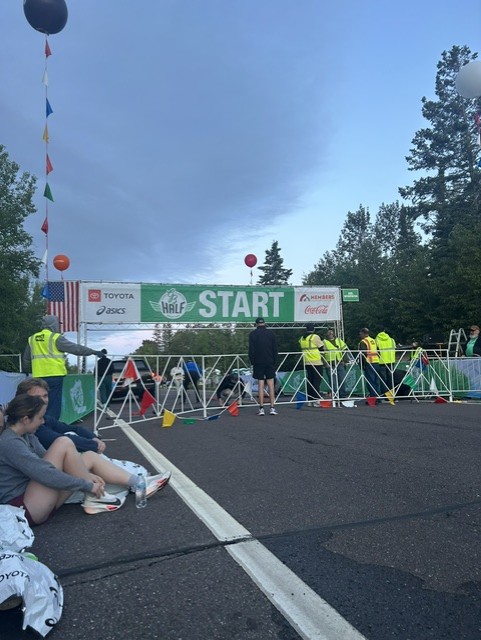
Start area about an hour before start. Note corral blocking access to the street ahead.

With an hour to go that was too early. So I sat down for a bit and talked to a couple of friends. With 45 minutes before race time, I decided to find the loo one more time. The corral was filling up quickly and the lines were getting long. I waited in line for 10 or 15 minutes, and by the time I got out they had pushed the corral back even further–with officials yelling at the jogging runners to stop and move back–and now it was standing room only. No place to warm up!

I briefly thought of backtracking those 200 or so meters to find some open ground but that would be like swimming against thousands of salmon heading to the spawning grounds, the walk way was only 2 wide (maybe 2 meters). That may have been a poor decision.

With 20 minutes to go I moved up to take my position near the front. For record purposes in Minnesota they use gun time so if that’s on your mind you had better move up near the front–maybe farther up than you might want to or should be! We weren’t packed shoulder to shoulder but there was barely enough room to stretch. After the elite introductions (they had all the room they needed of course) and national anthem (always too long and drawn out for my taste), I ran/jogged/hopped a little in place for 5 minutes. That was my warm up.

Racing the 36th Annual Garry Bjorkland Half Marathon

The elites went off and five minutes later they counted down for wave 1 and we were off! It took less than 2 seconds to cross the timing mats and we were off without a hitch. My plan was to run 6:35 for mile 1 and then about 6:30 for a couple of miles, and I wanted to settle into 6:25-6:30 until the final miles, where hopefully I could pick it up some more. My A+ goal was sub 1:24 but that seemed to be a stretch based on this spring’s training block. But 1:24:30 to 1:25 seemed reasonable. An A- goal would be 1:25:40, which was right at 90% age grade. That’s my standard for 2026, 90%. So far this year it was 90.6% for 10K, 90% for 5K, and 89.4% for 4 mile but that was on a hot humid morning. I’ll take that!

I needed to hit about 6:32/mile for the 1:25:40 and that seemed very likely considering training and last year’s half time of 1:24:38 at a race in Minneapolis.

My heart felt like it was racing (it was fine according to my wrist watch) and I did not feel quite on in that first mile. I was not feeling awake and my breathing was rapid. But I hit 6:35 on my watch (about 6:40 at the split marker). From then on my watch would buzz about 5-10 seconds ahead of the markers, but was consistent so I’ll go by watch time.

Mile 2 was right where I wanted to be with a 6:28 and, I was in a good group but I was not feeling comfortable! The temperature at about 55 was fine, and I did not feel any wind.

At about 2.5 miles, still not feeling comfortable, I backed off the effort slightly and dropped back from that group. That was an executive decision to save the race. Although the pace was close to what I was aiming for, I did not want to be digging a hole and end up struggling over the final 5 miles and 5 km. I wanted those miles to be the strongest of the day. Had I kept pressing, I think I would have had a much rougher finish. I don’t know if that affected the final outcome, but at the time it was the wiser choice. I slowed to 6:35-6:43/mile. Miles 4-7 were 6:35, 6:39, 6:32, 6:44. At about 7.5 miles we turned slightly inland, the wind picked up and it became more directly in our face. It was not a bad wind, at about 5-7 miles per hour and it felt cooling, but it was enough to make you want to draft if you could.

At about 7 or 7.5 miles I engaged more into the race, shifting from pacing to racing. I ran behind a couple of women and some larger (6-foot plus) guys much for much of that stretch. And when I fell off a bit, which happened every half mile or so, I would re-focus and reel them back in! We had some hills too. Miles 8-10 went 6:37, 6:38, and 6:40. This was the slowest stretch of my race.

Once we were on the downward side of Lemon Drop hill (9-about 9.7 miles) I finally opened it up a bit and started running more aggressively and started passing more runners, which felt great. There were a couple of stretches where I had to back off a bit, but I was mostly keeping the pedal down. I went back and forth with a few runners as we passed others who had slowed. That felt great! The pace was not the 6:20-6:25 I had envisioned but still a solid 6:28-6:30.

The wind was strong in the mile or so through downtown, but there was not time for caution, we had to push through it. I knew we’d have a respite once we got to the harbor area with about a mile to go. I remember really struggling in that stretch in the 2021 marathon, but not in a half this year. It was all solid. A few runners passed by but I was passing just as many who were fading.

The last km of this course is mentally tough because you have to route around the museum ore ship, William A. Irvine. It’s maddening but I knew it was coming and just bore with it. For the final kick, the young woman in red, with whom I had run much of the way, had a huge kick and pulled away. Otherwise, I held my own and I finished reasonably fast in the final couple hundred meters . My final three miles were 6:32, 6:29, 6:29, and the final 200 m were at 6:13 pace.
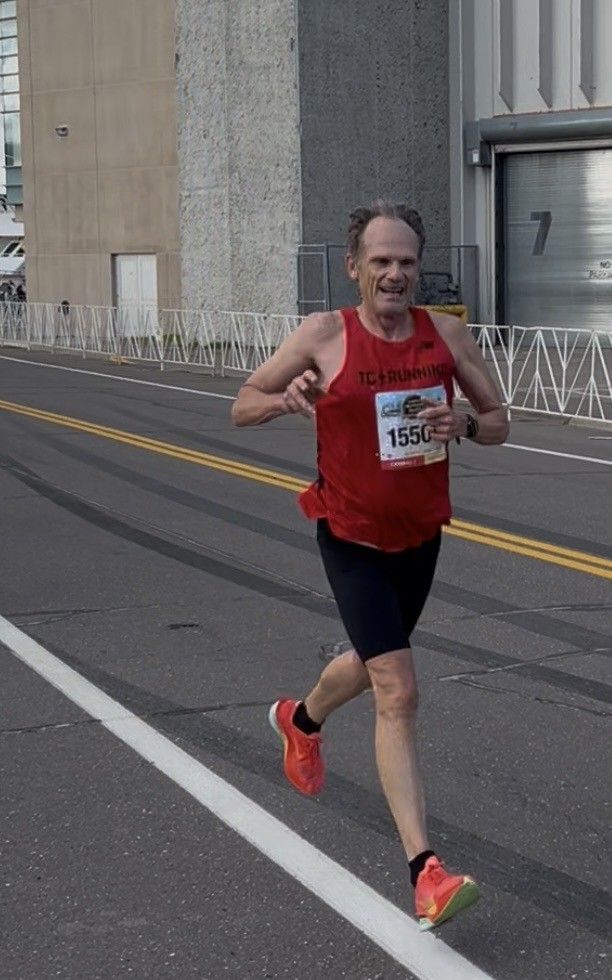
I was tired, but not overwhelmed with fatigue at the the finish. It just did not seem like a day that I dug deep. I have done that in half marathons before, but this time it was a strong, steady, on the edge effort. Maybe if it had been a championship and places/points, and money were on the line I would have found another 45 or 60 seconds, but I don’t know. If I had pushed harder from miles 3-7 or 8 I might have folded and run worse over the final half or few miles.

I’m not complaining. It went about as well as it could have for me on this day. I won my age group by more than 2 minutes, scored an 89.1% age grade (top 15 overall for men including the pros up front, and top 3 for masters men), and set a new single-year age state record, according to the Raceberryjam website. It was a good day! Not great. But good nonetheless.

Post Hoc

Grandma’s Marathon and the Garry Bjorkland Half have a great reputation. Grandma’s in particular. I’d like to go back for that race, maybe after I turn 70 (which is coming up sooner than I would like!). However, I’ll say that the start line situation was an issue. Runners, particularly the competitive runners (top 20% for sure) need some space to warm up, as well have access to the porta-potties. According to friends who have done this event, this is the first time they funneled everyone into smaller corrals without access to adequate space for a warm up jog.

I can see keeping people out of landowners yards and lots of for businesses near the start–you don’t want people going to the bathroom on those properties! But there is a way to keep it open. Normally, you can warm up alongside the elites–why couldn’t we do that this year? I’ll be writing to race management, and will let them know that leaving no warm up area for a half marathon is not really acceptable for a runner.

Other Activities

It was our anniversary and Father’s Day weekend, so we celebrated by cheering our son at 22 miles, as well as watching the elite runners go by. He ran a 10 minute PB and qualified for Boston. We all went out for a fun dinner on Saturday evening and topped off the weekend with some sight seeing in Duluth.
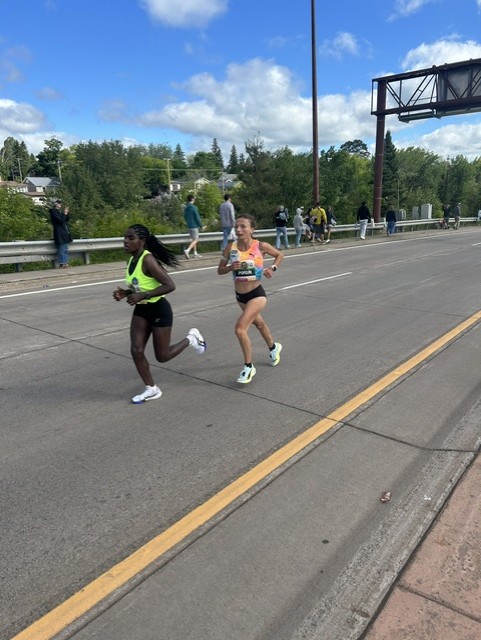
Lead women at 22! Bashanke Bilo (2nd) and Dakotah Popehn (1st).
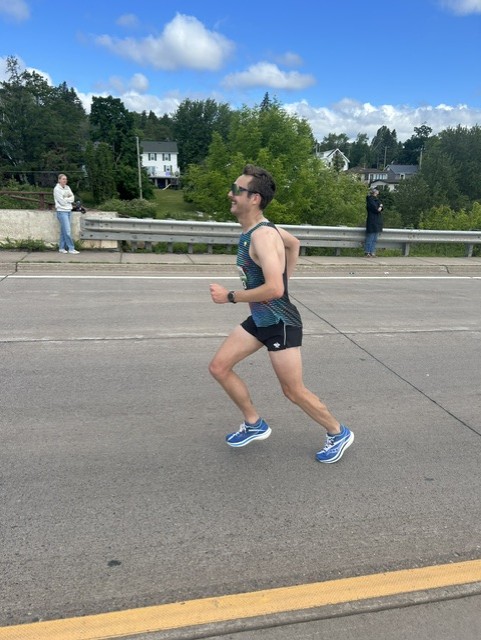
Our son cruising to a 10 minute personal best and a Boston qualifier.
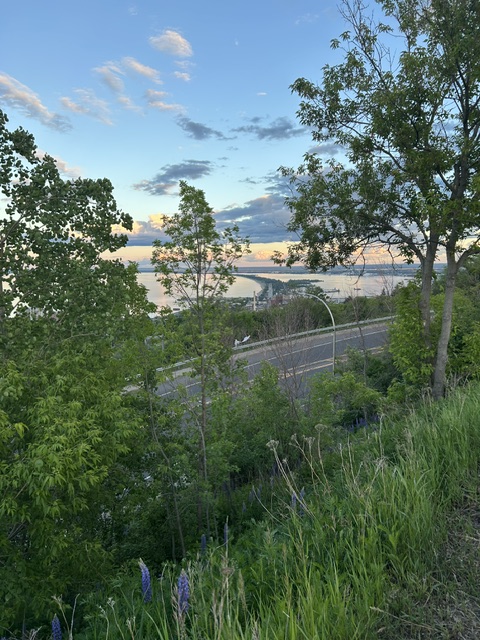
Closing out a great day in Duluth!
Spring Training

The spring training block is just about done. Phase I of the final exam was last weekend and the Phase II is next. That’s actually the real final. Meanwhile, I’ll be attending my 50th high school reunion this weekend.

Last week’s 4 mile was an A effort. I might have eked out another 5 or 6 seconds in that third mile, as I dropped off just a bit between about 2.7 and 3.5 miles before winding up for a strong finish. Even if I had managed to push through I don’t think I would have pulled off a 90% grade under those hot-humid conditions. In age grading I was 89% top six out of all participants. The naysayers on a place like Letsrun would say that still sucks. But we grade on a curve. That’s an A.

Here’s a deeper dive into the training this spring. We’ll go back 10 weeks, plus a few more. In March I just built up from about 20 miles a week to 40s by the end of the month. Workouts started in April with threshold sessions ending with some faster short reps at 5K to 1500 m effort. Nothing fancy.

April

I battled some tendon pain on the posterior tibialis insertion, in my ankle. I think it started from my new ski boots which were pressing on that point. For the most part the pain has been in the 1-4 range although there were some days when it hurt to even jog. In May I got some inserts and stretches and it has improved since then.

In the middle of April I got in some repeat 1K reps at 10K effort on the Get in Gear course and I felt pretty decent that day, hitting some wind-aided reps in the 6:15-6:20 range, which was goal pace. Typically, I did tempo/threshold type workouts or repetitions with progression in pace. I did not do any work faster than about 6 minute pace. On the double threshold day the morning workout was repeats at sub-threshold (7:00/mile down to about 6:35). A single tempo day would be closer to 6:30 pace on average. I only mixed in CV or V02 max type work in shorter reps at the end of some threshold running.

The work paid off and my 10K race was solid. Although I did not run under 6:20 I still ran 90% age grade, which is kind of my standard goal for sea level races.

Summary – Ran 27 days with seven workout days, one was a double threshold. One race with a two day cut back. 221 miles total.

May

I wanted to increase the miles in May and continue with the workouts. The May races (12K and 5K) were not A races, but I did cut back for two days leading up to each event. I ran the 12K at threshold effort (LT2), so not quite all out but still a challenging effort to maintain for nearly 50 minutes.

If you include that as a workout and not a race then I ran five workouts for the month, capped off with a “Michigan” in the last week. (1600 at 10K, 0.9 threshold, 1200 at 8K, 0.9 mile threshold, 800 at3K, 0.9 threshold, and 400 at 1 mile effort. That was my capstone workout. I also got in three decent long runs of 13, 14, and 15 miles.

The 5K was decent (90% age grade) but I did not feel fresh on race day.

Summary – I ran 265 miles with one day off and one day of cross training (cycling). I did six workouts if you include the double threshold and 12K race as a threshold workout. Three long runs.

June

June is when it counts. Most of the workouts and training are done and I have two big races this month. The first week was a full taper for the 4 mile road championship. I came in with a lot of doubts about my fitness, which were compounded by the sudden onset of seasonal heat and humidity over the previous 10 or 12 days. Turns out the training was decent and heat adaptation enough to have a good day of it. I did not get the 90% age grade, nor did I reach my goal of matching last year’s time on the same course, but considering the conditions I exceed expectations and came out with an age group win by a pretty large margin–not expected. Last week I jumped back in and logged in 62 miles with a couple of solid workouts to prepare for this weekend’s half.

Am I ready? Ask at about 7:00 or 7:30 AM on Saturday. The A+ goal would be under 1:24. My workouts have not indicated that I am ready for that. My Garmin and Strava apps have been predicting 1:26-1:27. My knowledge and experience say 1:25. I’d really like to be under 1:25, and that’ll be my goal pace starting out.

WeekWorkoutsLong Run         RacesTotal miles
March 30-April 5(1) 3X 1 mile LT; (2) 7:20, 5:50, 4:20, and 3X 1:2011.663
April 6-12(1) 3X 1 mile LT1, 3X 1 min V02; (2)5 min, 2X1.5, and 3X 7 min LT1, and 4X 45 sec V0210.0 41
April 13-19(1) 6X 1000 at 10K, 400, 200,100 at V0211.1 53
April 20-26(1) 3X 2.5 min, 2X 1 min, 2X 30 sec8.210K 39:3349
April 27- May 3Double T: 4X1 mi; 6X 2 min, 2X45  13.4 64
May 4-10Double T: 6X1200; 3X 3, 3X 1 :20 Fartlek sandwich: 200s, LT, 200s14.5 60
May 11-17(1) 8X 1K LT9.512K 49:2059
May 18-24(1) 1200, 6X 20013.0 54
May 25-31(1) ‘Michigan’ (3X 0.9 mile LT; 1600, 1200, 800, 400 cut down)15.45K 18:5766
June 1-7(1) 1 mile LT, 2X 300, 200, 1008.04 miles 24:5141
June 8-14(1) 6X 1 mile at 10K effort; (2) 4 mile threshold/progression13.7 62

Steaming at the Steamboat Classic

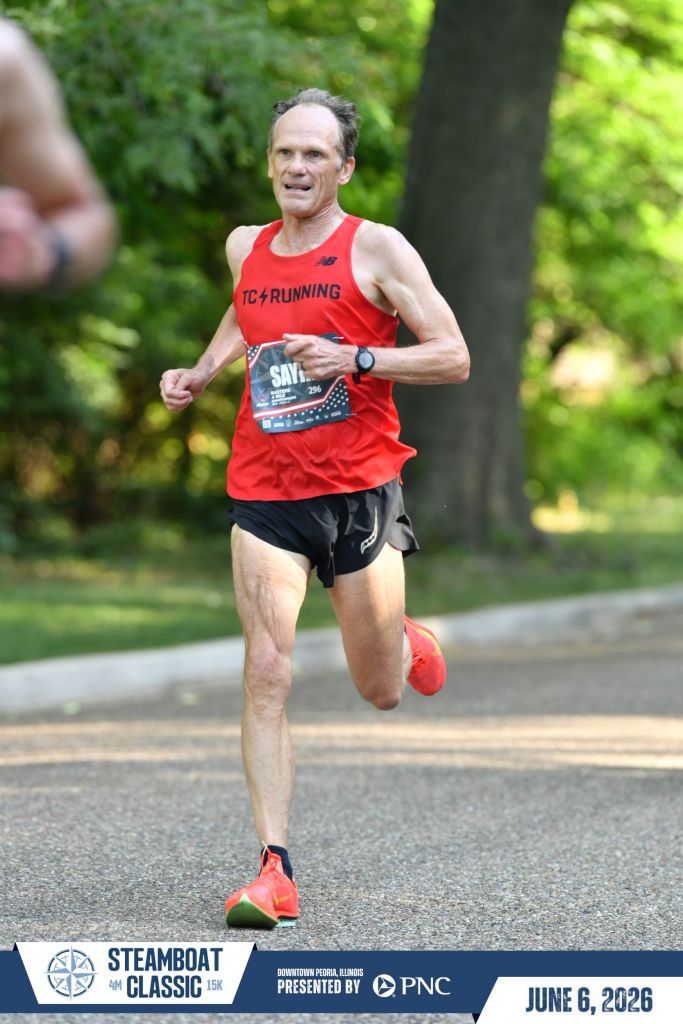
Other than taking a couple of recent runs in the middle of the day in recent weeks, I did not prepare much for the heat and humidity. By the day or two before last weekend’s race I was beginning to regret that. And even then, the actual conditions were worse than expected. Earlier the week the forecast called for race temperatures to be in the mid-high 60s with a dew point of 61. A day before they were saying 70 degrees and a dewpoint of 67. By 7 AM on race day it was already 72 degrees and sunny. Jogging to the start line on Saturday we knew we were in for a hot one.

Reluctant A Race

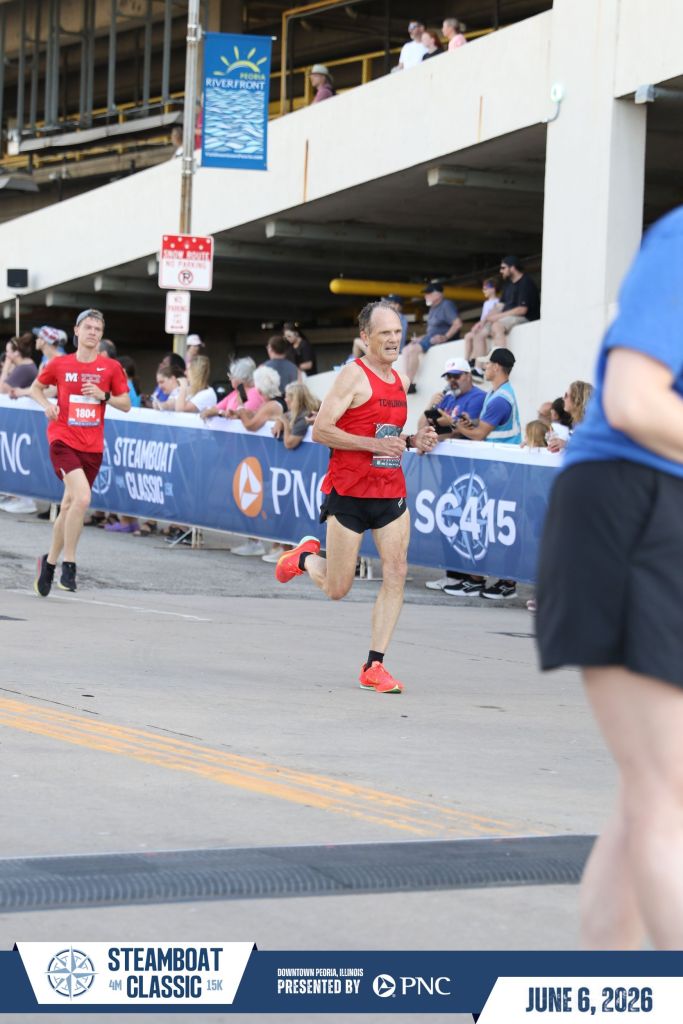
Over the past eight or nine years springtime has been my best running season. I tended to build a good aerobic and strength base over the winter, without much racing, and then by March I was ready to roll. This was my first year back in the Midwest after more than a decade in Colorado and like the slow slide into spring weather that we had, my fitness seemed to just lumber along at its own pace and not according to what I wanted. Add to that some spring travel delayed my racing season, which did not start until late April this year. I was left with a five race season with a good rust-buster 10K (90% age grade), the Bay to Breakers 12K last month in San Francisco that was more of a B race that I trained through and paced at threshold effort, and the following weekend I did a 5K that you might call A-/B+ both in priority and in outcome. The short on that is that I was aiming for a 91% age grade or so and to win my age class. I ended up matching my lower end goal of 18:57 and 90% age grade but ended up second in my age class. I was a tiny bit disappointed but not broken about that. It was all part of the process.

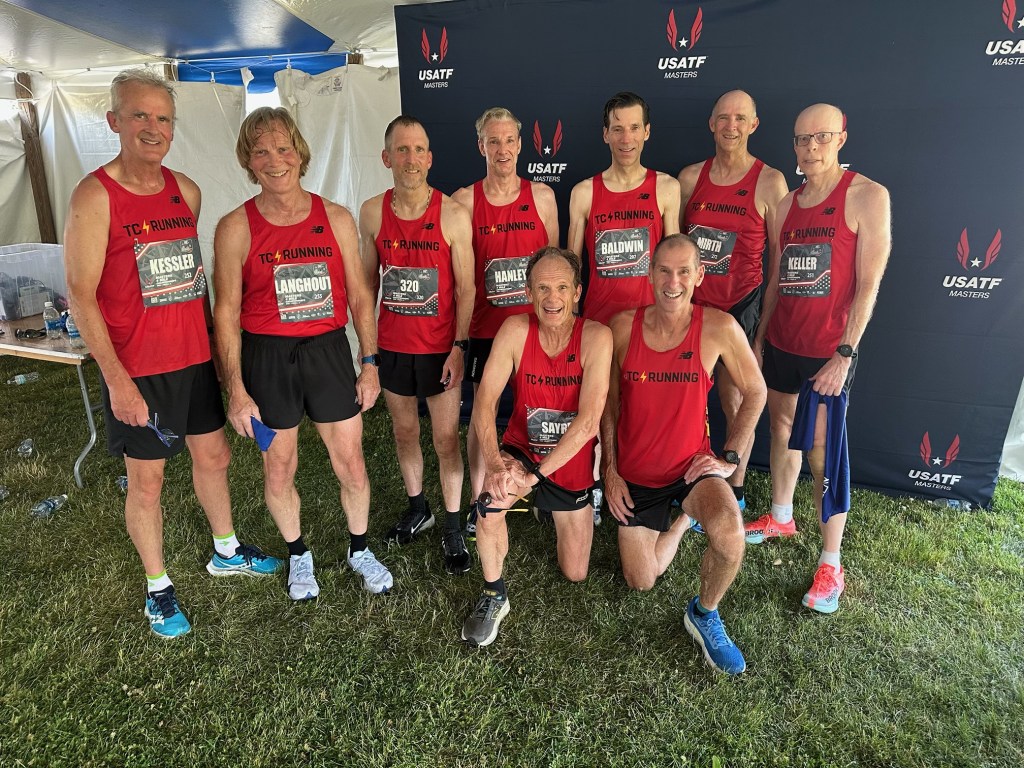
My A-level races for the spring of 2026 were the 4-mile last weekend and a half marathon in another two weeks. I do not consider the 4 mile to be a great distance to race do not even have an age group personal best for the distance–which I last raced, hmm maybe around 2000. Even though this was a championship race on the USATF circuit, it just did not seem like that big of a deal. Furthermore, I am now on a great masters racing team (not that the last one was bad–it was one of the best in the country for runners aged 50+) but was not expecting to be a scorer. The top three on our team are five or six years younger and a lot faster than have I been running in the past two years. So I would just be a filler, or maybe put on the B team.

In some ways, this felt more like a no-pressure situation, where I would travel, hang out with my teammates for a weekend, and maybe run well enough to also get an individual medal.

Training

I put in about 60 miles a week of training for the past eight weeks and it has been solid but not spectacular. The first five weeks or so included a double threshold day, another day with a moderate workout (easy tempo or fartlek), and a longer run. Over the past three weeks I did the Bay to Breakers in just under 50 minutes (which for me was pretty hard, but not quite race level). Recovery from that was slow. Then eight days later I did the 5K race, followed by my longest run of the block (15 miles) and three days later a Michigan workout (nearly 10K of work at threshold or faster effort). With three hard days in a five day span I was hoping for some supercompensation. My teammates exclaimed that such training might be considered crazy. I tapered over the last five days prior to the race, and hoped that would be enough of a recovery.

The Trip and the Race

Peoria is 7 hours away by car and almost the same by air because there are no direct flights. So we drove. It wasn’t too bad, although keeping our driver from getting distracted took some teamwork at times.

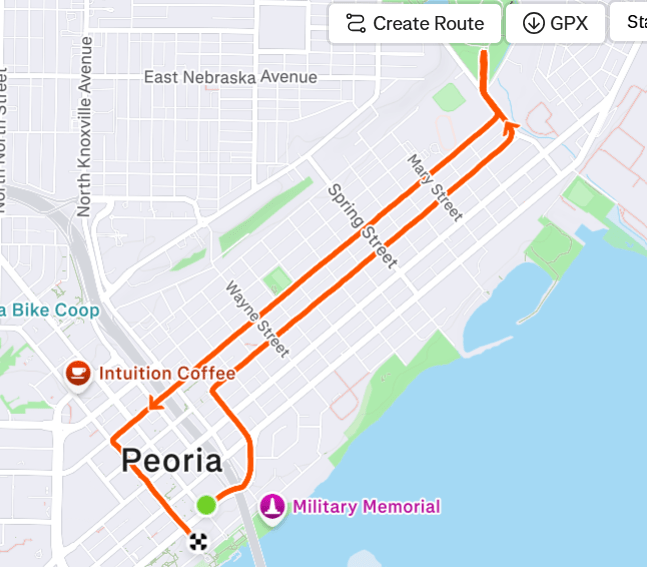
We took a short 25-30 minute shakeout run on Friday afternoon, surveying the course, which is out and back on parallel streets, but not quite a full loop. It only has one hill of note, from about 0.15 in to 0.5, and it features a nice long gradual downhill finish. They were expecting fast times and perhaps some American records.

The race also hosts the professional USATF championships for men and women, and has done so for decades. The pros were the headliners, the masters have been but a graying to gray sideshow over the past two seasons. As it should be.

At the start of race it was 77 degrees with a dew point of 71, a good deal warmer than forecast. I was not confident of doing well in this race. The masters runner who beat me by nearly a minute at last year’s Bix 7 was entered, and my teammate who had finished ahead of me in two of the previous three races was also racing. I figured first place was out of the question, especially seeing my opponent do some strides just before the race–he looked so smooth and fast! Like an elite runner. And in this heat and humidity, I thought I might be fighting for third or fourth. Or just to finish on my own two feet.

The elite women and men took off at 8:00 and 8:05. We, the masters runners aged 40-89, lined up with our own double traffic lane and the citizen runners had their lane next to ours. We’d merge at about 0.2, at bottom of the hill. It’s not a huge race (with some 1,400 participants overall), so things would sort out fairly quickly.

Last year I took the hill a little cautiously and never really got back into it. My time was okay and I did score an 89% age grade on a warm/humid morning (but about 10 or 12 degrees cooler than Saturday!). This time even though it was hot I wanted to engage a little earlier, while not trying to be too aggressive. I had three athletes I wanted to key off from, including my masters rival who is tall and wearing a light blue singlet–easy to pick out–and a couple other friendly competitors who I have raced against many times in previous years, and we are pretty even.

My age group rival already had 40 meters on me before we even crested the hill at 0.4 miles, and I figured he was gone. But I was right with the other two and actually not feeling too bad. The street has some big trees along it and the shade was ample. I felt in control and the heat was not bothering me.

By a half mile I could see that my age group rival was not pulling away, and if anything his cadence was slowing! At the mile he was 8 seconds ahead but was slowing. Maybe I had a chance, but I put that out of my head for the moment and just focused on running.

By about 2 km I caught him and passed him, and I just looked ahead trying to keep up with my other competitors as one by one we picked off some of the faster starters. Last year I really slowed down at the slight uphill just before the turn around and 2 mile marker. I stayed more focused this time and was 10 seconds faster than in 2025. It’s a long stretch, about 1.5 miles, on the same street and if not for the tall shade trees along the route you would be able to see the downtown buildings. I felt pretty strong through about 2.5 miles but some doubts the heat, my breathing, and ability to maintain this effort for another 8-9 minutes. I dropped off a little, my friend pulled away by about 5 seconds and I was kind of falling into survival mode. Fortunately, the blocks through the residential neighborhood went by quickly and we passed three miles. I was slower than last year but had not really lost much ground. I knew it was just a matter of holding on until that final 0.4 mile downhill. One km of grind as we approached the downtown area. The streets actually came up quickly and I could see where we would turn!

I was extremely surprised to see two of my teammates about ready to make the turn. They had been out of sight since the first half mile of the race and I figured the would be 60-90 seconds ahead (like they had been last year). But here they were, and slowing down. I passed them both just after the turn, gave some encouragement, and focused on striding out, accelerating each block, and getting to that finish line!

I crossed 18 seconds slower than last year, but was elated to win my age group, as unexpected as that may have seemed only 15 or 20 minutes prior. My two teammates rolled in within 15 or 20 seconds, but with me the back up as second runner it was obvious that we would not win the team title. My age group competitors whom I thought I would be either behind or battling to the finish would finish 1.5 and 2 minutes later.

A lot of runners really struggled in the heat, and for injury or health reasons, but I only slowed 4.5 seconds per mile compared to last year. I’ll take that as a win, and will go so far as to say that this was my best result since the USATF 10K in Massachusetts back in April 2025.