I am a long time runner and coach and I'm here to write about it. I have blogged some before (years ago), but that site is now archived. My plan is to write some personal reflections skipping around the 40+ years of my running career, probably some race reports. However, I'd like to spend a fair amount discussing current events in the world of running, and likely dishing out on some coaching and training advice. I have some opinions--okay a lot--and like to share those. rws_58@yahoo.com
Here are my obligatory PRs, all set way back in the 1980s and 1990s:
3K - 8:54
5K - 15:34
8K - 25:35
10K - 32:11
15K - 49:41
1/2 marathon - 1:13
marathon - 2:34
Now I'm a senior, yes a Senior (60+)! age group runner and here are my 60 and up PBs over the past couple of years:
1 mile road race - 5:15 (former American road record)
5K - 17:28 (USATF masters champion)
8K - 28:12 (USATF masters champion)
15K - 54:43 (Gasparilla 15K)
1/2 marathon - 1:17:49 (World Masters Champion)
At the London Marathon last weekend 59 year old Jenny Hitchings ran a 2:45:27, shattering her own age group world record of 2:50:36, which she set at New York City in 2019. That record spurred some online controversy, how could a relatively unknown run nearly five minutes faster than the venerated Olympic Gold Medalist Joan Samuelson at the same age?
This time, after bettering her lifetime personal best of 2:46, which she did back in 2011 at age 47, at least some on the internet have gone apoplectic, accusing her of using PEDs. Arguing that it’s impossible to PR at age 59.
I don’t know, I have seen a lot of remarkable masters breakthroughs in recent years, such as Tommy Hughes of Ireland running a 2:30 marathon in his 60s, or 60 year old Austrailian Steve Moneghetti doing a sub 16 5K last fall. Hitchings is at their level, and the trolls and naysayers on the internet don’t like it. Maybe because A) she is female and B) she was not an elite-level runner when she was younger while the likes of Hughes an Moneghetti were pros.
One of the more common arguments is that it’s simply not possible for an athlete to run as fast or faster at 60 compared to their mid-40s. And they cite the commonly used statistic that runners after the age of about 35 or 40 decline at a rate of about 1% per year. Of course, the first mistake they make is that they equate that 1% as a rule, and deviation Will Not Be Tolerated! (so if an athlete’s times decline at a rate much less than 1% they are immediately suspected of taking testosterone or performance-enhancing drugs). Another mistake you often see is that often the most outspoken have declined at a rate much higher than 1%, so using the famous adage ‘anyone faster than me must be cheating!’
This article Sub 3-Hour Marathon Runners for Five Consecutive Decades Demonstrate a Reduced Age-Related Decline in Performance https://www.frontiersin.org/articles/10.3389/fphys.2021.649282/full counters those arguments and insecurities, and the data from those in the 5 decades sub 3 marathon camp (including Olympic Gold medalist Joan Benoit Samuelson) have declined much less than 1% per year, more in the range of 0.5% to 0.7%. The journal article is also summarized here in Canadian Runner.
Before delving into my own rate of decline, what about Jenny Hitchings and her remarkable feat? Amazing is all I can say. I don’t think it’s at all fair to say that she’s an obvious drug cheat. Nevertheless, I’m in the camp of giving the benefit of any doubt but I also believe that high level athletes (record setters and champions) in the masters ranks need to tested both at competitive events and at random times outside of competition.
USATF and USADA need to up their testing. I have been to about 20 USATF championships over the past decade and one for World Masters championship. At these events you have to sign a waiver acknowledging clean sport and that you will agree to drug testing. That’s fine and needed, but they need to do more. Test at least six or eight athletes at every championship road or cross country race. Currently, they only test a few athletes a few times a year. They also need to implement random drug testing for athletes who are at or approaching the record breaking level of performance. As far as I know that is not done at all.
My Own Rates of Decline with Some Real Data
The table below summarizes my best performances at different ages over the years, starting with my best times as an open runner (all those list were set in my mid-late 20s), note those were altitude conversions, using the NCAA calculator. In my masters years, the times are mostly sea level but some years I didn’t live at or travel to sea level.
Age
1 mile
5K
1/2 Marathon
Marathon
20-39
4:26
15:15
1:10
2:29
40-45
4:38
16:21
1:17
2:44
46
5:08
17:41
1:21
3:12 (trail)*
47
4:56
17:03
1:19
3:00
48
4:54
17:08
1:19
3:10 (trail)*
49
5:08
17:28
—
—
50
5:00
17:23
1:19
3:09 (trail)*
51
5:00
17:01
1:18
—
52
5:14
18:05
—
—
53
5:11
17:43
1:20
—
54
5:03
17:17
1:19
—
55
5:10
17:17
1:20
3:17 (trail)*
56
5:10
17:27
1:19
3:15 (trail)*
57
—
18:21
1:20
—
58
5:11
18:10
1:24
—
59
5:11
17:40
1:18
2:58
60
5:14
17:29
1:19
3:12 (Boston)
61
5:14
17:28
1:17
—
62
5:24
18:10
1:26
—
63
5:28
18:11
1:23
3:02
64
5:18
18:30
1:21
3:00
65
?
18:24
1:24
How has it gone? I think the biggest drop off for me has been in the mile, while I have done better in the 5K and particularly half marathon, and the marathon is somewhere in between.
Open to 40-45 age group: In the mile I slowed by about 12 seconds in 12 years a drop of 4.5%. For the 5K it was 1:06 over 13 years 7.2% decline. In the half I slowed by 10.0% in 17 years, and marathon the decline was 9.8% in 16 years. Note that in my early 40s I was mostly running 40-50 miles a week, and only did one marathon block averaging 55-60 miles.
Open to now – age 64-65: I the mile I have declined by 14.7% and 5K 13.4%. In the half only 6%! and full it has been 9.3%.
Now the interesting statistics, the one that the online naysayers do not want deviation from 1% per year. From my 20s to mid-60s, the decline has been 0.41% per year for the mile, 0.55% at 5K, 0.15% for half marathon, and 0.23% a year for the marathon. So I beat the aging curve by a fair amount.
As to why, maybe that’s something for another blog post here, but I think some important contributing factors would be maintaining good healthy and weight, not getting frequently injured/nor having chronic biomechanical issues, adjusting my training and adapting to the aging process, and no doubt some good aging genetics thus far.
However, compared to the likes of Hitchings, Janine Rice, Jacob Nur, or Alistair Walker it’s nothing that remarkable. They are at the extreme end of the bell curve.
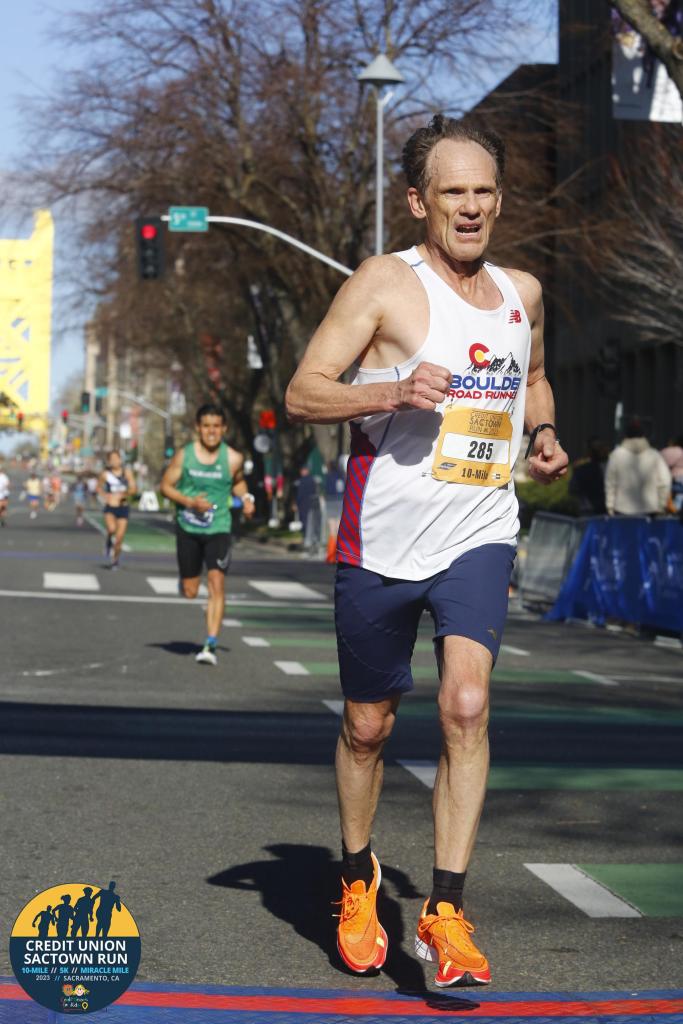
With just two weeks of recovery from my all-out effort at 10 miles in Sacramento, I figured doubling back would be fairly tough. It was.
The intervening training was mostly recovery for the first week, with a mix of cycling and running (including a 15 miler on the 8th) and capped off with a final ski outing on April 9. Only 40 miles of running but I did manage 9 hours for the week.
Last week I kept the volume up to an hour plus a day through Thursday, with a couple of moderate to light tune-up workouts. It was warm out all week (70s and 80s) so I took advantage of the year’s first heat wave in preparation for Syracuse.
Traveled on Friday and that was a “rest” day, although I walked a lot. On Saturday I drove down to Ithaca, where we lived for a few years in the early 1990s, and caught some of the old sights and took in a 4 mile run (probably warmer and hillier than it should have been) through the Cornell University campus and arboretum.
Race Day
The forecast called for high 50s to to low 60s with some clouds and wind. It ended up being 100% sunny, low-mid 60s, and a very light breeze out of the south or southwest. Not bad but weather would be a factor.
I did a short 10 minute warm-up, and could tell right way that my legs were not fresh. I have been planning to peak for a 25K race next month and if not for that I would have taken it a little easier last week. I adjust my goal from repeating last year’s time of 1:21:42, and with the warmer temperature figured that a sub 1:23 would be a good day. So I wanted to lock onto 6:20 pace. My watch had me at 6:18 for the 1st mile but that may have been deceiving because I started it at the gun and it had a net uphill. In hindsight that and the very much uphill 2nd mile (GAP 6:10, 6:19) were probably too fast for the day, although I did settle down early in that 2nd mile.
We were pretty strung out and mostly single file with growing gaps by the 3rd mile, different from last year when the field was twice the size and we ran in packs because of the wind. My official 5K split was 20:05.
From then on through mile 11, it was mostly a matter of hanging on to the effort and picking off runners one at a time. I passed maybe 6 or 7 runners, and clicked off 6:20-6:25 pace through the lightly rolling hills, and long downhill of mile 9 one was about 6:15. My 10K and 15K splits were 40:13 and 59:54.
The 12th mile was the toughest of the day, running into a slight headwind and totally exposed to the sun, I could only manage a 6:37 and I thought a sub 1:25 might be in jeopardy. One guy passed in that stretch but I couldn’t match his pace. I did regroup at about 20K as we headed back into the downtown canyons with a more favorable wind and some shade. Another young runner passed me, and encouraged me to keep up, saying “I believe in you!” That was kind of funny but my stomach was getting queasy and I knew I was at maximum sustainable pace at about 6:20.
I could not pick up the pace over that seemingly endless 0.4 mile straight after the final turn. Over the final block the announcer called my name and age, and the crowd gave a rousing cheer. I was top 5 among those 50 and up, and he said I might be leading the age grade category. I was hopeful of that! But it wasn’t so.
I won my age group by a good margin, and ended up third in the age grade rankings, with an 88.3%. That was not at the <1:23, >90% I had hoped for but given the day, a win’s a win, and another podium age grade finish is still very satisfying.
Next USATF race looks to be a road mile in June, which they just added, and May the 25K and Bolder Boulder 10K. Then, I’ll need a short break.
It’s only early April but the USATF Masters Grand Prix is half over and by the end of the month it will be three quarters done. Go figure.
This was my third race of the series for this season, which starts with Club Cross Country in December. I was only 64 for that race and placed 14th in the 60-64 age group, but would have been 2nd in the 65-69 age group. I only get credit for the 14th place.
There were only a dozen racers entered in my age group and none of the heavy hitters so I channeled my focus on age grading and making a top 5 in the overall age grading category. That’s a tall order, and I expected that it would take a 92% to make that top 5, and that was my A+ goal.
Training
For my 14 week training/base block I used a modified Norwegian system with a Nordic twist. Averaged 9.2 hours of aerobic work a week, 45 miles running (5 or 6 days a week) at 5300 to 7500 feet elevation, and cross country skiing another 21 miles (35 km) with the skiing (1-3 days a week) at elevations of 8500-10000 feet. This is the most skiing I had done since 2015 and jumped into several races, so it was good to mix that in.
For the first six or seven weeks I did a double threshold day every week and on five of those weekends did a ski race (7.5 to 32 km). The threshold workouts started with 5 or 6 minutes at current estimated marathon pace (low 7s), usually progressing toward actual threshold pace. The afternoon session were hill reps of 1.5 to 2.5 minutes at a faster effort, 10K to CV, and I would jog down equal time for recovery. Those were really hard this year (I did double-doubles, mostly running last year), and consistent snow, cold, and wind on those days didn’t make it easier.
After that period I shifted more to weekly threshold/progression work one day, and a progression from 10K to 5K repetitions on another day, plus a long ski or run on the weekend (1.5 to 2.5 hours). I raced one 5K, an 18:24 on a rolling course in Atlanta at the end of February. On paper, I think 1:02:30 was about what to expect, but I knew the course in Sacramento was fast and over the last couple weeks some of my reps started to creep down so I thought something in the 1:01s wasn’t unreasonable. I did a one week light cutback, with one easy ski of 90 minutes and 34 miles of running in 5 days, one day of rest.
Pre-Race
Traveled to Sacramento the day before, on an early flight that really messed up with my sleep. So that was a bit of ding. But I did get an hour nap after a short shakeout run. Slept okay the night before, getting maybe 6 hours of actual sleep. Did a short 15 minute warm up, on a cool breezy morning. Mid 40s and a stiff breeze from the south. So it would affect us more on the first half of the race, which was primarily an out and back along the Sacramento River, with a couple ~1 mile city loops for miles 1 and 10. My ideal plan was to go out cautiously, 6:15 and then wind it up to low 6s over the final miles.
Race
I lined up in about the 5th row. And we were off, but double clicked my watch so it stopped at the starting mat and I didn’t notice it until the first turn on the next block, so it was off about 30-40 seconds. I got swallowed up pretty quickly, but at about a quarter mile in I could see a number of runners I knew a ways ahead and they were pulling away, so I moved up a bit to get back in contention.
Coming from altitude to sea level without an adjustment period is always a mild shock. Your legs are going faster, you are breathing harder, and you just feel off. I have learned that you can push through that because you don’t go under as quickly. As a result I was running faster than comfortable but it also felt sustainable.
Things strung out by the end of the second mile as we crossed the bridge and headed south into the wind. The next group was pretty far up already so I settled into a pack of five or six other runners, a mix of masters and open men and younger women, going about 6:05 pace. With the headwind I mostly tucked int. Mile 3-4 was the hairiest because they narrowed the course two narrow lanes the out and back, and our pack congealed into 15 or so runners navigating a 6-foot wide section of road way, so it felt almost like track. But with some potholes you had to be wary. No one fell but there were a few close moments and a bit of bumping.
Back on the open road we opened up and I got to front of the group, trying not lead much but staying out of the way from feet and elbows. Splits for the first 5 miles were 6:01, 6:05, 6:03, 6:15, 6:06
Hit the 5.4 mile turn at 6:05 pace and was hoping to pick it up with the tail wind. However, my body said otherwise. I felt okay through 7 to 7.5 miles, and then it became a lot of work to maintain pace. A couple of the female runners from that big group caught up and I hung on through 8 or so, and fell back a bit more. One young guy encouraged me and I kept him in contact for another half mile but he also pulled away.
Even with the tail wind my 9th mile was a 6:13 (but did have a couple rollers). We had to turn back into the wind for about a half mile but I kept the effort going. Turned onto the bridge and toward the state capitol building, a half mile from the finish, I think one guy caught me but I held him off, but the three runners I had been running with/chasing since the middle part of the race pulled away some. So I didn’t didn’t close those low 6s I was hoping for, but held on okay.
Splits for the second half of the race were 6:06, 6:09, 6:02, 6:13, 6:13 (average of 6:09)
Officially finished in 1:01:09, and 92.24 age grade, an A+ goal time! I was pretty thrilled. Won my age group by several minutes, and ended up third overall in age grade rankings, so got some extra bling and chaching! Our age group team placed second so that was great as well.
Post-race
Had a good time rehashing the race with friends. I have been doing the Grand Prix circuit for five or six years now and know a lot of the competitors across the different age group. So we’re rivals on the course but once the race is done there is a lot of camaraderie. Took the train west in the afternoon to the Bay Area to visit family.
I returned to the USATF masters championship 5K Atlanta last week after three and a half years. A lot has happened since then.
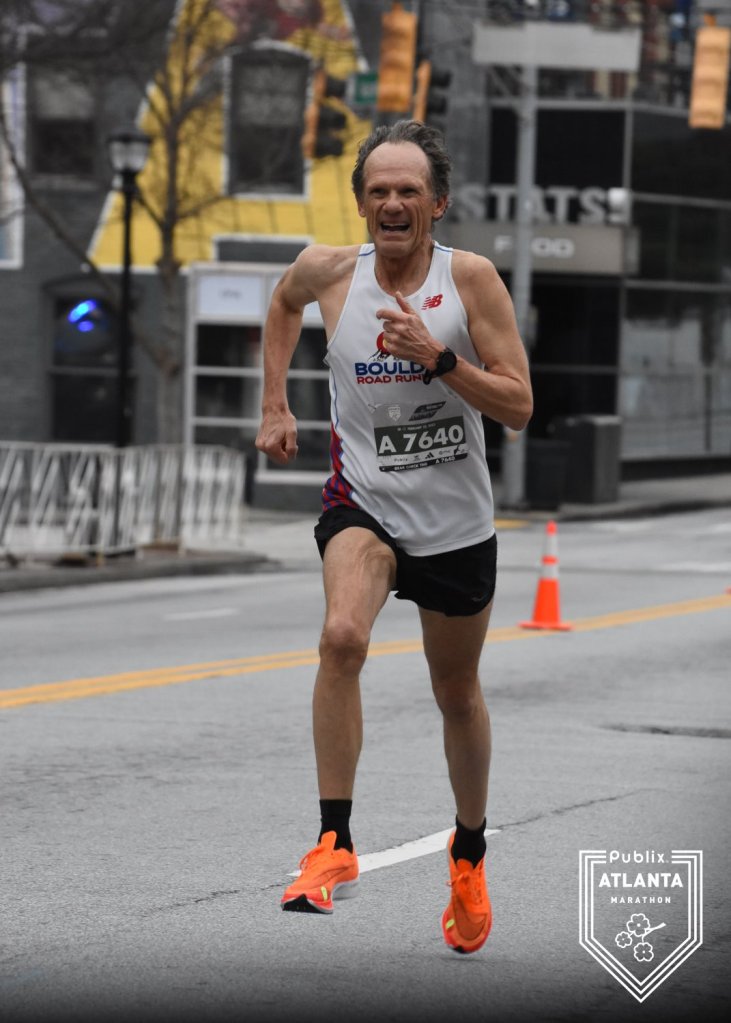
In 2019 I won my seventh individual US age group road championship with a 17:28 under withering heat and humidity, scored a 92.2% age grade which was 2nd place by just 1 second in the highly competitive overall age grade category. So that was my last really, really good race. Two months later I got injured, and then the pandemic hit, and I just haven’t yet returned to that level.
Now I’m into a new age group–with some mixed feelings about that. Umm Medicare, looming retirement, and Social Security. Officially a senior citizen. On n the other hand, I signed up enthusiastically hoping to run a way with a new title and to nab another high age grade award and some extra cash.
Build-up
I have had a pretty good post-Christmas block, with 9-10 weeks of consistent training. This year I have really enjoyed mixing in some more cross country skiing, getting out two or three times a week. The running workouts have been solid with a six week block of weekly threshold doubles, in addition to a number of ski workouts, plus five ski races from 7.5K to 32K.
At the end of January I shifted from the threshold emphasis to progression reps, and some CV, mixed in with a bit of speed work. So I went into Atlanta with a solid aerobic base and actually the faster stuff (sub 5:40 pace) felt more comfortable than 5K race pace efforts at +/-6:00 pace.
A 90% age grade is no given any more, not that it ever has been, and that is usually my standard for a great day. Turning 65 just a few days before Atlanta the calculator had 90% at 18:26. I felt fairly confident I could do that, and I was hoping for maybe a bit faster, like 18:10. American record holder Jacob Nur (17:00 last fall) did not enter this year (he won in 17:42 last year, beating all the 60-64 year old runners by 80 meters!), and I felt I could pull off a win. ATC’s Ken Youngers would be my biggest competition, and I knew he could give a good run for the win as well as age grade scoring.
The Race
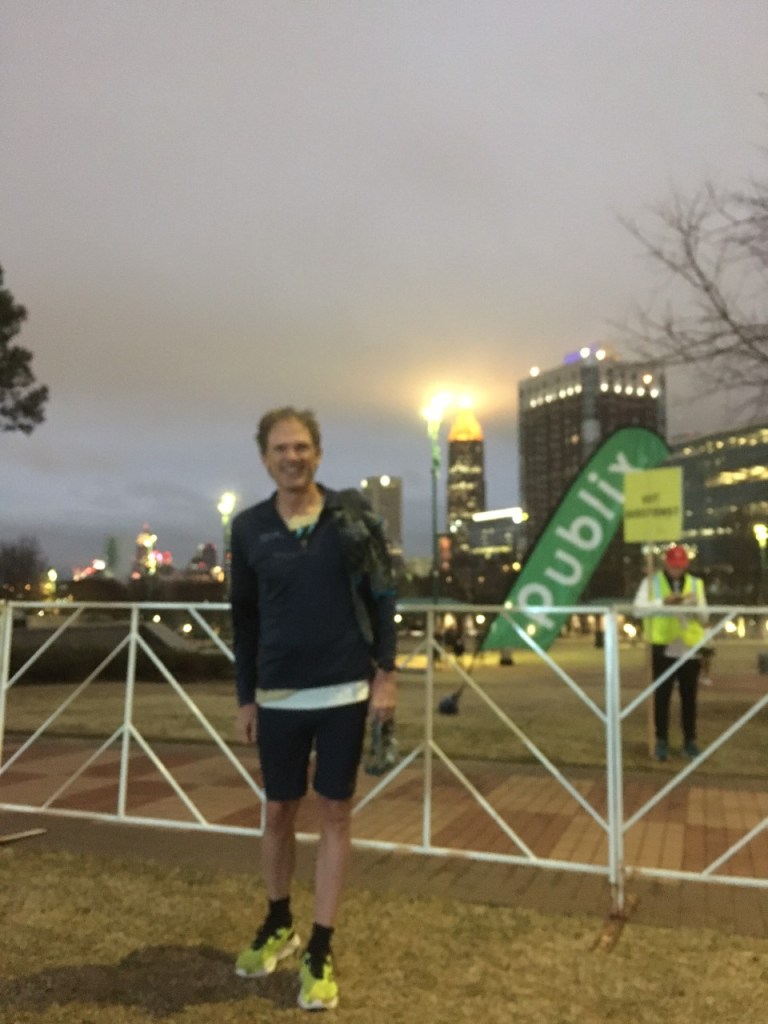
The morning was dark, at a moderate 55 degrees and a breeze, with low slung clouds, barely topping downtown Atlanta’s taller buildings. It was kind of eerie, evoking a sort of Batman motif. My teammates and I arrived about 45 minutes ahead of the start, I think we should have jogged over instead of walking because after our uniform and bib check with the officials we barely had a half hour for the actual warm up. Considering that we got up way early (5AM for 7:30 start), I shouldn’t have been rushed to warm up. Lesson re-learned, get to the start an hour in advance.
Nevertheless, I got in about 16 or 18 minutes of running, plus stretching and some drill on the grass in Centennial Olympic Park. We, 250 masters men and women, crowded into the start area which as usual was too narrow for a competitive field that scores based on gun time, not chip time. I lined up about 3 or 4 back, a few meters from the timing pads and said best of luck to my teammates and other friends. We were packed in so tightly you could feel the body heat.
The horn blew and we were off! It took 3 seconds to cross (and at the end they round up, so that’s like having a 4 second penalty). Ken had been battling a bad back and indicated he was slated for surgery in a couple of weeks, but he’s a competitor and I knew he’d take it it our fairly fast. More surprisingly were the two 55+ year old women Michelle Rohl (recent American record in the indoor mile with a 5:16) and the feisty Fionna Bayly, who has a strange running style but she’s blazing fast as well as fearless. Both of these women took it out at sub 6 minute pace in last summer’s sweltering 12K championships on the Jersey Shore. And one or both ended up in the med tent and don’t think either finished.
They started the same way on Saturday, but conditions were much better. They hit the mile in under 5:40 (about the pace I did in 2019) and I was some 8 or 9 seconds back, just a step ahead of Ken and his one of his teammates.
The day before Ken had mentioned that John Glidewell (great name for an ace runner!) was entered and that he was really fast, supposedly running a 17:30 5K in a time trial in recent weeks, captured on Youtube. After the start I never saw him and looking up 20 seconds ahead, saw no dark blue back bibs, so I thought I might be in the age group lead.
I picked it up over the second mile which had the first uphill, but it was net downhill of about 45 feet. The pace felt fast and furious, and I’m not used to running a 5:43! 11:34 net time. But my breathing was good. I had to tell myself to relax several times when I started to press too hard. The second hill is just a blip. And then there a nice downhill, where I caught the fast-starting women. I was in a pack of about 8-10 runners but nobody wanted to give an inch so I just settled in for the long grind of the erstwhile final hill climbing some 50 feet over 0.2 of a mile (the 2018-19 course finished differently, with a nice 300 m of flat or downhill to the line). On this course, runners crest the hill, and drop for half a block before making a sharp right up Baker Street, a steep 100 m, and then left back onto Marietta, a block south from where we had started, for another block of gradual up. So instead of three hills and a downhill finish this course had four and uphill until the final 80 or so meters into the park.
Anyway, this was where I lapsed a bit. I got to the top of the hill (2.6 miles) in fairly good shape, but rather than turning on the burners, I just maintained until I got to 3 miles (17:42 I think it was). Most of that pack had broken up, but two of the guys had pulled a few seconds ahead, and another came charging past with just 0.2 to go. I turned it on, but maybe a little later than I could have, and crossed the line in 18:24 (chip)17:27 (gun) 17:28 (official–see what I mean!).
For about 15 minutes I had thought that I won the age group. The 60-64 winner said, who finished almost a minute ahead of me, said that there was a 65 year old in his pack until the very final stretch. So I have to settle for 2nd.
All said and done, I eked out the 90% age grade (based on chip time) and was 5th for the overall age grading, and our team got 2nd to match my age group placing. We thought we might win against the host Atlanta team, but they were deep, with four of their runners ahead of our second guy (one by just a 0.1 second).
So not quite what I wanted, or what we had hoped for as team but a pretty good haul.
The Atlanta course, especially this edition, is not particularly fast, with 147 feet of vertical. But it’s fair enough. John Glidewell’s 17:30 was outstanding, that’s what I ran in 2018 and 2019 to win the younger age group and place top three age graded. Glidewell’s 95.6% ran away with age grading by 4%! So now we have two 65+ year old runners (Glidewell is 66, Nur 68) who are among the best ever in the US, if not the world for the age group. So for me, winning an individual title this year or next (or in the next 5 years with so many fast runners just a year or two younger), might be a tall order.
That’s the goal however, to keep striving, training well, eating properly and being mentally prepared to take on the field.
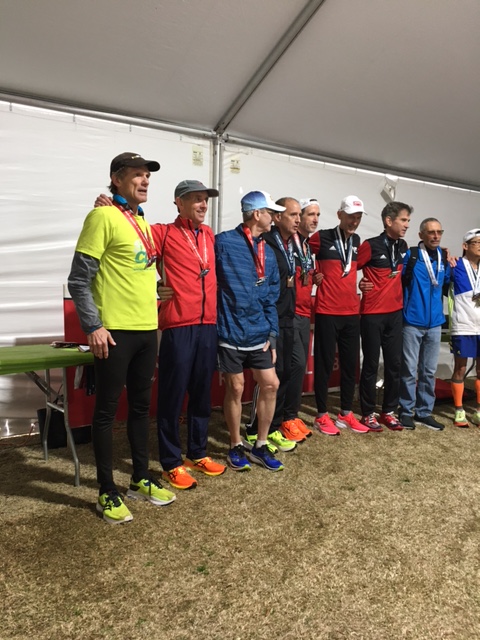
After the race we ran about 2.5 miles of the course with the winning Atlanta team (wearing red in the center). After so many years on the circuit we have become friends, which makes the travel all the more fun and rewarding.
“But you’re no Ben True,” exclaimed my friend some years back as I was attempting to explain my then future plans for running.
After more than a decade living in Alaska I had returned to my home state of Colorado for work. I didn’t move back for the skiing, although Colorado is a ski mecca. I returned for work and maybe to get away from the six or seven months of winter we had in the 49th state.
Maybe I set myself up for the slight, although I wasn’t actually trying to compare myself to the skiing-running accomplishments Ben True. That wasn’t even the point in the conversation with my friend, but he cut me off before I could finish. I was going to say that like True, I was ready to hang up the skis in favor or running and I was hoping to have some success as a masters runner into my late 50s and early 60s.
Mixing Up Cross Country Skiing and Running
I want to discuss how to balance the two sports. There is now one way, but I’ll weave in my personal experiences, going back to the mid-1980s.
In this day, the respective sports have become much more specialized. In fact, True is a bit of a throwback. It is now relatively rare for an NCAA Division I athlete to compete at the level of all-American in both cross country skiing and cross country running or track. He did all three! His former college teammate Glen Randall (infamous for taking a huge lead at Boston Marathon on a hot day and then fading badly) was one of the last to do that, ca. 2008 or 2009. Such crossover was more common in previous decades.
I mention that because the approach is now much more one or the other (trail and mountain running aside), even at the masters level.
Through much of my career as a post-college athlete and masters runner I typically lived from season to season. Only for a few years I did not do much extensive ski-specific training in the off season. I preferred to run into or through most of the fall, and then would ski once we had some snow. That was to the detriment of skiing because of the lack of upper body work, and I would often peak very late in the season, like March when others were already winding down. I worked, and I was able to compete at the higher levels of citizen racing, sometimes knocking heads with elite or sub-elite skiers from “factory” travel teams.
In Interior Alaska where I skied from my mid-40s to mid-50s, winters were so so long that dryland training was something of an option. I found a reasonable compromise. I’d do weight training (while coaching youth teams) through the year and a bit of dryland work–including roller skiing, hill bounding, ski walking–in the summer and fall. But we’d be on skis by mid-late October and some years through the month of April and I’d be putting in 150 days of skiing a year. In most of the lower 48, you can’t really get away with that if you want to be competitive on skis. You’ll need to do the weight work through most of the year, as well as some ski-specific training.
How Runners Can Prepare for Skiing
If you’re young or nimble enough, roller skiing is probably the best off-season training because it’s obviously the most ski specific. I did a bit of roller skiing in my early-mid 50s, but mostly from a coaching perspective. I tried to pick it up a couple years ago but was not comfortable, popped my shoulder after just 25 or 30 minutes of rather wobbly rolling, so I think my roller days are past.
If you have access, or can buy one, using a Ski Erg is a great way to keep your upper body and core in ski shape through the off season.
Ski bounding with poles is an excellent quality workout, and I think that’s why so many cross country skiers are such good mountain runners. In the 1960s and 70s Arthur Lydiard included bounding as an important component during base phase training. Now runners do more plyometrics and exercises that are specific to running, but hill bounding probably still has it place as a good crossover exercise that benefits both runners and skiers.
Ski walking/hiking is also good for classic ski workouts, but it’s slower and takes some patience and the right kind of incline. And runners other than mountain/trail runners probably prefer to run, not power hike. Moreover, to get a sustained workout you need some good vertical like a very large hill with over a 1,000 feet of vertical, or just do a lot of reps on a shorter hill and jog back down. Skiers often do long run/hikes (2-4 hours) with poles and carry them on the flats and downhills and then on the ups they will ski walk.
Although the amount of weight work runners do on a regular basis has increased a lot in the past 10-15 years, and weight training is essential, skiing requires more training. Body work (without weights) is still important, and for a non-pro runner about all that you need. However, lifting is necessary to prepare for cross country skiing if you want to be competitive.
When I was coaching youth skiers in Alaska a decade ago, we had a 2X per week routine throughout most the entire year. Sessions would start with 10 minutes of core work, planks, leg lifts, crunches, obliques, v-ups, etc., usually 1 minute per exercise.
Then we’d move into the weight room, and usually do about 6-8 types of weights, with an emphasis on triceps and shoulder development. We would sometimes do squats, deadlifts, and lunges (the kids more than me). Dumbbells were a staple with, curls, reverse curls, and bench presses. We would also do some body work like chair dips and pull ups (with or without weights), and push ups. Using machines, we’d do pull downs, wood choppers, and various pulling exercises to work the triceps. The weight session would take 20-30 minutes, and it would be periodized. So there would be a 4-6 week adaptation period with fairly light weights. Then a base-phase, usually doing just doing 2X 10-12 reps per weight at a reasonable weight. After that a maximum weight phase building to heavier weights and fewer reps each week until we’d do a test day or two, where skiers would do up to 3 reps at the highest weight they could handle. After that we’d lighten up and work toward maximum reps with lighter weights.
A serious runner-skier could do something like a routine described above, or just do lighter/moderate work. Personally, I have stepped away from most of this work (except core and a bit of body work) for the past 5 or 6 years, but I think after this ski season I’ll work on a moderate routine a couple times a week for body maintenance and ski strength. I am not the skier I was 8 or 10 years ago, and besides not skiing nearly as much, not doing the weights has been a big factor.
Let’s Flip the Switch, How to Maintain Running During Ski Season
I’ll describe some scenarios from the runner who only skis occasionally (1X a week or less) to the more frequent skier (2 – 4X a week), and high frequency skier (5-7X a week).
If you are not skiing all that often, say 10-15 times a season and you are running the rest of the time, there probably isn’t a lot to consider other than you are likely to be a little stiff and sluggish for the next day or two. An outing of an hour or less probably won’t even be that noticeable, but say you go out for 80 to 120 minutes. You’ll feel it the next day and you’ll probably just want treat it like you would after a moderate long run. Take an easy day or rest and you’ll probably be fine after that. Go 3 hours, yeah you might need 3 days of recovery.
For the consistent skier, it might depend on what your winter running goals are (e.g., racing vs. base building). You can have it both ways and can actually integrate the skiing into your weekly schedule. Say you did a hard running workout on Tuesday and plan for another on Thursday or Friday. If Wednesday is a mid-long or recovery day, just do that on skis. And if you are a bit sore or want something different for that second workout of the week, you can do it on skis. The crossover benefit might not be 100% but unless you are a pro or high level college runner, you body will hardly know the difference in a few weeks or months. You might be able do do more volume with skiing because you do not have to be concerned with joint injuries, but you probably want to be in the same ballpark for a given effort level.
With this mixed approach, you won’t be achieving maximum level for either sport, at least within that time frame (few weeks to a month) because you are not getting the full amount of specificity by going back and forth. Nevertheless, you can achieve a fairly high level in both. And as a runner for example, if you skied consistently for 6-8 weeks of the winter and have an early spring road or trail race, you’ll be primed within just a couple week of returning back to full time running.
If you are more of a skier, and skiing is your primary winter sport, it’s still a good idea to maintain a bit of a running base. For a number of years that I trained through winter I almost exclusively skied, but I found that transitioning back to running took longer and there was more chance at developing an injury during that time. At the very least I would run about 3 times a week for 20-30 minutes. Toward the end of the season maybe add a day or a little more time, unless there was a peak race that week and I was tapering. Another common way to keep your running legs going a bit is to run for part of your warm or cool down running instead of skiing. That’s an easy way to get in an extra 20-30 minutes of running a couple times a week.
The transition back to running most days still takes some time and you have to be patient for the first month or month and a half. I found I could build from about 10 miles a week to 40 miles in a month and the I would hold that for 3 weeks before adding more mileage. Meanwhile, late spring skiing can be a lot fun if there is still snow on the ground, and during that time you can still ski once or twice a week to maintain all that aerobic base you built up over the winter.
That’s some of the basics for runner-skiers. How about Ben vs. me!
No doubt he would continue to excel as a masters athlete if he choses to do so, and I wouldn’t doubt that he stays active in one sport or the for years to come.
Ben True
Me age 16-39
Me as a masters athlete
3 time NCAA all-American for Dartmouth skiing best finish 4th
1 year skiing NCSA club team for Colorado State University best finish 27th at Club Nationals
—
2 time Footlocker finalist (high school)
did not run in high school
—
2 time all-American for cross country running at Dartmouth
ran varsity for 3 years at Grinnell College, did not qualify for nationals, best finish at conference meet was 25th.
—
Top 10 finishes at US ski nationals
38th was best finish at US ski nationals (1987)
2 time winner at US Nordic Masters Nationals
lifetime personal bests for road running 1 mile: 3:57 5000: 13:20 10000: 27:50 1/2 marathon: 1:02 marathon: 2:12
I did not plan on it January was ski race month. I did four races on for consecutive weekends. Probably haven’t done that in 35 years, because even over those 10 Alaskan winters I never race every weekend and rarely did more than two in a row. There just weren’t that many local races over the long winter and I would only travel once or twice a year for a race.
2022
Frisco Gold Rush last year was my first outing in eight years and results were mixed. Racing at an elevation of 9000-9500′ was more difficult than I remember, and dang the age group competition was tough. I was top 25 overall in the race, but was only 5th in my age group and I only gained that final spot over the last kilometer. So if any type of age grading were used in these races, 60-64 would be the toughest on the Colorado citizen race circuit.
2023
The Grand County Nordic Series is new this year, and it’s somewhat overdue. They have several Nordic areas, but in the past eight years since we moved back to Colorado only three races a year (if you combine the Snow Mountain Stampede 25K/50K skate-classic on consecutive days). With such great skiing and a couple hundred Ks of trails at Snow Mountain, Devil’s Thumb, and Grand Lake it’s nice to have a series of five race weekends, the four races in January and then the double in March. February is a good month to go elsewhere, like the Alley Loop in Crested Butte, now a popular race, and the venerable Frisco Gold Rush. Add in the Birkie in Wisconsin and state high school championships, it’s a busy month.
The schedule for January was the 7.5/15K skate race at Snow Mountain on January 7, 7.5/15K classic at Snow Mountain (same course) on the 14th, 15/30K Stagecoach Classic on the 21st, and the 15/30K skate at Grand Lake on the 29th. They are keeping points, but it’s either for the long race or short race (no mixing) and for some reason combined the 50-69 in to one big age group, even though participation-wise in Colorado, this is probably the most active age range for citizen racing. Interestingly, the 60-64 age groups are more or less leading the score, with the leader in each short and long being 60+, and currently four of the top six in the long are 60+. Go figure.
Here is how it has gone for me so far.
January 7, 15K skate, Snow Mountain Ranch – This was just my second race in nine years, and I had only been on skis maybe five or six times in November and December, I was rusty. Pretty tough course, starting and finishing at 8500′ with four climbs of 150-200 feet (long grinders, taking 5-10 minutes apiece). With only a short warm up (traffic delays getting to the venue) I went into oxygen debt half way through the first lap and really had to back down on the second climb, heading back toward the lodge. But I pulled it together somewhat on the second lap and actually had a negative split. Finished 5th in the 60+ age group and 10th for the 0fficial 50-69 year olds. About like the Gold Rush last year (with most of the same skiers up there). 57:30 (3:50/km).
However, the most exciting part of the day was running into Bill an old friend from the mid-1980s. Bill taught me how to V1 skate in 1985, that was cutting edge back then, only World Cup/national skiers were doing that. Even the universities were skiing mostly classic. Hadn’t seen Bill in more than 30 years but we caught right back up.
January 14, 7.5K classic, Snow Mountain Ranch. I did not want to do the full 15K so signed up for the shorter race. This was my first classic race since 2014 and. that was hard. My main competition was 12-15 year old girls, and the got the better of it. I kind of folded on the last pitch of the last hill, and probably lost 30 seconds over a couple hundred meters (walking). 2nd in my age group, 29:30 (3:56/km), but something like five minutes off 1st (guy’s a Norwegian phenom).
January 21, 30K classic, Devil’s Thumb Ranch. I think it was wise to go shorter the first week, but had always wanted to do the Stagecoach Classic at Devil’s Thumb Range, near Fraser. Devil’s Thumb is rated the number one Nordic resort in the country. Not sure about that, but that’s what they say. Very upscale, and they do have some nice trails and a magnificent mountain backdrop on the leeward side of the Continental Divide.
I had a decent start/first few kms and was right in the thick of it, but think I blew it in ski and wax selection. It was mid-low teens and for kick I had three layers of blue, and a layer of Blue Extra in the middle. It was a little too grippy. That and I chose my softer skis. The course was gentler than at Snow Mountain, where either you are climbing or descending–with only a half K or so per lap of double poling. At Devil’s Thumb it was 70-75% double pole. So I held up on the ascent (first lap at least) but got swallowed up on the easy downhills and flats because the other skiers had better glide. My arms were aching by the end! And the race ended up taking 20 or 25 minutes longer than I had expected. 5th in 60-64 age group, 6th for 50-59, 2:27:50 (4:56/km)
January 29, 30k, no make that 32K skate, Grand Lake Nordic Center. I last raced in Grand Lake in 1985. It was my first ever skate race. Just before the start at encouragement of some friends, including Bill, I scraped off the kick wax from my Fischer Air Carbons and raced 10K, doing the marathon skate and single pole up the hills. I was a 30 minutes on fast spring snow.
This was January, and in addition to the fact that I’m 38 years older now, a lot has changed. The East Troublesome fire ripped through Grand County in the fall of 2020, and devastated the forest around the golf course and forest trails. Other than the steep herringbone climbs, the narrow 7.5K loop was unrecognizable.
I lined up in the third row, so top 15 but quickly got swallowed up by 8-10 skiers. After that it was just a slog. I picked off a few in the later laps and there were several drop outs. Each lap was a struggle. The snow was slow and soft, the course was very technical, and it feature numerous small but steep hills, on one 2.5 to 3 minute climb that thwarted your efforts.
Each of the four races had its challenges, but this was the hardest. I ended up in 18th overall, 3rd 60-64, and in 2:24 (4:30/km). I have skied faster for 45K on a cold day. And I won national masters titles at 50K in 2009 and 30K in 2013. But that was years ago. Will have to take it as it is now, and just glad I made it through!
What’s next? I’m doing a higher elevation (9000 feet) but easier course at Frisco next weekend. I actually won that race one year in the late 1980s. After that? Might go back to running, or might hang on for another month to do Snow Mountain Stampede 25K or (less likely) the 50K skate.
It’s a no duh to point out that all too frequently social media can bring out the worst in people. I spent years, I don’t know a decade or so, being somewhat sarcastic myself and mixing it up on running or tangentially related message boards. Typically not so much about running itself but politics, culture wars, and sometime it was just personality clashes. I think I have mellowed, but for the longest time I kept at it on Letsrun.com. The trolling and just plain meanness of spirit there are nearly unmatched unless you look at 4-Chan or the comments on Fox News, or the Yahoo News feed (all of which only peak at once every few years. But Letsrun would draw me in with running news, training threads, and some of the latest scuttlebutt and gossip. That part is okay I suppose, but the pervasive drumbeat–perpetuated by the moderators and site owners themselves–is unavoidable even if you try to stick to running only (I have tried!).
So Letsrun had been my guilty displeasure. A site I loved to hate.
However, even for the thickest skin its toxicity is too much. So I pulled the plug in December and haven’t looked back. At the same time, for similar but opposite reasons I stopped posting on another site I have frequented for quite some time. It was a spinoff from an old Coolrunning.com forum, a site that was quite active for about a decade starting the late 1990s. Some, folks there have known each other for 25 years! It’s kind of the anti-letsrun, with politically and socially opposite stances, but anymore just a few dozen regulars. I contributed for a good 15 years but as a later arrival never quite fit in. I was a moderator for many years but quit that as well. I’m also done with the CH. Wish ’em well.
It’s nice to have a supportive and engaged running community, but I don’t know if one exists for me. Probably it’s not them (users who frequent these places) it’s me. I’m older for one thing and I think that makes people uneasy. As of today, I’m officially on Medicare. Turning 50 or 60 was kind of a joy. It was so fun to take on the new challenges of a new decade. Likewise, 55 was fine I was on a roll, particularly with cross country skiing at the time. However, I also had some epic races (shattering the course record at the venerable Equinox Marathon–known as “Alaska’s oldest and toughest” not once but twice.
65 is different, it’s officially senior citizenship. Anyway, I’m not cool, never did fit in with the cool crowd. I’m not quitting that scene, and I’ll encourage others along the way, but I just don’t want to put anything out there about me as a person anymore, or even much as a runner. Done that for awhile, but what works for others doesn’t seem to be working on my end. In college, I remember friends (or where they frenemies?) that people seemed to bounce off me. So must be something about my personality and how I interact with others.
So not done on those venues, but limited in scope and measured. That said, my blog here is mine. I can put some stuff here, a site which is hardly even read.
What about real life? Yeah that too. I have been on a competitive masters team for the past 6 years and it’s wearing. My better friends from the earlier days have moved on, gotten injured or battled long-term health issues. And the travel budget is now meager, and the club is nickle and diming us for time, ancillary commitments, and even prize earnings. However, that’s actually the small stuff. More at issue is the dreaded T-word.
Toxicity.
I don’t need people throwing digs my way. As a young man I was an easy target and I put up with a lot. After my early 20s I built an amount of distance in relationships, and have kept that. Now, I have no tolerance for subtle or not-so-subtle digs or interpersonal challenges. For example, passive aggressive remarks on social media or while going to a race or on a run. Or simply a bit of one-upmanship in everyday conversation. Kind of like a dominance thing, like a dog pissing to mark its presence.
With that my exit will have to be quiet and and subtle, maybe passive, in its own right. I don’t like confrontation. Participate less and fade out. Eventually, I’ll have to say it, that I don’t want to be on the competitive team anymore. End of this year.
Meanwhile, looking forward to some big races! 25K road in Michigan in May is my primary race this spring.
I got banned from Letsrun several times this year. All for a bit of light taunting of the thin-skinned moderator George Malley (aka ‘malmo’). In November it was simply for saying one word: Winstrol.
In the early 2000s Malley admitted to trying the banned steroid, late in is running career although he said he didn’t compete while taking the the drug and that it didn’t help his performance so he stopped.
Thing is George is a known liar and his story line is incredulous. Like Bill Clinton saying he didn’t inhale marijuana while smoking with friends in the 1970s.
My latest ban, for 10 days for saying three names: malmo, greg, deno (latter two are apparently also serving bans). Not that I’d want to associate with either greg or deno, two long-time trolls who post all the time. A 10 day ban for a “low quality post.” Get serious drug cheat George Malley, you should be better than that.
Smirk and eyeroll.
Running and Races
By then very end of the year next week I’ll have put in about 2,800 miles of running and and another 300 km of XC skiing. I really got into the skiing in January and February last year and did my first race in 8 years. That was rough!
I classify races as A, B, and C. A races are major events, which means some specific training and a taper or cutback. I did five of those centering around two marathons. The half was by far my best, at 1:21 and 90.6% age grade. Although this was nearly three months into the new year it was my first real race of 2022. As build-up races I only did a 10K as a fartlek/progression in January (39:45 at altitude) and the 20K ski race in February.
I tried mixing my base training a bit (or a lot) by doing a personalized version of the Norwegian system, double threshold-type workouts twice a week. Did that for six weeks, building from 3X4 minute easy tempo in the morning/6X 1.5 minute hill reps in the afternoon to 6X 5 minutes (getting closer to threshold) and 8X 2 minute at CV effort on the hills. I think that worked and plan to try again in 2023.
Other than that, the marathons were key for 2022. And what can I say, I feel just everything went right training-wise, I just didn’t break through for sub 3. I wasn’t too upset about not making it at Boston with just over 3:00, finishing maybe 80 meters short (actually went long due to tangents and all but that’s Boston), but the 3:01 last month in the wind and rain at Indy was somewhat devastating for several weeks. I’m over it now.
The next most important races were the USATF events, following last year’s epic bronze and team for Club Cross Country. Other than the marathons, these were the main focus for 2022 and I wanted to help our team win the age group Grand Prix championship, scored as the five in the eight race series (going back to the 2021 Club Cross Country championship last December).
It was a year of coulda woulda shoulda for me, but the schedule timing did not help! The first race, USA cross country, in San Diego was only four weeks after Club XC (about two to five week earlier than usual), just after our planned holiday trip and I did not want turn it (both my running and travel plans) so quickly. So I did not go. If I had run that I would have had another good chance at a individual medal and we would have scored enough points for a team win. The next best opportunity the was 5K road championship in February, but similar schedule limits and I had some important work obligations that week.
Missing those two races cost us the team championship, because we could have scored well enough to hold off Shore AC in September. (note it didn’t center around me, as others didn’t show up to some of the races, but had I done five races instead of four for the 2022 season, we’d have won the series). That was a second bitter pill, especially since our team took finishing second in 2022 as a big loss, not winning second. A third bitter pill.
Nevertheless, of the races that I participated on we won at the half in Syracuse, placed 3rd in for the 12K in New Jersey, and nabbed another 1st at home in Boulder, probably the last time we will have the full strength top three with, Mark, and Tim, and me. Individually in those races I was 2nd, 3rd, and 6th (catching a bad cold just before the 5K in Boulder–bad timing there).
I had two other big races of note, bucket listers. Bloomsday 12K in May, and Bix 7 (which I had run once before, more than 40 years ago!) in which I won my age group. Those were fun, and to tell the truth, I’m looking more to those types of races (and maybe going for age group course records) than the USATF events.
The 2022 USATF Club XC championships in San Francisco will be one to remember. It was all about the storm. Northern California is known for it’s mild climate, but winter storms do role through from time to time. Locals had been saying that that this had been a wet autumn but they were grateful to have the moisture in this drought-parched region.
Much Ado About the Shoes
Prior to the race, most of the chatter was about which shoes to wear on the venerable but varied course at Golden Gate Park. The USA Championships have been held there several times since the mid-1980s, the last was in 2015. San Francisco was generally considered the premier destination trip for adult and masters cross country runners. It’s a fun city to visit and the course is challenging but fair. Some 2,000 runners open and masters runners participated in the last one, and they had to split the open races into two heats of 500 because the course can’t handle more than that for a single race.
Back to the shoes, there was sharp debate on what to wear, traditional cross country spikes or flats, new super road shoes (e.g., Nike Vaporfly or Saucony Endorphin Pro), or trail shoes. Everyone seemed to have an opinion. However, the weekend forecast called for heavy rains and wind on Saturday morning, with the heaviest at 10 AM, which would be in the middle of the men’s 60+ race.
I brought my new spikes, fucshia colored Saucony Kilkenny, a new pair of spike less flats (same type), and my old Adidas Adizero 4, pre-super shoe era which I use for the roads in 2019. And those had already been fitted with a couple hex screws in case it was slick. So much ado about shoes!
In 2015 I raced in spikes and they were perfect, but a lot has changed in particular on the course. Roughly a third of the race would be on the 750 m horse track that surrounds the polo field. Instead of packed sand/dirt the surface had been reinforced and hardened to a near asphalt level. Spikes are not good on the track. In addition, the path stretch along JFK drive also about a half mile long had degraded and it was now rockier. The locals were recommending super shoes–I was appalled. There ought to be rules against that for cross country! This is a sure sign of the impending apocalypse. For this race I refused to wear my Vaporflys.
Travel and Pre-Race
My son Mikko had traveled to Club XC a few times, including San Francisco in 2015, and we had some great father-son trips as he was just starting his college winter break. He’s busy with work, but for the first time Tamara traveled with me to a USATF championship event and we met Tristan, who now lives in the Bay Area about an hour away.
I ran the course on Friday, and didn’t really like what I saw. I was particularly concerned about catching a spike on the trail and tripping. So no matter what I opted to run spike less. I chose to take out the spikes on my gaudy Kilkenny’s because those seemed to fit my bunion addled feet better.
On the drive to San Francisco the wind was raw but only raining lightly at first, but 15 minutes from the city it started to pour, and that didn’t let up for another 5 or 6 hours. I hung out in the car for longer than I’d like but made my way out about 40 minute before our race. Jogged easy for 15 minutes, found my teammates, and switched in the shoes to do a short tempo effort to warm up and few soggy stride outs. It was too windy to wear a ball cap so I put on my Colorado headband and stripped off my soaked ski pants and jacket less than 5 minutes prior to the start.
The Race
The women’s masters went first. We started at 9:45 and would do 8K, starting in the wide meadow for a half mile before hitting the track for a full lap, back through the meadow in the opposite direction, and then nearly a mile of the hardpack, sometimes rocky, path that paralleled the roads. We’d circle back to the track at 3 miles in, and then do a half lap before heading back through the meadow before turning back on the trail before heading back to the track for a half lap to the finish. I liked this course last time.
We lined up and the gun went off, I sprinted for just a few seconds and settled into pace, so I was near the very front briefly but at about quarter mile in the pack swallowed me up like a sea swell and I was suddenly in about 40th place–probably too far back. I made may way up gradually as we found firmer ground on the horse track. Ran past the finish line in the top 25, already some 12 seconds behind the leaders.
Joe from GVH pulled up and passed me, he’s usually a slower starter who moves up so I went with him around the track and by the time we had done our half circuit we were well into the top 20. Tony, a newly minted senior runner (and past winner of several USATF championships) went down on the sharp turn onto the meadow. He got up looking a little wobbly, as Joe pulled away gradually. I was just behind Tony and a few others on the meadow and it was here that I realized that I really needed spikes in my shoes as I slipped a centimeter or so with each stride.
It was nice to get back on the trail and we had a gradual climb before dropping on the most significant downhill of the course, as it led toward JFK. Ian (who is among the all-time leaders in the duration between sub 3 marathons (43 years!) was just ahead and he must have been wearing the Vaporfly as he was actually ski/surfing down the slickened slope. Somehow he stayed on his feet, but he too looked little shook. I think there was one other runner in the mix, I don’t remember which team, but we were in the 13th-16th position. Coming off the roads we had another slick meadow for about quarter mile and then a steep but short (50-60 meters) woodchip covered climb. I pulled away from, got to the track.
Advantage Ian. He caught me within a 100 meters and pulled away easily with his road shoes. Tony was 20 meters back, as one of the women from his club urged him to catch up. He did. He passed and kept going, passing Ian in the meadow, not falling this time.
I think I lost some ground on the meadow as both Ian and Tony pulled away, but I knew we were closing in on the finish. I don’t remember the falling/fallen tree at all. But just moments before I came through, but just 150 meters from the start line and between 1st place (maybe 1:40 ahead at this point) and 10th (50 seconds up), a large eucalyptus tree came crashing down right next to the course.
I got past that and onto the firmer trail section but I heard footsteps. I was gassed and falling back. With a mile to go David (American record holder for the men’s 65 mile, at 5:10) had caught up. We have corresponded by email and on social media for the past several years but had not met in person. I recognized him and the green uniform from his club and said hi David, good job. We had a nice gradual downhill so I was able to follow in his footsteps without expending too much of whatever I had left in the tank.
We rounded the last turn (a near 180) onto the track, navigated around a big puddle, just a half mile to go. I know David has better 800 and mile speed than I do, and those are his specialty events. I’m more 5K and up, and more on the up with 15K and half being my better distances. We were keeping a good clip, under 6 minute per mile pace, and I was happy to match his smooth stride. I did not think I would be able to outkick David in final sprint over 150-200 meters (where I prefer to go), so upped the pace as we went along the curve with 500 to go. I also did not want to start a kick too soon and waited until we hit the straightaway before ratcheting up the pace. I got a step ahead, then two.
My stomach was okay, and therein I gradually picked it up, as David’s footsteps receded. The finish still looked a ways off, but kept focus. I never hit fill sprint force, but had accelerated to that zone where you are going all-out but not straining, keeping that short one burst in pocket if needed.
15th place. Wow, I was 3rd in last year and 2nd in 2018! I think this was the deepest 60 and over field for Club Cross country ever, and it was more competitive than World Masters road or cross country events.
Last year’s winner Dan King, fell and finished only 10th on Saturday. 2021 5th place runner Kevin Ostenberg was 11th. And so on. There is just a whole new level for cross country and road racing now.
Grateful for the competition in San Francisco, and for USATF for pulling it off under less than great circumstances, and I am very happy that no one got seriously hurt out there. But I’ll also be glad to move up into a new age division in February!
The women started first, at 9:20 Central time on a crisp (28-30 degree) day with some wind. The rolling two loop course looked firm.
TV coverage for these championships were great, perhaps one of the best ever for a running event and by far the best I have seen for cross country. The announcers, John Anderson, Carrie Tollefson (an NCAA champion), and Kyle Merber (ran in the NCAAs twice), were enthusiastic and knowledgeable. They had video from the lead vehicle, one of those ATV/gators, and from drones. The lead shots were sometimes broken up, although it was mostly good, while the drone footage was suburb.
The field took off as a mass, and it took several hundred meters before the lead group coalesced, with the favorites in front. Through the first split, just over 1 km, Valby and Tuohy were in front, but they were essentially even with the top group. Valby began pressing the pace at about 1.5 km and opened a gap. Initially Tuohy went with her but she dropped back. At a sharp turn Valby did veer off the curve, apparently following the lead vehicle instead of the tangent. That cost her maybe a half a second.
There was much post-hoc criticism of Valby and her course running acumen, not to mention not wearing socks on a fairly cool, almost cold, morning. Although she was not perfect on the tangents, and Tuohy was generally better, that drift was the only time that it really cost her.
Crossing 2K in 6:36, Valby took a 3 second lead over Touhy and mass of the lead group, which was yet to string out. The lead stretched to 9 seconds at 3K, with Tuohy leading a pack of 30 runners on the wide course. Soon after, Tuohy began to chase, and no one was really able to challenge her. The lead stretched to 12 seconds at 4K, and the announcers began to question whether the gap was too big with just 2K to go. Valby was definitely holding strong, but Tuohy seemed to be even more powerful and you could see that the gap was closing a bit with each stride.
At 5K the difference was 6 seconds, with Valby in 15:59, Tuohy in 16:05 and the pack another 6 or 7 seconds back. At this point the race appeared to be Tuohy’s, even though she was behind because she was gaining each time the camera angle changed. With 500 to go she was just a couple seconds back. Would Valby hold off the former teen phenom?
Over the final turn which was on an incline, Tuohy passed on the Valby’s inside. Yeah, that was another tactical error for Valby but the effect was miniscule, maybe a few tenths of a second. Nevertheless, that was all the fast-closing Tuohy would need, she was in control as she headed down to the finish over the final 200 meters. She pulled away decisively, and built enough of a gap to even let up over the final 40-50 meters, raising her gloved hands in victory in 19:27 a new course record. Valby closed in 19:30, while fast closing Kelsey Chmeil of NC State took a solid 3rd, having gapped the pack over the last kilometer.
In the team race for most of the way it was a battle between NC State and Alabama, but everyone knew that the even-starting/even-pacing New Mexico team would move up. And that’s what happened. In the end Alabama’s top 4 were ahead of NC State’s (even though State had all 4 in the top 25), but it came down to the 5th runner, and NC State’s runner was 7th, to Alabama’s 127, so the final score was 114-166. As expected New Mexico ran as a pack and although their top runner was 20th, they finished strong with 140 points to take 2nd. Oklahoma State was 4th with 201 points, and a surprise University of North Carolina placed 5th with 242 points.