No races to report and I have been neglecting any updates, as in there has nothing to write home about race-wise. However, to get race ready you have to do weeks or months of groundwork. Here’s the post-ski season springtime update.
I love skiing and I think it has added years onto my running life and probably a fair amount of cardiovascular benefit, but for the short term it does slow you down. Over the past decade in Colorado I only skied 15-20 times a year on average and any slow down was very short term, just a day or two where I’d feel sluggish. In that time, however, the late winter-spring races were typically my best of the year and I had it dialed in pretty well. During my full seasons in the past (1980s-90s) and the Alaska years (2004-14), it would take about a month to getup to 40 miles a week and then about another month to get my legs back to the point where I even would want to line up for a race.
This was my first year back to the Midwest (since 1997) and for an actual ski season since 2014. I skied about 50 days and raced 130 km in February. I kept on the skis at least a couple of times a week for the first three weeks of March before calling it a year. Ski season was a success and I met most of my goals and I’m looking forward to next year.
The transition to running has not been as smooth as I would like. After the Birkie 50K I took a very easy week and just jogged a couple times and skied a couple more. By March 1 I turned the focus to running. With a good aerobic base I was able to jump into lighter workouts fairly seamlessly, maybe too quickly, but nothing was hard until the end of March when I did a 5K time trial (Park Run) at about 10K effort.
The table shows the miles each week and type of workout, in short hand. The key to the abbreviations are footnoted below the table.
Lactate threshold 1 (HR 130-140, pace 7:00 to 6:40/mile) ↩︎
Critical velocity (HR 148-152,pace under 6:30/mile) ↩︎
Speed (5K to 1500 m pace, pace 6:00 to 5:30/mile) ↩︎
This weekend’s 10K will be the first test of the year and I don’t really know where I’m at. To put this in perspective, over the previous three springs, last year I did 10K at 6:10/mile on a tough weather day, in 2024 25K at 6:26/mile, and in 2023 10 miles at 6:09/mile.
This year, breaking 39:20 (6:20 pace) for the 10K will seem like a big win. I just have to take it as it is and know that although my overall training volume (hours opposed to miles) is right where I have been in previous years, although I’m barely at half of the running miles. So I have to keep faith that know that I have built a solid running foundation the racing fitness will come, be it this weekend (say surprise sub 39), next month, or maybe even later in the summer.
Parting words in short, my philosophy is do the work, listen to your body and don’t overextend, and enjoy the process even when things are not quite where you would want them.
Now we are back to the Upper Midwest after 30 years (from end to end of the continent!). Cross country skiing may not be king here, like in Scandinavia (hockey and basketball rule) but the ski culture is well embedded. I mentioned in earlier posts that access to reliable skiing was a motivating factor for moving to the Twin Cites. As my first season back here is wrapping up, I am not disappointed. The skiing was good. Although we had a colder than average winter, there have been a couple of thaws to mess things up. Other than that, I have been really impressed with the amount and quality of trails available in the cities, as well as the number of good skiers.
Trails of Dreams. Build the tracks and the skiers will come.
There are dozens of trail systems here, and four in the Cities have snowmaking. Through the 1990s cold and snow were the winter norm for at least a few months but that has become sporadic and unreliable in recent decades. I have been to each that have snowmaking and my only wish is that they would have a more kilometers with manmade snow. I like Hyland in Bloomington the best, it has a 5K loop that flows fantastically. We live near Battle Creek, located the eastern side of St. Paul, has a very challenging network totaling about 4 km of manmade snow. The best known is Wirth Park in northwest Minneapolis and it boasts 13K. Elm Creek is the smallest with a 2K section of manmade snow. It would be great the three areas could get up to 8 or 10K each. But I’m not complaining. These are world class trails and you can get in some great skiing.
When it snows enough it gets even better because you have so many options. This year I have tried Lake Elmo, Como Park, and Phalen Park as well as natural trails at Battle Creek, Hyland, and Wirth Park. All of this is within a 30 or 40 minute drive.
Trainingfor 2025 and 2026
I did not do any dryland preparation this year and rarely do. After the marathon in November I took some down time and the rest of the month was recovery running. I did add a little bit of upper body work, but just some push ups and chair dips a couple times a week. I started skiing as soon as we had enough snow, just after Thanksgiving.
Skiing in a new community is an adaptation process because you have to get used to the snow and trails. I have skied close to every other day for three months now. Mostly just getting out for some 50 to 80 minutes, with a longer ski once a week or so of 1.5 to 2.5 hours. I got in a handful of workouts starting in mid-January, with some tempo type work on a few occasions and faster repetitions as the race season was upon us.
Races
There are not many races here in the Cities, so I did not get in a full season of competition. I did sign up for an early season 10K at Elm Creek, but it was sub zero with -20s wind chills and I was not too disappointed that they cancelled the event.
By mid-December I had dialed into just three events. The City of Lakes Loppet 31K (make that 32.5!), the Vasaloppet USA 50K, and the American Birkebeiner 50K (which I had been planning for more than a year). They were all skate races. Ideally I would not have minded having a 10K-15K classic race in there, and maybe one other skate race (still possible). Four or five races makes it a full season, doing three races in four weekends makes for a very short campaign.
City of Lakes Loppet, Minneapolis, MN
The weather forecast seemed to be all over the place in the week leading up to the race. They predicted some snow and temperatures in the 20s. On race morning we got about 3 inches of snow and the temps were in the teens, with a brisk wind. This made for slow going.
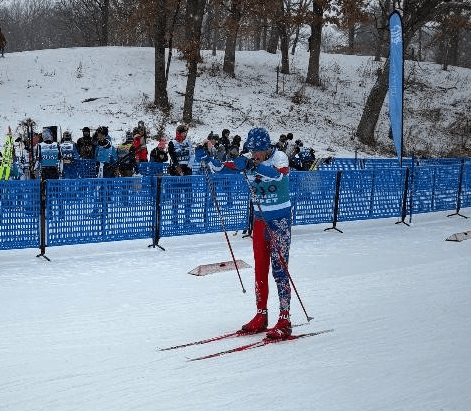
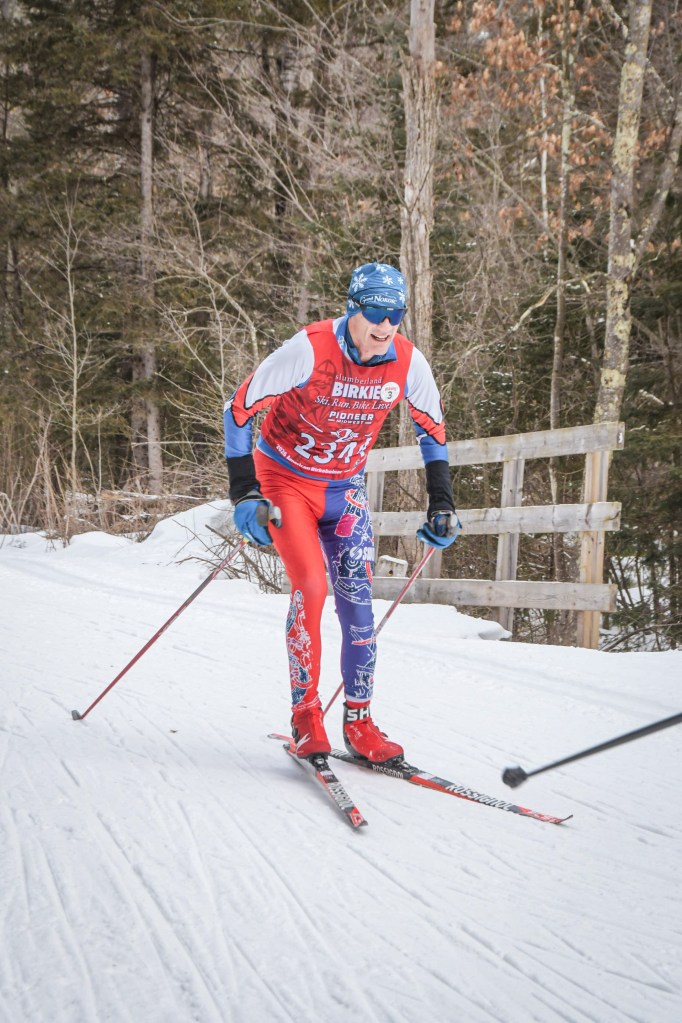
My son also raced this one and the shuttle bus barely got us to the start line in time! We had just a minute to spare before the second wave (of about 60 skiers) started. Within a minute or two I could tell this would be one of those long and tough days on the snow. Even though I was near the back when I lined up I was still getting passed by skiers from behind and quickly dropped from those ahead. The narrow sections through the first few Ks allowed the faster starters to get even farther ahead. Wave 3 skiers were passing me by the the time we hit 8K, onto the first of four loops through Wirth Park. Each loop (nearly 6K) was hilly, with maybe just a 1K of of true flat with each circuit. I did not bonk but was pretty gassed by the end, finishing mid-pack and over 2 hours (3:50/km) in a 200 skier field. That was a humbling experience. There are good skiers in the Twin Cities and I now feel just average. Nevertheless, did get 3rd in my age group, but the leaders were well ahead.
Looking way too stiff at the end of the City of Lakes 32K skate race.
City of Lakes was a good rust buster and reality check. Overall, I felt my endurance was decent but strength (power up the hills) was lacking. My technique is fair to okay, it has definitely slipped a lot from 12-15 years ago and probably some from the past few years in Colorado. I’m definitely a more cautious and less aggressive skier than in the past, when I’d really go after it.
I picked up some new boots the week before the race and had my ski bases ground for the first time in a dozen years. The boots were great compared to the beat up old Atomics, fraying and held together with duct tape and glue, but my heel was very sore with the new fit. My skis felt slow. They had been hot boxed (waxed and placed in a heated box for a day to allow the wax to soak in deeper) but maybe the skis needed a few more layers of wax to be race ready and fast.
Overall grade B/B-
Vasaloppet USA, Mora, MN
I have wanted to do the Vasaloppet for almost ever. Well, 40 years! I had some friends from Colorado who had done it a couple of times in the 1980s and said it was a great event. We then lived in NW Minnesota for several years in the 1990s but I did other races those years. Even before we moved here last summer, the Vasaloppet was on my radar and I was considering traveling from out of state for the race instead of the much larger, more famous Birkebeiner. I really wanted to do well at the Vasaloppet and made it my primary race for 2026.
We had some warm weather early in the week, followed by cold, so the tracks were somewhat icy and fast. I took the 90 minute drive to Mora on Wednesday to check out the course and liked it. It was a winding 15K loop through forest regrowth and what looked to be an old gravel pit. The start and finish would be on a street in the town where it ran for two blocks before crossing a bay on a lake and onto the loop at about 1.5 km. Easy.
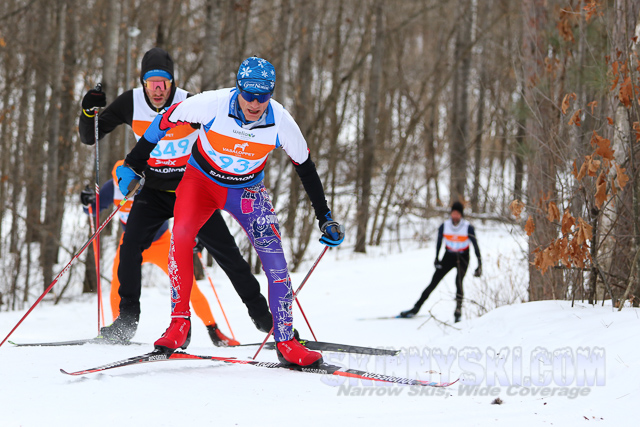
I had plenty of time to get ready for this one. The start was self-seeded. and I lined up about in the middle of the couple hundred skiers doing the 50K. That may have been too far back. The loops went by fairly quickly, and were mostly flat with a few rollers and lots of twists and turns to keep it interesting. Over most of the first two laps I felt held back by large (6-20 racers) groups of skiers ahead, and managed to pass just a few faster starters as we went. Most of the course was too narrow to pass more than one skier at time. The going felt pretty easy and I started to feel antsy in the 2nd lap. As we approached the high school the course widens to road width and I rocketed past the group of six I had been tailing. I expected them to go with me, but they did not and the chase was on!
Moving up through the field at the Vasaloppet.
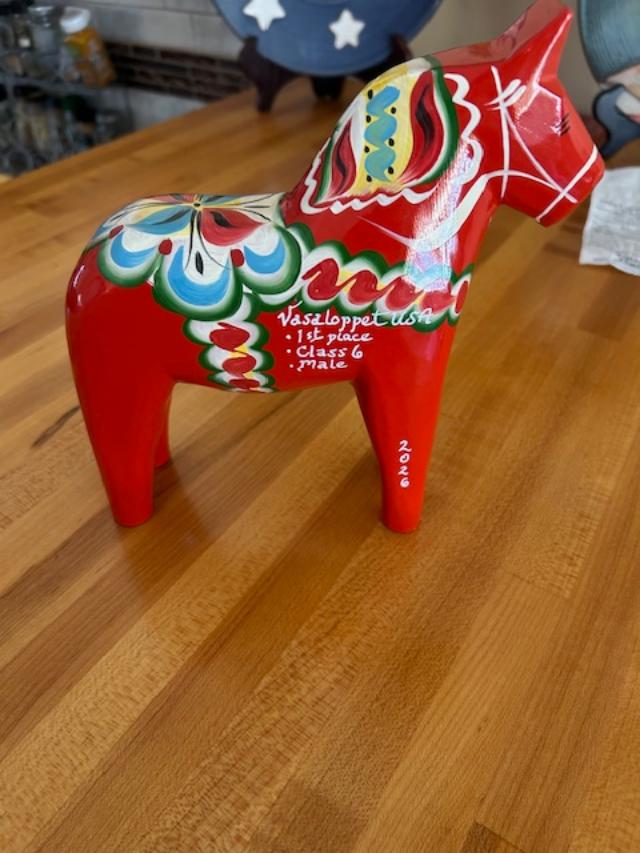
I picked off a number of skiers on the final lap and nabbed an easy age group win (and a wooden dala horse as a prize). Skiing 50K in 2:39 (3:11/km) I could not have been happier. I do think going forward this will be my favorite race.
Dala horse for age group placing at the Vasaloppet USA.
Self assessment: I used my son’s (I guess rather stiff) skate skis that he had used in college, and they were great! My glide was as good as anyone’s and the course is not technical so corners and transitions were fine. Again,though I was not aggressive until the final 16 km when could break away from the group I had been following and unable to pass. I passed another dozen or skiers over the final lap and finished fairly strong.
Overall grade A-/B+
TheBirkie, Cable to Hayward, WI
This is the big one. It’s a major international event, and the one ski race in the US that is known outside of cross country skiing circles. I liken it to being the Boston or NYC of ski marathons and it’s the race that people, even some non-racers, talk about all year.
I have a little history with the Birkie, having skied it in 1993 and 1996, where I had mixed results. As a first timer in 1993 I was relegated to Wave 3, but made my way through the crowds to place about 350th. Returning three years later and ostensibly in better ski shape (skiing over 100 days that year in Bemidji, MN) I hit the slowest day in the skate (post 1985) era, with 6 inches of fresh snow, warm temps in the 40s and 50s, and only a single lane groomed for much of the way. The day was frustrating, but I improved by about 20 places to 330, it wasn’t a total disaster but I felt I should have been approaching top 200 (and “elite wave” status).
Also memorable from that outing was that we brought our baby son with us, he was just 10 months old at the time. I hoped that someday I would be able to ski the Birkie with him. We moved the following year to Massachusetts for short stint and then Colorado. I didn’t have time to train or money to travel for many years and then we moved to Alaska. There was just no incentive to go back. However, our older son did his medical residency in Madison and skied the Birkie in 2023 and 2025; he asked if I’d join in 2025 but having not done much racing in a decade, and nothing longer than 20K I would be relegated to the back waves. Plus I had masters running competitions that would have conflicted with the Birkie.
That day to race with the kids finally arrived in 2026. Our other son (born a year and a half later) also joined us. You can’t beat that!
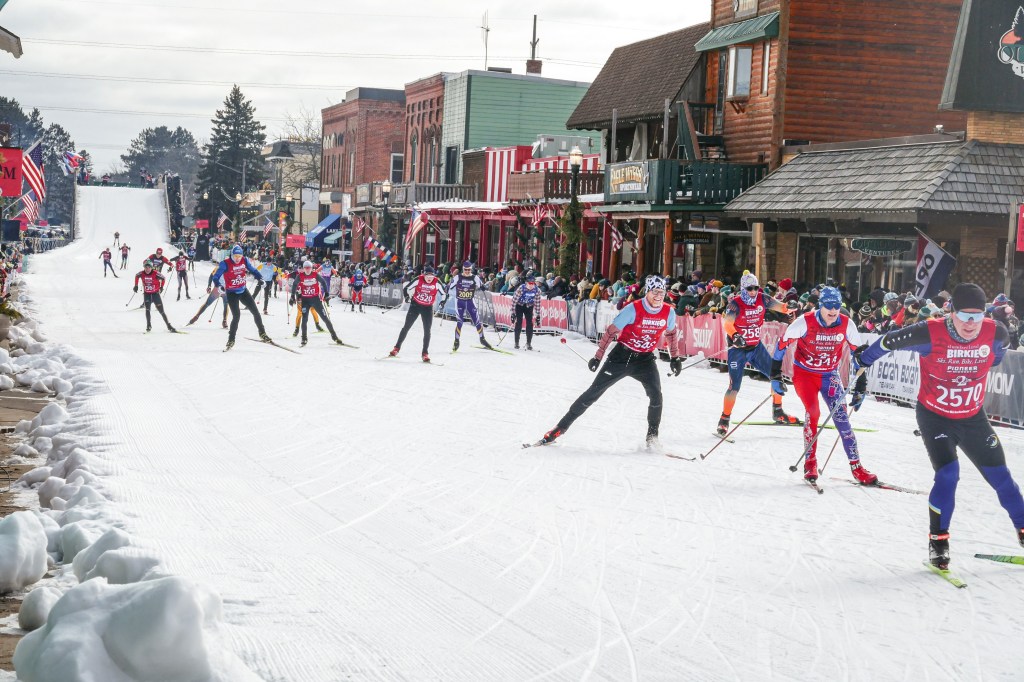
Race day was cold and a bit windy, with start line temps at about 11 degrees and a wind chill in the low single digits. The Birkie is an amazingly well run event–it’s massive and an an institution but they do everything to help make it a good experience. The only thing I might want to change is the start area procedure where you have to line up in staging areas or 20 or 25 minutes before you start. There is nowhere to drop your clothes, so you’re out there in spandex in the cold with the 500 skiers in each wave.
I was shivering but made it. But once again, I think I lined up a bit too far back.
Our wave started just before 9:10. I was about the 12th or 15th row back and it took me about 20 seconds to get to the start line and for the chip timer to start. It was pretty crowded to the Power Line section (about 1.5K in) and I mostly double polled lightly and stayed off to the side lane in the 3-4 wide traffic. There were only a few hiccups, people were respectful. It’s a lot like driving in heavy slow and go traffic and nobody wants a fender bender or crash. We hit the first major hills at 4 or 5K and that’s when the traffic gets backed up. The fortunate thing about these slower early kilometers was that I wasn’t going out too hard, breathing felt fine and easy. The downside was that I knew those who had faster start would face less traffic and would flow along easier.
The course climbs some 140 meters over the first 11K to High Point, with a lot of small rollers and a few bigger climbs. The course does not have much flat at all until the final 3K. However, after High Point the net drop is some 200 meters, and Saturday’s conditions were perfect for gliding a long ways. There was so much free time to be had. In addition, the traffic let up substantially after the climbs to High Point. The most challenging parts were to keep a check on your speed on some of the downhills (the 15-35 years ago me would have tucked and skated all out!) and to avoid some ice patches.
I got into a group of about skier of similar speed from about 12K to 42K. We just jockeyed back and forth, passing some slower skiers and after about 20K getting passed by some fast skiers from wave 3. The next big landmark was the Highway OO crossing at 22K, which is also the start area for the 29K Korteloppet, which is held on Friday.
My wife, daugher-in-law, son’s girlfriend, and a friend’s wife were there cheering and I was fresh enough to give a wave and get a drink.
Slightly better double pole form compared to City of Lakes Loppet.
The going was pretty smooth, and I never felt like I was straining. However, I did ski past a couple of fairly big crashes but managed to stay out of trouble. Our group started breaking up at about 40-42K and I managed to get ahead of some the skiers I had been with for 30K, while reeling in skiers who were slowing. I just kept it steady, not dipping into the well because I knew the lake section can be brutal. I bonked there in my previous two outings in the 1990s.
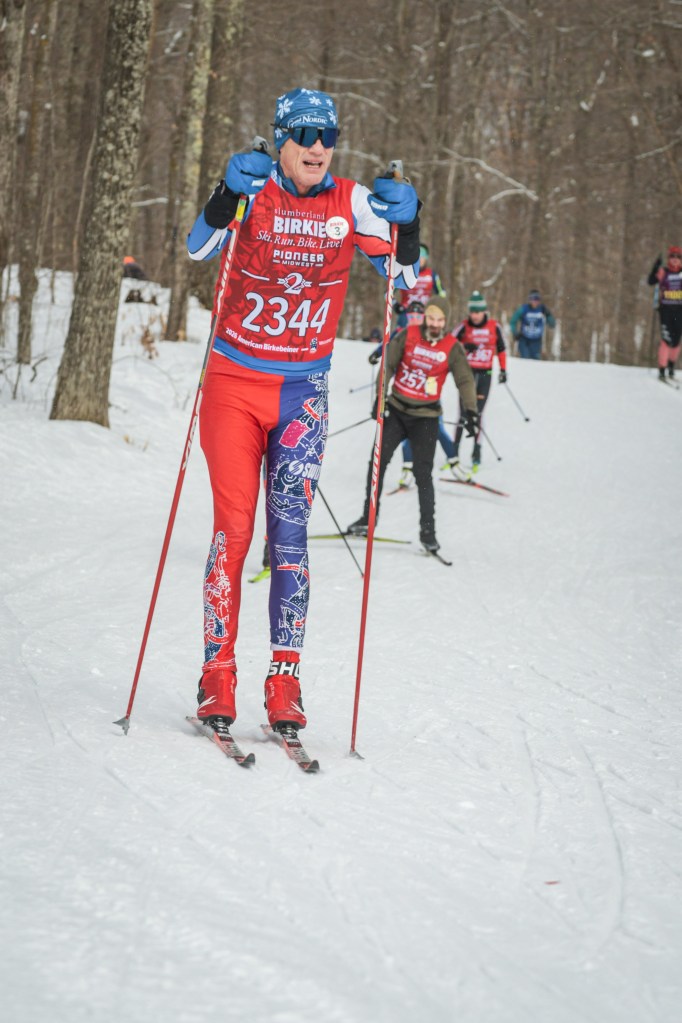
Just cruising along over the final 10K of the Birkie 50K skate.
We did have some big hills in the final 10K, but were rewarded with long run outs where you glide down the trail with no effort. The lake was a little challenging. The surface had melted during the week of the race and while it was nice and frozen at 15 degrees on Saturday, the trail itself was only about 6 or 8 feed wide and what snow cover it did have was very thin. You could only pass by double poling. It got backed up a little and I had to slow to the speed of the skiers ahead. It was kind of like slowing to 45 or 50 on a construction zone when you want to go 70. Finally over the last K the path to downtown Hayward opened up and I was able to scoot by a dozen more skiers before making one last little climb over the International Bridge. Just 300 m go, I skated in comfortably in 2:45 (3:21/km) and 7th in my age group.
Meters to go before the finish!
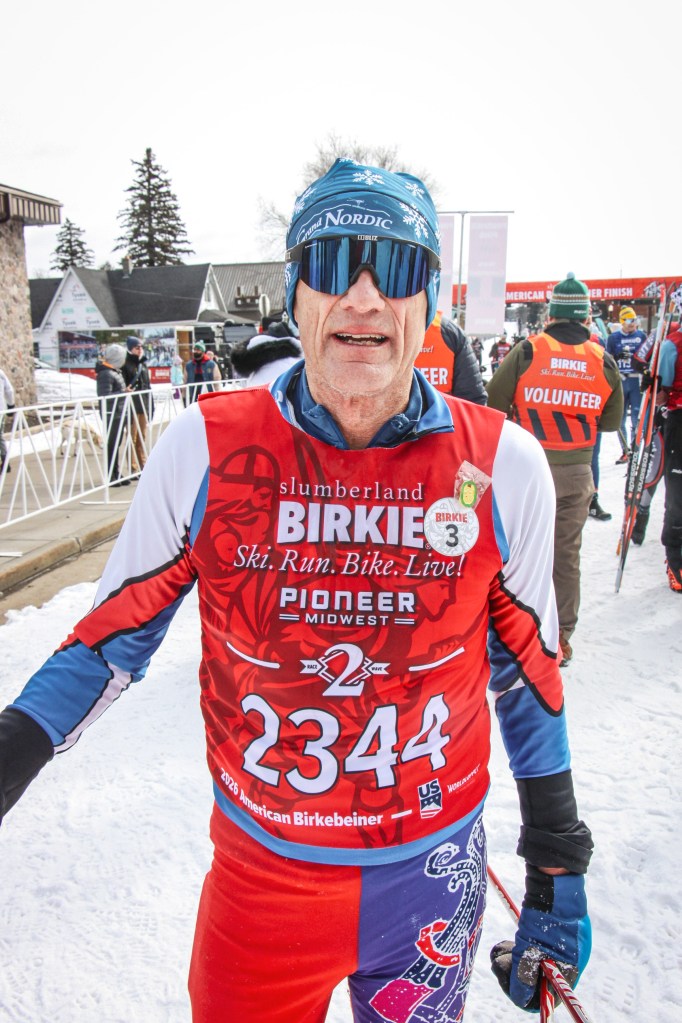
After finishing my third Birkie, but first in 30 years!
I was thrilled with the time, and had fun out there. So really my main objectives were accomplished. My sons did well in their respective divisions, and should they return they’ll be bumped up to wave 1. I think I’ll hold onto a wave 2 spot next year.
I knew traffic would be an issue and my goal was just to get through it all. However, I do think that I could have saved a couple of minutes and maybe moved up a couple of spots in the age group if I had started in the first three or four rows of the wave. Again I wasn’t very aggressive out on the course, the snow was fast but it was also slick and I did not want to fall and break some equipment or get hurt. Indeed my friend who traveled with us fell at 20K, broke his pole, scraped up his face pretty bad, and ended up with a slight concussion. He dropped out at 22K. That’s no fun.
Overall I give the Birkie experience an A! My race itself a B+/B. I think I actually raced better in Mora earlier in the month. But I’m not disappointed. There are things I can do to improve at the Birkie next year and I was just thrilled to be out there and share my birthday weekend with my family.
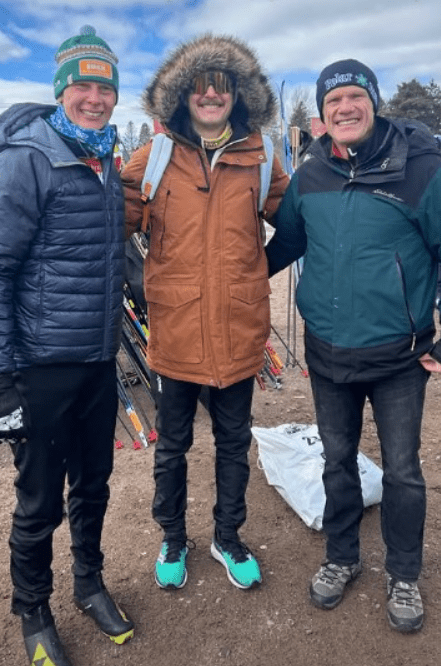
Best birthday present was spending some time with my family, and extra bonus for the boys to also do the 50K!
2025 was a year with a couple of major life transitions in our family. Although these events did not upend running, they certainly had an effect.
We spent last week of 2024 and celebrated New Year’s in Spokane, Washington, where were planning to move before this summer. We met with a realtor, looked at neighborhoods, and had our family stay with us while we scouted the area. We got in some nice runs along the Spokane River and had some very interesting cross country skiing outings on the snowy trails of Mt. Spokane.
We were looking forward to the move.
Things did not turn out that way, in fact they changed rather quickly. Before dawn on New Year’s day I took my son and his new wife (their wedding was in August) to the airport and sent them off. They piled out of the car with their gear, I gave them a hug and she said goodbye. At that moment I did not realize that goodbye meant just that. Not see you later as you would expect.
We wrapped up our trip on January 2nd and headed back to Colorado. A week later the daughter-in-law informed our son that even though they had been together for more than eight years and had gotten along quite well she did not want to be married. She had to find herself. That was an utter shock to him and to us when he broke the news about a week later. Our family was reeling with shock for weeks and months. And the big question even though they had a two year engagement why did she even go through with the marriage? We do no have that answer and maybe they don’t either.
That surprising revelation early in the year did not affect my day-to-day running that much–other than my thoughts, which for months and sometimes even to now, have been what the heck was all that about?
Nevertheless, we have moved on figuratively and literally. Our ex-daughter in law had grown up in the region a few hours away from Spokane and we had thought that living in that area would be a good change from an overcrowded, increasingly expensive Colorado. We made plans and put our condo on the market.
However, in mid-March and on the same day, Tamara and I separately realized that eastern Washington might not be the place for us to move. Our son had set up his life in Wisconsin. He had finished his residency and fellowship at the university, and was now working two jobs.
Why then would we want to go to Spokane, which was already remote from everyone in our family? On that day we decided to move to the Midwest. I had wanted a place with a decent airport nearby, and with reliable cross country skiing. Running won’t last forever, but hopefully I can ski into old age after my legs have given out. A couple years ago we had considered places Michigan, Wisconsin, and Minnesota but leaned to the West. Within a day of reconsidering our plans, we decided on the Twin Cities in Minnesota. And here were are!
I do miss Colorado, the mountains and our friends, and Spokane had a fair amount to offer. However, six months after making the move this was a great choice and a better location for skiing, for running, and actually for quality of life.
Highlights of 2025
This was my third year and in the age group, and once you get into your 50s and 60s you can usually each year you can expect a drop off in performance level and placings in competitive races and championships. Some masters athletes only compete in their first or second year of a five year age group. As long as I’m healthy, I like to keep going.
The First Half of 2025
At the beginning of the year I had pegged three key races/race weeks plus I decided to keep going with the USATF Masters Grand Prix, which scores your best five races on an eight race circuit. In that series I knew I would have greater competition this year, with younger athletes moving into the age group in particular Dan King the ace middle distance runner from Boulder, CO. The Grand Prix events would include 8K cross country in January, 10K road race in April, as well as the World Championship races, which would provide Grand Prix points depending on how you finished with the US runners.
I do like to fill the year with about 15 races on the schedule. Some I just work through them as a training or hard run, others I might go for a fast time and include a taper. Longer races require some recovery time. At the beginning of the year I placed the local BolderBoulder 10K and the Lilac Bloomsday 12K back in Spokane on the schedule. Those would follow the USATF/World Masters winter-spring races and would be more for fun.
The first half of the year could hardly gone better, I took a 2nd to King at the US Nationals Cross Country championships in January. By the time of the World Masters championships arrive in late March we had already decided to to move to Minnesota, and the house was on the market. I cut that trip short because I was needed back home for showings and packing. Woah, the move was getting real!
For World Masters, I put all my all my effort into one basket the 8K XC. That race was heated and close! On a hot morning I was within 3 or 4 seconds behind the leader, Jukka Kaupila of Finland with 2K to go, but I could not close that gap and finished with silver medal just 5 seconds back. However, the US dominated as a team and we won Gold, as we had in Sweden the previous year. You cannot beat a team victory at a world championship!
Meanwhile, in late winter the World Athletics canceled the World Road Racing championships altogether, and there went the half marathon which is my best distance. I would have to find another race (shorter) on to fill the calendar.
I think I peaked for the year in March-April. A month later after World Masters we had the US 10K road championship in Dedham, MA. I did not have a club team this time, and ran unattached. This was a hard fought win, but I ran 38:17 to win the age group and place second overall in age grading (91%).
Three days later we moved out of our foothills condo and had to spend two months in an AirBnb, while we wrapped things up and prepared for our move.
The May-June races were solid, but I did not feel at my best. I was first in the age group at the Bloomsday and BoulderBoulder. And was a late entry to the US masters 4 mile championship in Peoria, IL, where I placed 2nd to King again. However, this time he was a full minute ahead. And I was only 7th in the age grade ranking. That wrapped up a long spring campaign.
2025 the Second Half
We settled into our temporary apartment in the suburbs of St. Paul on July 1st. Settle is an understatement. We had no furniture. We bought a couple of office chairs and a table to get buy for the first couple of weeks, and a friend lent his air mattress after learning that we had been sleeping on the floor. That’s not too bad when you’re in your 20s, but in your mid-late 60s? uh uh. No good.
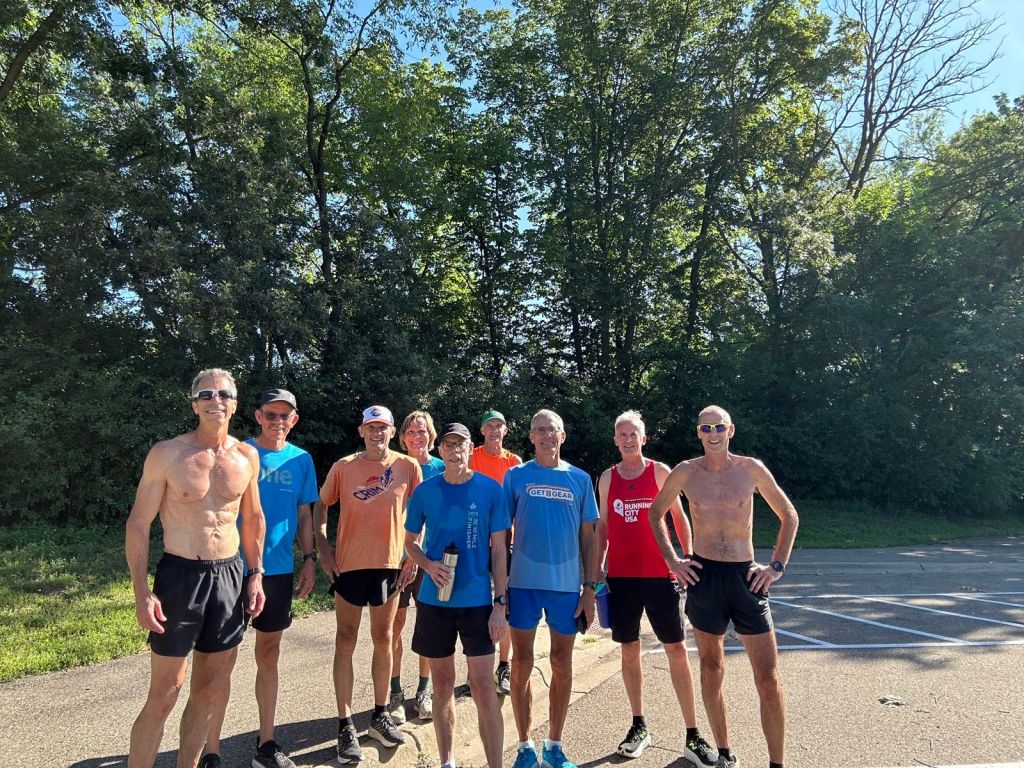
The best thing about being here has been finding a great group of masters running friends. What a team! They were very welcoming and we had a large gathering on our first weekend. I have been running with them every week and look forward to future races, workouts, and adventures.
First run in July with the new Twin Cities club.
July was just getting adapted to the hot and humid climate and to get in miles. By August I was was getting used to being here.
My friends from my club in Colorado had asked me to do the Hood to Coast Relay in late August, so while building for the November marathon, I worked toward that as well. Doing a number of threshold and double threshold sessions. Hood to Coast was a great trip and experience, truly one of the highlights of my running career, and it was great to know that I still have so many friends in Colorado.
Age group 1st place team at the Hood to Coast Relay.
The downside of running three legs totaling 16 miles in the heat, on top of my weekly long runs, was that my knees started to ache with some tendinitis which I wouldn’t shake until after the marathon. It didn’t really set me back much, but most of my runs were uncomfortable.
In September-October I had two big local races, a half marathon and a 10 miler. I managed to set the state record in the half (as well as the 10 mile split that day) run an age grade 90%, and win the age group at the Twin Cities 10 miler on an unseasonably warm morning (it was near 70 at the 6:55 AM start). To cap off the Grand Prix I traveled to Atlanta for the 5K road race with the new team, where we wrapped up the team championship for 2025. I placed 2nd for the age group and locked up a 2nd place for the Grand Prix with 485 points, with King winning it with 495 points.
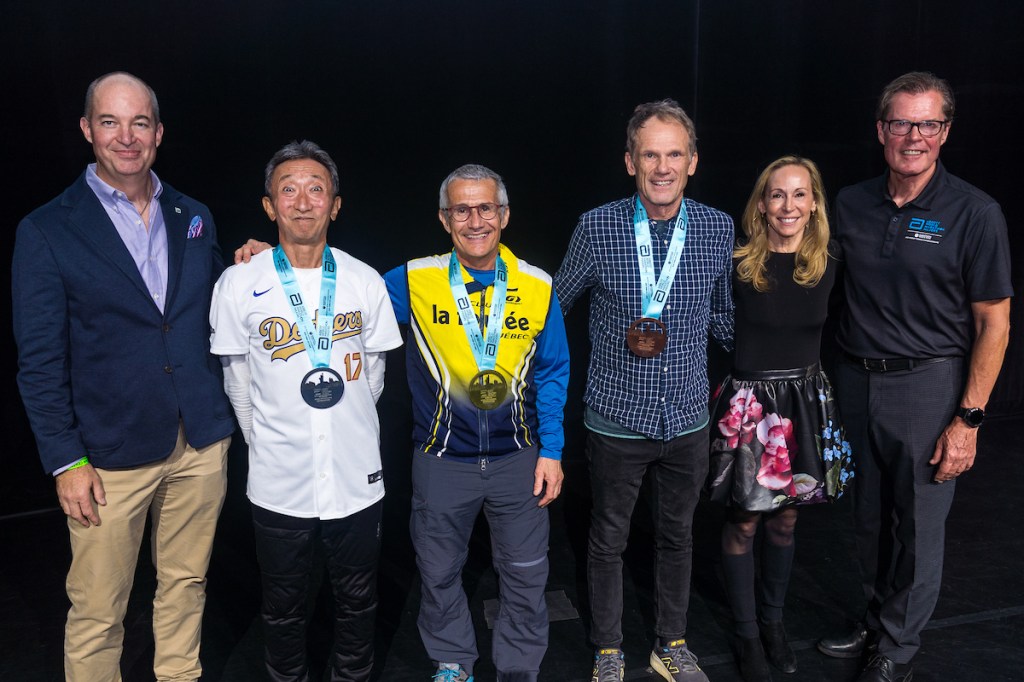
The finale would be the NYC Marathon/World Marathon Majors masters championships. I put in about 62 miles a week from July 1 through the end of October and had some decent long runs but nothing out of the park. Although I wanted to break 3 I wasn’t confident I had the fitness to hold a 6:52 pace. 7:00 or so, maybe. New York was an experience of a lifetime, although I was a good 3 minutes off from my goal time and did slow down over the second half, I closed better than my competitors (having the 3rd fastest final 13.1 miles in my age group) to finish 3rd in the championship with a 3:06:17. That was huge! Two world medals in one year.
Celebrating a bronze medal at the World Marathon Majors masters championships!
Challenges and Disappointments
Sure it would have been nice to win everything and score above 90% age grade four or five times instead of twice. However, I have nothing to complain about in 2025 and feel blessed to have held onto my fitness through a year that had huge disappointment and a major life transition. I’m glad that my achy knees held out through the end of 2025. Although the late spring races were not as strong as I would like I do not believe I had a single disappointing race.
Lessons Learned
I’m not superman, I’m in my late 60s and feeling my age creeping up every year. It gets harder each season, but this is what I do and what I love to do. I think an outsider would say maybe I had too many “big” races, with four Grand Prix races, a World Championship cross country race, a grueling 20 hour relay, a smattering of fairly big “A” (or at least A- races) along the way, and a championship marathon. That’s an ambitious schedule for anyone, let alone one into their golden years. I could learn from a less is more philosophy with the racing.
Next Year, 2026
I have not picked all of my races but have a pretty good plan. I do not think I will do a full USATF Grand Prix in 2026. The schedule is never perfect and this year is worse than most, with the first three of eight races occurring by January 11! And six in the first half of the year. I’ll do a perfunctory two or three with my team for team points and that will be enough.
There will be no World Masters for me in 2026. The championships are in South Korea in early September. I was quite intrigued by the prospect, but it would require a two week trip away from home (and leaving my wife behind), and a lot of money for some races in what promises to be very hot conditions (typically 90s and humid). Instead I have opted to do the Amsterdam Marathon in October. Tamara will travel with me, it’s a flat and fast course, and one more chance for a sub 3 marathon in my 60s.
In between I have a number of great local events and regional events (5K, 10K, 7 mile, and half marathon) and a bucket lister, the Bay to Breakers 12K in San Francisco next May. It’s a great schedule for me, maybe a little less ambitious than 2023-2025! The Amsterdam Marathon is my main goal, everything else just fits in as training, polishing, and fun.
Extensions of Gratitude
My wife Tamara, who can no longer run and race, has been my number 1 fan and supporter for years. I wish she could still participate, even at a casual level but her health does not allow it. I also wish she could travel to more of my races, but maybe that’s for the better–she might get bored–and the events that she does attend are special occasions.
My Colorado teammates. They were a great group. A half dozen showed up for a send off run and brunch last June at Barr Lake, east of Denver. That was a bittersweet parting. I do miss them and appreciate the nearly 10 years of partnership with the Boulder Road Runners. The long weekend in Portland for the Hood to Coast Relay was one of the highlights of my running life. We had so much fun and so many laughs. Thanks to the BRR 50s+ team for bringing an old 60s guy along with them for the running and van ride. I miss you guys too.
The new teammates in Minnesota have been outstanding. What a fun and focused group. They are so accomplished as runners as well as in life. The welcomed me onto their team as soon as we arrived and I look forward to future races, weekly runs, and weekend outings.
And I would like to shout out to my online friends at ARTC and the Moose Refuge. Small groups but they are passionate about running and racing while being supportive and kind.
Final Note and Update
Our son’s divorce was finalize last summer, the entire thing probably should have been annulled. Nevertheless, it was a No Fault divorce with no financial obligations to the runaway bride, and the only downside was that he had to wait six months for it to be finalized. In the meantime, we were happy to learn that he met a young woman who seems more compatible. When he told us about her he said that she’s a medical student who is very intelligent and organized and that she understands him and his life and ambitions as a doctor. He also ran a personal best at the half marathon with a 1:14, off of just 35 miles a week.
We are looking forward to a family gathering over New Years, with both sons.
I have been running turkey trots/Thanksgiving race since the early 1980s, and if my counting is correct Thursday’s 10K in Minneapolis was my 27th. I enjoy these events, which have become hugely popular with some very large events, into the 10s of thousands in some places, and it now it seems that every town or community has its own local turkey trot.
I chose this one because it would have a relatively fast and certified course. Two laps around Lake Harriet, southwest of downtown. The course is flat most of the way, but there is a decent hill at 1 and 4 miles, and a smaller incline just before 3 and 6 miles. Enough to keep you honest.
Training since the marathon has been a gradual add-on of miles without any workouts other than a tune-up fartlek last week at a local park.
We have had pretty warm weather this fall, and prior to last Tuesday only a few days when it was below freezing overnight. That changed on Tuesday night with a fast moving front that dropped a few inches of snow on the ground and brought the temperatures down into the 20s. We got an instant winter, but unlike Colorado when it gets cold here it tends to stay that way for weeks or months at a time.
Get used to it.
Thursday dawned clear and cold at 25 F and 8-10 mph winds, bringing the windchill down to about 15. I was concerned about ice on the course and spent 45 minutes doctoring my oldest pair of super shoes (Vaporfly 3s from 2023) with a half dozen hex spikes on each shoe.
Making my way to the start area from a nearby side street was the most difficult part because the streets sidewalks were mostly ice covered and I was glad to have the hex screws in my soles. However, the course around the lake was in fine shape, with nary an ice patch. So I opted to go spikeless.
I layered just right, with tights and compression socks underneath, a merino wool shirt long-sleeve and my old Alaska Salmon Runners singlet and arm warmers. Ski cap and running gloves. I was just about right for temperature management.
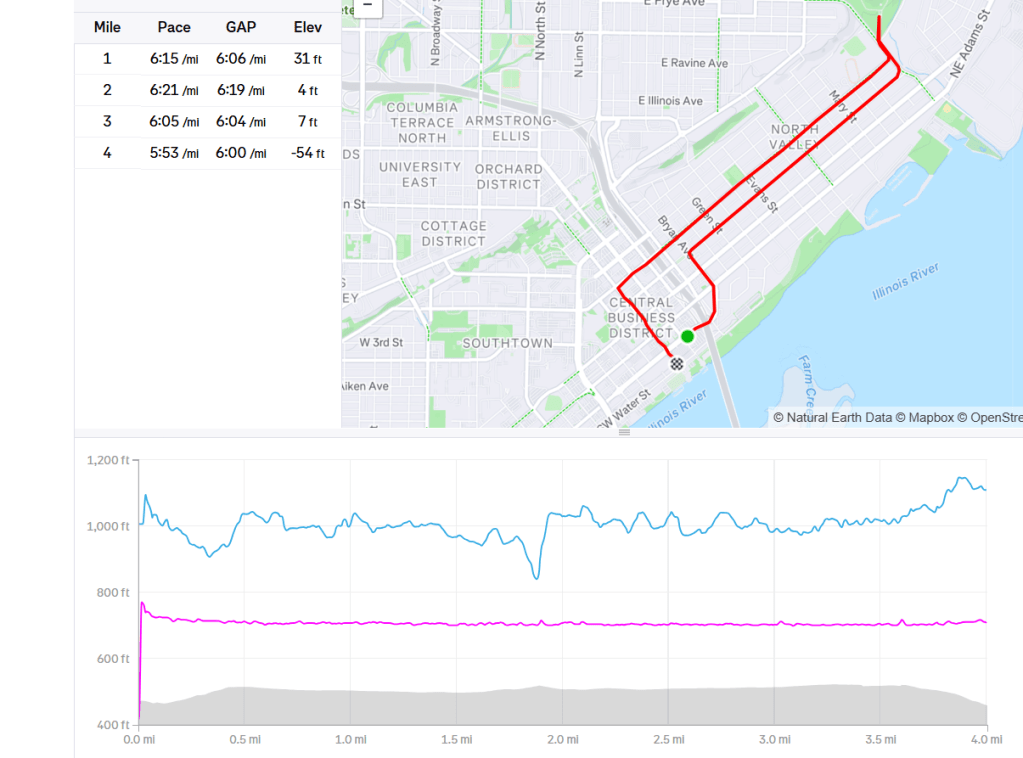
They sent us off at 8-sharp, I was in about the 3rd row with nearly 1000 runners behind me. The first mile felt okay, not too fast not too slow but hitting that first hill I got kind of gassed and knew I would be able to hold this effort. Crossing the mile in 6:28 (6:23 GAP) should be about right for a 10K–but more mid-season. Twenty five days after the marathon I’m not yet ready for prime time running and I eased up. A few runners passed and the group I had been with pulled away. I settled into what a month a go would have been a moderate tempo pace. This was more like threshold, a pace I could hold on for an hour.
Did not feel the wind much for the first two miles but as we rounded the north end of the lake we got some headwind. I was not really close enough to draft much. Passed 5K in just over 20:20, so not near my pre-race goal of sub 40 for the full 10K. However I was maintaining okay. A woman passed me (1st woman) soon after but I caught up to a teenage runner who had fallen back. On the far side of the lake I did try to pick it up some but it wasn’t enough to speed up my splits or drop the runner. An older guy (not in my age group) caught up with about 2K to go and pulled away swiftly the youngster went with him so I was in no man’s land into the wind, nevertheless holding on okay. I wasn’t slowing down, they were just speeding up.
As we near the end of the lap, we had to turn right to extend the distance to a full 10K. I picked up the pace with about 500 m to go and carried it in. A masters runner caught me in the final stretch but I did not mount a counter sprint. Just took it in. Splits (remarkably close the mile markers on the course for once!) were 6:28, 6:40, 6:40, 6:35, 6:37, 6:40. I have a good baseline for upcoming tempo runs weather permitting as temps are dropping and snow is falling.
My first turkey trot in Minnesota was a success. The goal for these is to run hard but not too hard, and have some fun but also get a decent workout from the effort. Success. I’d go back.
Background and Training. This was my second attempt at the NYC Marathon. I ran it in 2009 with a bum knee that gave out on the Queensborough Bridge, and by 18 miles I could not run another step. It has been my only DNF in more than 40 years. The damage to my knee from that mishap nearly ended my running career and it took me out of running for about 18 months.
I signed up this year not just to complete some unfinished business but it also was the Abbott World Marathon Majors masters championship race for 2025, and because it was a huge bucket list race that I have wanted to do for decades, going back to the late 1970s when I was in college. I did try to get in for 2021 and 2022, but got froze out on the internet pile up with so many applicants filing at the same time.
For training since early July I averaged 62 miles a week, ranging from the high 40s (for race taper weeks) to mid-70s, with two or three threshold (dialed back to LT1 for the most part) workouts plus a long run every week or two through July and August.
Training block.
By September I was doing a more more traditional schedule with a weekly 10K-5K pace workout and tempo run, and long run. I got in three 20+ milers and a bunch of 16-18 milers since early July. It was a pretty good build, although I sometimes felt that I should have done more volume and fewer races if I had really wanted to prepare for the marathon.
The September-October races went well, I ran 1:24 for the half, 1:04 for the 10 mile, and wrapped up with ~18:50 for 5K (19:07 for 3.16 miles) a couple of weeks ago. These could arguably point toward a low or sub 3 marathon, but I was not all that confident on breaking 3 this time out. I could just feel it in the long runs, 6:50-55 felt too fast. However, I did feel that 7:00 pace or a bit under would be an achievable goal.
There were no glitches during the training block, although my knees did get a little sore over the final month and I wore a patellar strap to help with that. In the final week I had a couple nights of bad sleep before the trip, waking up at 2 AM on Friday, several hours before I needed to for our early flight, and that got into my head too much.
Flying into the city on Friday morning, with Verrazzano Narrows Bridge and Brooklyn under a gray sky.
Travel. We traveled to NYC on Friday and breezed through bib pick up. You actually had to schedule a block to get your bib and that spread out the crowding so there were no long lines. However, the wind howled all Friday night and into the morning enough shake our building and whistle through the windows so I did not sleep great on Friday. I was utterly boring on Saturday, only venturing out for a shakeout run in Central Park and for dinner at a nearby Italian restaurant.
Central Park shakeout run.
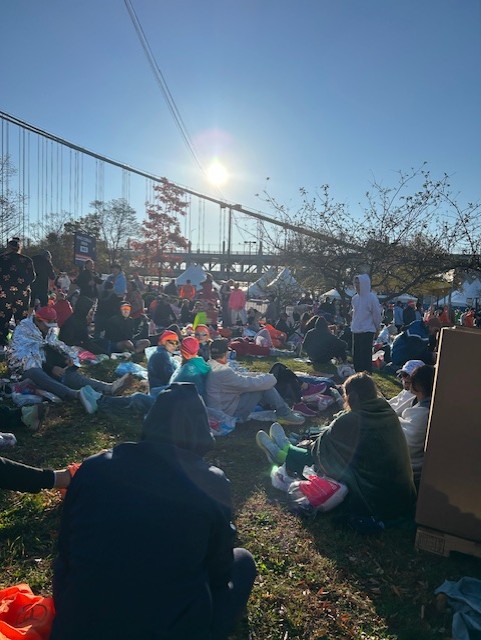
Race Day. I slept better than usual for the night before a marathon, waking up at 3:30 but did not get up until 4:00, and arrived to the ferry terminal at a bit after 5:00 and took the 5:30 ferry to Staten Island. We arrived at the athletes village at about 7. It all went pretty smoothly. I tried to relax and stay warm, gnawing on bagels (2) and taking in some caffeine and fluids. Visited the porta johns more times than I can ever recall before a race. But the lines weren’t bad, they were set up very well for that.
Athletes Village on Sunday morning.
Made it to the packed start corral with a healthy 6 minutes to spare but got kind of chilly waiting for our move up to the bridge, I should have kept my sweater. I was dressed in half-tights, a singlet, and had a pair light gloves.
The Five Boroughs. We lined up and a few minutes of announcements the cannon fired. It took about 40 seconds to get across the line and we were off. The Staten Island section was brief, before we got over the water. The first mile was slow because it climbs the massive bridge, second mile fast because it drops 120 feet into Brooklyn, and third mile just about right, and I was 21:30 at 5K. I kept having to hold back, because every time I checked my watch my saw the pace creeping in to the 6:40s. The group I had started with pulled ahead as others caught up and passed.
I still was under 7:00/mile pace through 8 miles but had been feeling too warm in the half tights, so when I saw Tamara and my cousin I peeled those off to my split shorts but had to dig my gels out of my pocket and would carry them by hand for the rest of the way. That pit-stop cost about 40 seconds, but I think it was worth it in the end.
Brooklyn was crazy! It was 10 miles of nearly continuous scream tunnel, with the Hasidic section of Williamsburg being the only quiet interlude. Hardly anyone was out, I remembered more activity in 2009. Once we got back into the other neighborhoods, where it was more lively, it was a mixed blessing. Surely raucous and fun, but people were getting wild sometime darting into the field of runners or crowding onto the street so much that we slowed considerably. And some were setting off confetti poppers practically in your face. And some narrow sections had a bit of a Tour de France feel with people in the streets reaching out and hollering. On few occasions it narrowed so much the entire field had to slow down to 7:20 pace for a block or two.
My legs started feeling tight at about 10 miles, not always a good sign in a marathon! I would prefer not to get heavy legs until at least 15.
I crossed the half marathon in 1:32, so with that 40 second stop, I was holding that 7:00 pace. I was not feeling too bad, but still had 13 miles to go!
The short section in Queens was almost as rowdy as Brooklyn they were really loud, but the street was wider than some of those earlier sections. The Queensborough Bridge was a respite from the noise and mostly you could only hear was the pounding steps of the runners and a lot of heavy breathing. I started to pick off lots of faster starting runners, and that continued for most of the rest of the race.
1st Avenue was packed 10 deep with people on both sides, for miles, but it was maybe not as noisy as I remember. Still there was a lot of enthusiasm. I passed the infamous 18-mile point with my knees in reasonable condition and relished that from there on I would be setting course PBs.
However, the miles were getting tougher. My splits for miles 19-20 had slowed to 7:10-15 pace but overall was still at low 7. I think the miles in north Manhattan and the Bronx were the toughest of the day. I split 20 miles at 7:01 or 7:02 pace. However, the next few miles were the toughest of the day and even though my effort level was increasing I dropped to 7:20s. By 21 miles, rather than passing people I was just maintaining position, passing some but getting passed. I saw my wife and cousin at 35K and that cheered me up.
A face in the crowd at 35K.
Even though we started with a long climb after returning to Manhattan, turning onto 5th Avenue was a boost and I started passing more runners again. This is where the race for the medals really played out. I passed two or three other age group competitors over the final 3 miles.
Carnage on the course was beginning mount, as runners suddenly stopped or veered in front with some ailment or another. I had to do some dodging and start-stopping.
Central Park was a blast and I was able pick off many dozens of runners, although my pace had not picked up. Turning onto 59th Street felt great, knowing I had less than a mile to go. I put in all that I had and crossed in 3:06, a few minutes over goal time but I felt that it had been a solid effort. I didn’t think I had placed well in the age group rankings but was just happy to bring home a finishers medal and satisfaction of finally finishing this great event.
Half mile to go!
Post Race. I stumbled around for about a half hour, huddled in a NYRR insulated poncho, before finding my family. The restaurants were too crowded to get a meal, so we just headed back to my cousin’s place.
New York City Marathon finisher medal (right), which I waited 16 years to earn, and the bronze medal for the Age Group World Championship.
Later in the day I learned that I had finished 3rd for the World Marathon Majors championship (but 4th in age group, because the overall age group winner did not sign up for the championships) and was in the top 100 overall for age grading. That could not have gone better. But more importantly I am simply thrilled to finally have had the full New York City marathon experience.
I have now finished all three World Marathon Majors in North America (Boston 2018, 2022 and Chicago 2023). Not sure if I’ll ever go for six or eight or wherever they land with new additions to the tour but this is good for now.
Now. Rest. Rehab my sore knees, cross train, and get ready for winter–then 2026. No marathons planned. I want to focus on the half and under next year.
This was my fifth race on the USATF masters national points circuit this year, following the 8K XC championships in Lubbock, TX in January (2nd), World Masters 8K XC in Gainesville, FL (1st American), 10K road race in Dedham, MA (1st), and the 4 mile road race in Peoria, IL (2nd). Note, there was no 12K, 15K/10 mile, or half marathon this year, but that’s different story.
I came in with 390 points and was second in the standings. I needed to show up in Atlanta to secure second (maybe first if DanK does not race the 5K XC race in San Francisco next month) in the best of five series.
I’m at the end of a marathon block and have averaged about 60 miles a week since July 1, with some peak weeks in the mid-70s. I had no injury setbacks along the way. In August I decided not to give the New York City (NYC) Marathon top priority. That would require training through the fall races, and I decided those would be just as important as the marathon. With that in mind, I ran the half marathon my new city this September and the 10 mile road race in October. Both went well, in course record time and I was happy to check those boxes and to establish some local street credibility.
Regarding last weekend’s 5K in Atlanta, I don’t like approaching a championship race with a heavy training week so cut back after Wednesday, with some easy runs. This meant that I would be starting marathon my taper a little early.
Did You Bring Your Singlet?
We arrived in Atlanta on Saturday afternoon, only to find out that one of the guys forgot his singlet. We had to have matching singlets to compete as a team, so we spent the remainder of the afternoon hunting down a set of jerseys. Traffic in the city was bad, but we got it done in time to do a 25 minute shakeout run in the evening to preview most of the course. The course would have a lot of sharp turns and two big hills.
Race Day
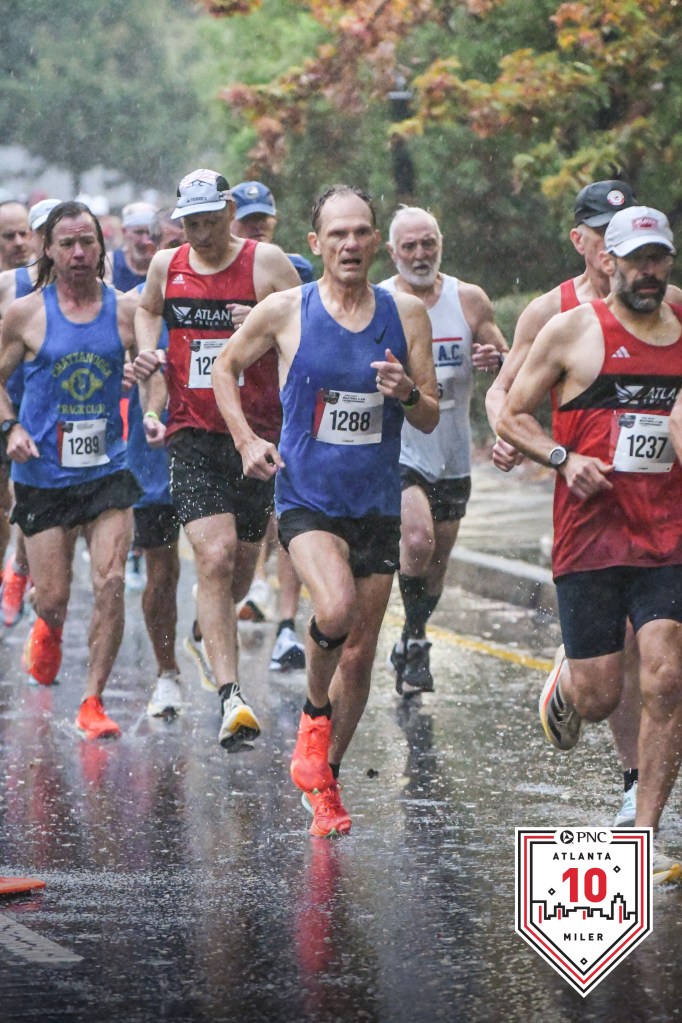
A front moved through on Sunday morning, and it was blustery and cloudy during the warm up. Rain started falling about a half hour before the start and it was a downpour as we did final stride outs and started lining up.
I lined up on the 4th row of the narrow start, which had a right-turn within the first 30 meters. Great. Why do they do this?
The horn sounded and we crossed and I was immediately met with a few elbows as runners got past me before the turn, which I took fairly easily. Within the first 400 m I noticed that my mesh shoes were already saturated and holding water. It was going to to be a squishy 5K.
Splish splash it was a bath.
The goal was to run about 6:00 for the mostly flat (but with many turns) first mile and then handle the hilly second and third miles the best I could. My watch had me right at 6:00 (maybe 6:03 to cross the mile marker), and I was situated in a fairly tight pack with runners from our rival team, plus several more from younger age groups. My chief competition in the individual age group was about 30 meters up. I was right about where I need to be.
As expected the climb was arduous. About 600 meters of steady climb at 4-6%. I did what I could do to hold with the group of five or six other runners, and crested the hill in reasonable condition. We made a right onto a side street and had another short incline. There my arms got a little numb there and I was feeling near the edge. However, breathing was decent and I wasn’t slowing down.
One of the rivals from the other team surged ahead. I crossed the half way timing mat in 9:12. The guy who surged suddenly slowed up and now we were in a pack of four as we made some winding turns and sharp downhills. The course hits a low point at 2, which I crossed in 12:09 on my watch (12:17 by the marker). Les, my rival from Atlanta pulled away as we turned into the wind and up another 600 m (but less steep at 2-4%) hill and I fell back 20 meters. I pulled away from a guy in a younger age group but did not like running into the headwind so eased up slightly and he and another guy went around. I tucked in and saved my energy for the final kilometer or so. We got to the top of that grinding hill and I worked on catching up to Les.
I felt pretty good on the long gentle downhill, and it seemed that Les might be struggling a bit. In hindsight maybe I should have gone all in then, with some 800 meters to go, and tried to get a gap on him. That hesitation may have had some implications in the team race.
Making the penultimate turn.
Instead I just maintained the gap of a few meters back, and decided to wait until the final few hundred meters. We turned past the start line and the course marshal said “400 meters to go!” Les surged a few times and I matched his pace, but did not pass. Instead, I kept a meter or two behind. With about 120 m to go we had a sharp right and then a left to the final 80 or so meters to the finish line. I was a step behind on the turns and then threw in what I had left. I pulled slightly ahead for a moment. But he surged back and half a half a step. One more push to the line! We finished in a dead heat.
Lean baby lean!
So team scoring would come down to how our other runners did.
Results came out, and they determined that I had outleaned Les by less than 0.1 of a second. I finished 2nd in the age class, and he would be fifth in his. The team score came out at the awards and it turns out we were second by just a handful of seconds. Each of us kicked ourselves a little, I think you can always find a place or two where you maybe could have made up a couple of seconds. For me it was on that stretch with 600 or 800 to go. But you also never know, I might have flamed out and lost more time there.
It was all in good fun. We may be rivals on the course, but when the race is over we’re friends. Less and I have raced many times over the years and this year I beat him in cross country, while he was ahead in the 10K and 4 mile road races. So we’re even in this head to head. Kudos to Les. And I was happy to contribute to my new team after a summer of running unattached. We locked up the age group title with our showing, and that was really the main mission.
Post Race
After a rather chilly awards ceremony, in front of a Victoria’s Secret store of all places, we got a good meal in the shopping area and then spent the afternoon touring the city, seeing some historic sites like the Martin Luther King National Park, Carter Library, and many sports and cultural venues. Also took in a tour of the College Football Hall of Fame. We had a late flight and I did not get home until nearly 2 AM, about 20 hours after I had got up on Sunday. Phew. Glad that is behind.
20225 has been a long year for us, with many months in limbo due to the move. After two months we were still not yet settling into Minnesota, still living out of boxes while living in temporary quarters. Truthfully, I had not felt quite “on” since mid-spring this year.
After moving to sea level from altitude I thought I might experience an aerobic boost, but the humidity was so high and sleep so poor that I never felt that strong in July when I had a couple of okay but not great races. In early August the blood test from my annual physical revealed that my red blood cell count, hemoglobin, and hematocrit were already back to levels indicative of an athlete from lower elevations. So much for the past 11 years (and nearly 40 years in my life) of altitude benefits! It goes away quickly.
With a quick turn-around from the Hood to Coast Relay in late August, I didn’t know how I would feel for the half marathon. After returning I recovered for a few days then got in 70 miles from Thursday to Wednesday before cutting back to recover for the race. Fortunately, I felt pretty good over those two weeks.
Last year I hit 1:24 three times for the half marathon, and arguably four if you count Canyonlands Half at altitude (1:26). But based on mid-year 2025 results and how I was feeling over most of the first two months here I was thinking a mid to low 1:25 might be more likely.
The Race
Although the race is limited to only 2,000, for the local competitive runner this is one of the bigger races of the year for competitive runners around here and the fields are pretty deep. However, the event is also preparatory race for most, not really the main goal race.
The course is pretty narrow in parts (start in particular) and that is why the fields are limited. Some races sell out in minutes or days, the half marathon did not sell out this year.
I got to the race about an hour before the start and started my 2 mile warmup 40 minutes before the gun would go off.
Warmup up just before the start of the race.
The course is a figure 8 that has a long neck between two lakes. Each lake is about 3 miles around and the connecting segment between them is about 0.4 of a mile. It only has a few hills, four per lap, but they can take a toll on the second lap. Otherwise, the course is quite flat and fast. It was unseasonably cool and a perfect day for racing, with temperatures mid-40s at the start and little to no wind. We also had a good field and a fast course.
I lined up in about the 4th row (which was probably too far up considering how many people passed me) and everyone rocketed off the line. I settled into a less frantic pace after about a half mile, just before a couple short hills. Visibility was poor in the shady sections, with the bright sun reaching through the shadows while it reflected off of the puddles on the road in a strobe light effect. Nevertheless, I navigated early miles without mishap.
The first 5K split was just at 20:00 but it felt fast. A couple dozen runners had passed me, but I didn’t fight it. Some local women in the group that I was in were getting lots and lots of cheers from their clubmates and friends. I was Mr. Incognito.
Mid-way through the first lap, Mr. Incognito into the scream tunnel as hundreds of bystanders cheer the runners on.
I was a little over 40 at 10K (40:05 if the marker was accurate). Things got harder on the second (of two) circuits but I was clicking off most miles in the 6:27-6:33 range, so hanging in there. The official 10-mile split was in 1:04:35, and I had promised myself to hold that effort through 11 or 11.2 miles before trying to run hard to the finish. I don’t think that really happened because the early miles had taken enough out of my legs that all I could do was hold on and not lose too much ground.
The finish stretch has a hill just before 13 and then you can sprint the final 0.1 or 0.15, which is downhill. I wanted to break 90% age grade and knew that it’d be close so gave it all I had to finish in 1:24:38 (final 5K in about 20:08), which was enough to achieve that goal. So time-wise I was happy.
This was my best race since April.
I think I could have gone out a little easier over the first 5K and would have spent less time in the pain cave (most of the second lap), but didn’t lose a whole lot of time. It was a great event and I look forward to returning in the future.
October: Across Two Cities for 10 Miles
After recovering from the half I got in another solid mini-block of training through the rest of September. That included my first 20 miler of the year with a friend and that went well. I did a couple tempo workouts at race pace and hilly runs to get ready for the more challenging TC 10 mile course. I was hoping for cool weather and a faster time than I split for the half.
The weather did not cooperate. We hit a bit of a heat spell on the weekend of the race, with highs reaching the upper 80s and low 90s that weekend. At the start of the race it was about 69 degrees. Fortunately, the humidity was not bad and the stiff 10-15 mph (with higher gusts) from the south cooled things down a bit. Still, just warming up it felt uncomfortable.
In the half I lined up a bit too far, this time I was too far back, but after waiting in the porta potty line for 15 minutes I barely had minute to spare the start and no time to move up. I lost 13 seconds just getting across the line.
The first mile was a little crowded as I made my way up the field, not weaving too much and not making any crazy accelerations. Several teammates had lined up more favorably and I caught a couple by a mile or mile and a half.
With the heat and wind the running never felt comfortable on Sunday, and then we had the hills. On this course you are running mostly uphill from mile 2.4 to 7.
The 5K split was 20:15, so already a decent amount off from my split last month. That included the steepest hill of the day, where you climb 80 feet in about 0.4 mile. We had a bit of a respite after crossing the bridge and for a few minutes after before making the turn onto the long grind up Summit. It’s not steep at 1-2 percent most of the time, but it is relentless. My 5 mile split was about 32:20, 6:28 per mile. A few runners passed here and there but I just focused on trying to stay with the group and maintaining the effort. We were passing at least as many runners as were passing us, and were not slowing down.
I was relieved to reach the high point on Summit Avenue at about 7 miles into the race. After that grind it was easy street. I remember running a personal best 5 mile on this route, way back in the early 1980s and how happy I felt that day.
The last 3 miles felt comparatively easy and I was able to enjoy the morning, with splits of 6:28, 6:34, and closing at 6:15 made up a little time to finish in 1:05:29. Although that was short of my goal (to finish under the time I split at the half marathon the previous month, I was still happy with the result and do not think I could have run much faster on the day.
Twin Cities 10 mile and marathon have an epic finish.
The City of Lakes and TC 10 mile were two great race experience and while I do miss aspects of living in Colorado, I’m really glad that we moved here.
Upcoming are the USATF 5K this weekend and NYC marathon two weeks later. These should be a good way to wrap up racing in 2025, which has been a busy and eventful year.
I might need to admit that I never really went out my way to do the Hood to Coast Relay, even though it has been a big deal and on the radar for more than 40 years. The Mother of All Relays. Something about staying up all night and running relay legs on highways, city streets and backroads for some 20 hours (give or take, depending on the competitiveness of your team) or up to 30 hours did not seem all that appealing. Not to mention the need to cut back some to prepare and then recover for a week or more from the effort did not seem to fit into my training schedule for late summer races.
Going back to the late 1980s I had been asked a few times to run Hood to Coast, or similar events like the Klondike Relay in the Yukon (was asked just this year!). However, I always had work or travel commitments.
Most recently, in 2023, the Boulder Road Runners (BRR) 50s+ team wanted to put together a team to go for the “Supermasters” record, which had been set by the renowned Bowerman Track Club some 20 years prior. I declined because I would be returning from a two week trip to Europe just before that, for our son’s wedding, and would be too broke and behind at work to make a five day trip to the West Coast. I have to admit there was a bit of FOMO before, during, and after as the guys from Boulder went out and did what they set out to do. They ran the course record averaging an astonishing 6:17 per mile. It would have been great to be part of that epic weekend.
2025
That was then.
Tamara and I just moved to the Midwest this summer and I am switching team alliances for the USATF races, but as still a member of BRR and having been friends with these guys for years, and without hesitation I said yes when they asked this spring. It seemed like a fun thing to do, I’m retired and not working anymore, and my early fall season was fairly open. So why not as a last hurrah with the club, albeit the younger age group. I would be 8 years older than the next oldest on the team.
Age is just a number, right?
Although I readily agreed for the opportunity to run that does not mean that there was no trepidation! I thought about it a lot all summer and was a little nervous. Could I handle the expected paces on three legs and how would I hold up in the middle of the night?
Originally, and for the entire summer they had me down for two fairly easy and one kind of challenging legs covering 3.9, 4.1 and, and 7 miles. However, things went south over the final week or so as two runners pulled up with injuries. There were some back up runners, but there was some shuffling and last minute additions.
The goal this year was to break the record again, our leaders Chris and Flavio felt that there were enough glitches in 2023–including injuries and substitutions, getting lost, pacing in the heat, and getting the vans through traffic at the exchange zones–that the 2025 crew could surpass the the record by a decent margin (5 or 10 minutes) if everything worked well.
Travel and Setup
More than half of our team had been on the 2023 team, and several of them had done the race on other teams in prior years. Their knowledge and experience were invaluable, and we seemed pretty dialed in with the logistics.
We all met in Portland on Thursday and got a tour of the Nike Headquarters in Beaverton. You don’t get more Oregon than that! The highlight was seeing the futuristic Nike campus and famous buildings (some of which have had to be renamed in recent years due to controversies surround some former athletes/coaches, i.e., Alberto Salazar and Joe Paterno). Nevertheless, the tour was fascinating, and the highlights for me were venturing into the atrium of the Lebron James research and development building (no photos allowed), the Seb Coe display including his gold medals from the 1980 and 1984 Olympics and his training logs, and the Michael Johnson track (speaking of controversy! I do hope that he pulls Grand Slam Track back together, or at least keeps out of jail for millions of dollars of non-payment).
FuturisticNike Campus
Sebastian Coe’s Olympic medals and memorabilia
Lane 1 Michael Johnson Track
One of the more interesting things on the tour was a display in the Lebron James building that had some Nike memos from the past. I could not take a picture but they had a simple single sheet outline, typewritten and probably from the early or mid-early 1970s, that described the Nike credo in those early days. I wish I could remember more, but it had about a dozen sentences in outline form. Here are ones that I remember:
Be bold
Your work does not stop with the clock and you are not finished until the job is done!
Work with your peers
Be willing to take chances
You may offend people along the way (but that’s okay, and expected)
Keep connected to the sport
I thought that these really exemplified the super-competitive, take no prisoners of the Nike brand, i.e., no limits.
Lane 1 Michael Johnson Track
After the tour we stopped at the Nike store and with a special discount most of bought some shoes.
We had dinner at the house of a relative of one of our runners, which made good for some team bonding and introduction of newer runners. We went over the final logistics. Most people would run on the legs that they were scheduled to do, but some had additions and switches, and I had a complete overhaul of relay legs. Instead, I would be in a different van (Van 1) and would run legs of 4.1, 6, and 5.7 miles. So a little further than the original plan and at completely different times: approximately 11:30 AM 7:30 PM on Friday, an at 1:30 AM on Saturday. I actually liked the change in timing, knowing that I expected be done by 2:30 or so in the morning instead of 7:30 or 8 AM.
We stayed a sleazy hotel in east Portland, not far from downtown. There were a lot of jokes about hookers and coke. We got our gear together and settled in by 10 PM. I slept okay, not great, maybe 6.5 hours.
After a quick breakfast run at a funky coffee shop a few blocks away, we loaded our gear and selves into the vans at 7:30 sharp and headed to Mt. Hood, which was about 1:45 away.
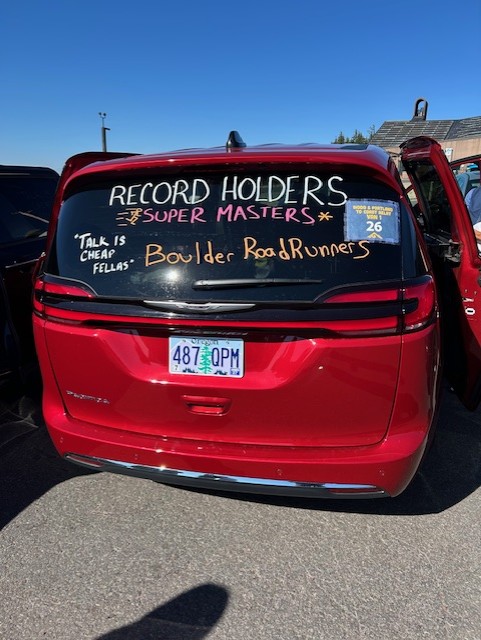
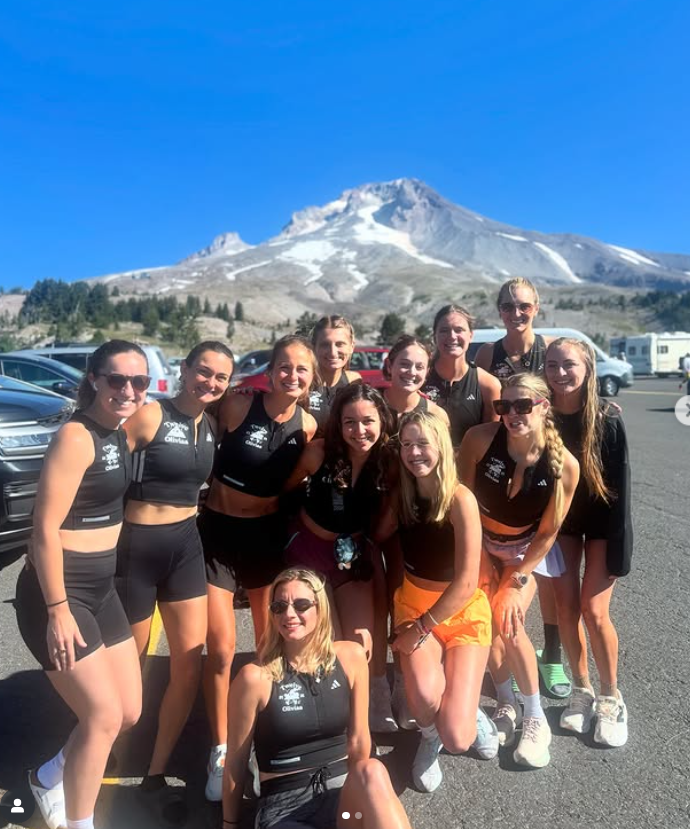
As we got onto the highway we started noticing other team vans all loaded up with runners and graffiti. It’s kind of a tradition to pain up your van with team identification and some smart and saucy comments. We found ourselves driving for a half our alongside the 12 Olivias, and noticed that they appeared to be a team of 20 or 30-something women. We kidded our driver Glenn (one of the most talented runners in the club but unable to run due to injury) as he tried to keep up with the Olivias. Eventually they did speed off, leaving us old guys in the dust.
Van graffiti
“Talk is Cheap Fellas” said the announcer to Boulder Roadrunners as they started their successful record quest in 2023.Here is Van 1 in 2025.
Van 2 before they marked it up.
The Actual 12 Olivias; 12 women whose real name is Olivia, recruited for the relay by an Olivia on Instagram
We had nearly and hour and a half to mill around the ski lodge and parking area at Mount Hood, gawking at the volcanic heap, rising nearly 6,000 feet higher than our elevation of 5,800 feet, the views of the nearby valleys and other peaks (Mt. Jefferson to the south), and of course other vans and runners as they prepped for the staggard start, with a dozen teams going off every 10 or 15 minutes through the morning and early afternoon. We took pictures and got ourselves ready for 196 miles of road.
Our intrepid Supermasters Team, from left to right: Rick, Me, Todd, Garry, Frank, Brian, Eric, Flavio, Chris, Kevin (kneeling), Glen, Mike (kneeling), Tony
Was this crazy or what!? There was a lot of energy in the air.
It was also warm. About that. The heat was the story of this year’s relay. After a relatively mild week, Portland and the surrounding areas expected highs in the 100s on Friday afternoon. I was grateful that I was in Van 1 and most of us would escape the worst of the heat, although it would still be a challenge and ultimately it would define our race.
196 Miles of Sweat, Not a Whole Lot of Glory, But a Lot of Fun
Van 1 Legs 1 to 6
After our team picture we left our first runner Tony at the start line and the rest us from Van 1 loaded up and headed down the course. The first leg drops more than 2000 feet over 6.2 miles, by the time we got to the exchange at 11:00 AM it was already approaching 80 degrees.
Tony, the youngest and a newcomer to the team, sped through ahead of schedule and handed the wrist slap baton to Mike, a veteran of the record-breaking campaign. Mike kept close to pace. I would be up next!
Mike taking the wrist baton from Tony at the End of Leg 1
By the time I got the baton, we were already below 3000 feet and the temperatures were in the 80s. Fortunately the first mile and a half were on a deeply shaded forest access road. With minimal warm up and some bumps in the pavement I took the first mile rather easy (6:30) before settling into +/-6:00 pace. Dropping 150 feet/mile this was a tempo/threshold effort. I felt great through about 15 minutes, but onto the busy 4-lane Highway 26, there was no more shade and I could feel my core temperature rising. I figured only a mile and a half to go.
However, as I approached 4 miles there was no exchange zone! The organizers had switched the location of the start and the leg ended up being 4.5 miles. My heart rate climbed into the 150s, which is hard tempo effort although I was trying not to push too hard. We were still near goal pace, after my leg and Garry’s. Twenty miles into the race, we had dropped 4,700 feet. After those legs course would involve rolling terrain and a lot of uphill for the next 176 miles. Things got tough for Frank and Flavio on Legs 5 and 6 with temperatures climbing into the 90s with little shade, and some arduous climbs.
A lighter moment, one of the gang hamming it up for his newest fans, while team leader cajoles him to get to the exchange zone–You don’t want to miss the start!
The scoop was that we could be as far back as 10 minutes by half way (end of Leg 12) and still be in contention for the record. That worked for them in 2023, but on that day they had a later start (less time in the high heat) and it was 10-15 degrees cooler in Portland. Nevertheless at the end of Leg 6, at Sandy High School on the east side of Portland, we had a 4 minute deficit. Remarkable considering the increasing heat.
Respite and a Shower
After that exchange Van 2 took over for Stage 2. They had the toughest lift. Running in 100-103 degree temperatures through the afternoon.
We piled into Van 1 and made our way back some 40 minutes to the motel near downtown. After a shower and quick meal it was time for an afternoon siesta, and we nodded off for about an hour. We then loaded up the van for the evening-night session. It was blistering hot just to walk across the parking lot and I could not imagine what our teammates in Van 2 were going through at this time.
Stage 3 (Legs 13 to 18): The Heat is Still On
The sun was getting lower but the temps were still slow to drop, showing 102 on our dashboard and 101 on the weather app. We got to the busy exchange at the end of Leg 12 at about 6 PM and no one ventured out of the van as the AC blew full blast. We dropped off Tony for his leg and headed out on the course, deciding to find a shaded parking area where we could monitor his progress and to provide him with some ice and cold water.
By the time he got the baton we were 20 minutes behind the schedule and any realistic chance at the record was gone, even if the temperature suddenly dropped to 60 degrees. Tony was already feeling it, about 2 miles into his leg and we stopped again. Same for Mike on his long 8 mile leg. He was in and out of shade but the temperature was still well into the 90s. Mike looked great at 2 and 4 miles, but the heat wore on him.
I was next. We were leaving the Portland suburbs and heading north on Highway 30 parallel to the Columbia River. It was past 8 and the sun was behind the hills but it was still 92 degrees. Maybe not blistering hot, but there was no escaping it. My leg started with a half mile climb over a bridge and I used that as my warm up, knowing that I’d be giving up more than a minute just to get started. Onto the highway, I did my best to find a proper rhythm and effort. My leg was 6 miles, I was slated to run 6:00 pace, but knew that was out of my reach (even fresh and at 50 or 60 degrees), so my goal was 6:30 per mile. The first mile was right at 7:00. I wasn’t going to be able to run 6:20 for the rest of the way to make that back. I ended up running 6:30-45 for the remaining 5 miles of the leg. The first half went okay. And it was a relief to see the van at 3 miles, where they handed me a water bottle with cold water. I carried my handheld for fluid on this leg, so just dumped the 16 ounces of water on my head and shoulders. I felt great for another half mile, and then it got tough!
Feeling good at the moment, just after splashing cold water on my head. Things got real over the next mile. Real and indeed difficult the 90 degree heat.
I hung on as best I could, I had to go to the bathroom but also had to hold on to the pace. I concentrated on running steady and looked forward to some relief!
I found Garry at the exchange and told my catcher, Mike that I needed a bathroom! Now! I wouldn’t be able to make it to the next stop. There were no porta potties in sight so I grabbed some wipes from the van and headed to the woods on the other side of the exchange area.
Later read that at the Hood to Coast everyone has a poop story. I was glad to have escaped disaster.
Back into the van as dusk is turning to night. By the time Garry’s 4 mile leg is done it was almost dark. And by the time we got to the exchange it was. Temperatures were still in the mid-high 80s at that time.
We turned due west off of Highway 30 and sent Frank into the dark but still hot night. The next 7 hours would be a blur of glow vests, headlights and headlamps. The exchanges were still crowded and we figured that this would be peak time. It was a challenge to find parking and then to exit in time to get on the road before the next leg.
Frank, the fastest and arguably toughest runner on our team, was exhausted after his leg. I sent Flavio off into the darkness for his leg. When he finished we’d be done with round 2 for Van 1 before Van 2 would then take over for the next 5 or so hours. We loaded Flavio into the van after is leg and headed west to exchange 24. It was a long drive, more than an hour, through quiet back roads and much of it was away from the race course. At times i seemed like we were just randomly driving through the forest.
Respite but No Sleep for the Weary
The temperature dropped quickly and before long it was in the 70s and 60s! Relief from the heat at last, although the humidity increased.
I tried to sleep some. And would nod off for a few minutes at a time. Mostly, though it was some quiet talk and music–sometimes loud, I think we were listening to a classic rock station. At one point The Ramones’ I Wanna Be Sedated was blaring, but someone said it was too loud so we switched to some quiet country music.
Finally we arrived to the exchange and settled in for a few hours of rest. At first there were only a few vans in the field, but it filled up and soon got noisy even though it was 11 PM. Some people kept their flood lights on. We tried to sleep in the van, and maybe I got 1o or 20 minutes of snooze before it got noisy outside as more and more vans came in and departed. We rousted ourselves up and got ready for our final push, legs 25 to 30.
Stage 5 Into the Darkness We Drift
I would be doing leg 26, 5.7 miles starting after 2 AM. We were now more than 45 minutes behind, but still pushing. I had never run at 2 in the morning and haven’t run much in the dark for more than a decade. I put on my light vest and headlamp, made my way to the exchange, and did a minute or two of light jogging in the adjacent parking lot.
They called my bib number and I darted across the road to take the baton from Mike.
Game on! Running in the dark with a thin headlamp. The course started downhill for about the first half mile but it took a while to find my stride, so I did not really get an advantage on that stretch. The temperature was cool, which was refreshing after the evening’s 40 minutes of approaching heat stroke. However, found that I had difficulty running faster than about 6:50/mile. This was 20 seconds slower than I had anticipated and my teammates would want more than that. I wanted to stay on my feet, visibility and the possibility of tripping were limiting factors. When cars passed I’d get 10-15 seconds of extra illumination and could surge.
That’s pretty much how went on that dark and lonely leg. I passed a couple dozen runners along the way, and the effect was surreal. You would see road right ahead of you and the light vests bobbing in the distance and not much in between. It seemed like we were bioluminescent creatures at sea. There were a few stretches where I could see no one ahead and there were no cars. It was eerie in places.
One runner passed me at after half way on the leg. I did my best to keep up and maintained a 60-80 m distance until the final mile or so. We had a steady climb for about a mile and then a nice half mile descent to finish the leg. I made up some time there. I shouted my bib number to the officials who were about 100 m from the exchange, but the receivers did not get the memo! I crossed the line, somewhat exhausted but there was no Garry!
I stood there dumbly, not sure what to do. Then I heard them shout, here he is. He was still in the staging area across the road, as they had not announced that my bib number was coming in. Ackk! Garry took the baton and sped off into the dark night.
I was done. Although I did not approach my goal pace, and we were now 50 minutes behind schedule, I was happy to have completed my third leg of the Hood to Coast relay. We quickly piled back into the van and I took some fluid and an energy bar. At the next stop I was able to switch into some dry clothes and relax a bit. I fell asleep somewhere in there, maybe for 5 or maybe it was 20 minutes. The last two legs of our final van segment were sort of blurry. We were getting pretty punchy and made a lot jokes and comments that were funny to us at the moment, but now I can barely remember what we were laughing about.
The exchanges were overcrowded with vans and with some luck and swift maneuvering we made our way through the parking areas without much delay. I was only half awake during final legs through the forest on the dark pavement. By 5 AM Van 1 was done and Van 2 took over.
We drove about 45 minutes to Seaside and found a cafe that would open at 6. We waited for a few minutes and along with occupants of several other vans, piled out and got in line for the breakfast rush. Some caffeine and protein (eggs and vegetables for me) were perfect. I was tired but not crushed.
To the Beach
We made our way to the beach and a couple of us jumped into the surf. I only went waist deep because the water was cold, but the chilling salty surf felt good on my calves and thighs.
Garry and I get our feet wet early on Saturday morning.
Flavio, or team leader, carried us in for the last leg and we greeted him at the finish line for the final jog and photo. Then as a group we went back to the beach for some more surf time before embarking on a 2 day binge of rest, rehab, and a lot of eating.
Supermasters team champions and top 2 percent overall.
Aftermath
After the relay had two days to enjoy the Oregon Coast. That two naps on Saturday afternoon, another trip to the finish area to collect our team awards, big meals, a beach run, and coastal hike.
All day beach part for the Hood to Coast.
View from our beach house.
When I was there I wanted to soak it in and figured this might be a one time thing for me. I’m not getting any younger! However, the BRR calls in 2025 or 2026 I am pretty sure I would say yes! That was an amazing experience.
This was my fourth Bix 7 road race, third in four years after a 42-year hiatus from this historic mid-summer road race in the heartland. After a rather inauspicious debut as a 22 year old in 1980, when I sort of tempoed the effort in about 40 minutes. I was nursing a hip injury that knocked me out of summer training that year and opted to run 5:40-5:45 pace instead of going all out. That was an epic year in Bix history, as legendary marathoner Bill Rodgers raced it for the first time and it transformed from a fairly sleepy local/regional race to the big time national scene.
My return races in 2022 (44:07 1st in my age group) and 45:15 (again first in a new age group) were good. The 2023 effort should have been noted as an age group record, but in 2019 a runner seemed to have cut the course short and walk-jogged his way to a 44:52. Never did actually get to the bottom of that issue, but I think that’s the story. In previous years he had either walked the entire course in about 2 hours or had done the short course at about 22-23 minutes a mile. Maybe 2019 was inadvertent or maybe on purpose.
Build-up and training
I was a little flat this June after a long winter-spring of training and racing. My last two races, the Bolder Boulder 10K in Colorado and Steamboat 4-miler in Peoria, IL were decent but I could tell I was at the end of a long block. I took a few days off following the 4-mile and just ran easy-unstructured through the rest of June. We moved out from Colorado on the 29th and arrived in our new home (house yet to be determined) in Minnesota on the next day.
July was a build-back month and I got in three solid weeks of 63, 67, 68 miles leading into last week. I didn’t do any fast workouts, but ran a weekly double threshold of repeat 4-6 minutes on Tuesday mornings, followed by hill reps of 1.5 – 2 minutes in the afternoon. A couple of days later I would do a fartlek, tempo, or strides, and on the weekends a long run of 15-17 miles.
So far have really enjoyed being in Minnesota and meeting people, and I have joined a new club team that is stacked with very good masters runners. It’s the deepest in the country and they have a good team spirit and sense of community.
Running at sea level has felt pretty good so far, although the transition has been slowed somewhat by warm-hot and humid weather. In a land of some 20,000 lakes (and three major rivers converging within 10 miles from here) there is a lot of moisture in the air. Almost all of my runs have been at a dew point of 68 to 72, with temperatures ranging from the high 60s to 90 degrees. By last week I was feeling pretty well adapted but also hoped that I retained some residual red blood cells and hemoglobin from nearly 11 years of living and training at altitude.
Last week I ran “through” to Wednesday, keeping my daily mileage up to 9 or 10 (70-80 minutes of running) on those first three days. On Thursday I rested, and we drove to Iowa. We first stopped in Iowa City, where I met three of my high school friends. I did a 4 mile shakeout run on Friday morning with another friend, and Tamara and I ventured the hour to Davenport under hot and humid conditions. Bib pick up was a breeze and we checked into the (first) hotel at 3 PM.
Injecting a rival into the mix
As far as competition goes, my return in 2022 and 2023 were a breeze for the age group and won those by 2 or 3 minutes, while also beating almost everyone else in their 50s. However, this spring I had a couple of the Quad City locals tell me that they had a friend who wanted to take me down and set a new course record. A bit of trash talk I figured, but it seemed like this runner had some solid credentials (recent 5Ks in the low to mid 18s), so I knew I’d have to be ready. I figured that three and a half weeks of solid base training should be enough to hold off almost anyone. I didn’t try to engage in any one upmanship with my friends and at the same time, wanted to keep the race as a fun event where the main competition was me vs. the course and conditions.
Nevertheless, the race was on my mind for much of the week as I focused on what I could do for my own race and to let others do what they will. This was not a championship event and the only thing on the line was a little blue Iowa-shaped ceramic plaque and some pride.
And then the rains came down
Friday afternoon was hot and muggy. We went out to dinner a little early (5:30) and got there just in time to beat the pre-race rush! It started to rain as soon as we got to the restaurant.
After dinner we settled back into our hotel, an older place about 10 or 12 minutes from downtown and the race. At 8:30 we noticed a fire engine in the parking lot, and moments later the fire alarm went off! We grabbed the dog and a few items (including my race gear of course) and headed out the door. A fireman was right there and he told us to stay put.
So we did. We waited about 10-15 minutes in an empty and eerily silent hotel, while the firefighters worked upstairs, and mulled our next steps. Earlier I noticed that our lamp and clock were flashing on and off due to electrical surges and moments before all of the commotion I heard scratching and crackling in the walls and ceiling–this ended up being an electrical fire. We decided to bug out and made new reservation at a nearby hotel.
Despite the turmoil and some extra expense we were in bed by 10. Sleep was a little restless but not bad. I woke up just befor 5:00 AM to a sharp thunder clap. Rain was coming down hard and it would not relent for hours. We wanted to get to a parking ramp near the start early and had just packed the car, ready to go, when I got the delay of race text. We wouldn’t be starting until 9 AM a delay of one hour. Back to the room. It was still pouring rain when we headed to the race but there had not been any lightning that we could see. However, we did have to change our parking plans, and avoided the downtown area. We parked along the Mississippi River, about 3/4 of a mile from the downtown and I waited until 30 minutes before the start to head out into the rain and begin my warm-up.
It was pouring.
I did just a short warm-up of about 1.3 miles with some drills and strides. I’m not sure if that was not sufficient for the day. It was still fairly warm at 73 degrees, and I didn’t want to overheat once we started racing. The rain helped everything feel cooler.
I got to the Orange corral (2nd) about 16 minutes before the start of the race. I think I have been in Orange every year I have run it. The White corral is for the elite and next fastest couple hundred runners. After the race I found out from a local that you have to request an elite/sub-elite start position in the White corral.
This did make a difference on Saturday. In my previous outings I had lined up fairly near the front of the Orange corral, and was able to run up Brady Street hill without much interference. In 2022 I probably took it out a little fast and was struggling for breath the rest of the way. I ran an 18 second positive split and moved up 22 spots from half-way. That was solid for first time back in 42 years. The next year in 2023 I started out a little easier on the first mile and ran a 10 second negative split. Tha.t felt better
My goal was to run a bit faster than 2023, under 45 minutes and to have a shot at the existing (what I think was false) record of 44:52. To do that I wanted to get out in about 6:40 for the first mile and run 6:20s for most of the rest of the way.
The race
The Orange corral had filled up fast (and early) and I lined up towards the front. Ultimately it was not far enough and I should have found a way to the very front. Once they dropped the ropes and we made the final approach I was about 10 or 12 meters back from the start line. The gun went off and it took about 10 seconds to cross the start line. I figured I’d be fine because everything is by chip time based on when you cross the start; however it soon became apparent that there were many many of runners ahead, going out at variable speeds.
I was boxed in.
The first half mile up Brady Street is a straight climb at a 7-8% grade. The trick is that you don’t want to go out too fast and then suffer the rest of the way, but you also don’t want to go out slow and fall behind. I got trapped behind clumps of runners a few times and had to do some weaving around and stutter stepping to get through. By the time we reached the top of the hill I had found some better navigation. But the going was still choppy.
The split for the first mile was 6:55, and that was too slow. On the good side, I wasn’t breathing hard as I picked it up on the downhill second mile but it was still quite crowded and had to slow and weave several times to get around slowing runners.
One of the highlights of the day was when a youngster ran by and said “hey, you’re a good runner!” I thought that was funny and asked him how old he was. He said 12! My second mile was in 6:10. The street was crowded but I stayed pretty close to my young friend through the turn-around.
I hit the half-way split in just under 23 minutes. My goal to run under 45 minutes and the opportunity to set a new record appeared to be slipping. Saturday would not be a record breaker for me. I wanted at least to hold 6:30/mile pace throughout (45:30) and I reminded myself to hang on for that.
My 12 year old friend dropped off soon after the half-way point.
Miles 4, 5, 6 on this course are a grind. After you crest that first hill at about half a mile, you have just over miles 2 miles of flat downhill, mostly on Kirkwood Avenue. That’s the best part of the race. However, at 2.6 miles you hit another big uphill on Middle Road, it’s about a quarter mile of 5-8% grade and it’s a gut punch. You then drop down to the turn around and have to do it again but in reverse (longer but not quite as steep on the return). The respite on the leeward side of Middle Road feels too short. My 3rd and 4th miles were 6:35 and 6:36, slower than I had wanted but it would have to do.
Tamara was there to cheer at about 4.2 miles, just before we started the long gradual ascent to Brady Street.
From 4.2 to 6.2 it’s almost all uphill with a couple steep pitches and here is where the course really gets tough. You are getting fatigued but still far from the finish. My splits for mile 5 and 6 were 6:39 and 6:41. At about 4.5 miles I had caught up to another masters runner that I know and we went back and forth to the finish. He kept me going, and I think I kept him going.
With about 0.7 to go, the long downhill down Brady Street and past the start is usually a lot of fun. But unlike the early miles running down Kirkwood, it’s a hurting sort of fun. You know that you are almost done, but the fatigue, leg aches, and hypoxia have taken their toll. I just wanted to keep up with my masters compatriot, knowing that if I did I’d finish ahead in the standings because he was in the White corral at the start and had a gap off the bat.
We hammered that last mile! I hit that last split in 5:46 my fastest split of the day and faster than in 2022 and 2023!
My final time was 16 seconds slower than in 2023, and 32 seconds from my pre-race goal time (and 40 seconds shy of the old “record”).
And what of my age group rival, whom my friends had touted? I had crossed and initially thought I had finished ahead, because I had passed a couple of other 60-something runners along the way.
Moments later, however, I saw him with a group of his “Faster Masters” team. He had finished a minute ahead and had broken the previous mark by 20 seconds. Although I would have liked to have been on top (he ran the time that I had dreamed of in an A++ scenario) I’m glad that had set a legitimate mark for our age group. But dang! Where did he come from? Prior to this year I think I was ahead of his performance level, and we had faced off head-to-head a couple of times and I had triumphed. Not this year.
Post hoc shakeout
For age grade, I have been consistent. I ran 86.7% in 2022, 85.6% in 2023, and this year it was 86.5%. I’m not unhappy with my age grade score, my competitor at two years younger was less than 0.2% ahead in age grading, and we ended up finishing 1-2 in overall in age grading for masters men (unofficially).
Looking at it a few days later I had a good but not great race and I should be proud of the effort even though I did not win the age group or set the record. That would have required an extraordinary effort and I simply do not have the fitness right now to run minute faster than I did.
That said, I have a couple muses. Primarily, I need to find a way to get into that White elite/sub elite corral. In my three recent outings I have beaten many runners who have had the opportunity to line up ahead of me. I could also keep my warm up going a little longer and confidently line up and run my pace up that hill and over the first couple miles with less interference. I think that cost me 20 seconds.
Second, my new age group rival, what the heck kind of community effort was that to get him on top? He had a lot of encouragement and maybe some intel from his running mates (some of whom I share Strava accounts, so they could see what types of workouts I was running).
Finally, the fields at many races are getting stronger and deeper in our age group. It is rather remarkable. I can’t just try to maintain age grade points (and slow down a bit each year) and expect to win every time. And this is especially the case as you get up in your age category. That means going forward I have to be better prepared for big races.
A weekend of fire and rain that ended up going pretty well. Bix is a great event. Usually with 12,000-15,000 runners these days, and a quality professional field. I’ll be back, especially now that it’s only a half day’s drive to get there.
One more for the road! I ran the Steamboat Classic on Saturday to close out a long winter-spring racing campaign with seven races over the past six months.
The pre-race was a little hectic, but there was no getting round that for this race. I had an endoscopy on Thursday afternoon, and they had to knock me out for half an hour. The procedure went well but I was groggy on Friday morning.
I flew out to Peoria on Friday evening and arrived at the Airbnb that teammates had rented just before 10 PM local time. Everyone got up a 4:30 (so 3:30 my time), we had some breakfast and caffeine, and got to the race by 6 for check in and warm up. During the 20 min warm up I mentioned that it all felt sort of out of body because I wasn’t awake enough yet.
Conditions were decent but not perfect–67 F but 92% humidity with a light head wind on the way out. The course basically had 1 hill over the first half mile and a fast downhill over the last one-third mile. Otherwise it seemed almost completely flat.
The elites went off just after 7 AM and we started about 10 minutes later. My plan was to run about 24-flat or low 24 for the 4 miles and score >90% to close out the season (7th race in 6 months). I have been feeling a little flat since the 10K out east at the end of April.
I felt terrible up that gradual hill but hoped I would be able to pick it up once we got on the flat street toward the turn around. I checked my watch a couple of times and saw I was only running 6:10, although it felt like 6-flat. Maybe I could have surged to snap out of it, but instead I tried to work into it a faster pace. Split 6:15, way slower than planned.
I was running in about 25th place and 40 meter gap had opened up with a pack of 10 or 12 runners at about 6:00-6:05 pace. I briefly went after them but tied up and my breathing got heavy, so I eased up and ran with the lead woman from the masters field and an open runner. We played cat and mouse through mile 2. That split was even worse! 6:20. It looked like I might not be able break 25, so I was was writing it off as a bad day.
But at the turn around a masters runner from my age group was only a few seconds back. I decided to fight it out for as long as I could. Dan, my main rival was already well ahead, and I figured that going home with a silver medal would be better than a bronze. Plus there was team competition and age grading to consider, both with prize money.
The lead woman were just a few seconds ahead, so I surged to catch up and stuck with them through mile 3. We picked up, and that split was a 6:05. I didn’t feel great but the pace and effort were more like it. We crossed 3 in 18:40.
Over the last mile I pulled away from those runners, and my masters challenger, and worked to reel in stragglers from the faster-starting group. They had 20 seconds on me, and although I did not catch them I made up some ground. I kept it together by looking at the stoplights as focal points. We made the turn to head down the hill and I picked it up to closed in 5:51 to take an age group sliver and to help our team to win.
I fell short of my age grade goal, with 89.5%. I needed to have been a few seconds faster in the opening mile or two to be at 90%. The highlight of the day was to drop down an age class and to run with the men’s 50-59 team. We won that against some stiff competition from the Atlanta Track Club and Shore Athletic Club.
Mixed on these results. Ended up running little less strongly than what I had expected. However, I haven’t been firing off great workouts lately so it wasn’t unexpected. It is the end of a long campaign and I had a lot going on last week.
I’m looking forward to a few days off dialing back for a couple of weeks, with not much intensity work over the next month or so. That should be a pretty good reset for the next training block.