Background
As a long-time runner and fan of the sport I became aware of the Amsterdam Marathon back in 1980 when Dutch superstar Gerard Nijbor ran a 2:09:01, just a few months before winning an Olympic silver medal in Moscow. At the time it was the second fastest (official) time in history. A quarter century later the great Haile Gebreselassie ran a 2:06 in Amsterdam. And in the late 2010s there were some great battles and fast times, by then I knew that someday I would like to run this race.
Someday arrived this past weekend.
Meanwhile, my quest over the past nine years has been to get back under 3 hours for the marathon. As part of this quest has been to run sub 3 in five different different decades and to extend my span between sub 3s (currently at 34 years). I ran my first sub 3 in 1983, with a 2:35. Only ran two marathons in my peak years (both in 1983) and did not attempt the distance again until 1999, when I ran 2:44. Followed that with a 2:54 in 2008, and 2:58 in 2017. Since then, subsequent efforts have been 3:12 (Boston 2018 the terrible rain and wind year), 3:02 (Grandma’s 2021), 3:00 (2022—getting some revenge at Boston), 3:05 (Chicago 2023), 3:03 (Indy 2024), and 3:06 (NYC 2025).
After NYC last year my wife asked what race would provide the best chance for a sub 3. I thought Berlin, Chicago, and Amsterdam would be top candidates for a fall marathon and even before we got home from that trip, I decided on Amsterdam.
Preparation and Travel
Over the past year or two, other than NSM (Norwegian Single Method) the biggest buzzword about training is “durability” (or resilience). These have been the hottest topics of discussion for competitive recreational runners. This concept of durability isn’t exactly new, coaches Vigil and Canova have been advocating building durability for decades. And of course many programs have incorporated marathon pace.
The programs designed by Vigil or Canova are tailored for elite or very good sub-elite runners. Online you’d see more recreational level runners adopt a Canova or Vigil model, but the workouts look very daunting even when they are scaled down to someone aiming for 2:40 or 2:50 off of say 55-80 miles a week.
Some relatively recent journal articles and podcasts (ca. 2024-25) have discussed training for durability, and I decided to incorporate the idea while training for last year’s NYC marathon. Rather than easy effort with marathon pace mixed in on long runs I added bouts 90-95 of marathon pace (as well as faster tempo runs at threshold or sub-threshold effort on mid-week workouts). I think it did help in the stretch last year, as I passed hundreds of runners in the second half including five or six in my age group, which allowed for a high placing for the WMM age group championship.
John Davis’s Marathon Excellence (2025) is a Canova-inspired training guide and it provides insights and schedules for a wide range of runners. I also was fortunate to attend a Davis lecture last spring, where he went into detail on the science and theory for marathon training and the rationale for building durability as component to compliment aerobic endurance, threshold, V02 max training (as well as recovery). My marathon blocks have typically been in the 65-75 miles/week range and I studied the Gale Plan from his book, particularly for long runs and some of the workouts. However, I deviated some along the way and moved some workouts around. Kept the mileage in the 60-75 mpw range (six of seven weeks in that last ten weeks were over 70) and I probably did about 70% of the workouts from the schedule.
For starters I jumped in at Week 3 (end of June) because the month had been focused on tapering and racing the USATF 4 mile event in Illinois and a half marathon two weeks later. I followed the half with a one week recovery that included a few days off. After the week I was able to jump right into the program (the 10-12 weeks preceding the half had been at 55-65 miles with tempos and mid-long runs of 12-16 miles).
I followed it reasonably closely for about five or six weeks into mid-August but then used some of my own workouts for the next six or seven weeks. I modified a couple of the long runs in August and September. I also did more work at threshold and CV (critical velocity) and perhaps a little less at V02 max-type efforts than Davis’s schedule.
For example in early September I did a 3 hour long run, primarily for time on feet instead of a long steady run at 90+% of marathon pace. And a couple weeks later I made the 5X 4K effort into a 20 miler. In addition, I raced more than the plan advocated, but with the exception of the half marathon in early September, used those races as hard workouts.
I had no real struggles with the training, and other than a bout of an ill-timed (is there ever a good time?) stomach virus-in mid-August which knocked me flat for two days and set things back for another four or five days. I had no setbacks and no injuries or niggles. I did not travel or race as much this year (no big masters championships during the block). September went well and I ran a season’s best of 1:25:15 in the half and 38:49 for the 10K, and I bounced right back from those efforts.
As other runners using Davis’s schedule have said, the last three weeks of the training (the two weeks before the final week of taper) have the most challenging sessions. I thought the 5X 4K incorporated into a long run would be the most difficult and wanted to add some miles so I went to a low key half marathon in Wisconsin and did a long warm up to make it a 20 mile day. There I did 1X 2K, 4X 5K, and 1X1K with 1K float recoveries. It took some concentration to keep it rolling but I covered the half in 1:30 (alternating 6:40s and 7:20s, with a fast close). That felt great!
The sneaky hard workout was 10 days later, and that was the 7X or 8X1K under MP (basically LT1 pace, ~6:35 for me) with 1K float. I’m not used to doing such a long interval between faster reps, and this workout ended up being quite grueling. I got through 7X 1K alright but took a longer (5.5 minute recovery) after the last one, and on the 8th rep I could no longer hold 6:30s so on the fly I made it 2K at MP (6:48-50) and I think that was a good simulation. By then I knew I had enough on my legs (hay was in the barn) and I skipped the 6X 1200 a couple days later and instead just ran an easy 85 minutes on the Sunday before the marathon.
Travel and Pre-Race
I did catch a cold just before leaving for Europe, but fortunately it was fairly mild after the first few days of sniffles and the overnight travel did not make it worse. I wanted good recovery from the travel before lining up and decided that leaving a week ahead of the race should be sufficient to adjust to the sleep schedule (as well as other biological functions). I did not want to arrive on say Wednesday or Thursday and still be adjusting to it all on race day.
After a bleary recovery day and a half (Monday-Tuesday) we had a great time in the Netherlands, did a bike ride, visited museums, and a castle, went to different restaurants, and did a little window shopping. We moved into our race hotel (a small inn with tight little rooms) on Friday and I got a massage that evening because my legs were still a tight from the bike ride a couple days earlier. On Saturday I did a shakeout with a friend and did not do a lot more than that other than going out to eat.
The carbo load was okay, not perfect, I didn’t really plan out the details but yeah cut back on fats and fiber, ate enough protein for daily sustenance, and just chilled out. We had mostly great weather all week, but Sunday’s forecast called for some wind and rain. Oh well that’s racing. Fortunately, they were not expecting a lot of accumulation, only 0.1 of an inch or so.
The hotel was only 1200 meters from the stadium and start area, and I made my way over in the dark. Hardly anyone was on the street and it seemed like, was this thing even going to happen? Just when I arrived at the stadium we had our first downpour of the day. It was still about 90 minutes before the start. I had a poncho and enough clothing but ducked under a cubby by the stadium and waited it out. By the time it let up 15 minutes later the area was filling with people. I went through the security gates about an hour before the start and found the first bank of porta potties. There were only about 40 or 50 people ahead and there were 10 units. Easy, right? Nope, the first 20 or so people must have had some bathroom issues because that line did not move for 10 or 15 minutes! WTF was that?
By the time I got in and out, a half hour had passed and I still needed to make final preps, strip down, dump my gear bag, and get to the start line by 8:50. By then the staging area was wall-to wall people and mass chaos. I dropped off my bag, but moments later realized I forgot my handheld with Maurten 480 (480 calories of liquid that would be my fuel for half the race). It was too late to go back and the clock was ticking, with 15 or 18 minutes to go. I wrapped around the east side of stadium which had corral numbers in a rather odd order. The banners went Zone 3, 4, 5 (I was in Zone 2), and I saw dozens of bewildered looking people heading back toward the west side of the stadium. I saw no signs for Zones 1 and 2 and seemed like the others were just as baffled, so I turned around and followed (against the flow of the masses); we got all the way to the west side of the stadium only to have a security guard say that there was no access from that side and that we must go back on the opposite side. It was 8:47. I turned around and dodged around people to get to the other side in a couple of minutes and finally found the entrance for Zones 1 and 2. I think there were 100s behind me and wonder how many may have missed the cutoff. It was just before 8:50 when I got into the infield and on the track. Phew!
Then the sky opened up again, this time the rain was fairly light but I was wet and shivering a little in that final 10 minutes. They made their last minutes announcements and the elites and sub 2:40 group took off at 9:00. They funneled us in Zone 2 into a line of roped rows (single file on 10-15 lanes) giving us a sort of rolling start. I crossed the starting pads at 9:02:30.
The Race is On!
The first 200 meters were on the Olympic track, I was wet but excited to be moving. At about 1K we merged with start line B (started on a nearby city street) and were soon running 8-10 wide along the street/trolly lane, it was treacherous. At about a mile the course turns into Vondelpark and it’s straight route for about 2 more miles. I just tried to settle in, but noticed my watch may have been a little off already making it seem that I was running faster but I made sure to check a split at 1 and 2K (8:40). I would need to run 4:15 to break 3, but figured an easier start was fine. My wife was there just past 2K and it was nice to get a cheer early on.
The rain let up and I was starting to warm. I stripped off my arm warmers (long socks with the toes cut out) at about 2.5K and tossed them aside. There were spectators along the entire way through the city, but not packed in as much as you will see in the majors.
So the pacing was okay, legs and breathing check, but then I kind of realized that I might need to find a porta loo. I passed some at 2K but put it of mind. Not once in 50 years of racing have I had to make a bathroom stop during a race.
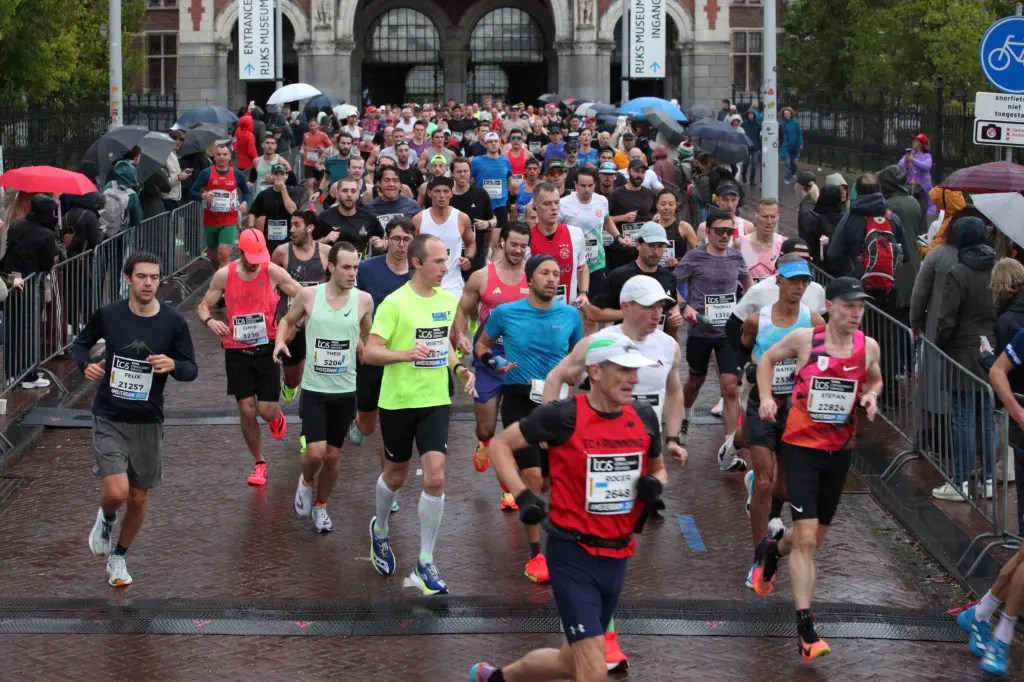
Running under the Rijksmuseum. Note the huge phalanx of runners behind!
We wound around some streets and circled back to the park area and under the Rijks Museum and behind the Van Gough museum. So a lot of turns I that part. 5K split was just under 22. I had hoped to be 21:30 but moving up would require some dodging and weaving and I did not want to expend too much energy too soon. There was another bank of porta potties at about 8K, but I kept going figuring we’d see them every 5K or so. I was in a good group and finding my pace. The 10K was 43:30 and I felt that the effort was just about right. However, I got double bumped from the 3 hr pace group who were running wall to wall my now on heels. I did not want to get swallowed up so surged a bit, a half K later there were some porta potties. Took the second one and was out in less than a minute. NASCAR would be proud!
Traffic was still thick, we were running five wide on half the street. Passing was not easy. Just before 15K the course turned onto the Amstel River pathway. The 15K split was 1:05:40 and I knew a sub 3 would be a long shot.
But the pace was still solid. We were on a bike path that was about 4 meters wide. It was brick/cobblestone and crowned, which made for some uncomfortable running, but there was a 1 foot or so strip of concrete on the each side and the footing was better—you just had to watch your step and not fall off to the side, which dropped off. We were still running 4-5 wide, but by now you could pass slowing runners without too much extra work. The wind was pretty stiff along this stretch and I opted to stay tucked into a group. People in the Netherlands are so tall! I’m 5’9” and some, and felt like I was in the bottom 20% for men and there a lot of women my size or taller! Made for good drafting, however.
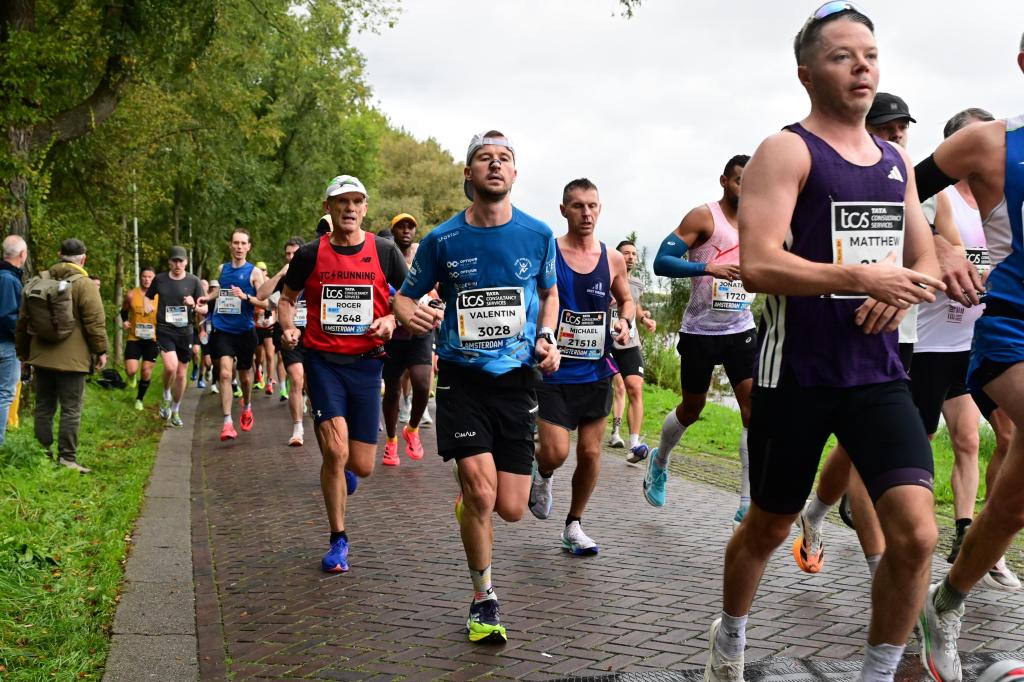
Bike path that went from about 15-20K. The concrete on the sides had better footing than the brick path.
Before 20K the course made a turn to cross to the east side of the river. We headed directly into the wind for about 700 meters. It was raining again, going up the bridge into the wind and rain reminded me of cross country, where you often relish the worst of the weather.
This was refreshing and I smiled inside. Through that point I had run somewhat conservatively and while I wasn’t feeling super bouncy and knew that there was a long way to go and a lot could happen I just felt energized. The split between 15 and 20K was 21:10, so finally back on pace and I felt that I could sustain that for the next hour at least. I began passing people and keying off the runners who were also moving through the pack. It was still moderately narrow bike path, but with no concrete side path here. However, things were stringing out and it was getting easier to get around other runners.
My half split was 1:31:32. Yeah, I wasn’t going to break 3:00 on this day unless I really picked it up now and managed to hold on late in the race. Nevertheless, my Garmin had me at +/6:40s and the 20-25K split was in 21:06. This was probably my best stretch. I was moving well but not pressing too hard.
Back on the city streets, winding through different areas, the next 5K split at 30K was 21:00—which would be my fastest of the day. Things started to get real over the next 5k. I got through 32 and 3K okay but then instead of trying not to think too much between kilometer markers I found myself picking landmarks 300-500 meters ahead, getting there and finding the next one. I tried not to check my watch too much. The crowds and noise levels were increasing as we re-entered the main parts of the city.
There was carnage as some runners pulled out. One had crashed onto his hip on sharp segment of curb and was writhing in pain as we streamed by—hope he made it and without a fracture.
My legs were getting heavier yet, and I couldn’t wait to get to 35K. That split was 21:13, I was working harder and going a little slower by now. But I knew that if I could hold on I could still be 3:00:X by the finish. The section between 35 and 39K were kind of blur, lots of city streets lined three deep, more in some areas, with people yelling. It was not NYC, Boston, or Chicago loud and crazy but despite the rain they were enthusiastic and some even yelled out your name (most everyone had their name on their bib) as you passed.
39K was a landmark for me because I did not want to county how many miles/kms left until there (a bit over 2 miles to go). And yes by there I was starting to hurt a bit, but knew I had a 3:00 or 3:01 in the bag if I could just keep rolling. I kept waiting to return to the familiar road in Vondlepark and it seemed to take forever. I was hoping to be buoyed by that had visualized running 6:30s and 6:40s through there, picking of dozens or hundreds of runners through the park and to the finish. However, by then I was one of the runners that was slowing. My companions over the second half had started to pull away.
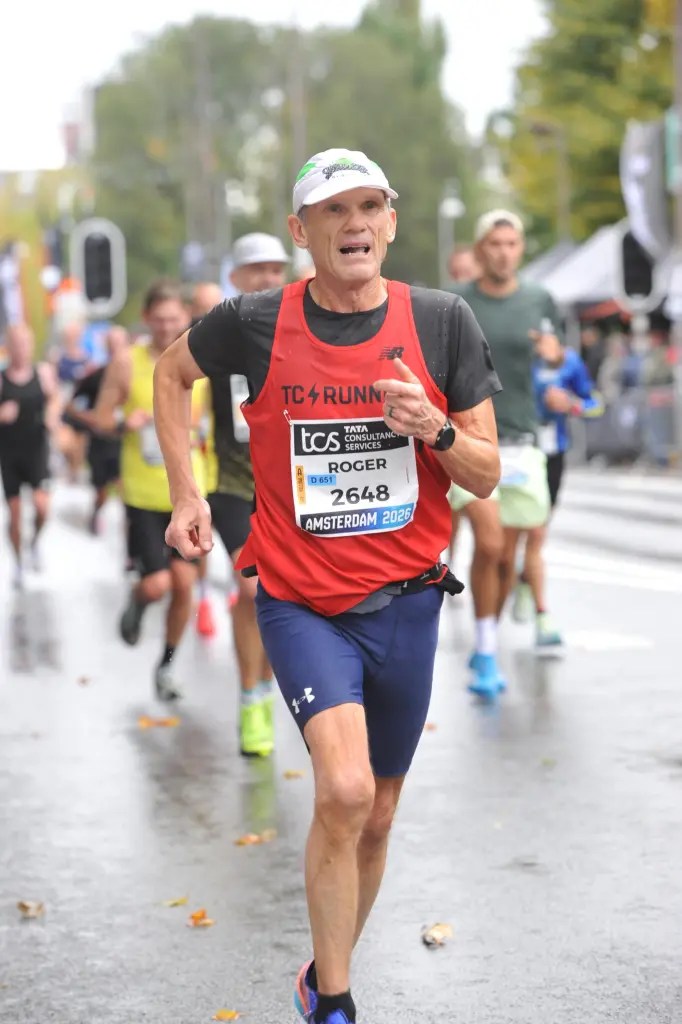
Questioning life choices with about a kilometer to go.
The split to 40K was 21:37, and I knew that a sub 3:01 was slipping way unless I had a miraculous energy recovery over the last stretch. We made the turn and headed toward the stadium with about 1.5K to go. I was still bleeding time but kept moving. Finally crossing 41K was a psychological boost and I started to pick it up the best I could to the stadium. My pace dropped back to sub 7/mile over the final kilometer, entering the noisy stadium with just 200 m to go was a thrill. My wife cheered for me, but I’m not sure if I heard her—I did hear my name a couple of times but it was so loud through there you couldn’t tell who or exactly were it was coming from. I think more runners passed me on the track than I was passing but I was finishing the Amsterdam Marathon!
The second half was a nifty 1:30-flat, and actually I covered the last 30K in sub 3 hour pace.
Aftermath and Conclusion.
It took me 35 minutes to exit the stadium and walk 500 meters to where my wife was waiting. And by then the rain had picked up to a steady drip. We had just over a kilometer back to the hotel and that took another 30 minutes of very small steps and I got quite chilled.
For each marathon where you put it out there—running a full training block, good taper and readiness, and running as well and as hard as you can—will has its own level of epic. Sometimes you walk away disappointed and think about what would have or could have been if such and such factors had gone better. Some stand out more than others. For me this was one of the best, maybe the best overall experience. Certainly this was top two or three (my debut in Denver and last year’s NYC with a surprise podium finish for the WMM age championship are the only ones that would be close) and as time goes on it might be number 1.
There is so much to be grateful for. We had a great trip, outside of the marathon. I’m luck to be able to do these events at this stage in my life!
This was a very good training block and things clicked and I came out if it healthy. This was an age group PB by nearly 2 minutes. I did not break 3 hours on a day that, who knows, maybe I could have, with a better start for one thing, not pitstop, and by holding on better through Vondelpark. Nevertheless, I had my best ever negative split in a marathon—90 seconds faster over the second half. It was also an age grade PB by a good margin. I have had several in the 85-86% range, this time I ran 88.7%. If you look at the “equivalency” (feel free to take that with a grain of salt) my relative time was 2:15:54. It was a great day and we had a wonderful trip. And we plan to go back.


